
Eligibility Agniveer Indian Army
Notes Optics
1. Ray Optics or Geometrical Optics In this optics, the light is considered as a ray which travels in a straight line. It states that for each and every object, there is an image.
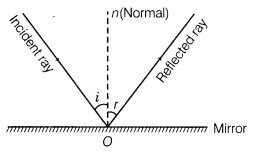
2. Reflection Reflection is the phenomenon of changing the path of light without any change in the medium.
3. Reflection of Light The returning back of light in the same medium from which it has come after striking a surface is called reflection of light.
4. Laws of Reflection
Two laws of reflection are given as below:
(i) The angle of incidence i is equal to the angle of reflection r.
i.e. ∠i = ∠r.
(ii) The incident ray, reflected ray and normal to the reflecting surface at the point of incidence all lie in the same plane.
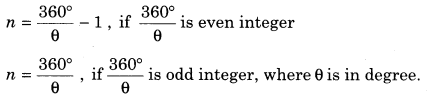
5. Total number of images formed by two plane mirrors inclined at an angle θ with each other is given by
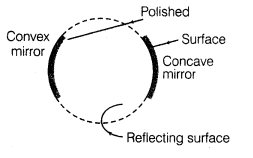
6. Reflecting surface of a spherical mirror is a part of a hollow sphere. Spherical mirrors are of two types, (i) Concave spherical mirror (ii) Convex spherical mirror.
7. Sign Convention All measurements should be taken from pole of mirror. All measurements along the direction of incident ray will be positive and opposite to incident ray are negative. All the measurements for the distances above the principal axis are taken as positive and below the principal axis are taken as negative.
8. For a real object, u is negative whereas v is negative for real image and positive for virtual image.
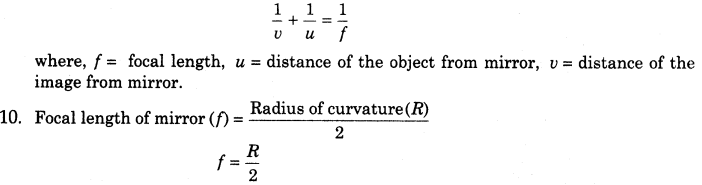
9. Mirror Formula Mirror formula is a relation between focal length of the mirror and distances of objects and image from the mirror.
11. Linear Magnification The ratio of the size of the image formed by a spherical mirror I to the size of the object O is called the linear magnification produced by the spherical mirror.

12. Magnification (m) It is negative corresponding to real image and positive for virtual image.
13. Refraction The phenomenon of changing in the path of light as it goes from one medium to another is called refraction.
14. Laws of Refraction
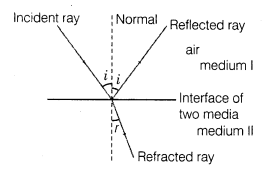
Two laws of refraction are given as below:
(i) The incident ray, refracted ray and the normal to the refracting surface at the point of incidence lie in the same plane.
(ii) The ratio of the sine of the angle of incidence to the sine of the angle of refraction is constant for the two given media. This constant is denoted by n and is called the relative refractive index.
n = sin i/sin r (Snell’s law)
where, n is refractive index of the second medium when first medium is air.
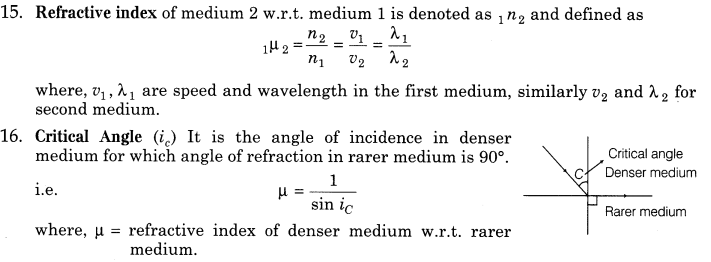
17. Total Internal Reflection (TIR) When a ray of light travelling from denser medium to rarer medium is incident at the interface of two medium at an angle greater than the critical angle for the two media, the ray is totally reflected back to denser medium. This phenomenon is called Total Internal Reflection. It occurs only when angle of incidence in denser medium is greater (not equal) than critical angle, i.e. i> ic.
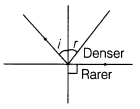
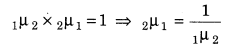
18. Principle of reversibility of light states that when final path of a ray of light after any number of reflections and refractions is reversed, the ray retraces its entire path.
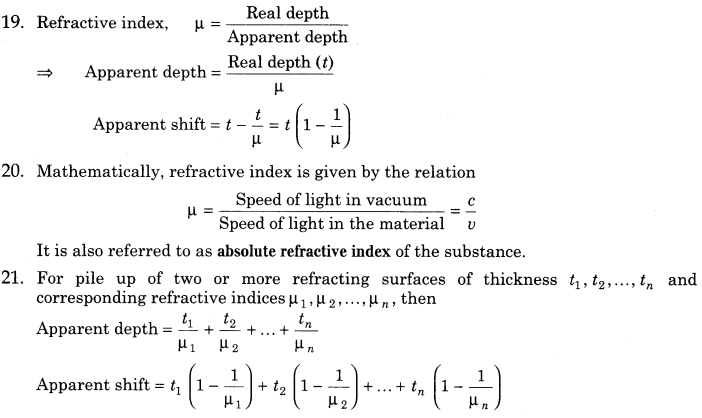
22. Optical fibre, mirage, sparkling of diamond, totally reflecting prism, etc. work on the principle of total internal reflection.
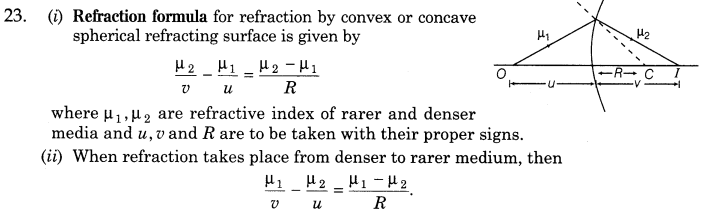
24. Lens is a transparent medium bounded by two surfaces of which one or both surfaces are spherical.
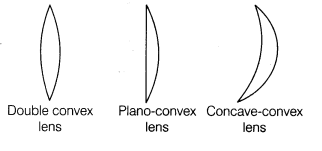
(i) Convex or Converging Lens A lens which is thicker at the centre and thinner at its end is called convex lens.
Convex lenses are of three types which are given as below:
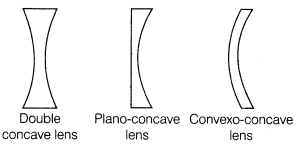
(ii) Concave or Diverging Lens A lens which is thinner at the centre and thicker at its ends is called a concave lens.
Concave lenses are of three types which are given as below:
25. Lens maker’s formula

26. When lens of refractive index μ is immersed in a medium of refractive index μ, then
(i) When lens is taken in another medium, then focal length changes to fm which is given by
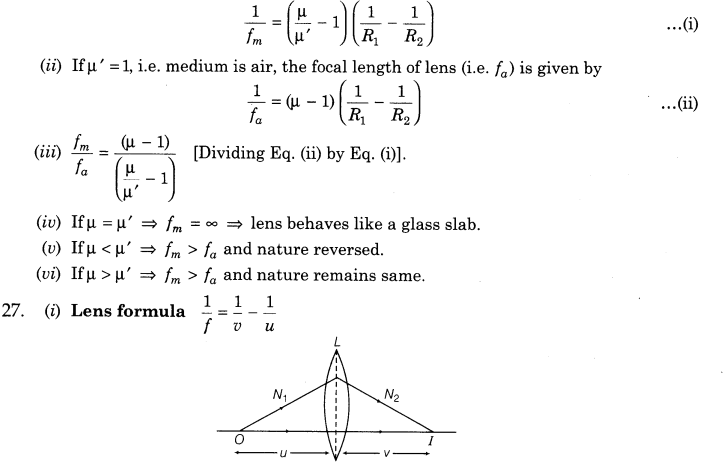
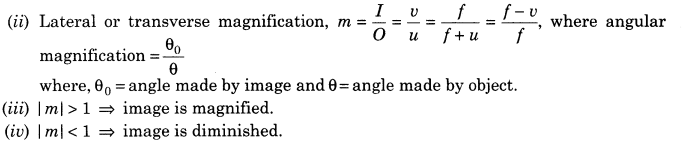
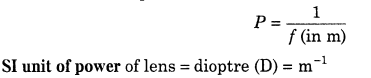
28. Power of Lens The ability of a lens to converge or diverge the rays of light incident on it is called the power of the lens.
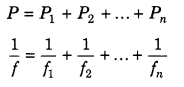
29. Power of combination lenses in contact is given by
30. Magnification by combination of lenses
m = m1 × m2 × m3 ………..
31. (i) Prism have got the property of bending the incident light towards its base.
A prism is a portion of a transparent medium bounded by two plane faces inclined to each other at a suitable angle.
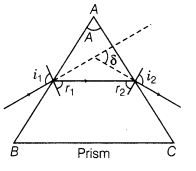
(ii) When the prism is adjusted at angle of minimum deviation, then
(a) angle of incidence is equal to the angle of emergence

31. Dispersion by a Prism The phenomenon of splitting of light into its component colours is known as dispersion.
Angular Dispersion Angular dispersion produced by a prism for white light is the difference in the angles of deviation for two extreme colours i.e. violet and red.
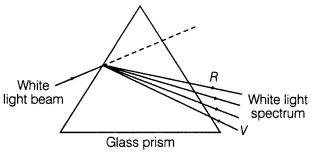
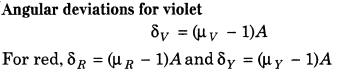
Dispersive Power Dispersive power of a prism is defined as the ratio of angular dispersion to the mean deviation produced by the prism.
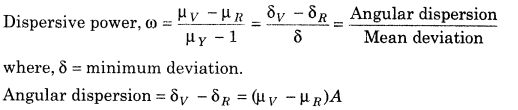
33. Combining two thin prisms we can study two conditions
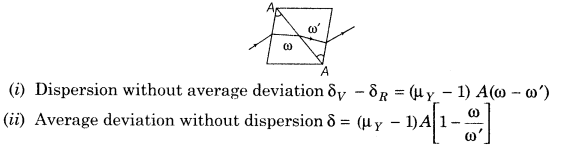

1. Wave Optics Describes the connection between waves and rays of light. According to wave theory of light, light is a form of energy which travels through a medium in the form of transverse wave.
2. Wave front The locus of all those particles which are vibrating in the same phase at any instant is called wave front. Thus, wave front is a surface having same phase of vibrating particles at any instant at every point on it.
3. Phase Speed Phase speed is the speed with which wave front moves and it is equal to wave speed.
4. The shape of wavefront due to a
(i) point source is spherical
(ii) line source is cylindrical
(iii) source at infinity is a plane.
5. A line perpendicular to a wave front is called a ray. The direction of rays are always perpendicular to the wave front along the direction of propagation of wave.
6. Huygens’ Principle Huygens’ principle is essentially a geometrical construction, which gives the shape of the wave front at any time, allows us to determine the shape of the wave front at a later time. According to Huygens’ principle,
(i) Every point on a wave front behaves like a light source and emits secondary wavelets.
(ii) The secondary wavelets spread in all directions in space (vacuum) with the velocity of light.
(iii) The envelope of wave front of secondary wavelets, after a given time, along forward direction gives the new position of wave front.
7. The laws of reflection and refraction can be verified using Huygens’ wave theory.
8. Huygens’ wave theory successfully explains the phenomenon of interference, diffraction and polarisation.
9. As, frequency v is characteristic of the source, therefore v = 1/T remains the same as light travels from one medium to another.
10. Wavelength is inversely proportional to refractive index (μ) of the medium
i.e. λ’ = λ/μ
11. Behaviour of a Prism, Lens and Spherical Mirror towards Plane Wave front
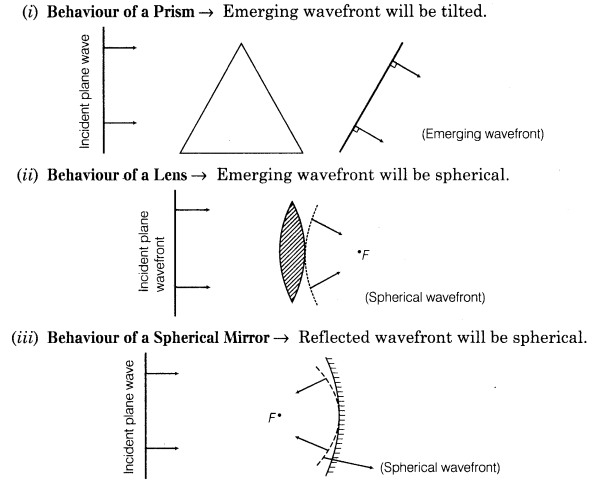
12. Laws of reflection on the basis of Huygens’ wave theory As shown in figure, consider a plane wave front AB incident on the reflecting surface XY, both the wave front and the reflecting surface being perpendicular to the plane of paper.
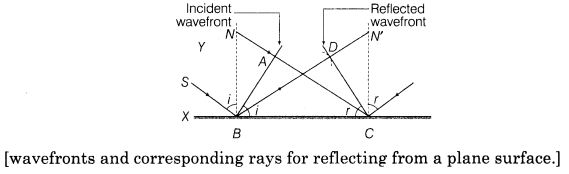
First the wave front touches the reflecting surface at B and then at the successive points towards C. In accordance with Huygens’ principle, from each point on BC, secondary wavelets start growing with the speed c. During the time the disturbance from A reaches the point C the secondary wavelets from B must have spread over a hemisphere of radius BD = AC = ct, where t is the time taken by the disturbance to travel from A to C. The tangent plane CD drawn from the point C over this hemisphere of radius ct will be the new reflected wave front.
Let angles of incidence and reflection be i and r, respectively . In AABC and ADCB, we have
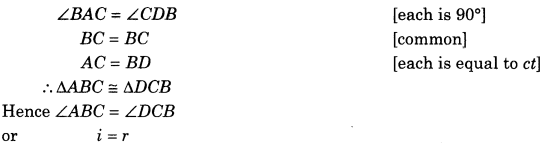
i.e. the angle of incidence is equal to the angle of reflection. The proves the first law of reflection.
Further, since the incident ray SB, the normal BN and the reflected ray BD are respectively perpendicular to the incident wave front AB, the reflecting surface XY and the reflected wave front CD (all of which are perpendicular to the plane of the paper) therefore, they all lie in the plane of the paper i.e. in the same plane. This proves the second law of reflection.
13. Law of refraction on this basis of Huygens’ wave theory Consider a plane wavefront AB incident on a plane surface XY, separating two media 1 and 2, as shown in Figure.
Let v1 and v2 be the velocities of light in two media, with v1 <v2.
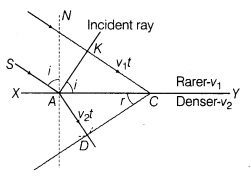
The wave front first strikes at point A and then at the successive points towards C. According to Huygens’ principle, from each point on AC, the secondary wavelets starts growing in the second medium with speed v2. Let the disturbance take time t to travel from B to C, then BC = v1t. During the time the disturbance from B reaches the point C, the secondary wavelets from point A must have spread over a hemisphere of radius AD = v2t in the second medium. The tangent plane CD drawn from point C over this hemisphere of radius v2t will be the new refracted wave front.
Let the angles of incidence and refraction be i and r, respectively.
From right AABC, we have
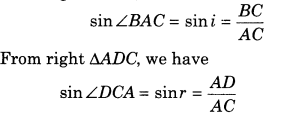

This proves Snell’s law of refraction. The constant 1μ2 is called the refractive index of the socond medium with respect to first medium.
Further, since the incident ray SA, the normal AN and the refracted ray AD are respectively perpendicular to the indicent wave front AB, the dividing surface XY and the refracted wave front CD (all perpendicular to the plane of the paper), therefore, they all lie in the plane of the paper, i.e. in the same plane. This proves another law of refraction.
Clerk / Store Keeper Technical All Arms Exam Pattern – Agniveer Indian Army
Clerk Exam Pattern
1. Passing Marks- 80 (32 in each part)
2. Marking Scheme- 4 mark for each correct answer
3. Negative Marking of 0.25 marks for each incorrect answer
| Indian Army CCE Exam Pattern (Clerk) | |||
| Part | Subjects | No. of Questions | Max. Marks |
| Part -1 | General Knowledge | 05 | 20 |
| General Science | 05 | 20 | |
| Maths | 10 | 40 | |
| Computer Science | 05 | 20 | |
| Part-2 | General English | 25 | 100 |
| Total | 50 | 200 | |
Technical All Arms Exam Pattern – Agniveer Indian Army
Technical Exam Pattern
1. Passing Marks- 80
2. Marking Scheme- 4 mark for each correct answer
3. Negative Marking of 1 mark for each incorrect answer
| Indian Army CCE Exam Pattern (Technical) | ||
| Subjects | No. of Questions | Max. Marks |
| General Knowledge | 10 | 40 |
| Maths | 15 | 60 |
| Physics | 15 | 60 |
| Chemistry | 10 | 40 |
| Total | 50 | 200 |
General Duty All Arms Exam Pattern- Agniveer Indian Army
General Duty Exam Pattern
1. Passing Marks- 35
2. Marking Scheme- 2 mark for each correct answer
3. Negative Marking of 0.25 marks for each incorrect answer
| Indian Army CCE Exam Pattern (General Duty) | ||
| Subjects | No. of Questions | Max. Marks |
| General Knowledge | 15 | 30 |
| General Science | 15 | 30 |
| Maths | 15 | 30 |
| Logical Reasoning | 05 | 10 |
| Total | 50 | 100 |
Agniveer General Duty Women in Corps of Military Police – Agniveer Indian Army
The following Bonus Marks will be awarded on qualifying in the written examination to Agniveer (General Duty) Women in Corps of Military Police :
Ser. No | Category | Agniveer (General Duty) Women in Corps of Military Police (Total Maximum Marks 200) |
|---|---|---|
| (a) | Daughter of Servicemen (DOS), Daughter of Ex-Servicemen (DOES), Daughter of War Widow(DOWW), Daughter of Widow of Ex-Servicemen(DOW) | 20 Marks |
| (b) | Widows of Def pers who have died in harness | 20 Marks |
| (c) | Sportswomen:- | |
| (i) Represented India at the International level | 20 Marks | |
| (ii) Represented State at the Senior/Junior National level and have won any medal in individual event or have reached upto eighth posn in Team event | 15 Marks | |
| (iii) Represented College / University in Inter University Championship and have won any medal in individual event or have reached up to sixth posn in the Team event | 10 Marks | |
| (iv) Represented State at National Level in Khelo India Games and have won any medal in individual event or have reached upto sixth posn in the team event | 10 Marks | |
| (v) Represented Dist at the State Level and have won any medal in individual event or have reached upto fourth posn in the Team event | 05 Marks | |
| (vi) Represented the State school team in the events org by All India School Games Federation and have won any medal in individual event or upto sixth posn in the Team event | 05 Marks | |
| (d) | NCC ‘A’ Certificate | 05 Marks |
| (e) | NCC ‘B’ Certificate | 10 Marks |
| (f) | NCC ‘C’ Certificate | Exempted from CEE |
Note :
1. Only one type of Bonus Marks (Max of the permissible) will be added to the total.
2. Bonus marks will be accorded on qualifying in the written examination.
3. Only one ward (daughter/son) of Service/Ex-Servicemen/War Widow/Widow of Ex-servicemen can avail bonus marks in written examination.
4. Original Certificates to be carried by all above categories at rally site.
5. Sports Certificate are valid for two years from the issue date as on first day of the recruitment rally for which the candidate is being screened.
Award of Bonus Marks for Agniveers – Agniveer Indian Army
The following Bonus Marks will be awarded on qualifying in the written examination to under mentioned categories :
Award of Bonus Marks for Agniveers
The following Bonus Marks will be awarded on qualifying in the written examination to under mentioned categories :
Ser. No | Category | Agniveer (General Duty) (Total Maximum Marks 200) | Agniveer Clerk / Store Keeper Technical, Agniveer Technical (Total Maximum Marks 200) | Agniveer Tradesmen (Total maximum Marks 200) |
|---|---|---|---|---|
| (a) | Son of Serving (SOS) Soldier / Ex-Servicemen(SOEX) /Son-in-Law of a War Widow(SOWW) / Son of Widow (SOW) (One son only) | 20 Marks | 20 Marks | 20 Marks |
| (b) | Sportsmen:- | |||
| (i) Represented India at the International level | 20 Marks | 20 Marks | 20 Marks | |
| (ii) Represented State at the Senior/Junior National level and have won any medal in individual event or have reached upto eighth position in Team event | 15 Marks | 15 Marks | 15 Marks | |
| (iii) Represented College / University in Inter University Championship and have won any medal in individual event or have reached up to sixth position in the Team event | 10 Marks | 10 Marks | 10 Marks | |
| (iv) Represented State at National Level in Khelo India Games and have won any medal in individual event or have reached upto sixth position in the team event | 10 Marks | 10 Marks | 10 Marks | |
| (v) Represented Dist at the State Level and have won any medal in individual event or have reached upto fourth position in the Team event | 05 Marks | 05 Marks | 05 Marks | |
| (vi) Represented the State school team in the events org by All India School Games Federation and have won any medal in individual event or upto sixth position in the Team event | 05 Marks | 05 Marks | 05 Marks | |
| (c) | NCC ‘A’ Certificate | 05 Marks | 05 Marks | 05 Marks |
| (d) | NCC ‘B’ Certificate | 10 Marks | 10 Marks | 10 Marks |
| (e) | NCC ‘C’ Certificate | 20 Marks | 15 Marks | 15 Marks |
| (f) | NCC ‘C’ Certificate and participated in Republic Day Parade | 25 Marks | 20 Marks | 20 Marks |
| (g) | Candidates for Agniveer Clk/SKT cat having ‘O’ level (IT) Course Certificate issued by NIELIT and having higher level IT Courses Certificate from NIELIT ie., ‘A’, ‘B’ or ‘C’ level. (‘O’ level (IT) course certificate under DOEACC scheme issued only by NIELIT on or after 01 Jan 2020. | — | 15 Marks | — |
| (h) | Bonus Marks for ITI/Skill qualified candidates is as under :-. | |||
| (i) One year course at ITI | — | 30 Marks | — | |
| (ii) Two year course at ITI | — | 40 Marks | — | |
| (iii) Diploma holder | — | 50 Marks | — |
Note :
1. Maximum bonus marks that can be given is 25 Marks even if a candidate qualifies for more than one type of bonus marks except Agniveer (Technical).
2. Maximum bonus marks that can be given is 50 Mks even if a candidates qualifies fo more than one type of bonus marks to Agniveer (Technical).
Documents Required for Online Application – Agniveer Indian Army
1. Matric Certificate – The following details will be filled strictly as per matric certificate
Candidate Name.
Father Name.
Mother Name.
Date of Birth.
Matric Certificate number as issued by Education Board.
2. Valid E mail address – Each candidate is required to have personal Email Id which will be his user Id. All messages will be sent to the Email Id regarding Short Listing, Call Ups, Joining Instruction, Results, etc.
3. Mobile Number – Each Candidate will be required to have an individual mobile number. Sharing of mobile number between candidates will not be permitted. OTP key and other message will be sent to mobile number.
4. Details about your State, District and Tehsil/ Block of Domicile (Only for JCO / OR Enrolment Application).
5. Scanned passport size photo of size between 10 Kb to 20 Kb in jpg format. This photo will be uploaded on the application form.
6. Scanned photo of signature of size between 5 Kb to 10 Kb in jpg format. This photo will be uploaded on the application form.
7. Detailed mark sheet of Class X, and other higher education qualification, required to be filled in the application form as per the eligibility criteria of the category/ entry applied for.
Do’s & Don’ts
Do’s
Before Rally
Prepare at least 2-3 months in advance for 1.6 Km run and other physical tests.
Prepare necessary documents as required.
Clarify doubts/ queries from nearest Recruitment Office.
Get minor medical ailments treated to avoid rejection.
Go through ‘eligibility’ requirements thoroughly to apply for most suitable trade / category.
Rectify any anomalies in your documents before rally (e.g. variation in name in 10th and 12th Marks sheet).
Prepare for the Tradesmen Aptitude Test (if applying for the same).
After Rally
Report and get medical review done in time (Permanent Unfit Cases- 21 days, Temporary Unfit Cases- 42 days).
Prepare for written exam CEE (Common Entrance Exam).
Check date of results and check personally results either through IVRS or your ARO.
If selected, submit relevant documents in time and report for dispatch to training centers on due date with necessary belongings.
Dont’s
Before Rally
Do not come to rally with incorrect or fake documents.
Do not approach anybody other than Recruitment Office Staff for clarification regarding recruitment.
Do not come to rally with major medical ailments/ injuries or if operated upon recently and wounds not yet healed.
Do not pay heed to any one claiming to get you recruited.
During Rally
Do not get lured by any strangers/touts. Army recruitment is absolutely free and transparent.
Do not run on a date not allotted for your district or trade.
Do not carry mobile handsets or costly personal belongings to the rally site.
Do not fight or argue with other candidates/ recruitment staff.
Do not litter the rally site inside or outside. Do not damage public/ private property.
Do not misbehave with public and women in particular.
Do not indulge in any anti social activity.
After Rally
Do not travel atop bus or train while coming to or going from rally location.
Do not be late for medical review to the nominated Military Hospital.
Do not be late for CEE or absent for result declaration. Result will not be disclosed to anyone else on your behalf.
Do not be late/ absent for dispatch to Training Centre.
Beware of Touts
1. Please be Wary of Touts(Dalal). They cannot influence the recruiting procedure at all. They are liars and take advantage of your lack of knowledge of the recruiting procedure. Army recruiting is absolutely free, fair and totally merit based. Individual having the required qualifications and capability will get selected on his own steam. No one can change the procedure to push in undeserving candidates since the procedure has stringent checks and balances and mostly automated. Therefore when you come for recruitment, have self belief. Anyone offering guarantee of recruitment must be reported to police or the rally officials immediately. Over a period we have identified many methods a tout adopts to lure candidates. They are given below for you to ward off any such offers.
2. Likely Victim. Before a tout targets a candidate, he checks the candidate thoroughly. Normally he selects boys who are physically fit with no medical problems and would in all probability be good in studies. Such candidates generally pass on their own steam. He gives false assurances and says “You just pass the run. I will get the rest of it done.” When a candidate passes, in such case, the tout will take the credit. If the candidate gets rejected, the tout returns the money or at least a major part of it with a lie that “some money, I can’t give back since I gave it to officials. However they have assured me that they will definitely do something next time, since there was lot of strictness this time”.
3. Tricks To Acquire Candidates Trust. The tout will do anything to acquire the candidate’s faith so that they give him money easily e.g. in the middle of a recruitment rally, the tout will go up and make a deliberate effort to shake hands with recruiting personnel claiming to be an ex-servicemen or any other identity. Mind you, he will want you(candidate) to notice this and then he capitalizes on this hand shake.
4. Telling Candidates False Indicators. Tout will misleadingly say “wear this coloured vest (baniyan)/Shorts, I’ve told the people concerned. They won’t ask you anything but will know that you are my man.” or
5. “When you go for the interview of the Director Recruiting, say ‘Namaste’ or touch his feet. He will understand.”
6. No one but only you can make it through the recruitment process, if you have the qualification and capability. Don’t lose your parents hard earned money to unscrupulous touts