Eligibility Agniveer Indian Navy
Notes Optics
1. Ray Optics or Geometrical Optics In this optics, the light is considered as a ray which travels in a straight line. It states that for each and every object, there is an image.
2. Reflection Reflection is the phenomenon of changing the path of light without any change in the medium.
3. Reflection of Light The returning back of light in the same medium from which it has come after striking a surface is called reflection of light.
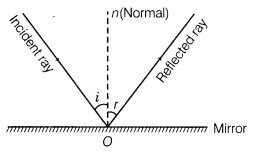
4. Laws of Reflection
Two laws of reflection are given as below:
(i) The angle of incidence i is equal to the angle of reflection r.
i.e. ∠i = ∠r.
(ii) The incident ray, reflected ray and normal to the reflecting surface at the point of incidence all lie in the same plane.
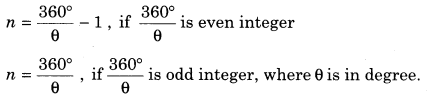
5. Total number of images formed by two plane mirrors inclined at an angle θ with each other is given by
6. Reflecting surface of a spherical mirror is a part of a hollow sphere. Spherical mirrors are of two types, (i) Concave spherical mirror (ii) Convex spherical mirror.
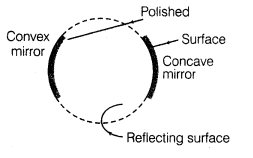
7. Sign Convention All measurements should be taken from pole of mirror. All measurements along the direction of incident ray will be positive and opposite to incident ray are negative. All the measurements for the distances above the principal axis are taken as positive and below the principal axis are taken as negative.
8. For a real object, u is negative whereas v is negative for real image and positive for virtual image.
9. Mirror Formula Mirror formula is a relation between focal length of the mirror and distances of objects and image from the mirror.
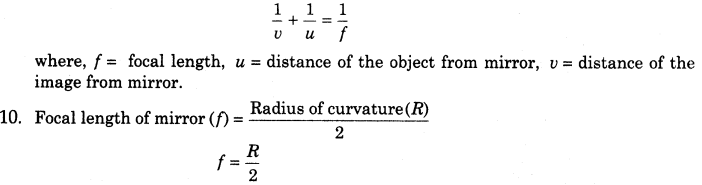
11. Linear Magnification The ratio of the size of the image formed by a spherical mirror I to the size of the object O is called the linear magnification produced by the spherical mirror.

12. Magnification (m) It is negative corresponding to real image and positive for virtual image.
13. Refraction The phenomenon of changing in the path of light as it goes from one medium to another is called refraction.
14. Laws of Refraction
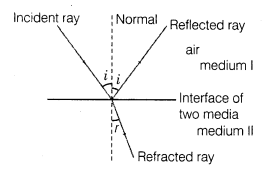
Two laws of refraction are given as below:
(i) The incident ray, refracted ray and the normal to the refracting surface at the point of incidence lie in the same plane.
(ii) The ratio of the sine of the angle of incidence to the sine of the angle of refraction is constant for the two given media. This constant is denoted by n and is called the relative refractive index.
n = sin i/sin r (Snell’s law)
where, n is refractive index of the second medium when first medium is air.
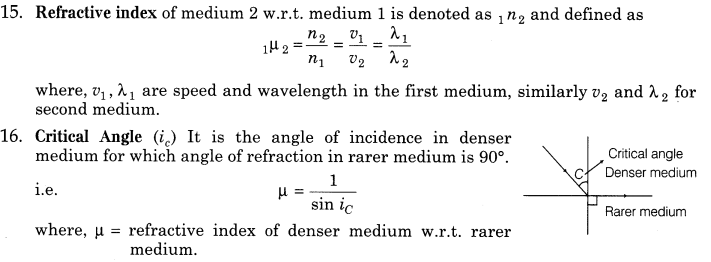
17. Total Internal Reflection (TIR) When a ray of light travelling from denser medium to rarer medium is incident at the interface of two medium at an angle greater than the critical angle for the two media, the ray is totally reflected back to denser medium. This phenomenon is called Total Internal Reflection. It occurs only when angle of incidence in denser medium is greater (not equal) than critical angle, i.e. i> ic.
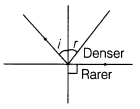
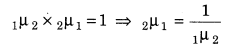
18. Principle of reversibility of light states that when final path of a ray of light after any number of reflections and refractions is reversed, the ray retraces its entire path.
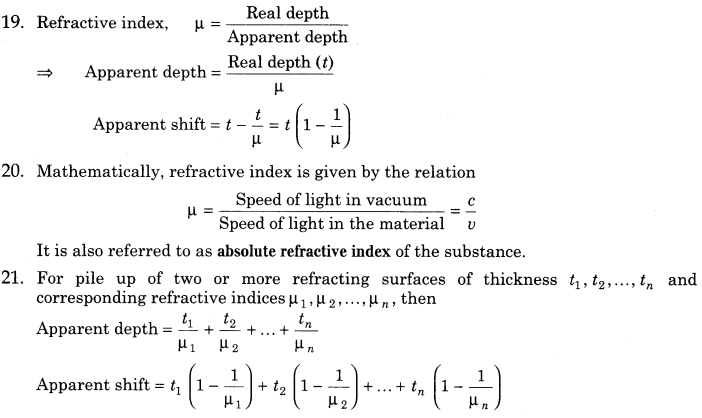
22. Optical fibre, mirage, sparkling of diamond, totally reflecting prism, etc. work on the principle of total internal reflection.
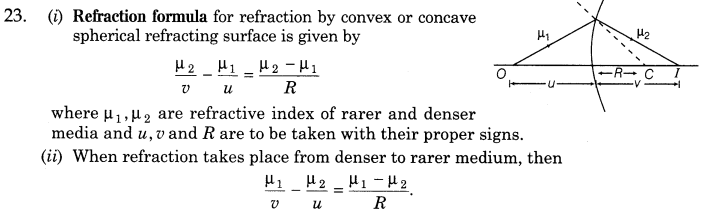
24. Lens is a transparent medium bounded by two surfaces of which one or both surfaces are spherical.
(i) Convex or Converging Lens A lens which is thicker at the centre and thinner at its end is called convex lens.
Convex lenses are of three types which are given as below:
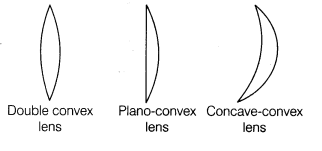
(ii) Concave or Diverging Lens A lens which is thinner at the centre and thicker at its ends is called a concave lens.
Concave lenses are of three types which are given as below:
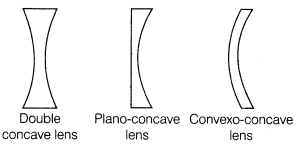
25. Lens maker’s formula

26. When lens of refractive index μ is immersed in a medium of refractive index μ, then
(i) When lens is taken in another medium, then focal length changes to fm which is given by
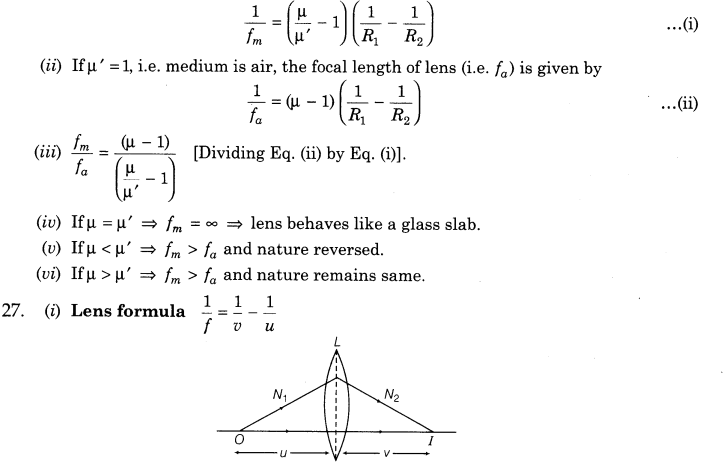
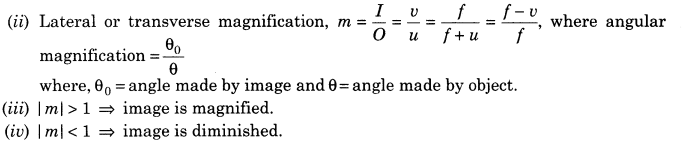
28. Power of Lens The ability of a lens to converge or diverge the rays of light incident on it is called the power of the lens.
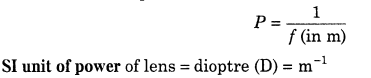
29. Power of combination lenses in contact is given by
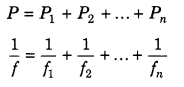
30. Magnification by combination of lenses
m = m1 × m2 × m3 ………..
31. (i) Prism have got the property of bending the incident light towards its base.
A prism is a portion of a transparent medium bounded by two plane faces inclined to each other at a suitable angle.
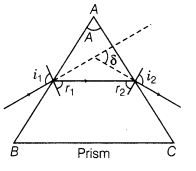
(ii) When the prism is adjusted at angle of minimum deviation, then
(a) angle of incidence is equal to the angle of emergence

31. Dispersion by a Prism The phenomenon of splitting of light into its component colours is known as dispersion.
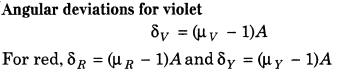
Angular Dispersion Angular dispersion produced by a prism for white light is the difference in the angles of deviation for two extreme colours i.e. violet and red.
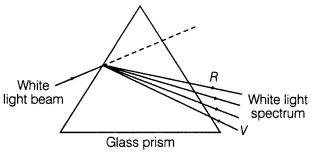
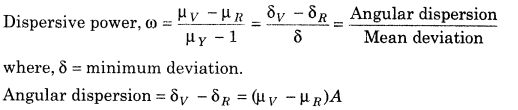
Dispersive Power Dispersive power of a prism is defined as the ratio of angular dispersion to the mean deviation produced by the prism.
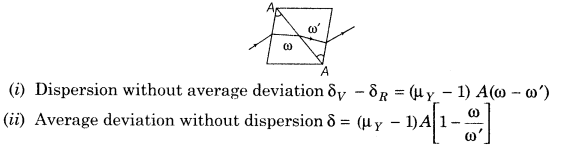
33. Combining two thin prisms we can study two conditions

1. Wave Optics Describes the connection between waves and rays of light. According to wave theory of light, light is a form of energy which travels through a medium in the form of transverse wave.
2. Wave front The locus of all those particles which are vibrating in the same phase at any instant is called wave front. Thus, wave front is a surface having same phase of vibrating particles at any instant at every point on it.
3. Phase Speed Phase speed is the speed with which wave front moves and it is equal to wave speed.
4. The shape of wavefront due to a
(i) point source is spherical
(ii) line source is cylindrical
(iii) source at infinity is a plane.
5. A line perpendicular to a wave front is called a ray. The direction of rays are always perpendicular to the wave front along the direction of propagation of wave.
6. Huygens’ Principle Huygens’ principle is essentially a geometrical construction, which gives the shape of the wave front at any time, allows us to determine the shape of the wave front at a later time. According to Huygens’ principle,
(i) Every point on a wave front behaves like a light source and emits secondary wavelets.
(ii) The secondary wavelets spread in all directions in space (vacuum) with the velocity of light.
(iii) The envelope of wave front of secondary wavelets, after a given time, along forward direction gives the new position of wave front.
7. The laws of reflection and refraction can be verified using Huygens’ wave theory.
8. Huygens’ wave theory successfully explains the phenomenon of interference, diffraction and polarisation.
9. As, frequency v is characteristic of the source, therefore v = 1/T remains the same as light travels from one medium to another.
10. Wavelength is inversely proportional to refractive index (μ) of the medium
i.e. λ’ = λ/μ
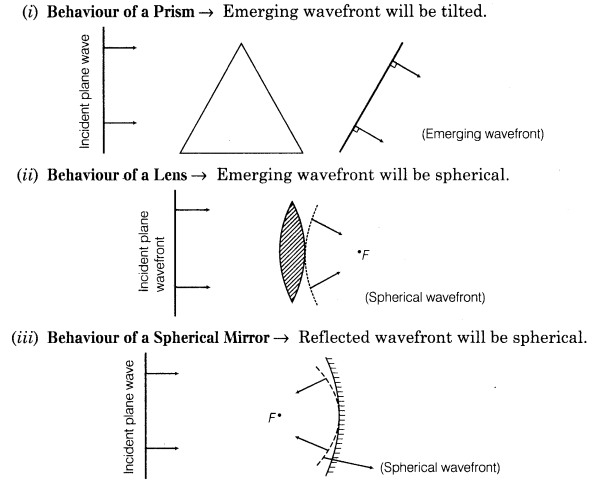
11. Behaviour of a Prism, Lens and Spherical Mirror towards Plane Wave front
12. Laws of reflection on the basis of Huygens’ wave theory As shown in figure, consider a plane wave front AB incident on the reflecting surface XY, both the wave front and the reflecting surface being perpendicular to the plane of paper.
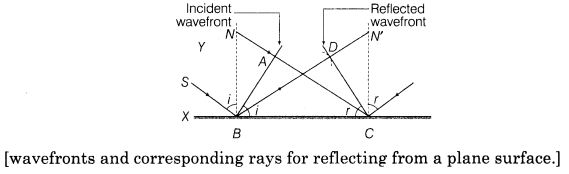
First the wave front touches the reflecting surface at B and then at the successive points towards C. In accordance with Huygens’ principle, from each point on BC, secondary wavelets start growing with the speed c. During the time the disturbance from A reaches the point C the secondary wavelets from B must have spread over a hemisphere of radius BD = AC = ct, where t is the time taken by the disturbance to travel from A to C. The tangent plane CD drawn from the point C over this hemisphere of radius ct will be the new reflected wave front.
Let angles of incidence and reflection be i and r, respectively . In AABC and ADCB, we have
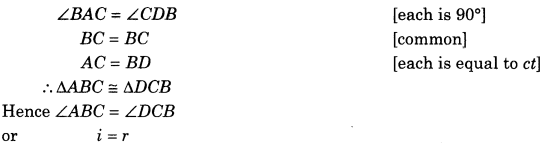
i.e. the angle of incidence is equal to the angle of reflection. The proves the first law of reflection.
Further, since the incident ray SB, the normal BN and the reflected ray BD are respectively perpendicular to the incident wave front AB, the reflecting surface XY and the reflected wave front CD (all of which are perpendicular to the plane of the paper) therefore, they all lie in the plane of the paper i.e. in the same plane. This proves the second law of reflection.
13. Law of refraction on this basis of Huygens’ wave theory Consider a plane wavefront AB incident on a plane surface XY, separating two media 1 and 2, as shown in Figure.
Let v1 and v2 be the velocities of light in two media, with v1 <v2.
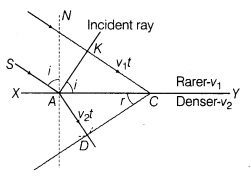
The wave front first strikes at point A and then at the successive points towards C. According to Huygens’ principle, from each point on AC, the secondary wavelets starts growing in the second medium with speed v2. Let the disturbance take time t to travel from B to C, then BC = v1t. During the time the disturbance from B reaches the point C, the secondary wavelets from point A must have spread over a hemisphere of radius AD = v2t in the second medium. The tangent plane CD drawn from point C over this hemisphere of radius v2t will be the new refracted wave front.
Let the angles of incidence and refraction be i and r, respectively.
From right AABC, we have
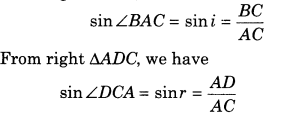

This proves Snell’s law of refraction. The constant 1μ2 is called the refractive index of the socond medium with respect to first medium.
Further, since the incident ray SA, the normal AN and the refracted ray AD are respectively perpendicular to the indicent wave front AB, the dividing surface XY and the refracted wave front CD (all perpendicular to the plane of the paper), therefore, they all lie in the plane of the paper, i.e. in the same plane. This proves another law of refraction.
Notes Oscillations
• Periodic Motion
Motions, processes or phenomena, which repeat themselves at regular intervals, are called periodic.
• Oscillatory Motion
The motion of a body is said to be oscillatory motion if it moves to and fro about a fixed point after regular intervals of time. The fixed point about which the body oscillates is called mean position or equilibrium position.
• Simple Harmonic Motion
Simple harmonic motion is a special type of periodic oscillatory motion in which
(i) The particle oscillates on a straight line
(ii) The acceleration of the particle is always directed towards a fixed point on the line.
(iii) The magnitude of acceleration is proportional to the displacement of the particle from the
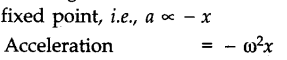
• Characteristics of SHM
The displacement x in SHM at time t is given by
x = A sin (ωt+ Ф )
where the three constants A, ω and Ф characterize the SHM, i.e., they distinguish one SHM from another. A SHM can also be described by a cosine function as follows:
x = A cos (ωt + δ)
• The displacement of an oscillating particle at any instant is equal to the change in its position vector during that time. The maximum value of displacement in an oscillatory motion on either side of its mean position is called “displacement amplitude” or “simple amplitude”.
Thus, amplitude A = x max.
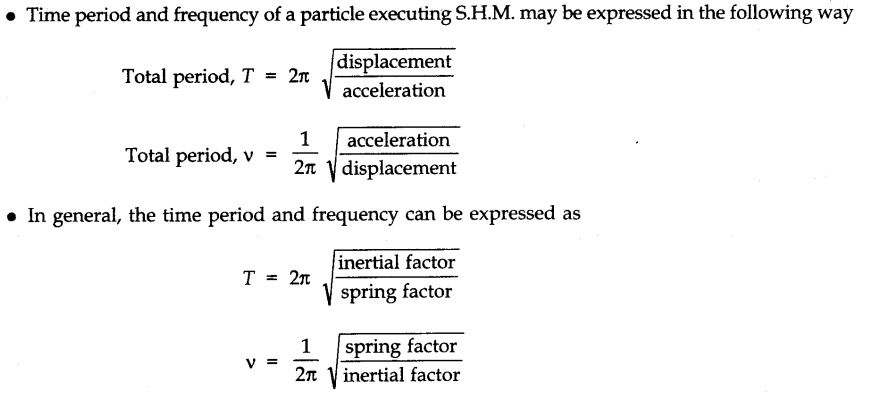
• The time taken by an oscillating particle to complete one full oscillation to and fro about its mean (equilibrium) position is called the “time period” of SHM. It is given by

• Frequency
The number of oscillations in one second is called frequency. It is expressed in sec-1 or Hertz. Frequency and time period are independent of amplitude.

• Phase
The quantity (ωt+ Ф) is called the phase of SHM at time t; it describes the state of motion at that instant. The quantity Ф is the phase at time f = 0 and is called the phase constant or initial phase or epoch of the SHM. The phase constant is the time-independent term in the cosine or sine function.
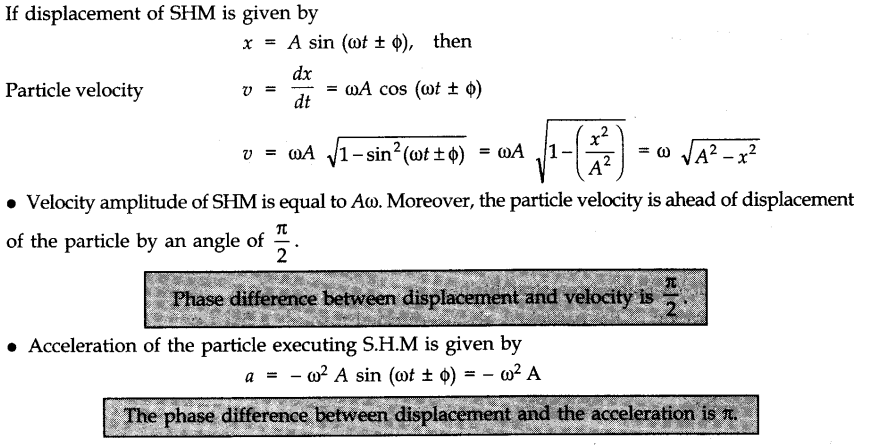
• The force responsible for maintaining the S.H.M. is called restoring force.
If the displacement (x) from the equilibrium position is small, the restoring force (F) acting on the body is given by
F = -kx
where k is a force constant.
• Energy in S.H.M.
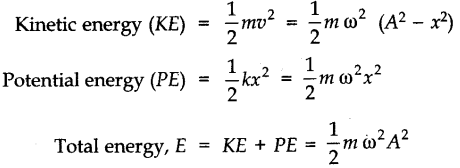
When a body executes SHM, its energy changes between kinetic and potential, but the total energy is always constant. At any displacement x from the equilibrium position:
• Springs in Series
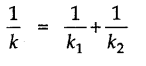
If two springs, having spring constant k1 and k2, are joined in series, the spring constant of the combination is given by
• Springs in Parallel
If two springs, having spring constants k1 and k2, are joined in parallel, the spring constant of the combination is given by
k = k1 + k2
• When one spring is attached to two masses m1 and m2, then

• Simple Pendulum
A simple pendulum is the most common example of bodies executing S.H.M. An ideal simple pendulum consists of a heavy point mass body suspended by a weightless in extensible and perfectly flexible string from a rigid support about which it is free to oscillate.
• The time period of simple pendulum of length ‘l’ is given by
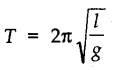
The time period of a simple pendulum depends on
(i) length of the pendulum and
(ii) the acceleration due to gravity (g).
• A second’s pendulum is a pendulum whose time period is. 2s. At a place where g = 9.8 ms-2, the length of a second’s pendulum is found to be 99.3 cm (= 1 m).
• If a liquid of density p oscillates in a vertical U-tube of uniform cross sectional area A, then the time period of oscillation is given by

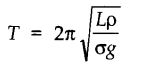
• If a cylinder of mass m, length L, density of material p and uniform area of cross section A, oscillates vertically in a liquid of density o, then the time period of oscillation is given by
• Undamped and Damped Simple Harmonic Oscillations
Undamped Simple Harmonic oscillations: When a simple harmonic system oscillates with a constant amplitude which does not change with time, its oscillations are called undamped simple harmonic oscillations.
Damped Simple Harmonic oscillations: When a simple harmonic system oscillates with a decreasing amplitude with time, its oscillations are called damped simple harmonic oscillations.
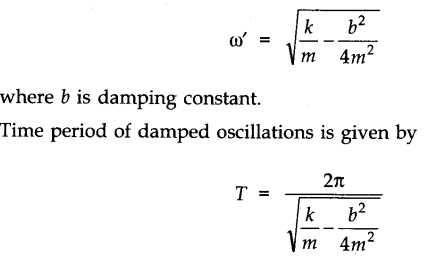
The angular frequency of the damped oscillator is given by
• A system is said to execute free oscillations, if on being displaced or disturbed from its position of equilibrium, it oscillates itself without outside interference.
When a system is compelled to oscillate with a frequency other than its natural frequency, it is said to execute forced oscillations.
The external force which causes forced oscillation, is of sinusoidal nature. It is given as

• Resonance is the phenomenon of setting a body into oscillations with large amplitude under the influence of some external periodic force whose frequency is exactly equal to the natural frequency of the given body. Such oscillations are called the “resonant oscillations”.
• The two or more oscillations linked together in such a way that the exchange of energy takes place between them are called coupled oscillators. The oscillations produced by coupled oscillators are known as coupled oscillations.
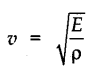
• The speed of a mechanic wave depends upon the properties of the medium in which it is travelling. If E is the elastic constant and ρ is the density of the medium then the speed of the wave is given by
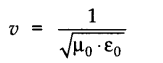
• In case of electric magnetic waves, we know that they are the combinations of the oscillation of electric and magnetic fields in perpendicular directions. Their speed of propagation depends upon the permitivity and the permeability of the medium. If μ0 is permeability and ε0 is the permitivity of the medium in vaccum, then
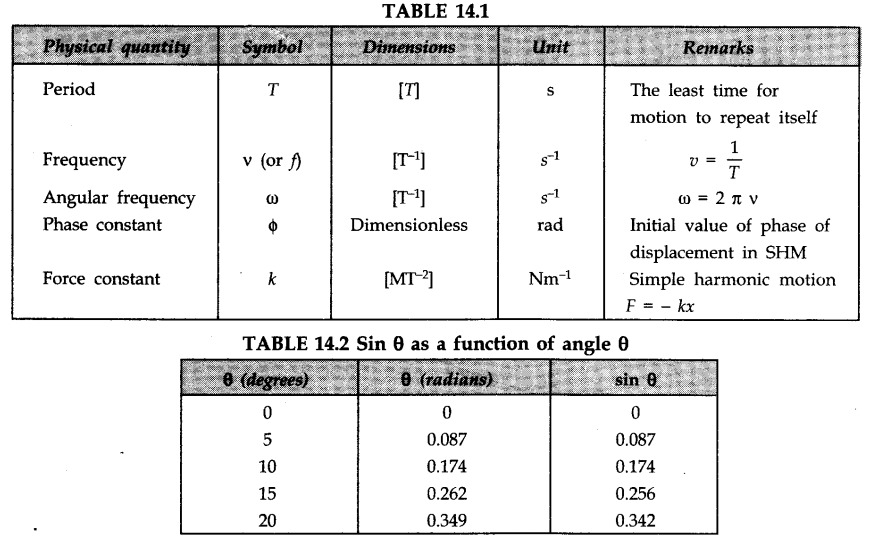
• IMPORTANT TABLES
Notes Mechanics of Solids and Fluids
Mechanics of Solids
• Inter molecular Force
In a solid, atoms and molecules are arranged in such a way that each molecule is acted upon by the forces due to the neighbouring molecules. These forces are known as inter molecular forces.
• Elasticity
The property of the body to regain its original configuration (length, volume or shape) when the deforming forces are removed, is called elasticity.
• The change in the shape or size of a body when external forces act on it is determined by the forces between its atoms or molecules. These short range atomic forces are called elastic forces.
• Perfectly elastic body
A body which regains its original configuration immediately and completely after the removal of deforming force from it, is called perfectly elastic body. Quartz and phospher bronze are the examples of nearly perfectly elastic bodies.
• Plasticity
The inability of a body to return to its original size and shape even on removal of the deforming force is called plasticity and such a body is called a plastic body.
• Stress
Stress is defined as the ratio of the internal force F, produced when the substance is deformed, to the area A over which this force acts. In equilibrium, this force is equal in magnitude to the externally applied force. In other words,

• Stress is of two types:
(i) Normal stress: It is defined as the restoring force per unit area perpendicular to the surface of the body. Normal stress is of two types: tensile stress and compressive stress.
(ii) Tangential stress: When the elastic restoring force or deforming force acts parallel to the surface area, the stress is called tangential stress.
• Strain
It is defined as the ratio of the change in size or shape to the original size or shape. It has no dimensions, it is just a number.
Strain is of three types:
(i) Longitudinal strain: If the deforming force produces a change in length alone, the strain produced in the body is called longitudinal strain or tensile strain. It is given as:

(ii) Volumetric strain: If the deforming force produces a change in volume alone, the strain produced in the body is called volumetric strain. It is given as:

(iii) Shear strain: The angle tilt caused in the body due to tangential stress expressed is called shear strain. It is given as:

• The maximum stress to which the body can regain its original status on the removal of the deforming force is called elastic limit.
• Hooke’s Law
Hooke’s law states that, within elastic limits, the ratio of stress to the corresponding strain produced is a constant. This constant is called the modulus of elasticity. Thus

• Stress Strain Curve
Stress strain curves are useful to understand the tensile strength of a given material. The given figure shows a stress-strain curve of a given metal.

• The curve from O to A is linear. In this region Hooke’s Proportional limit law is obeyed.
• In the region from A to 6 stress and strain are not . proportional. Still, the body regains its original dimension, once the load is removed.
• Point B in the curve is yield point or elastic limit and the corresponding stress is known as yield strength of the material.
• The curve beyond B shows the region of plastic deformation.
• The point D on the curve shows the tensile strength of the material. Beyond this point, additional strain leads to fracture, in the given material.
• Young’s Modulus
For a solid, in the form of a wire or a thin rod, Young’s modulus of elasticity within elastic limit is defined as the ratio of longitudinal stress to longitudinal strain. It is given as:

• Bulk Modulus
Within elastic limit the bulk modulus is defined as the ratio of longitudinal stress and volumetric strain. It is given as:

– ve indicates that the volume variation and pressure variation always negate each other.
• Reciprocal of bulk modulus is commonly referred to as the “compressibility”. It is defined as the fractional change in volume per unit change in pressure.
• Shear Modulus or Modulus of Rigidity
It is defined as the ratio of the tangential stress to the shear strain.
Modulus of rigidity is given by

• Poisson’s Ratio
The ratio of change in diameter (ΔD) to the original diameter (D) is called lateral strain. The ratio of change in length (Δl) to the original length (l) is called longitudinal strain. The ratio of lateral strain to the longitudinal strain is called Poisson’s ratio.

• Elastic Fatigue
It is the property of an elastic body by virtue of which its behaviour becomes less elastic under the action of repeated alternating deforming forces.
• Relations between Elastic Moduli
For isotropic materials (i.e., materials having the same properties in all directions), only two of the three elastic constants are independent. For example, Young’s modulus can be expressed in terms of the bulk and shear moduli.

• Breaking Stress
The ultimate tensile strength of a material is the stress required to break a wire or a rod by pulling on it. The breaking stress of the material is the maximum stress which a material can withstand. Beyond this point breakage occurs.


Hence, the elastic potential energy of a wire (energy density) is equal to half the product of its stress and strain.
• IMPORTANT TABLES


Mechanics of Fluids
• Fluids are the sustances which can flow e.g., liquids and gases. It does not possess definite shape.
• When an object is submerged in a liquid at rest, the fluid exerts a force on its surface normally. It is called thrust of the liquid.
• Pressure
The thrust experienced per unit area of the surface of a liquid at rest is called pressure.

• When a liquid is in equilibrium, the force acting on its surface is perpendicular everywhere. The pressure is the same at the same horizontal level.
• The pressure at any point in the liquid depends on the depth (h) below the surface, density of liquid and acceleration due to gravity.
• Pascal’s Law
According to Pascal’s Law, the pressure applied to an enclosed liquid is transmitted undiminished to every portion of the liquid and the walls of the containing vessel.
• Hydraulic system works on Pascal’s law. Force exerted to area, ratio will be same at all cross¬sections.

Note: A large force is experienced in larger cross-section it a smaller force 4cross is applied in smaller by the relation section.
• A column of height h of a liquid of density p exerts a pressure P given

• If Pa be the atmospheric pressure then pressure in a liquid at a depth h from its free surface is given by P = Pa+ hρg. Relation is true for incompressible fluids only.
• The gauge pressure (Pg), is the difference of the absolute pressure (P) and the atmospheric pressure (Pa).
Absolute pressure (P) = Gauge pressure (Pg) + Atmospheric pressure (Pa)
Pg=P-Pa
• Archimedes Principle
When a body is partially or completely immersed in a liquid, it loses some of its weight. The loss
in weight of the body in the liquid is equal to the weight of the liquid displaced by the immersed
part of the body.
• The upward force excerted by the liquid displaced when a body is immersed is called buoyancy. Due to this, there is apparent loss in the weight experienced by the body.
• Law of Floatation
“A body floats in a liquid if weight of the liquid displaced by the immersed portion of the body is equal to the weight of the body.”
. When a body is immersed partially or wholly in a liquid, then the various forces acting on the body are
(i) upward thrust (T) acting at the centre of buoyancy and whose magnitude is equal to the
weight of the liquid displaced and
• (ii) the weight of the body (W) which acts vertically downward through its centre of gravity.
(a) When W > T, the body will sink in the liquid;
(b) When W = T, then the body will remain in equilibrium inside the liquid;
(c) When W < T, then the body will come upto the surface of the liquid in such a way that the weight of the liquid displaced due to its immersed portion equals the weight of the body. Thus the body will float with only a part of it immersed inside the liquid.
• The flow of a liquid is said to be steady or stream line flow if such particle of the fluid passing
through a given point travels along the same path and with same speed as the preceding particle passing through that very point.
• If the liquid flows over a horizontal surface in the form of layers of different velocities, then the flow of the liquid is called laminar flow.
• The flow of fluid in which velocity of all particles crossing a given point is not same and the motion of fluid becomes irregular or disordered is called turbulent flow.
• Equation of Continuity
According to equation of continuity, if there is no fluid source or sink along the length of a pipe, then mass of the fluid crossing any section of the pipe per unit time remains constant. i.e„ a1 v1ρ1 = a2v2 ρ2
For incompressible liquids (i.e., fluids) ρ1 = ρ2 and hence the equation is given as
a1v1=a2v2
– It means that speed of flow of liquid is more where the pipe is narrower and speed of flow is less
where the cross-section of pipe is more.
• Energy of a liquid
A liquid can possess three types of energies: (i) kinetic energy, (ii) potential energy and (iii) pressure energy
The energy possessed by a liquid due to its motion is called kinetic energy i.e., 1/2mv2.
The potential energy of a liquid of mass m at a height h is given by P.E. = mgh
The energy possessed by a liquid by virtue of its pressure is called pressure energy. Pressure energy of liquid in volume dV = PdV
Pressure energy per unit mass of the liquid

• Bernoulli’s Theorem
For an incompressible, non-viscous, irrotational liquid having streamlined flow, the sum of the pressure energy, kinetic energy and potential energy per unit mass is a constant i.e.,

• For steady flow of a non-viscous fluid along a horizontal pipe, Bernoulli’s equation is simplified as

• Viscosity
Viscosity is the property of the fluid (liquid or gas) by virtue of which an internal frictional force comes into play when the fluid is in motion in the form of layers having relative motion. It opposes the relative motion of the different layers. Viscosity is also called as fluid friction.
• The viscous force directly depends on the area of the layer and the velocity gradient.

• Coefficient of Viscosity
Coefficient of viscosity of a liquid is equal to the tangential force required to maintain a unit velocity gradient between two parallel layers of liquid each of area unity.

The SI unit of coefficient of viscosity is poiseuille (Pl) or Pa – s or Nm-2 s or kg m-1 s-1 . Dimensional formula of q is [ML-1T-1].
• Stoke’s Law
According to Stokes’ law the backward dragging force acting on a small spherical body of radius r moving with a velocity v through a viscous medius of coefficient of viscosity ή is given by
F = 6πήr
• Terminal Velocity
It is maximum constant velocity acquired by the body while falling freely in a viscous medium. This is attained when the apparent weight is compensated by the viscous force.
It is given by

where p be the density of the material of the body of radius r and o be the density of the medium.
• Poiseuille’s Equation
According to Poiseuille, if a pressure difference (P) is maintained across the two ends of a capillary tube of length ‘l’ and radius ‘r’, then the volume of liquid coming out of the tube per second is directly proportional to the pressure difference (P).
(ii) directly proportional to the fourth power of radius (r) of the capillary tube.
(iii) inversely proportional to the coefficient of viscosity (ή) of the liquid.
(iv) inversely proportional to the length (i) of the capillary tube.
It is given as

• Reynold’s Number
Reynold number Re is a dimensionless number whose value gives an approximate idea whether the flow of a fluid will be streamline or turbulent. It is given by

where p = density of fluid flowing with a speed u, d stands for the diameter of the pipe and q is the viscosity of the fluid. Value of Re remains same in any system of units.
• It is observed that flow is streamline or laminar for Re <= 1000 and the flow is turbulent for Re >= 2000. The flow becomes unsteady for Re between 1000 and 2000. The critical value of Re , at which turbulence sets, is same for the geometrically similar flows.
• Re may also be expressed as the ratio of inertial force (force due to inertia i.e., mass of moving fluid or due to inertia of obstacle in its path) to viscous force i.e.,

• Critical Velocity
The critical velocity is that velocity of liquid flow, upto which its flow is streamline and above which its flow becomes turbulent.
It is given by

where K is a dimensionless constant, q is coefficient of viscosity of liquid, p is density of liquid and r is the radius of tube.
• Surface Tension
It is the property of the liquid by virtue of which the free surface of liquid at rest tends to have minimum area and as such it behaves as a stretched elastic membrane.
• The force acting per unit length of line drawn on the liquid surface and normal to it parallel to the surface is called the force of surface tension.
It is given by
The SI unit of surface tension is Nm-1 and its dimensional formula is [MT-2],
• Surface Energy
Energy possessed by the surface of the liquid is called surface energy. Change in surface energy is the product of surface tension and change in surface area under constant temperature.
• The height to which water rises in a capillary tube of radius r is given by

where T is the surface tension of the liquid and 0 is the angle of contact.
Due to surface tension there is excess pressure on the concave side of a surface film of a liquid over
the convex side and is equal to 2T/r . For a soap bubble the excess pressure is 4T/r where, r denotes the radius of the surface.
• Angle of Contact
The angle which the tangent to the liquid surface at the point of contact makes with the solid surface inside the liquid is called angle of contact.
• Intermolecular force amongst molecules of the same material is called the force of cohesion. However, force amongst molecules of different materials is called the force of adhesion.
• Torricelli’s Theorem
According to this theorem, velocity of efflux i.e., the velocity with which the liquid flows out of on orifice {i.e., a narrow hole) is equal to that which a freely falling body would acquire in falling through a vertical distance equal to the depth of orifice below the free surface of liquid.
The velocity is given by
V = √2gh
• Magnus Effect
When a ball is given a spin when it is in a streamline of air molecules, it will follow a curved path which is convex towards the greater pressure side. This idea is the basis of the ball from spin bowlers getting a lift and areodynamics.


Notes Heat Thermodynamics
• The branch of physics which deals with the study of transformation of heat into other forms of energy and vice-versa is called thermodynamics.
Thermodynamics is a macroscopic science. It deals with bulk systems and does not go into the
molecular constitution of matter.
• A collection of an extremely large number of atoms or molecules confined within certain boundaries
such that it has a certain values of pressure (P), volume (V) and temperature (T) is called a ; thermodynamic system.
• Thermal Equilibrium
A thermodynamic system is in an equilibrium state if the macroscopic variables such as pressure, volume, temperature, mass composition etc. that characterize the system do not change in time. In thermal equilibrium, the temperature of the two systems are equal.
• Zeroth Law of Thermodynamics
This law identifies thermal equilibrium and introduces temperature as a tool for identifying f equilibrium. According to this law “If two systems are in thermal equilibrium with a third system then those two systems themselves are in equilibrium.”
• Heat, Work and Internal Energy
— Energy that is transferred between a system and its surroundings whenever there is temperature difference between the system and its surroundings is called heat.
— Work is said to be done if a body or a system moves through a certain distance in the direction of the applied force. It is given as
dW = PdV
where P is the pressure of the gas in the cylinder.
— If we consider a bulk system consisting of a large number of molecules, then internal energy ; of the system is the sum of the kinetic energies and potential energies of these molecules.
This energy is possessed by a system due to its molecular motion and molecular configuration. The internal energy is denoted by U.
U = Ek + Ep
where Ek and Ep represent the kinetic and potential energies of the molecules of the system.
• Internal energy of a system is a macroscopic variable and it depends only on the state of the system. Its value depends only on the given state of the system and does not depend on the path taken to arrive that state.
• First Law of Thermodynamics
The first law of thermodynamics is simply the general law of conservation of energy applied to any system. According to this law, “the total heat energy change in any system is the sum of the internal energy change and the work done.”
When a certain quantity of heat dQ is subjected to a system, a part of it is used in increasing the internal energy by dU and a part is used in performing external work dW, hence
dQ = dU + dW
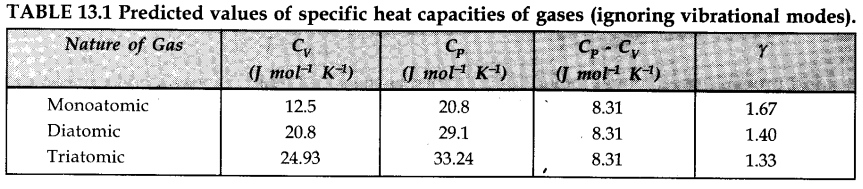
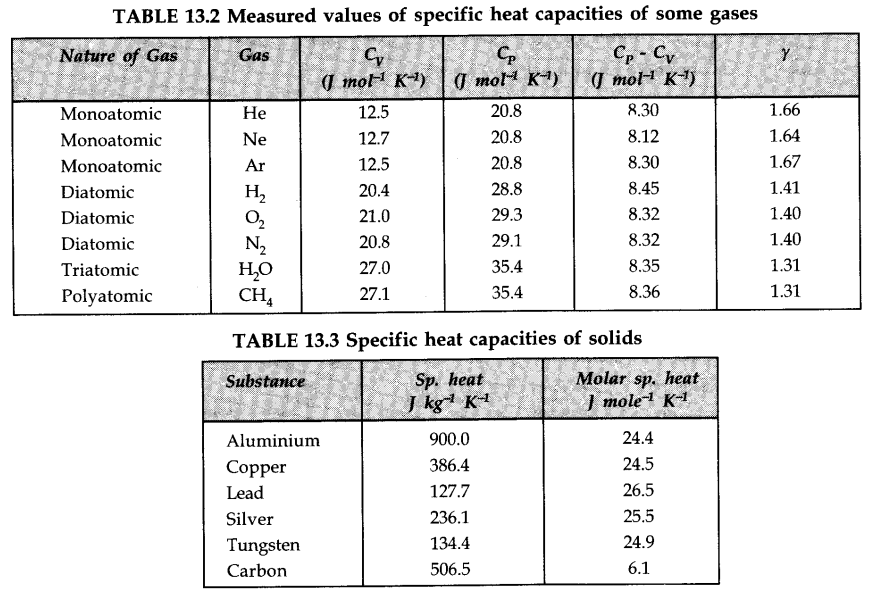
• For gases, the specific heat capacity depends on the process or the conditions under which heat capacity transfer takes place. There are mainly two principal specific heat capacities for a gas. These are specific heat capacity at constant volume and specific heat capacity at constant pressure.
• From First Law of Thermodynamics we find a relation between two principal specific heats of an ideal gas. According to the relation
Cp-Cυ = R
Here Cp and Cυ are molar specific heats under constant pressure and constant volume condition respectively.
The specific heat capacity of a gas at constant pressure is greater than the specific heat capacity of the gas at constant volume i.e. Cp > Cυ. Reason is that when heat supplied to a gas at constant volume, no work would be done by the gas against the external pressure and all the energy is used to raise the temperature of the gas. On the other hand when the heat is supplied to the gas at constant pressure, its volume increases and the heat energy supplied to it is used to increase the temperature of the gas as well as in doing the work against the external pressure.
The difference, between the two specific heats is the thermal equivalent of the work done in expanding the gas against the external pressure.
• Expression for the Relation between Cp and Cυ
Let P, V and T be the pressure, volume and absolute temperature initially of one mole of an ideal gas.
Case (i): The heat dQ is supplied to the gas at constant volume so that the temperature increases to T + dT.


• Thermodynamic State Variables
Thermodynamic state variables of a system are the parameters which describe equilibrium states of the system. For example, equilibrium state of gas is completely specified by the values of pressure, volume, temperature, mass and composition.
• Equation of State
The equation of state represents the connection between the state variables of a system. For example, the those equation of state of an ideal/perfect gas in represented as
PV = μRT
where g is number of moles of the gas and R is gas constant for one mole of the gas.
• Thermodynamic state variables are of two kinds, extensive and intensive. Extensive variables indicate the size of the system but intensive variables do not indicate the size. Volume, mass, internal energy of a system are extensive variables but pressure, temperature and density are intensive variables.
• Thermodynamic Processes
Any process in which the thermodynamic variables of a thermodynamic system change is known as thermodynamic process.
• Quasi-Static Processes
Processes that are sufficiently slow and do not involve accelerated motion of piston and/or large temperature gradient are quasi-static processes.
In this process, the change in pressure or change in volume or change in temperature of the system is very small.
• Isothermal Process
A change in pressure and volume of a gas without any change in its temperature, is called an isothermal change. In such a change, there is a free exchange of heat between the gas and its surroundings.
• Adiabatic Process
A process in which no exchange of heat energy takes place between the gas and the surroundings, is called an adiabatic process.
• The work done dW under isothermal change is given by

• P-V Diagram
A graph representing the variation of pressure with the variation of volume is called P-V diagram. The work done by the thermodynamic system is equal to the area under P-V diagram. It is given as

• Reversible Process
A process which can retrace so that the system passes through the same states is called a reversible process, otherwise it is irreversible.
Irreversibility arises mainly from two causes:
(i) Many processes like free expansion or an explosive chemical reaction take the system to non-equilibrium states.
(ii) Most processes involve friction, viscosity and other dissipative effects.
• Second Law of Thermodynamics
This principle which disallows certain phenomena consistent with the First law of thermodynamics is known as the second law of thermodynamics.
Following are the two statements of second law of thermodynamics.
Kelvin-Planck Statement: It is impossible to construct an engine, operating in a cycle, to extract
heat from hot body and convert it completely into work without leaving any change anywhere i.e., 100% conversion of heat into work is impossible.
Clausius Statement: It is impossible for a self acting machine, operating in a cycle, unaided by any external energy to transfer heat from a cold body to a hot body. In other words heat can not flow itself from a colder body to a hotter body.
• A heat engine is a device by which a system is made to undergo a cyclic process that results
in conversion of heat to work. Basically, a heat engine consists of: (i) a heat source, (ii) a heat sink, and (iii) a working substance.
• Carnot’s Engine. He proposed a hypothetical engine working on a cyclic/reversible process operating between two temperatures. Its efficiency is independent of the working substance and is given by, η=1-T2/T1 where T1 is the temperature of source and T2 is the temperature of sink.
• According to Carnot’s theorem: (a) working between two given temperatures T1 and T2 of the hot and cold reservoirs respectively, no engine can have efficiency more than that of Carnot’s engine, and (b) the efficiency of the Carnot engine is independent of the nature of the working substance.
• Refrigerator
The process of removing heat from bodies colder than their surroundings is called refrigeration and the device doing so is called refrigerator.
In the refrigerator, heat is absorbed at low temperature and rejected at higher temperature with the help of external mechanical work. Thus, a refrigerator is a heat engine working backward and hence it is also called heat pump.
Refrigerator works on the reverse process of Carnot engine. By the work done on the system, heat is extracted from low temperature sink T2 and passed on to high temperature source T1. The coefficient of performance is given by

• IMPORTANT TABLES


General Awareness Syllabus Agniveer MR – Agniveer Indian Navy
Geography: Soil
Rivers
Mountains
Ports
Inland
Harbours
Culture and Religion
Freedom Movement
Important National Facts about India
Heritage
Arts and Dance
History
Defence
Wars and neighbours
Awards and Authors
Discoveries
Diseases and Nutrition
Current Affairs
Languages
Capitals and Currencies
Common Names
Full Forms and Abbreviations
Eminent Personalities
National : Bird/Animal/Sport/Flower/Anthem/Song/Flag/Monuments
Sports : Championships / Winners/Terms/ Number of Players
Science and Mathematics Syllabus Agniveer MR – Agniveer Indian Navy
Nature of Matter
Universe (Planets/Earth/ Satellites/ Sun)
Electricity and its applications
Force and Gravitation
Newton’s Laws Of Motion
Work
Energy and Power
Heat
Temperature
metals and Non Metals
Carbon and its Compounds
Measurements in Science
Sound & Wave Motion
Atomic Structure
Mathematical Simplification
Ratio and Proportion
Algebraic Identities
Linear Equations and Polynomials
Simultaneous Equations
Basic Trigonometry
Simple Mensuration
Geometry
Measures of Central Tendency (Average Median and Mode)
Interest
Profit
Loss and Percentage
Work
Time
Speed and Distance
Notes Work, Energy and Power
• Work is said to be done when a force applied on the body displaces the body through a certain distance in the direction of applied force.
It is measured by the product of the force and the distance moved in the direction of the force, i.e., W = F-S
• If an object undergoes a displacement ‘S’ along a straight line while acted on a force F that makes an angle 0 with S as shown.
The work done W by the agent is the product of the component of force in the direction of displacement and the magnitude of displacement.

• If we plot a graph between force applied and the displacement, then work done can be obtained by finding the area under the F-s graph.
• If a spring is stretched or compressed by a small distance from its unstretched configuration, the spring will exert a force on the block given by
F = -kx, where x is compression or elongation in spring, k is a constant called spring constant whose value depends inversely on unstretched length and the nature of material of spring.
The negative sign indicates that the direction of the spring force is opposite to x, the displacement of the free-end.

• Energy
The energy of a body is its capacity to do work. Anything which is able to do work is said to possess energy. Energy is measured in the same unit as that of work, namely, Joule.
Mechanical energy is of two types: Kinetic energy and Potential energy.
• Kinetic Energy
The energy possessed by a body by virtue of its motion is known as its kinetic energy.
For an object of mass m and having a velocity v, the kinetic energy is given by:
K.E. or K = 1/2 mv 2
• Potential Energy
The energy possessed by a body by virtue of its position or condition is known as its potential energy.
There are two common forms of potential energy: gravitational and elastic.
—> Gravitational potential energy of a body is the energy possessed by the body by virtue of its position above the surface of the earth.
It is given by
(U)P.E. = mgh
where m —> mass of a body
g —> acceleration due to gravity on the surface of earth. h —> height through which the body is raised.
—> When an elastic body is displaced from its equilibrium position, work is needed to be done against the restoring elastic force. The work done is stored up in the body in the form of its elastic potential energy.
If an elastic spring is stretched (or compressed) by a distance Y from its equilibrium position, then its elastic potential energy is given by
U= 1/2 kx2
where, k —> force constant of given spring
• Work-Energy Theorem
According to work-energy theorem, the work done by a force on a body is equal to the change in kinetic energy of the body.

• The Law of Conservation of Energy
According to the law of conservation of energy, the total energy of an isolated system does not change. Energy may be transformed from one form to another but the total energy of an isolated system remains constant.
• Energy can neither be created, nor destroyed.
• Besides mechanical energy, the energy may manifest itself in many other forms. Some of these forms are: thermal energy, electrical energy, chemical energy, visual light energy, nuclear energy etc.
• Equivalence of Mass and Energy
According to Einstein, mass and energy are inter-convertible. That is, mass can be converted into energy and energy can be converted into mass.

• Collision
Collision is defined as an isolated event in which two or more colliding bodies exert relatively strong forces on each other for a relatively short time.
Collision between particles have been divided broadly into two types.
(i) Elastic collisions (ii) Inelastic collisions
• Elastic Collision
A collision between two particles or bodies is said to be elastic if both the linear momentum and the kinetic energy of the system remain conserved.
Example: Collisions between atomic particles, atoms, marble balls and billiard balls.
• Inelastic Collision
A collision is said to be inelastic if the linear momentum of the system remains conserved but its kinetic energy is not conserved.
Example: When we drop a ball of wet putty on to the floor then the collision between ball and floor is an inelastic collision.
• Collision is said to be one dimensional, if the colliding particles, move along the same straight line path both before as well as after the collision.
• In one dimensional elastic collision, the relative velocity of approach before collision is equal to. the relative velocity of separation after collision.

• Coefficient of Restitution or Coefficient of Resilience
Coefficient of restitution is defined as the ratio of relative velocity of separation after collision to the relative velocity of approach before collision.

• Elastic and Inelastic Collisions in Two Dimensions


• Non-conservative Forces
A force is said to be non-conservative if the work done in moving from one point to another depends upon the the path followed.
Let W, be the work done in moving from A to B following the path 1. W2 through the path 2 and W3 through the path 3. Fig. (i).

Examples of non-conservative forces are :
(i) Force of friction (ii) Viscus force
Low of conservation of energy holds goods for both conservative and non-conservative forces.


Notes Laws of Motion
• Dynamics is the branch of physics in which we study the motion of a body by taking into consideration the cause i.e., force which produces the motion.
• Force
Force is an external cause in the form of push or pull, which produces or tries to produce motion in a body at rest, or stops/tries to stop a moving body or changes/tries to change the direction of motion of the body.
• The inherent property, with which a body resists any change in its state of motion is called inertia. Heavier the body, the inertia is more and lighter the body, lesser the inertia.
• Law of inertia states that a body has the inability to change its state of rest or uniform motion (i.e., a motion with constant velocity) or direction of motion by itself.
• Newton’s Laws of Motion
Law 1. A body will remain at rest or continue to move with uniform velocity unless an external force is applied to it.
First law of motion is also referred to as the ‘Law of inertia’. It defines inertia, force and inertial frame of reference.
I here is always a need of ‘frame of reference’ to describe and understand the motion of particle, lhc simplest ‘frame of reference’ used are known as the inertial frames.
A frame of referent, e is known as an inertial frame it, within it, all accelerations of any particle are caused by the action of ‘real forces’ on that particle.
When we talk about accelerations produced by ‘fictitious’ or ‘pseudo’ forces, the frame of reference is a non-inertial one.
Law 2. When an external force is applied to a body of constant mass the force produces an acceleration, which is directly proportional to the force and inversely proportional to the mass of the body.


Law 3. “To every action there is equal and opposite reaction force”. When a body A exerts a force on another body B, B exerts an equal and opposite force on A.
• Linear Momentum
The linear momentum of a body is defined as the product of the mass of the body and its velocity.

• Impulse
Forces acting for short duration are called impulsive forces. Impulse is defined as the product of force and the small time interval for which it acts. It is given by

Impulse of a force is a vector quantity and its SI unit is 1 Nm.
— If force of an impulse is changing with time, then the impulse is measured by finding the area bound by force-time graph for that force.
— Impulse of a force for a given time is equal to the total change in momentum of the body during the given time. Thus, we have

• Law of Conservation of Momentum
The total momentum of an isolated system of particles is conserved.
In other words, when no external force is applied to the system, its total momentum remains constant.

• Recoiling of a gun, flight of rockets and jet planes are some simple applications of the law of conservation of linear momentum.

• Concurrent Forces and Equilibrium
“A group of forces which are acting at one point are called concurrent forces.”
Concurrent forces are said to be in equilibrium if there is no change in the position of rest or the state of uniform motion of the body on which these concurrent forces are acting.
For concurrent forces to be in equilibrium, their resultant force must be zero. In case of three concurrent forces acting in a plane, the body will be in equilibrium if these three forces may be completely represented by three sides of a triangle taken in order. If number of concurrent forces is more than three, then these forces must be represented by sides of a closed polygon in order for equilibrium.


• Commonly Used Forces
(i) Weight of a body. It is the force with which earth attracts a body towards its centre. If M is mass of body and g is acceleration due to gravity, weight of the body is Mg in vertically downward direction.
(ii) Normal Force. If two bodies are in contact a contact force arises, if the surface is smooth the direction of force is normal to the plane of contact. We call this force as Normal force.

Example. Let us consider a book resting on the table. It is acted upon by its weight in vertically downward direction and is at rest. It means there is another force acting on the block in opposite direction, which balances its weight. This force is provided by the table and we call it as normal force.
(iii) Tension in string. Suppose a block is hanging from a string. Weight of the block is acting vertically downward but it is not moving, hence its weight is balanced by a force due to string. This force is called ‘Tension in string’. Tension is a force in a stretched string. Its direction is taken along the string and away from the body under consideration.

• Simple Pulley
Consider two bodies of masses m1 and m2 tied at the ends of an in extensible string, which passes over a light and friction less pulley. Let m1 > m2. The heavier body will move downwards and the lighter will move upwards. Let a be the common acceleration of the system of two bodies, which is given by


• Apparent Weight and Actual Weight
— ‘Apparent weight’ of a body is equal to its ‘actual weight’ if the body is either in a state of rest or in a state of uniform motion.
— Apparent weight of a body for vertically upward accelerated motion is given as
Apparent weight =Actual weight + Ma = M (g + a)
— Apparent weight of a body for vertically downward accelerated motion is given as
Apparent weight = Actual weight Ma = M (g – a).
• Friction
The opposition to any relative motion between two surfaces in contact is referred to as friction. It arises because of the ‘inter meshing’ of the surface irregularities of the two surfaces in contact.
• Static and Dynamic (Kinetic) Friction
The frictional forces between two surfaces in contact (i) before and (ii) after a relative motion between them has started, are referred to as static and dynamic friction respectively. Static friction is always a little more than dynamic friction.
The magnitude of kinetic frictional force is also proportional to normal force.

• Limiting Frictional Force
This frictional force acts when body is about to move. This is the maximum frictional force that can exist at the contact surface. We calculate its value using laws of friction.
Laws of Friction:
(i) The magnitude of limiting frictional force is proportional to the normal force at the contact surface.

(ii) The magnitude of limiting frictional force is independent of area of contact between the surfaces.
• Coefficient of Friction
The coefficient of friction (μ) between two surfaces is the ratio of their limiting frictional force to the normal force between them, i.e.,

• Angle of Friction
It is the angle which the resultant of the force of limiting friction F and the normal reaction R makes with the direction of the normal reaction. If θ is the angle of friction, we have

• Angle of Repose
Angle of repose (α) is the angle of an inclined plane with the horizontal at which a body placed over it just begins to slide down without any acceleration. Angle of repose is given by α = tan-1 (μ)

• Motion on a Rough Inclined Plane
Suppose a motion up the plane takes place under the action of pull P acting parallel to the plane.
• Centripetal Force
Centripetal force is the force required to move a body uniformly in a circle. This force acts along the radius and towards the centre of the circle. It is given by

where, v is the linear velocity, r is the radius of circular path and ω is the angular velocity of the body.
• Centrifugal Force
Centrifugal force is a force that arises when a body is moving actually along a circular path, by virtue of tendency of the body to regain its natural straight line path.
The magnitude of centrifugal force is same as that of centripetal force.


• Motion in a Vertical Circle
The motion of a particle in a horizontal circle is different from the motion in vertical circle. In horizontal circle, the motion is not effected by the acceleration due to gravity (g) whereas in the motion of vertical circle, the motion is not effected by the acceleration due to gravity (g) whereas in the motion of vertical circle, the value of ‘g’ plays an important role, the motion in this case does not remain uniform. When the particle move up from its lowest position P, its speed continuously decreases till it reaches the highest point of its circular path. This is due to the work done against the force of gravity. When the particle moves down the circle, its speed would keep on increasing.

Let us consider a particle moving in a circular vertical path of radius V and centre o tide with a string. L be the instantaneous position of the particle such that

Here the following forces act on the particle of mass ‘m’.
(i) Its weight = mg (verticaly downwards).
(ii) The tension in the string T along LO.

We can take the horizontal direction at the lowest point ‘p’ as the position of zero gravitational potential energy. Now as per the principle of conservation of energy,

From this relation, we can calculate the tension in the string at the lowest point P, mid-way point and at the highest position of the moving particle.
Case (i) : At the lowest point P, θ = 0°


When the particle completes its motion along the vertical circle, it is referred to as “Looping the Loop” for this the minimum speed at the lowest position must be √5gr
• IMPORTANT TABLES

Notes Kinematics
• The kinetic theory was developed in the nineteenth century by Maxwell, Boltzman and others. Kinetic theory explains the behaviour of gases based on the idea that the gas consists of rapidly moving atoms or molecules.
• Ideal Gas
An ideal gas or a perfect gas is that gas which strictly obeys gas laws such as Boyle’s law, Charle’s law, Gay Lussac’s law etc.
An ideal gas has following characteristics:
(i) Molecule of an ideal gas is a point mass with no geometrical dimensions.
(ii) There is no force of attraction or repulsion amongst the molecules of the gas.
• Kinetic Theory and Gas Pressure
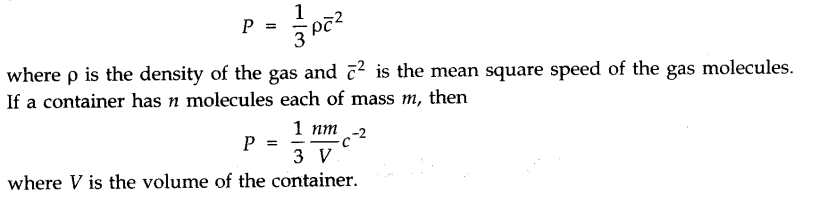
The pressure of a gas is the result of continuous bombardment of the gas molecules against the walls of the container. According to the kinetic theory, the pressure P exerted by an ideal gas is given by
• Boyle’s Law
According to this law, the volume (V) of a fixed mass of a gas is inversely proportional to the pressure (P) of the gas, provided temperature of the gas is kept constant.

• Charle’s Law
According to this law, the volume (V) of a given mass of a gas is directly proportional to the
temperature of the gas, provided pressure of the gas remains constant.

• Gay Lussac’s Law (or Pressure Law)
According to this law, the pressure P of a given mass of a gas is directly proportional to its absolute temperature T, provided the volume V of the gas remains constant.

• Equation of State of an Ideal Gas
The relationship between pressure P, volume V and absolute temperature T of a gas is called its equation of state. The equation of state of an ideal gas
PV = nRT
where n is the number of moles of the enclosed gas and R is the molar gas constant which is the same for all gases and its value is
R = 8.315 JK-1 mob-1
• Avagadro’s Law
Equal volumes of all gases under S.T.P. contain the same number of molecules equalling 6.023 x 10²³.
• Graham’s Law of Diffusion of Gases
It states that rate of diffusion of a gas is inversely proportional to the square root of the density of the gas.

Hence, denser the gas, the slower is the rate of diffusion.
• Dalton’s Law of Partial Pressures
According to this law, the resultant pressure exerted by a mixture of non-interacting gases is equal
to the sum of their individual pressures.
i-e., P = P1 + P2 + ————-Pn
• Mean (or average) speed of molecules of a gas is defined as the arithmetic mean of the speeds of gas molecules.

• Root mean square speed of gas molecules is defined as the square root of the mean of the squares of the speeds of gas molecules.

• Most probable speed of gas molecules is defined as the speed which is possessed by maximum number of molecules in a gas

• Kinetic Interpretation of Temperature
The total average kinetic energy of all the molecules of a gas is proportional to its absolute temperature (T). Thus, the temperature of a gas is a measure of the average kinetic energy ‘IT of the molecules of the gas.
U = 3/2 RT
According to this interpretation of temperature, the average kinetic energy U is zero at T = 0, i.e., the motion of molecules ceases altogether at absolute zero.
• Degrees of Freedom
The total number of independent co-ordinates required to specify the position of a molecule or the number of independent modes of motion possible with any molecule is called degree of freedom.
Mono-, di-, and polyatomic (N) molecules have, 3,5 or (3 N-K) number of degrees of freedom where K is the number of constraints [restrictions associated with the structure].
• Law of Equipartition of Energy
For a dynamic system in thermal equilibrium, the energy of the system is equally distributed amongst the various degrees of freedom and the energy associated with each degree of freedom per molecule is 1/2 kT, where k is Boltzman constant.
• Mean Free Path
Mean free path of a molecule in a gas is the average distance travelled by the molecule between two successive collisions
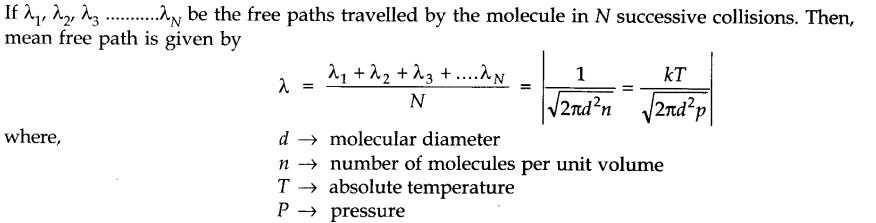
(i) Smaller the number of molecules per unit volume of the gas, larger is the mean free path.
(ii) Smaller the diameter, larger is the mean free path.
(iii) Smaller the density, larger is the mean free path. In the case of vacuum, ρ = 0, λ —>∞
(iv) Smaller the pressure of a gas, larger is the mean free path.
(v) Higher the temperature of a gas, larger is the mean free path.
• IMPORTANT TABLES