
eVidyarthi
Menu
  • School
    • Close
    • CBSE English Medium
    • CBSE Hindi Medium
    • UP Board
    • Bihar Board
    • Maharashtra Board
    • MP Board
    • Close
  • English
    • Close
    • English Grammar for School
    • Basic English Grammar
    • Basic English Speaking
    • English Vocabulary
    • English Idioms & Phrases
    • Personality Enhancement
    • Interview Skills
    • Close
  • Sarkari Exam Preparation
    • Close
    • All Govt Exams Preparation
    • State Wise Competitive Exam Preparation
    • India – Notes for All Competitive Exams
    • MCQs & Notes for Competitive Exams
    • NCERT Syllabus for Competitive Exam
    • Close
  • Study Abroad
    • Close
    • Study in Australia
    • Study in Canada
    • Study in UK
    • Study in Germany
    • Study in USA
    • Close
  • Current Affairs
    • Close
    • Current Affairs
    • Current Affairs Quizzes
    • State Wise Current Affairs
    • Monthly Current Affairs
    • Close
Science Class 10 Maharashtra Board | Menu
  • MCQ Science Class 10 Maharashtra Board
  • Book Science Class 10 Maharashtra Board
  • Question Answers Science Class 10 Maharashtra Board
  • Notes Science Class 10 Maharashtra Board
  • Important Questions Science Class 10 Maharashtra Board
  • Science Class 10

Science and Technology Part I Notes Chapter 1 Class 10 Maharashtra Board

Notes For All Chapters – Science & Technology Part I Class 10

Gravitation


1. Introduction to Gravitation

Definition: Gravitation is a universal force that acts between all objects in the universe, attracting them towards each other.

Discovery: Sir Isaac Newton discovered gravitation by observing an apple falling vertically downward, leading him to conclude that the Earth attracts objects towards its center.

2. Key Concepts

Gravitational Force

Acts between any two objects, e.g., Earth and an apple, or Earth and the Moon.

Directed towards the center of the Earth for objects on or near its surface.

Extends to greater distances, affecting objects like the Moon, planets, and the Sun.

Force and Motion

A force is required to change the speed or direction of an object’s motion.

Newton’s Laws of Motion:

First Law: An object remains at rest or in uniform motion unless acted upon by a force.

Second Law: Force = mass × acceleration (F = ma).

Third Law: For every action, there is an equal and opposite reaction.

3. Circular Motion and Centripetal Force

Centripetal Force: A force that acts on an object moving in a circular path, directed towards the center of the circle.

Example: A stone tied to a string moving in a circle experiences centripetal force towards the center. If the string is released, the stone moves tangentially due to its velocity.

Application: The Moon orbits the Earth due to the Earth’s gravitational force acting as the centripetal force. Similarly, planets orbit the Sun.

4. Kepler’s Laws of Planetary Motion

First Law: Planets move in elliptical orbits with the Sun at one focus.

Second Law: The line joining a planet and the Sun sweeps equal areas in equal intervals of time.

Third Law: The square of a planet’s period of revolution (T²) is proportional to the cube of its mean distance from the Sun (r³), i.e., T² ∝ r³ or T²/r³ = constant.

5. Newton’s Universal Law of Gravitation

Every object in the universe attracts every other object with a force proportional to the product of their masses and inversely proportional to the square of the distance between their centers.

Formula: F = G (m₁m₂ / d²)

F = gravitational force

m₁, m₂ = masses of the two objects

d = distance between their centers

G = Universal Gravitational Constant (6.673 × 10⁻¹¹ N m² kg⁻²)

Implications:

Doubling the mass of one object doubles the force.

Doubling the distance reduces the force to one-fourth.

For non-spherical objects, the force acts between their centers of mass.

6. Acceleration Due to Gravity (g)

Definition: The acceleration produced in an object due to the Earth’s gravitational force, directed towards the Earth’s center.

Formula: g = GM / R²

G = Universal Gravitational Constant

M = Mass of the Earth (6 × 10²⁴ kg)

R = Radius of the Earth (6.4 × 10⁶ m)

Value of g on Earth’s surface ≈ 9.77 m/s² (approximately 9.8 m/s²).

Variation of g:

On Earth’s Surface: Varies slightly due to Earth’s non-spherical shape. Highest at poles (9.832 m/s²), lowest at equator (9.78 m/s²).

With Height: g decreases as height increases (r increases in g = GM/r²).

With Depth: g decreases as the effective mass of Earth contributing to gravity reduces.

At Earth’s Center: g = 0, as gravitational forces cancel out.

On Other Planets: g varies with the planet’s mass and radius (e.g., on the Moon, g ≈ 1/6th of Earth’s g).

7. Mass and Weight

Mass: Amount of matter in an object, measured in kg, a scalar quantity, constant everywhere.

Weight: Force with which the Earth attracts an object, W = mg, measured in Newtons, a vector quantity, varies with g.

Example: A 75 kg person weighs 735 N on Earth (g = 9.8 m/s²) but only 122.5 N on the Moon (g ≈ 1.63 m/s²).

8. Free Fall

Definition: Motion of an object under the influence of gravity alone, with initial velocity u = 0 and acceleration a = g.

Equations of Motion for Free Fall:

v = gt

s = (1/2)gt²

v² = 2gs

For objects thrown upwards, acceleration is –g (opposite to velocity).

Example: Galileo’s experiment showed that objects of different masses fall at the same rate in a vacuum, as g is independent of mass.

9. Gravitational Potential Energy

Definition: Energy stored in an object due to its position in a gravitational field.

Formula: PE = –GMm / (R + h) (negative because PE is zero at infinite distance).

For small heights (h << R), PE ≈ mgh, assuming g is constant.

10. Escape Velocity

Definition: The minimum velocity required for an object to escape Earth’s gravitational pull and reach infinite distance.

Formula: v_esc = √(2GM/R) = √(2gR)

On Earth: v_esc ≈ 11.2 km/s

On Moon: v_esc ≈ 2.37 km/s (due to lower mass and radius).

Conservation of Energy: Total energy (kinetic + potential) at the surface equals zero at infinite distance.

11. Weightlessness in Space

Objects and astronauts in orbiting spacecraft appear weightless because they are in free fall, moving with the same velocity as the spacecraft under Earth’s gravity.

12. Gravitational Waves

Predicted by Einstein in 1916, these are waves in the fabric of space-time caused by massive accelerating objects.

Detected in 2016 by LIGO, providing new insights into the universe.
Notes Science and Technology Class 10 Maharashtra Board Marathi Medium

Science and Technology Part I Class 10 Maharashtra Board

Science and Technology Part II Class 10 Maharashtra Board

Notes Science and Technology Part – I Class 10 Maharashtra Board

Chapter 1: Gravitation

Chapter 2: Periodic Classification of Element

Chapter 3: Chemical reactions and equations

Chapter 4: Effects of electric current

Chapter 5: Heat

Chapter 6: Refraction of light

Chapter 7: Lenses

Chapter 8: Metallurgy

Chapter 9: Carbon compounds

Chapter 10: Space Missions

Science and Technology Part – I Important Questions Chapter 10 Class 10 Maharashtra Board

Space Missions


Short Questions


1. What is an artificial satellite?

Answer : An artificial satellite is a man-made object that revolves around the Earth or another planet in a fixed orbit.

2. Who was the first person to orbit the Earth?

Answer : Yuri Gagarin of the USSR orbited the Earth in 1961.

3. What was the first artificial satellite launched into space?

Answer : Sputnik was the first artificial satellite, launched by the Soviet Union in 1957.

4. What powers most artificial satellites?

Answer : Most artificial satellites are powered by solar energy using photovoltaic panels.

5. What is the purpose of geosynchronous satellites?

Answer : Geosynchronous satellites are used for communication, meteorology, and broadcasting as they appear stationary relative to Earth.

6. What is the escape velocity of Earth?

Answer : The escape velocity of Earth is 11.2 km/s.

7. What is a polar orbit?

Answer : A polar orbit is an elliptical medium Earth orbit passing over the polar regions, used for studying these areas.

8. What is the function of the INSAT satellite series?

Answer : INSAT satellites support telecommunication, television broadcasting, and meteorological services in India.

9. What is the critical velocity of a satellite?

Answer : Critical velocity is the tangential velocity required for a satellite to maintain a stable orbit around Earth.

10. What is the primary fuel source for satellite launch vehicles?

Answer : Satellite launch vehicles use specific fuels that combust to produce thrust, propelling the vehicle into space.

11. What is the role of ISRO in India’s space program?

Answer : ISRO develops and launches satellites and launch vehicles, contributing to India’s space research and applications.

12. What was the significant discovery of Chandrayaan-1?

Answer : Chandrayaan-1 discovered the presence of water on the Moon’s surface.

13. What is space debris?

Answer : Space debris includes non-functional satellites, launcher parts, and collision fragments orbiting Earth.

14. What is the purpose of the IRNSS satellite series?

Answer : IRNSS provides precise location data for navigation, determining latitude and longitude across India.

15. Why are multi-stage launch vehicles used?

Answer : Multi-stage launch vehicles reduce weight during flight by detaching empty fuel tanks, increasing efficiency.


Long Questions


1. Explain the importance of space missions in modern society.

Answer : Space missions enable global communication, internet access, and real-time weather forecasting, connecting the world. They provide critical data for disaster management, resource exploration, and national security through surveillance. Satellites facilitate education, navigation, and scientific research, driving national development.

2. Describe the classification of artificial satellites based on their functions.

Answer : Artificial satellites are classified into communication (e.g., INSAT), navigation (e.g., IRNSS), remote sensing (e.g., IRS), and weather satellites. Communication satellites handle telecom and broadcasting, while navigation satellites provide location services. Remote sensing and weather satellites monitor Earth’s resources, climate, and natural phenomena.

3. How are the orbits of artificial satellites classified based on height?

Answer : Satellite orbits are classified as Low Earth Orbits (180-2000 km), Medium Earth Orbits (2000-35780 km), and High Earth Orbits (>35780 km). Low Earth Orbits host scientific satellites, Medium Earth Orbits include polar and navigation satellites, and High Earth Orbits house geosynchronous satellites. The orbit height determines the satellite’s function and revolution time.

4. Why are geosynchronous satellites significant, and what are their limitations?

Answer : Geosynchronous satellites, at 35780 km, appear stationary, enabling continuous monitoring for communication and meteorology. They are ideal for equatorial regions but cannot effectively observe polar regions due to their fixed position over the equator. Polar orbits are used instead for polar studies.

5. Explain the working principle of satellite launch vehicles.

Answer : Satellite launch vehicles operate on Newton’s third law, where combustion gases are expelled to generate thrust. Multi-stage vehicles discard empty fuel tanks to reduce weight, improving efficiency. Fuels and engines are tailored to the satellite’s weight and target orbit.

6. Describe the structure and advantages of a multi-stage launch vehicle like PSLV.

Answer : PSLV has multiple stages, each with solid or liquid fuel, e.g., solid fuel in the first stage and liquid in the second. After each stage’s fuel is exhausted, it detaches, reducing the vehicle’s weight for higher speed. This design allows heavier satellites to reach precise orbits economically.

7. What are the challenges posed by space debris, and why is its management crucial?

Answer : Space debris, including defunct satellites and collision fragments, can damage operational satellites and spacecraft. With over 2 crore pieces larger than 1 cm, it threatens future missions. Effective management is essential to ensure safe satellite launches and space exploration.

8. Discuss the significance of India’s Chandrayaan-1 and Mangalyaan missions.

Answer : Chandrayaan-1, launched in 2008, confirmed water on the Moon, a global first, enhancing lunar research. Mangalyaan, orbiting Mars since 2014, provided valuable data on Mars’ surface and atmosphere. Both missions highlight ISRO’s cost-effective innovation in space exploration.

9. How does the critical velocity of a satellite depend on its orbital height?

Answer : Critical velocity (v_c = √(GM/(R+h))) decreases as the orbital height (h) increases, as per the formula. At higher altitudes, the gravitational pull weakens, requiring less speed to maintain orbit. This velocity ensures the satellite balances centripetal and gravitational forces.

10. Explain the contributions of Vikram Sarabhai to India’s space program.

Answer : Vikram Sarabhai founded the Physical Research Laboratory and led the establishment of ISRO. He initiated India’s first satellite, Aryabhatta, and set up the Thumba launch center. His vision drove India’s advancements in satellite technology and space research.

Science and Technology Part – I Important Questions Chapter 9 Class 10 Maharashtra Board

Carbon compounds


Short Questions


1. What are organic compounds?

Answer : Organic compounds are carbon-containing compounds, excluding CO₂, CO, carbides, carbonates, and bicarbonates.

2. Why are carbon compounds called covalent compounds?

Answer : Carbon compounds form covalent bonds by sharing electrons, not ionic bonds.

3. What is a covalent bond?

Answer : A covalent bond is formed by sharing valence electrons between two atoms.

4. What is catenation?

Answer : Catenation is carbon’s ability to form strong covalent bonds with other carbon atoms, creating large molecules.

5. What are hydrocarbons?

Answer : Hydrocarbons are organic compounds containing only carbon and hydrogen atoms.

6. What are saturated hydrocarbons?

Answer : Saturated hydrocarbons (alkanes) have only single bonds between carbon atoms.

7. What are unsaturated hydrocarbons?

Answer : Unsaturated hydrocarbons (alkenes and alkynes) have double or triple bonds between carbon atoms.

8. What is structural isomerism?

Answer : Structural isomerism is when compounds with the same molecular formula have different structural arrangements.

9. What is a functional group?

Answer : A functional group is a group of atoms that determines the chemical properties of a carbon compound.

10. What is a homologous series?

Answer : A homologous series is a group of compounds with the same functional group and increasing carbon chain length.

11. What is the general formula for alkanes?

Answer : The general formula for alkanes is CₙH₂ₙ₊₂.

12. What is the general formula for alkenes?

Answer : The general formula for alkenes is CₙH₂ₙ.

13. What is the IUPAC nomenclature system?

Answer : IUPAC nomenclature is a standardized system for naming carbon compounds based on their structure.

14. What is combustion in carbon compounds?

Answer : Combustion is the reaction of carbon compounds with oxygen, producing CO₂, H₂O, heat, and light.

15. What is an addition reaction?

Answer : An addition reaction occurs when an unsaturated compound adds atoms to form a saturated compound.

16. What is a substitution reaction?

Answer : A substitution reaction replaces one atom or group in a molecule with another, typically in alkanes.

17. What is ethanol commonly known as?

Answer : Ethanol is commonly known as alcohol or spirit.

18. What is glacial acetic acid?

Answer : Glacial acetic acid is pure ethanoic acid, which freezes at 17°C, resembling ice.

19. What is a polymer?

Answer : A polymer is a macromolecule formed by the repetition of small units called monomers.

20. What is saponification?

Answer : Saponification is the reaction of an ester with a base to form soap and alcohol.


Long Questions


1. Explain why carbon forms a large number of compounds.

Answer : Carbon’s tetravalency allows it to form four covalent bonds with various atoms, including itself. Its catenation ability enables the formation of long chains and rings, increasing compound diversity. Isomerism further multiplies the number of compounds with the same molecular formula.

2. Describe the covalent bond formation in carbon compounds with an example.

Answer : Carbon shares its four valence electrons to form covalent bonds, achieving a stable noble gas configuration. For example, in methane (CH₄), carbon shares one electron with each of four hydrogen atoms, forming four single covalent bonds. This sharing ensures no ions are formed, keeping the molecule neutral.

3. What is the difference between saturated and unsaturated hydrocarbons?

Answer : Saturated hydrocarbons (alkanes) have only single C-C bonds, making them less reactive, e.g., ethane (C₂H₆). Unsaturated hydrocarbons (alkenes and alkynes) contain double or triple bonds, increasing reactivity, e.g., ethene (C₂H₄). Unsaturated compounds undergo addition reactions, unlike saturated ones.

4. Explain the concept of structural isomerism with an example.

Answer : Structural isomerism occurs when compounds with the same molecular formula have different structural arrangements. For example, butane (C₄H₁₀) has two isomers: n-butane (straight chain) and isobutane (branched chain). These isomers differ in properties due to their distinct structures.

5. Describe the characteristics of a homologous series.

Answer : A homologous series has compounds with the same functional group and general formula, differing by a -CH₂- unit. Each member’s molecular mass increases by 14 u, and physical properties show gradation, e.g., boiling points rise in alkanes. Chemical properties remain similar due to the same functional group.

6. How is the IUPAC name of a carbon compound determined?

Answer : The IUPAC name consists of a prefix, parent, and suffix based on the compound’s structure. The parent is the longest carbon chain, with suffixes like -ene or -yne for double or triple bonds. Numbering ensures the functional group gets the lowest possible number, e.g., propan-2-ol.

7. Explain the combustion reaction of carbon compounds with examples.

Answer : Carbon compounds burn in oxygen to produce CO₂, H₂O, heat, and light, e.g., CH₄ + 2O₂ → CO₂ + 2H₂O. Saturated compounds like ethanol burn with a clean blue flame, while unsaturated ones like naphthalene produce sooty yellow flames. Combustion is exothermic, releasing energy.

8. Describe the oxidation reaction of ethanol and its significance.

Answer : Ethanol (CH₃CH₂OH) is oxidized by alkaline potassium permanganate to form ethanoic acid (CH₃COOH). The pink color of KMnO₄ disappears as it’s consumed, indicating oxidation completion. This reaction demonstrates the transformation of an alcohol’s functional group into a carboxylic acid.

9. What is an addition reaction, and how is it used to test unsaturation?

Answer : An addition reaction involves an unsaturated compound adding atoms across its multiple bond, forming a saturated product. For example, ethene reacts with bromine, decolorizing orange bromine water, confirming a double bond. This test distinguishes unsaturated oils from saturated Vanaspati ghee.

10. Explain the substitution reaction in alkanes with an example.

Answer : Substitution reactions replace hydrogen atoms in alkanes with other atoms, like chlorine, in sunlight. For example, methane (CH₄) reacts with Cl₂ to form chloromethane (CH₃Cl) and HCl: CH₄ + Cl₂ → CH₃Cl + HCl. Multiple substitutions can occur, producing compounds like CCl₄.

11. Describe the chemical properties of ethanol and their applications.

Answer : Ethanol reacts with sodium to form sodium ethoxide and hydrogen, indicating its acidic -OH group. It undergoes dehydration with concentrated H₂SO₄ at 170°C to form ethene, used in polymer synthesis. As a solvent, ethanol is used in medicines and tinctures due to its reactivity.

12. Explain the chemical properties of ethanoic acid and its uses.

Answer : Ethanoic acid reacts with bases like NaOH to form sodium ethanoate and water, and with carbonates to produce CO₂, e.g., 2CH₃COOH + Na₂CO₃ → 2CH₃COONa + H₂O + CO₂. It forms esters with alcohols, used in fragrances. Its 5-8% solution (vinegar) is a preservative.

13. What is esterification, and how is it reversed?

Answer : Esterification is the reaction of a carboxylic acid with an alcohol, forming an ester and water, e.g., CH₃COOH + C₂H₅OH → CH₃COOC₂H₅ + H₂O. Concentrated H₂SO₄ catalyzes this reaction. Saponification reverses it, using NaOH to regenerate the alcohol and sodium carboxylate.

14. What are polymers, and how are they formed?

Answer : Polymers are macromolecules formed by repeating monomer units through polymerization, e.g., polyethylene from ethylene. Natural polymers like starch consist of glucose monomers, while synthetic ones like nylon use multiple monomers. Catalysts and specific conditions facilitate the bonding of monomers into long chains.

15. Describe the significance of natural and man-made macromolecules.

Answer : Natural macromolecules like proteins, polysaccharides, and nucleic acids support life, forming body structures and controlling heredity. Man-made macromolecules, such as plastics and synthetic fibers, provide durable materials like polyethylene and nylon for various applications. Their polymeric nature allows tailored properties for specific uses, e.g., elastomers in tires.

Science and Technology Part – I Important Questions Chapter 8 Class 10 Maharashtra Board

Metallurgy


Short Questions


1. What is metallurgy?

Answer : Metallurgy is the science and technology of extracting metals from their ores and purifying them for use.

2. What are the physical states of metals at room temperature?

Answer : Most metals are solid, except mercury and gallium, which are liquid.

3. Which property allows metals to be drawn into wires?

Answer : Ductility allows metals to be drawn into wires.

4. What is the property of metals that produces a sound when struck?

Answer : Sonority is the property that produces a sound when metals are struck.

5. Which nonmetal is lustrous?

Answer : Iodine is a lustrous nonmetal.

6. Which nonmetal is the hardest natural substance?

Answer : Diamond, an allotrope of carbon, is the hardest natural substance.

7. What are electropositive elements?

Answer : Metals are electropositive elements as they lose electrons to form positively charged ions.

8. Which metals react with cold water to liberate hydrogen gas?

Answer : Sodium and potassium react with cold water to liberate hydrogen gas.

9. What is the reactivity series of metals?

Answer : It is the arrangement of metals in decreasing order of their reactivity.

10. Which metal is more reactive, iron or copper?

Answer : Iron is more reactive than copper, as it displaces copper from copper sulphate solution.

11. What are electronegative elements?

Answer : Nonmetals are electronegative elements as they gain electrons to form negatively charged ions.

12. What is an ionic compound?

Answer : An ionic compound is formed by the electrostatic attraction between cations and anions.

13. Why do ionic compounds have high melting points?

Answer : Strong electrostatic forces between ions require large energy to break, resulting in high melting points.

14. What are ores?

Answer : Ores are minerals from which metals can be extracted economically.

15. What is gangue?

Answer : Gangue is the impurities like soil, sand, and rocky substances present in ores.

16. What is the purpose of concentration of ores?

Answer : Concentration of ores separates gangue to increase the metal compound’s concentration.

17. Which method concentrates sulphide ores like zinc blende?

Answer : Froth floatation method concentrates sulphide ores like zinc blende.

18. What is roasting in metallurgy?

Answer : Roasting is heating sulphide ores in air to convert them into oxides.

19. What is corrosion?

Answer : Corrosion is the deterioration of metals due to reactions with environmental factors like moisture and oxygen.

20. What is galvanizing?

Answer : Galvanizing is coating iron or steel with a thin layer of zinc to prevent corrosion.


Long Questions


1. Explain the physical properties of metals with examples.

Answer : Metals are generally solid, lustrous, ductile, malleable, and good conductors of heat and electricity. For example, copper is ductile and used for wires, while tungsten has a high melting point (3422°C). Exceptions include soft alkali metals like sodium and liquid metals like mercury.

2. Describe the physical properties of nonmetals with exceptions.

Answer : Nonmetals are often gases or brittle solids, non-lustrous, and poor conductors of heat and electricity. Exceptions include iodine, which is lustrous, and diamond, which is extremely hard. Graphite, another carbon allotrope, is a good conductor of electricity.

3. How do metals react with oxygen, and what is the nature of the products?

Answer : Metals react with oxygen to form metal oxides, which are often basic. For example, sodium forms sodium oxide (Na₂O), which reacts with water to form alkali (NaOH). Magnesium forms magnesium oxide (MgO), which produces magnesium hydroxide with water.

4. Explain the reaction of metals with water, including variations in reactivity.

Answer : Highly reactive metals like sodium and potassium react vigorously with cold water, liberating hydrogen gas. Calcium reacts slowly with cold water, while metals like aluminium and iron react only with steam. Less reactive metals like gold and copper do not react with water.

5. What is the significance of the reactivity series in metallurgy?

Answer : The reactivity series ranks metals by their ability to displace others from salt solutions, guiding extraction methods. Highly reactive metals like sodium require electrolytic reduction, while less reactive ones like copper are extracted by heating. It helps predict reactions and choose suitable reducing agents.

6. Describe the formation and properties of ionic compounds.

Answer : Ionic compounds form when metals lose electrons to nonmetals, creating oppositely charged ions held by electrostatic forces. They are crystalline, hard, brittle, and have high melting points due to strong ionic bonds. They conduct electricity in molten or aqueous states as ions become mobile.

7. How is bauxite concentrated using Bayer’s process?

Answer : In Bayer’s process, bauxite is ground and heated with concentrated sodium hydroxide to form soluble sodium aluminate. Insoluble impurities like iron oxide are filtered out, and the solution is diluted to precipitate aluminium hydroxide. The precipitate is calcined at 1000°C to obtain pure alumina.

8. Explain the electrolytic reduction of alumina to extract aluminium.

Answer : Alumina is mixed with cryolite and fluorspar to lower its melting point and electrolyzed in a steel tank with a graphite cathode. Aluminium ions are reduced to molten aluminium at the cathode, while oxygen is liberated at the anode, forming carbon dioxide. The molten aluminium is collected from the tank’s bottom.

9. What is the froth floatation method, and how is it used in metallurgy?

Answer : Froth floatation separates sulphide ores by exploiting their hydrophobic properties, wetting them with oil while gangue is wetted by water. Air is blown through a mixture of ore, water, and oil, forming froth that carries sulphide particles to the surface. This method concentrates ores like zinc blende and copper pyrite.

10. How are moderately reactive metals extracted from their ores?

Answer : Moderately reactive metals like zinc and iron occur as sulphides or carbonates, which are converted to oxides by roasting or calcination. The oxides are then reduced using carbon or reactive metals like aluminium. For example, zinc oxide is reduced with carbon to produce zinc.

11. Describe the process of corrosion and its effects on iron and copper.

Answer : Corrosion is the reaction of metals with environmental factors, forming compounds like rust (Fe₂O₃·H₂O) on iron and copper carbonate (CuCO₃) on copper. Rusting weakens iron structures, causing financial loss, while copper’s green patina affects its appearance. Both reduce the metal’s durability and aesthetic value.

12. Explain methods to prevent corrosion of metals.

Answer : Corrosion is prevented by coating metals with paint, oil, or non-corrosive metals like zinc (galvanizing) or tin (tinning). Electroplating applies a less reactive metal layer, and alloying, like stainless steel, reduces corrosion intensity. Anodization forms a protective oxide layer on metals like aluminium.

Science and Technology Part – I Important Questions Chapter 7 Class 10 Maharashtra Board

Lenses


Short Questions


1. What is a lens?

Answer : A lens is a transparent medium bound by two surfaces, at least one of which is spherical.

2. What is a convex lens?

Answer : A convex lens is thicker at the center and converges light rays to a focal point.

3. What is a concave lens?

Answer : A concave lens is thinner at the center and diverges light rays.

4. What is the principal axis of a lens?

Answer : It is the imaginary line passing through the optical center and centers of curvature.

5. What is the optical center of a lens?

Answer : It is the point on the principal axis where light rays pass without deviation.

6. What is the principal focus of a convex lens?

Answer : It is the point where parallel rays converge after refraction through the lens.

7. What is the principal focus of a concave lens?

Answer : It is the point from which diverging rays appear to originate after refraction.

8. What is the focal length of a lens?

Answer : It is the distance between the optical center and the principal focus.

9. Why is a convex lens called a converging lens?

Answer : It converges parallel light rays to a point on the principal axis.

10. Why is a concave lens called a diverging lens?

Answer : It diverges parallel light rays, making them appear to come from a focal point.

11. What is the lens formula?

Answer : The lens formula is 1/v – 1/u = 1/f, relating object distance (u), image distance (v), and focal length (f).

12. What is the unit of power of a lens?

Answer : The unit of power of a lens is Dioptre (D).

13. How is the power of a lens calculated?

Answer : Power (P) is calculated as P = 1/f, where f is the focal length in meters.

14. What is the power of a lens combination?

Answer : The power of a lens combination is the sum of the powers of individual lenses (P = P1 + P2).

15. What is nearsightedness?

Answer : Nearsightedness (myopia) is a defect where distant objects appear blurry but nearby objects are clear.

16. What lens corrects nearsightedness?

Answer : A concave lens corrects nearsightedness by diverging light before it enters the eye.

17. What is farsightedness?

Answer : Farsightedness (hypermetropia) is a defect where nearby objects appear blurry but distant objects are clear.

18. What lens corrects farsightedness?

Answer : A convex lens corrects farsightedness by converging light before it enters the eye.

19. What is presbyopia?

Answer : Presbyopia is the age-related loss of the eye’s ability to focus on nearby objects.

20. What is persistence of vision?

Answer : It is the phenomenon where an image remains on the retina for 1/16th of a second after the object is removed.


Long Questions


1. Explain the difference between a convex lens and a concave lens in terms of their structure and function.

Answer : A convex lens is thicker at the center, converging light rays to form real or virtual images. A concave lens is thinner at the center, diverging light rays to form only virtual, erect, and smaller images. Their surfaces are parts of spheres, with convex lenses bulging outward and concave lenses curving inward.

2. Describe the Cartesian sign convention for lenses.

Answer : The optical center is the origin, with distances to the right and above the principal axis taken as positive. Distances to the left and below are negative, and the object is placed on the left. The focal length is positive for convex lenses and negative for concave lenses.

3. How does a convex lens form a real image when an object is placed beyond 2F1?

Answer : When an object is beyond 2F1, a convex lens forms a real, inverted, and diminished image between F2 and 2F2. A ray parallel to the principal axis passes through F2, and a ray through the optical center passes undeviated. These rays intersect to form the image, as shown in ray diagrams.

4. Why does a concave lens always form a virtual image?

Answer : A concave lens diverges light rays, making them appear to come from a focal point on the same side as the object. The rays never actually converge, so the image is virtual, erect, and smaller. This occurs regardless of the object’s position, as per the ray diagram rules.

5. How does the human eye adjust to see objects at different distances?

Answer : The eye’s lens changes shape via ciliary muscles to adjust its focal length, a process called accommodation. For distant objects, the lens flattens to increase focal length; for near objects, it rounds to decrease it. This ensures a sharp image forms on the retina.

6. Explain the cause and correction of nearsightedness (myopia).

Answer : Nearsightedness occurs when the eyeball is too long or the lens’s converging power is too high, forming images of distant objects in front of the retina. A concave lens diverges incoming light, allowing the eye’s lens to focus the image on the retina. The lens’s negative power is chosen based on the degree of myopia.

7. Explain the cause and correction of farsightedness (hypermetropia).

Answer : Farsightedness results from a shortened eyeball or reduced lens converging power, causing near object images to form behind the retina. A convex lens converges light before it enters the eye, enabling proper focus on the retina. The lens’s positive power depends on the extent of hypermetropia.

8. What is presbyopia, and how is it corrected?

Answer : Presbyopia is the age-related loss of lens elasticity, reducing the eye’s ability to focus on near objects. Bifocal lenses, with a concave upper part for distant vision and a convex lower part for near vision, correct it. This allows clear vision at varying distances.

9. How does a simple microscope work, and what is its use?

Answer : A simple microscope uses a convex lens with a short focal length to form a magnified, virtual, and erect image. When an object is placed within the focal length, the lens magnifies it, making it appear larger. It is used for tasks like watch repair and examining small objects.

10. Describe the working of a compound microscope.

Answer : A compound microscope uses two convex lenses: an objective with a short focal length and an eyepiece with a longer focal length. The objective forms a real, magnified image, which the eyepiece further magnifies into a virtual image. This allows high magnification for viewing minute objects like cells.

11. Explain the role of lenses in a refracting telescope.

Answer : A refracting telescope uses a large-diameter, long-focal-length objective lens to collect and focus light from distant objects, forming a real image. The eyepiece, with a shorter focal length, magnifies this image for viewing. The lenses’ alignment and adjustable distance enhance magnification and clarity.

12. What is persistence of vision, and how is it demonstrated in daily life?

Answer : Persistence of vision is the retina retaining an image for 1/16th of a second after the object is removed. This is seen when rotating a burning incense stick forms a continuous circle or when a spinning card with a bird and cage appears as one image. It underlies motion perception in films and animations.

Science and Technology Part – I Important Questions Chapter 6 Class 10 Maharashtra Board

Refraction of light


Short Questions


1. What is refraction of light?

Answer : Refraction is the bending of light when it passes from one transparent medium to another.

2. State the first law of refraction.

Answer : The incident ray, refracted ray, and normal at the point of incidence lie in the same plane.

3. What is the second law of refraction known as?

Answer : The second law of refraction is known as Snell’s law.

4. What is the refractive index of a medium?

Answer : It is the ratio of the speed of light in a vacuum to the speed of light in the medium.

5. What happens to light when it passes from a rarer to a denser medium?

Answer : Light bends towards the normal.

6. What happens to light when it passes from a denser to a rarer medium?

Answer : Light bends away from the normal.

7. What is the critical angle?

Answer : The angle of incidence for which the angle of refraction is 90°.

8. What is total internal reflection?

Answer : It occurs when light reflects entirely back into a denser medium at an angle greater than the critical angle.

9. What causes the twinkling of stars?

Answer : The twinkling of stars is due to the changing refractive index of atmospheric gases.

10. Why don’t planets twinkle?

Answer : Planets appear as a collection of point sources, so their average brightness remains constant.

11. What is dispersion of light?

Answer : Dispersion is the separation of light into its component colors while passing through a medium.

12. Which color of light bends the least in a prism?

Answer : Red light bends the least due to its longer wavelength.

13. Which color of light bends the most in a prism?

Answer : Violet light bends the most due to its shorter wavelength.

14. What is a mirage?

Answer : A mirage is an illusion of water caused by the refraction of light in varying air densities.

15. Why can we see the Sun slightly before sunrise?

Answer : Atmospheric refraction bends sunlight, making the Sun visible before it crosses the horizon.


Long Questions


1. Explain the phenomenon of refraction with an example from the given activities.

Answer : Refraction occurs when light changes direction while passing from one medium to another, like water to air. In Activity 1, a pencil in water appears thicker and bent due to refraction at the water-air interface. This happens because light slows down in water, bending towards the normal.

2. How do the laws of refraction apply to a light ray passing through a glass slab?

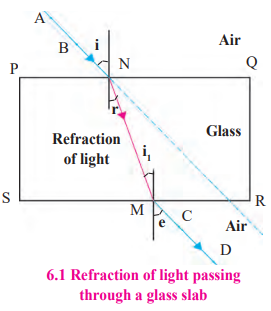
Answer : The first law states that the incident ray, refracted ray, and normal lie in the same plane. The second law (Snell’s law) states that the ratio of sine of the angle of incidence to sine of the angle of refraction is constant. In a glass slab, the emergent ray is parallel to the incident ray due to equal but opposite refractions at parallel surfaces.

3. What is the refractive index, and how is it related to the velocity of light?

Answer : The refractive index is the ratio of the speed of light in a vacuum to that in a medium. It is calculated as n = v1/v2, where v1 is the speed in the first medium and v2 in the second. A higher refractive index indicates slower light speed in that medium.

4. Why does a rainbow form, and what processes are involved?

Answer : A rainbow forms due to dispersion, refraction, and total internal reflection in water droplets. Sunlight refracts and disperses into colors inside a droplet, reflects internally, and refracts again while exiting. This creates a spectrum of colors visible as a rainbow.

5. Why do stars twinkle but planets do not?

Answer : Stars twinkle because their light, from a point source, bends due to changing atmospheric refractive indices. Planets, appearing as a collection of point sources, have their brightness averaged out, preventing twinkling. Atmospheric turbulence affects starlight more due to their greater distance.

6. What is total internal reflection, and how does it contribute to optical phenomena?

Answer : Total internal reflection occurs when light in a denser medium hits a rarer medium at an angle greater than the critical angle, reflecting entirely back. This is crucial in phenomena like rainbows, where light reflects inside water droplets. It’s also used in optical fibers for efficient light transmission.

7. How does atmospheric refraction affect the apparent position of stars?

Answer : Atmospheric refraction bends starlight towards the normal as it enters denser air layers. This makes stars appear higher in the sky than their actual position. The changing refractive index due to air movement causes the twinkling effect.

8. Explain how a mirage is formed with reference to atmospheric conditions.

Answer : A mirage forms when light from a distant object bends due to varying air density near a hot surface. Hot air near the ground is rarer, causing light to bend upward, creating an illusion of water. This is due to continuous refraction as light passes through layers of increasing refractive index.

9. How does dispersion of light occur in a prism, and what is the result?

Answer : Dispersion occurs when white light passes through a prism, and different colors bend at different angles due to varying refractive indices. Red light bends the least, and violet the most, creating a spectrum. This separation of colors is visible as a rainbow-like band.

10. How can you demonstrate refraction using a glass slab as described in Activity 3?

Answer : In Activity 3, a light ray passing through a glass slab refracts at the air-glass interface, bending towards the normal. It refracts again at the glass-air interface, bending away, resulting in a parallel emergent ray. The activity shows the ray’s displacement and confirms the laws of refraction.

Science and Technology Part – I Important Questions Chapter 5 Class 10 Maharashtra Board

Heat


Short Questions


1. Why does the temperature remain constant during the melting of ice despite heat input?

Answer : Heat is absorbed as latent heat of fusion to break molecular bonds without increasing kinetic energy.

2. How does pressure affect the melting point of ice in regelation?

Answer : Increased pressure lowers the melting point, causing ice to melt at a temperature below 0°C.

3. What is the significance of water’s maximum density at 4°C?

Answer : It ensures denser water sinks, preserving aquatic life by maintaining liquid water under ice.

4. How does the latent heat of vaporization differ from sensible heat?

Answer : Latent heat changes phase at constant temperature, while sensible heat changes temperature without phase change.

5. Why does regelation allow ice to reform after a wire passes through it?

Answer : Water refreezes when pressure is removed, restoring the melting point to 0°C.

6. What happens to water’s density when cooled from 10°C to 0°C?

Answer : Density increases from 10°C to 4°C, then decreases as water expands below 4°C.

7. How does Hope’s apparatus confirm water’s anomalous behavior?

Answer : It shows water at 4°C sinks due to maximum density, with colder water rising above it.

8. Why does air at 20°C hold less water vapor than at 40°C before saturation?

Answer : Warmer air has a higher capacity to hold water vapor before reaching saturation.

9. What indicates that air has reached its dew point?

Answer : Condensation begins as the air becomes saturated with water vapor, forming droplets.

10. How is relative humidity related to absolute humidity?

Answer : Relative humidity is the ratio of actual vapor mass (absolute humidity) to the saturation vapor mass.

11. Why do rocks crack in cold regions due to water’s properties?

Answer : Water’s anomalous expansion below 4°C exerts pressure when freezing, cracking rocks.

12. What role does latent heat play in the formation of dew?

Answer : Latent heat is released when water vapor condenses into droplets at the dew point.

13. Why is the calorie defined for a specific temperature range (14.5°C to 15.5°C)?

Answer : Water’s specific heat varies slightly with temperature, requiring a standard range for consistency.

14. How does specific heat capacity affect thermal equilibrium in a calorimeter?

Answer : It determines the heat absorbed or released to reach a common temperature during exchange.

15. Why does iron penetrate deeper into wax than lead in the specific heat experiment?

Answer : Iron’s lower specific heat allows it to absorb more heat, melting more wax.

16. What is the effect of high relative humidity on cloud formation in airplane trails?

Answer : High relative humidity slows the dissipation of condensed vapor trails, forming persistent clouds.

17. How does the principle of heat exchange ensure no net energy loss?

Answer : Heat lost by a hot object equals heat gained by a cold object in an isolated system.

18. Why is the specific heat of water higher than that of metals like copper?

Answer : Water’s hydrogen bonds require more energy to increase molecular motion compared to metals.

19. What happens to latent heat during the condensation of steam?

Answer : Latent heat of vaporization is released as steam condenses into water at 100°C.

20. How does the anomalous behavior of water prevent pipes from bursting in some cases?

Answer : Water’s contraction from 0°C to 4°C reduces volume, delaying freezing and pressure buildup.


Long Questions


1. Explain the concept of latent heat during the transformation of ice to water.

Answer : Latent heat of fusion is absorbed by ice at 0°C to weaken molecular bonds, converting it to water without raising temperature. This heat, typically 80 cal/g for ice, is used to change the phase from solid to liquid. The temperature remains constant until all ice melts, as shown in the temperature vs. time graph.

2. How does regelation allow a wire to pass through an ice slab without breaking it?

Answer : Pressure from the wire lowers the melting point of ice, causing it to melt into water beneath the wire. Once the wire passes, the pressure is removed, and the water refreezes, reforming ice. This process, called regelation, keeps the ice slab intact as the wire moves through.

3. Why does water exhibit anomalous behavior between 0°C and 4°C, and what is its significance?

Answer : Unlike most liquids, water contracts when heated from 0°C to 4°C, reaching maximum density at 4°C. Beyond 4°C, it expands, reducing density, due to changes in hydrogen bonding. This behavior preserves aquatic life in cold climates by keeping denser 4°C water at the bottom of lakes.

4. How does Hope’s apparatus demonstrate the anomalous behavior of water?

Answer : Hope’s apparatus shows water at the bottom (T1) cools faster to 4°C, then remains stable as denser water sinks. The upper water (T2) cools to 0°C first due to less dense water rising below 4°C. The intersection of T1 and T2 curves at 4°C indicates maximum density.

5. Explain how relative humidity is determined and its relation to dew point.

Answer : Relative humidity is the ratio of actual water vapor mass to the mass needed for saturation at a given temperature, expressed as a percentage. At the dew point, air is saturated, and relative humidity reaches 100%. Higher relative humidity indicates air is closer to saturation, affecting weather perception.

6. Why do water droplets form on a cold bottle taken out of a refrigerator?

Answer : The cold bottle’s surface cools surrounding air to its dew point, causing water vapor to condense into droplets. This mirrors dew formation, where cool surfaces at night reach the dew point of atmospheric air. It demonstrates the presence of water vapor in the air.

7. How does the principle of heat exchange apply in a calorimeter to measure specific heat?

Answer : In a calorimeter, heat lost by a hot object equals heat gained by water and the calorimeter until thermal equilibrium is reached. Using Q = m × c × ΔT, the specific heat of the object is calculated from known masses and temperatures. This ensures no heat is lost to the environment in an isolated system.

8. Why does aquatic life survive in cold regions despite freezing temperatures?

Answer : Due to water’s anomalous behavior, 4°C water, being densest, sinks, forming a layer above which ice forms at 0°C. Ice, less dense, floats and insulates the water below, maintaining a stable 4°C environment. This allows aquatic organisms to survive in liquid water beneath the ice.

9. Calculate the heat required to convert 1 kg of ice at 0°C to water at 20°C, and explain the process.

Answer : Heat for melting ice: Q1 = 1 × 80 = 80 kcal; heat to raise water temperature: Q2 = 1 × 1 × 20 = 20 kcal; total Q = 100 kcal. Latent heat of fusion is absorbed at 0°C to change phase, then sensible heat increases temperature. This reflects the energy needed for phase and temperature changes.

10. How does specific heat capacity affect the heating of different substances, and why is it significant?

Answer : Specific heat capacity determines how much heat a substance absorbs to raise its temperature, varying across materials (e.g., iron vs. copper). Higher specific heat, like water’s 1 cal/g°C, means more heat is needed, affecting thermal regulation. This property is critical in applications like cooling systems and climate moderation.

Science and Technology Part – I Important Questions Chapter 4 Class 10 Maharashtra Board

Effects of electric current


Short Questions


1. What determines if a material is a good conductor of electricity?

Answer : A material with low resistance, allowing easy flow of electrons, is a good conductor.

2. Why don’t we get an electric shock from a piece of iron on the ground?

Answer : It’s not connected to a live circuit, so no current flows through it.

3. What is the source of energy in an electric circuit with a resistor?

Answer : The electric cell provides the energy to drive the current through the resistor.

4. How is electrical power defined in a circuit?

Answer : Electrical power is the rate of energy transfer, given by P = V × I (volt × ampere).

5. What is Joule’s law of heating?

Answer : Heat produced in a resistor is H = I² × R × t, where I is current, R is resistance, and t is time.

6. Why is nichrome used in electric heaters?

Answer : Nichrome has high resistivity and can withstand high temperatures without melting.

7. What unit is used for electrical energy consumption in households?

Answer : Kilowatt-hour (kWh), where 1 kWh = 3.6 × 10⁶ J.

8. What causes a short circuit in a home electrical system?

Answer : Contact between live and neutral wires due to faulty insulation causes excessive current flow.

9. What is the function of a fuse wire in a circuit?

Answer : It melts at high current to break the circuit, preventing fire or damage.

10. What produces a magnetic field around a current-carrying wire?

Answer : The flow of electric current generates a magnetic field, as discovered by Oersted.

11. What does the right-hand thumb rule predict?

Answer : It determines the direction of magnetic field lines around a current-carrying conductor.

12. How does the magnetic field vary with distance from a current-carrying wire?

Answer : The magnetic field strength decreases as distance from the wire increases.

13. What is a solenoid, and how does it behave magnetically?

Answer : A solenoid is a coil of wire that acts like a bar magnet when current flows through it.

14. What does Fleming’s left-hand rule describe?

Answer : It relates the directions of current, magnetic field, and force on a conductor in a motor.

15. What is the principle behind an electric motor?

Answer : It converts electrical energy to mechanical energy via force on a current-carrying conductor in a magnetic field.

16. What is electromagnetic induction, as discovered by Faraday?

Answer : It is the production of current in a conductor due to a changing magnetic field.

17. When is the induced current maximum in a conductor?

Answer : When the conductor’s motion is perpendicular to the magnetic field.

18. What does Fleming’s right-hand rule indicate?

Answer : It shows the direction of induced current relative to the magnetic field and conductor motion.

19. How does an AC generator differ from a DC generator?

Answer : An AC generator produces alternating current, while a DC generator produces direct current.

20. What is the frequency of AC power supply in India?

Answer : The frequency of alternating current in India is 60 Hz.


Long Questions


1. Explain how energy is transferred in an electric circuit with a resistor.

Answer : The cell converts chemical energy into electrical energy, driving charge Q through the resistor. The work done, VQ, is converted to heat energy in the resistor, following H = I²Rt. This heat increases the resistor’s temperature, as per Joule’s law.

2. Why does a short circuit lead to fire hazards, and how is it prevented?

Answer : A short circuit occurs when live and neutral wires touch, causing a large current to flow. This generates excessive heat, igniting nearby flammable materials like wood or plastic. Fuse wires or MCBs melt or trip to break the circuit, preventing fires.

3. How does the heating effect of electric current power household appliances?

Answer : Current through high-resistivity materials like nichrome or tungsten produces heat (H = I²Rt). In appliances like heaters, this heat is used for cooking or warming; in bulbs, it causes light emission. The choice of material ensures high heat output without melting.

4. Describe the magnetic field produced by a current-carrying straight conductor.

Answer : A straight conductor carrying current produces a magnetic field in concentric circles around it. The field’s direction is given by the right-hand thumb rule, with the thumb pointing along the current. Field strength decreases with distance and increases with current.

5. How does a solenoid’s magnetic field resemble that of a bar magnet?

Answer : A solenoid’s magnetic field has parallel lines inside, with one end as a north pole and the other as a south pole, like a bar magnet. The field is uniform inside the solenoid, unlike the curved external field of a bar magnet. The right-hand rule determines pole orientation.

6. Explain the force on a current-carrying conductor in a magnetic field.

Answer : A conductor in a magnetic field experiences a force perpendicular to both the current and field directions, per Fleming’s left-hand rule. The force is maximum when the current is perpendicular to the field, causing motion in devices like motors. Reversing current or field direction reverses the force.

7. Describe the working principle of an electric motor with a diagram.

Answer : A rectangular coil in a magnetic field rotates due to forces on opposite sides, per Fleming’s left-hand rule. Split rings reverse current every half-turn, ensuring continuous anticlockwise rotation. This converts electrical energy into mechanical energy for applications like fans.

8. How does electromagnetic induction produce current in a conductor?

Answer : A changing magnetic field, caused by moving a magnet or altering current in a nearby coil, induces current in a conductor. Faraday’s law states this occurs when magnetic flux through the coil changes. The induced current’s direction follows Fleming’s right-hand rule.

9. Why is alternating current (AC) preferred for long-distance power transmission?

Answer : AC can be stepped up to high voltages, reducing current and minimizing power loss (I²R) in wires. It can be easily transformed to lower voltages for household use. This efficiency makes AC more practical than DC for long-distance transmission.

10. Explain the construction and working of an AC generator.

Answer :  A coil rotates in a magnetic field, inducing current via electromagnetic induction, with ends connected to slip rings. As the coil rotates, the magnetic flux changes, producing alternating current, per Fleming’s right-hand rule. Slip rings ensure continuous AC output to external circuits.

11. How does a DC generator differ from an AC generator in construction and output?

Answer :  A DC generator uses a split ring (commutator) instead of slip rings, ensuring current flows in one direction externally. The coil’s rotation in a magnetic field induces current, but the commutator reverses connections every half-turn. This produces direct current, unlike the oscillatory AC output.

12. Calculate the resistance of a circuit producing 100 W with a 3 A current, and explain its significance.

Answer : Using P = I²R, R = P/I² = 100/(3²) = 100/9 ≈ 11 Ω. This resistance determines the heat generated in the circuit, critical for appliance design. Higher resistance increases heat output, as per Joule’s law, affecting efficiency and safety.

Ads

HSC आणि SSC महाराष्ट्र – मराठी माध्यम – महाराष्ट्र बोर्ड

📘 महाराष्ट्र बोर्ड परीक्षा साहित्य (मराठी माध्यम)

  • HSC आणि SSC प्रश्नसंच – मराठी माध्यमातील PDF
  • महाराष्ट्र बोर्ड नमुना प्रश्नपत्रिका व मॉडेल पेपर्स (मराठी माध्यमात)
  • SSC आणि HSC च्या मागील वर्षांच्या प्रश्नपत्रिका – मराठी माध्यम
  • SSC/HSC साठी मराठी माध्यमातील नोट्स आणि सराव चाचण्या (मॉक टेस्ट)
  • मराठी माध्यमातील MCQs (बहुपर्यायी प्रश्न) समाविष्ट
  • सर्व परीक्षा साहित्य मराठी माध्यमात उपलब्ध

📗 महाराष्ट्र बोर्ड पाठ्यपुस्तके व PDF (मराठी माध्यम)

  • इयत्ता 10 वी (SSC) चे पाठ्यपुस्तक PDF – मराठी माध्यमात
  • इयत्ता 12 वी (HSC) चे पाठ्यपुस्तक PDF – मराठी माध्यमात
  • मराठी डायजेस्ट – PDF डाउनलोड
  • SSC आणि HSC इयत्तांची पुस्तके – मराठी माध्यमातील PDF
  • डाउनलोडसाठी उपलब्ध पाठ्यपुस्तके व PDF – महाराष्ट्र बोर्ड

📒 महाराष्ट्र बोर्डासाठी मराठी अभ्यास साहित्य

  • प्रकरणनिहाय नोट्स – मराठी माध्यमात
  • प्रकरणनिहाय प्रश्नोत्तरे (प्रश्न व उत्तरे) – मराठी माध्यमात
  • SSC आणि HSC साठी महत्त्वाचे प्रश्न – मराठी माध्यम
  • महत्त्वाच्या सूत्रांचा सारांश (इयत्ता 6 वी ते 12 वी)
  • MCQs, प्रश्नसंच, नमुना प्रश्नपत्रिका आणि मागील वर्षांच्या प्रश्नपत्रिका

CBSE Board Englsih and हिंदी माध्यम

CBSE Board

Mathematics Class 6
Science Class 6
Social Science Class 6
हिन्दी Class 6
सामाजिक विज्ञान कक्षा 6
विज्ञान कक्षा 6

Mathematics Class 7
Science Class 7
SST Class 7
सामाजिक विज्ञान कक्षा 7
हिन्दी Class 7

Mathematics Class 8
Science Class 8
Social Science Class 8
हिन्दी Class 8

Mathematics Class 9
Science Class 9
English Class 9

Mathematics Class 10
SST Class 10
English Class 10

Mathematics Class XI
Chemistry Class XI
Accountancy Class 11

Accountancy Class 12
Mathematics Class 12

Learn English
English Through हिन्दी
Job Interview Skills
English Grammar
हिंदी व्याकरण - Vyakaran
Microsoft Word
Adobe PhotoShop
Adobe Illustrator
Learn German
Learn French
IIT JEE
Privacy Policies, Terms and Conditions, About Us, Contact Us
Copyright © 2026 eVidyarthi and its licensors. All Rights Reserved.