
eVidyarthi
Menu
  • School
    • Close
    • CBSE English Medium
    • CBSE Hindi Medium
    • UP Board
    • Bihar Board
    • Maharashtra Board
    • MP Board
    • Close
  • English
    • Close
    • English Grammar for School
    • Basic English Grammar
    • Basic English Speaking
    • English Vocabulary
    • English Idioms & Phrases
    • Personality Enhancement
    • Interview Skills
    • Close
  • Sarkari Exam Preparation
    • Close
    • All Govt Exams Preparation
    • State Wise Competitive Exam Preparation
    • India – Notes for All Competitive Exams
    • MCQs & Notes for Competitive Exams
    • NCERT Syllabus for Competitive Exam
    • Close
  • Study Abroad
    • Close
    • Study in Australia
    • Study in Canada
    • Study in UK
    • Study in Germany
    • Study in USA
    • Close
  • Current Affairs
    • Close
    • Current Affairs
    • Current Affairs Quizzes
    • State Wise Current Affairs
    • Monthly Current Affairs
    • Close
Political Science Class 11 Maharashtra Board | Menu
  • MCQ Political Science Class 11 Maharashtra Board
  • Book Political Science Class 11 Maharashtra Board
  • Questions Answers Political Science Class 11 Maharashtra Board
  • Notes Political Science Class 11 Maharashtra Board
  • Important Questions Political Science Class 11 Maharashtra Board
  • Political Science Class 11

Important Question Class 11 Chapter 10 Political Science Maharashtra Board

The world since 1945 – II


Short Questions

1. What was the significance of the Camp David Summit in 1959?
Answer: It began a new era in the Cold War by seeking to create goodwill between the US and the Soviet Union.

2. Why was the Berlin Wall erected in 1961?
Answer: To cut off West Berlin from East Berlin, preventing movement and separating families.

3. What triggered the Cuban Missile Crisis in 1962?
Answer: The Soviet Union placed missiles in Cuba, threatening the United States.

4. What is a naval blockade?
Answer: It prohibits ships from entering a port or country using naval forces.

5. Who were the founding members of the Non-Aligned Movement?
Answer: Nehru (India), Nasser (Egypt), Nkrumah (Ghana), Sukarno (Indonesia), and Tito (Yugoslavia).

6. What does détente mean in the context of the Cold War?
Answer: It refers to the reduction of tensions between the US and the Soviet Union.

7. What was the purpose of the Hotline established between the US and the Soviet Union?
Answer: To enable direct telephonic communication between leaders during a crisis.

8. What was the New International Economic Order (NIEO) demanded by non-aligned countries?
Answer: It aimed for poor countries to participate in global economic decision-making.

9. What is the South Asian Association for Regional Cooperation (SAARC)?
Answer: A regional organization established in 1985 to promote economic and social cooperation in South Asia.

10. What was Perestroika in the context of Soviet reforms?
Answer: It referred to the reconstruction of the Soviet political and economic system.


Long Questions

1. Explain the impact of the Cuban Missile Crisis on the Cold War.
Answer: The Cuban Missile Crisis (1962) was a critical Cold War event where Soviet missiles in Cuba led to a US naval blockade. It heightened fears of nuclear war, prompting both superpowers to de-escalate tensions and negotiate missile withdrawal.

2. Describe the principles of the Non-Aligned Movement as established in 1961.
Answer: The Non-Aligned Movement, formalized at Belgrade in 1961, emphasized independent foreign policies, support for national independence, and avoidance of Cold War alliances. It promoted peace and active participation in global affairs.

3. What were the key outcomes of the 1972 Moscow Summit between Nixon and Brezhnev?
Answer: The 1972 Moscow Summit marked the start of détente, with the US and Soviet Union signing agreements to limit nuclear missiles. It initiated efforts to reduce bilateral tensions and improve communication.

4. How did the Apollo-Soyuz joint flight contribute to détente?
Answer: The 1975 Apollo-Soyuz joint flight symbolized US-Soviet cooperation in space, reducing Cold War tensions. It showcased mutual goodwill and was a significant step in the détente process.

5. What was the significance of the Helsinki Conference on Security in Europe (1975)?
Answer: The Helsinki Conference (1975) involved 35 European nations, including the US and Soviet Union, to reduce tensions between Eastern and Western Europe. It fostered dialogue and promoted security cooperation.

6. Discuss the role of the Organisation of the Petroleum Exporting Countries (OPEC) in the 1973 Arab-Israel war.
Answer: During the 1973 Arab-Israel war, OPEC reduced oil production to pressure Israel, causing a global oil price surge. This highlighted the economic influence of Third World countries in international relations.

7. What were the objectives of the South Asian Association for Regional Cooperation (SAARC)?
Answer: SAARC, established in 1985, aimed to promote welfare, economic growth, and cultural development in South Asia. It fostered mutual trust and collaboration in economic, social, and technical fields.

8. How did Gorbachev’s policies of Perestroika and Glasnost impact the Soviet Union?
Answer: Perestroika restructured the Soviet political and economic system, introducing democracy and decentralization. Glasnost allowed freedom of expression, enabling criticism of government policies and ending Communist Party monopoly.

9. What changes occurred in East Europe following the disintegration of the Soviet Union?
Answer: The 1989 East European revolution ended communist rule in countries like Poland, Hungary, and East Germany. These nations adopted democratic governments, and Germany unified in 1990.

10. Explain the formation and purpose of the Commonwealth of Independent States (CIS) in 1991.
Answer: The CIS was formed in 1991 after the Soviet Union’s disintegration, comprising former Soviet states like Russia, Ukraine, and Belarus. It provided a framework for military, foreign policy, and economic cooperation.
Notes Class 11 Chapter 10 Political Science Maharashtra Board

The world since 1945 – II


1. Phase 1959–1962: Shifts in the Cold War

Cold War Background: The Cold War was a period of tension between the United States (USA) and the Soviet Union (USSR) without direct fighting. It began after World War II (1945).

Camp David Summit (1959):

  • A meeting between the USA and USSR leaders to improve relations.
  • Aimed to reduce tensions but did not fully succeed.

Berlin Wall (1961):

  • The USSR built a wall in Berlin, Germany, dividing East Berlin (Soviet-controlled) and West Berlin (Western-controlled).
  • It stopped people from moving between the two sides, separating families and friends.

Cuban Missile Crisis (1962):

  • The USSR placed nuclear missiles in Cuba, close to the USA, posing a direct threat.
  • The USA responded with a naval blockade, preventing Soviet ships from reaching Cuba.
  • This was the closest the Cold War came to a nuclear war.
  • Outcome: The USSR removed the missiles, and both sides worked to reduce tensions.

What is a Naval Blockade?

  • A naval blockade stops ships from entering or leaving a country’s ports using naval forces. The USA used this to block Soviet weapons from reaching Cuba.

2. Non-Aligned Movement (NAM)

What is NAM?

  • A group of countries that chose not to align with either the USA or USSR during the Cold War.
  • Focused on peace, independence, and development.
  • Not passive; these countries actively participated in global affairs to promote peace.

First Summit (1961):

  • Held in Belgrade, Yugoslavia, with 25 member countries.
  • Today, NAM has 120 members.

Founding Leaders:

  • Jawaharlal Nehru (India)
  • Gamal Abdel Nasser (Egypt)
  • Kwame Nkrumah (Ghana)
  • Sukarno (Indonesia)
  • Josip Broz Tito (Yugoslavia)

Criteria for Non-Alignment (Belgrade, 1961):

  • Follow an independent foreign policy based on coexistence.
  • Support national independence movements.
  • Avoid joining Cold War military alliances.
  • Not part of bilateral military alliances or regional defense pacts tied to great powers.
  • Not allow foreign military bases on their soil.

Goals of NAM:

  • Promote peace and development.
  • Fight for economic and political rights of developing countries.
  • Address modern challenges like terrorism, human rights, and strengthening the United Nations.

What is the Third World?

  • Refers to developing countries in Asia, Africa, and South America.
  • Most were former colonies with low industrialization, low literacy, and high population.
  • Many joined the Non-Aligned Movement.

3. Phase 1962–1972: Foundations of Détente

Impact of Cuban Missile Crisis:

Showed the danger of nuclear war, pushing the USA and USSR to reduce tensions.

Key Steps Toward Détente:

  • Hotline (1963): A direct telephone link between USA and USSR leaders to communicate during crises.
  • Nuclear Arms Agreements: Both countries signed deals to limit nuclear weapons.

Moscow Summit (1972):

  • US President Richard Nixon and Soviet leader Leonid Brezhnev met.
  • Signed agreements to limit nuclear missiles.
  • Marked the start of détente (reduction of tensions).

USA-China Relations:

  • In 1972, Nixon visited China, recognizing its communist government for the first time since 1949.
  • Improved USA-China relations, a major Cold War development.

4. Phase 1972–1979: Détente

What is Détente?

A process of reducing tensions between the USA and USSR, not full friendship.

Key Initiatives:

  • Paris Conference (1973): Efforts to end the Vietnam War.
  • Apollo-Soyuz Mission (1975): A joint USA-USSR space mission, symbolizing cooperation.
  • Helsinki Conference (1975): 35 European nations, including the USA and USSR, worked to reduce tensions in Europe.

Camp David Accords (1978):

  • US President Jimmy Carter, Egyptian President Anwar el-Sadat, and Israeli Prime Minister Menachem Begin met.
  • Aimed to reduce tensions between Israel and Arab countries.

Economic Developments:

Arab-Israel War (1973): Arab nations reduced oil production to pressure Israel, causing a global oil price hike through OPEC (Organization of the Petroleum Exporting Countries).

New International Economic Order (NIEO):

  • Proposed by non-aligned countries.
  • Demanded that poor countries have a say in global economic decisions, which were dominated by rich countries.

North-South Divide:

  • North: Rich countries (USA, Europe, USSR).
  • South: Poor countries (Asia, Africa, South America).
  • Highlighted economic inequalities.

Economic Cooperation:

Formation of trade blocs to promote free trade by removing barriers like tariffs (taxes on imports) and quotas.

Examples:

  • ASEAN (Association of South East Asian Nations).
  • European Union (EU).
  • NAFTA (North American Free Trade Agreement: USA, Canada, Mexico).
  • Regional organizations like SAARC (South Asian Association for Regional Cooperation), OAS (Organization of American States), and AU (African Union) promoted economic and trade cooperation.

What is SAARC?

Established in 1985 to promote cooperation in South Asia.

Members: Afghanistan, Bangladesh, Bhutan, India, Maldives, Nepal, Pakistan, Sri Lanka.

Goals:

  • Improve quality of life.
  • Promote economic growth and cultural development.
  • Build mutual trust and cooperation.

5. Phase 1979–1985/86: New Cold War

End of Détente:

Two events in 1979 increased tensions, starting a “New Cold War.”

Iranian Revolution (1979):

  • The Shah of Iran was overthrown, and Ayatollah Khomeini established an Islamic state.
  • Iran cut ties with the USA and left the CENTO military alliance.

Afghanistan (1979):

Babrak Karmal became leader with Soviet support, making Afghanistan a socialist state aligned with the USSR.

Outcome: The USA and USSR returned to Cold War tensions.


6. Phase 1985–1991: The Gorbachev Era

Mikhail Gorbachev’s Reforms:

  • Became Soviet leader in 1985 and introduced major changes.
  • Perestroika: Restructuring the Soviet political and economic system.
  • Introduced democratic practices like free elections.
  • Ended the Communist Party’s monopoly.
  • Decentralized the economy.
  • Glasnost: Openness, allowing freedom of expression and criticism of the government.

New Foreign Policy:

  • Opened dialogue with China.
  • Focused on arms control and disarmament.
  • Withdrew Soviet troops from Afghanistan.
  • Improved relations with India.

Impact in Eastern Europe (1989):

  • Gorbachev’s reforms inspired people in Eastern Europe to demand political freedom.
  • Popular uprisings ended communist rule in countries like Poland, Czechoslovakia, Hungary, Romania, East Germany, and Bulgaria.
  • These countries became democratic.

Disintegration of the Soviet Union (1991):

  • Gorbachev resigned on December 25, 1991.
  • The Soviet Union officially ended on December 26, 1991.
  • New countries emerged, including Russia, Ukraine, Belarus, and others.

Other Changes:

  • Germany: East and West Germany unified in 1990 to form one Germany.
  • Czechoslovakia: Split into Czech Republic and Slovakia.
  • Yugoslavia: Split into Serbia, Croatia, Bosnia and Herzegovina, Macedonia, Slovenia, Kosovo, and Montenegro.

Commonwealth of Independent States (CIS):

  • Formed in 1991 after the Soviet Union’s collapse.
  • Members: Former Soviet states like Russia, Ukraine, Belarus, Armenia, Azerbaijan, etc.
  • Purpose: Coordinate military, foreign policy, and economic cooperation.
7. Post-Cold War Era (After 1991)

End of the Cold War:

  • The disintegration of the Soviet Union ended the Cold War.
  • New terms: “Post-Soviet era” and “post-Cold War era.”

Rise of New Powers:

Countries like China, India, Brazil, and South Africa became important globally.

New Organizations:

  • World Trade Organization (WTO): Promotes global trade.
  • G20: Group of 20 major economies.
  • BRICS: Brazil, Russia, India, China, South Africa.

Question Answers Class 11 Chapter 10 Political Science Maharashtra Board

The world since 1945 – II


Exercise

1. (A) Choose the correct alternative and complete the following statements.

1. The Cuban Missile Crisis took place in 1962. (American, Cuban, Russian, Chinese)
2. In 1978, the United States held a conference at Camp David to resolve the Arab-Israel dispute. (Camp David, Helsinki, Paris, Geneva)


(B) Identify the incorrect pair in every set, correct it, and rewrite.

Incorrect pair:
(c) Soviet Union – Richard Nixon

Corrected pair:
(c) Soviet Union – Mikhail Gorbachev

Rewritten set:
(a) Iran – Ayatollah Khomeini
(b) Afghanistan – Babrak Karmal
(c) Soviet Union – Mikhail Gorbachev


(C) Select the appropriate concept for the given statement.

1. Prohibiting ships from entering the port or a country.
Concept: Naval Blockade

2. Reconstruction of the political and economic system established in the Soviet Union.
Concept: Perestroika


2. (A) Complete the concept map.

Answer:
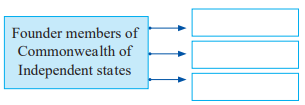
Founder members of Commonwealth of Independent States

  • Russia
  • Ukraine
  • Belarus

(B) Observe the given map and answer the following questions.
Map of East Europe today.
(i) Name any 4 countries formed after the disintegration of Soviet Union.

  1. Russia
  2. Ukraine
  3. Belarus
  4. Kazakhstan

(ii) Name two neighbouring countries of Hungary.

  1. Austria
  2. Slovakia

3. State whether the following statements are true or false with reasons.

1. Non-aligned countries put forth the demand of NAFTA.
False.
Reason: NAFTA (North American Free Trade Agreement) was established between Canada, the United States, and Mexico to promote free trade. Non-aligned countries, however, demanded the New International Economic Order (NIEO) to ensure participation of poor countries in global economic decision-making.

2. Pandit Jawaharlal Nehru was the founder of ASEAN.
False.
Reason: Pandit Jawaharlal Nehru was one of the founding members of the Non-Aligned Movement (NAM), not ASEAN. ASEAN (Association of South East Asian Nations) was founded by Indonesia, Malaysia, the Philippines, Singapore, and Thailand in 1967.


4. Explain the co-relation between the following.

Cold War and Non-aligned Movement
The Cold War was a period of tension and rivalry between the United States and the Soviet Union, dividing the world into two power blocs. The Non-Aligned Movement (NAM) emerged as a response to this division, where countries, led by leaders like Jawaharlal Nehru, Gamal Abdel Nasser, and Josip Broz Tito, chose not to align with either superpower. NAM promoted independence, peace, and cooperation among developing nations, allowing them to maintain sovereignty and avoid entanglement in Cold War conflicts. Thus, the Cold War’s ideological divide gave rise to NAM as a platform for neutrality and collective strength.


5. Answer the following.

1. Explain the term – New Cold War.
Answer: The term “New Cold War” refers to the period starting in 1979 when tensions between the United States and the Soviet Union resurfaced, ending the era of détente. It was triggered by events like the Iranian Revolution, where Iran became an Islamic state and ended ties with the U.S., and the Soviet-backed government change in Afghanistan. These events revived mistrust and hostility, resembling the earlier Cold War dynamics.

2. What is a trade bloc?
Answer: A trade bloc is a group of countries that agree to reduce or eliminate trade barriers, such as tariffs and quotas, to promote economic cooperation. Examples include NAFTA (North American Free Trade Agreement) and ASEAN (Association of South East Asian Nations), which aim to enhance trade and goodwill among member nations.


6. Express your opinion on the following.

India played an important role in the Cold War.
In my opinion, India played a significant role in the Cold War by championing the Non-Aligned Movement (NAM). Under Jawaharlal Nehru’s leadership, India advocated for neutrality, refusing to align with either the U.S. or the Soviet Union. This stance allowed India to maintain its sovereignty and promote peace, development, and cooperation among newly independent nations. By hosting NAM summits and voicing the concerns of the Third World, India helped shape a balanced global order, reducing the dominance of superpowers in international affairs.


7. Answer the following in detail with reference to the given points.
Elaborate the period of Détente.

(a) Meaning

Détente refers to the reduction of tensions between the United States and the Soviet Union during the Cold War, particularly from 1972 to 1979. It was not about friendship but about easing hostilities to avoid direct conflict, especially after the Cuban Missile Crisis highlighted the risk of nuclear war.

(b) Initiatives taken by superpowers to reduce tensions

  • Hotline Establishment: A direct telephonic link was set up between U.S. and Soviet leaders to communicate during crises, preventing misunderstandings.
  • Nuclear Arms Agreements: The 1972 Moscow Summit between Richard Nixon and Leonid Brezhnev resulted in agreements to limit nuclear missiles, reducing the arms race.
  • Vietnam War Negotiations: A 1973 Paris conference aimed to halt the Vietnam War, reducing U.S.-Soviet tensions in Asia.
  • Apollo-Soyuz Joint Flight (1975): A symbolic U.S.-Soviet space mission fostered cooperation.
  • Helsinki Conference (1975): This involved 35 nations, including the U.S. and Soviet Union, to promote security and reduce tensions in Europe.
  • Camp David Conference (1978): The U.S. facilitated talks between Egypt and Israel, indirectly easing broader Cold War-related tensions in the Middle East.

Important Question Class 11 Chapter 9 Political Science Maharashtra Board

The world since 1945 – I


Short Questions

1. What marked the end of Europe’s primacy after World War II?
Answer: The defeat of major European powers and the rise of the USA and USSR.

2. What was the main objective of the United Nations established in 1945?
Answer: To maintain international peace and security.

3. Which ideology was adopted by East European countries post-World War II?
Answer: Socialism.

4. What was the Iron Curtain described by Winston Churchill?
Answer: The division between East and West Europe during the Cold War.

5. Which conference in 1947 promoted Asian regionalism?
Answer: Asian Relations Conference.

6. What was the purpose of NATO formed in 1949?
Answer: To defend West European countries from Soviet threats.

7. Which war began in 1950 involving North and South Korea?
Answer: Korean War.

8. Who proposed the policy of peaceful co-existence in the Soviet Union?
Answer: Nikita Khrushchev.

9. What was the Bandung Conference of 1955 about?
Answer: Promoting cooperation among Asian and African nations.

10. Which organization was created in 1951 to foster economic cooperation in Europe?
Answer: European Coal and Steel Community.


Long Questions

1. Explain the division of Europe after World War II.
Answer: After World War II, Europe split into East and West. East Europe, under Soviet control, adopted socialism, while West Europe, influenced by the USA, followed capitalism, creating ideological and political divides.

2. What was the significance of the United Nations’ formation in 1945?
Answer: The UN was formed to replace the League of Nations, aiming to prevent conflicts, promote peace, and foster global cooperation on humanitarian and development issues.

3. How did the Cold War impact Asia during 1949-1959?
Answer: The Cold War spread to Asia with China’s communist shift in 1949 and the Korean War (1950-53), leading to military alliances like SEATO and heightened regional tensions.

4. Describe the role of ideology in the Cold War.
Answer: Ideology fueled the Cold War, with East Europe embracing socialism under Soviet influence and West Europe adopting capitalism under US leadership, shaping political and economic systems.

5. What were the outcomes of the Asian Relations Conference of 1947?
Answer: Held in Delhi, it united Asian leaders to discuss common issues, fostering regionalism and mutual understanding, laying the groundwork for future Afro-Asian cooperation.

6. Why was the Warsaw Pact created in 1955?
Answer: The Warsaw Pact was formed by the Soviet Union to counter NATO, ensuring military defense for East European socialist countries against Western threats.

7. How did the rise of Asia influence global politics post-1945?
Answer: Asia’s rise through anti-colonial struggles, like India’s independence in 1947, shifted global focus, empowering nations to contribute to international peace and politics.

8. What was the importance of the Camp David Summit in 1959?
Answer: The summit marked a dialogue between the USA and USSR leaders, easing Cold War tensions and signaling a move toward peaceful co-existence.

9. How did military alliances shape the Cold War in Europe?
Answer: NATO and the Warsaw Pact solidified the East-West divide, with each alliance protecting its ideological bloc, heightening tensions without direct conflict.

10. What was the role of the Bandung Conference in promoting regionalism?
Answer: The 1955 Bandung Conference united Asian and African nations to promote cooperation, address common issues, and assert their global role, expanding regionalism.

Notes Class 11 Chapter 9 Political Science Maharashtra Board

The world since 1945 – I


Introduction

The period after World War II (1939–1945) brought major changes to the world. These changes shaped international relations and led to the Cold War, a time of tension between the United States and the Soviet Union. This chapter explains the key events and trends since 1945 in simple language.


Effects of World War II

World War II changed the global order. Here are the main effects:

End of Europe’s Dominance:

  • Before the war, European countries like Germany, France, and the UK were powerful, making the world “Eurocentric.”
  • After the war, these countries were weakened or defeated.
  • The United States and Soviet Union became the new superpowers, reducing Europe’s importance.

Division of Europe:

  • During the war, Soviet forces controlled Eastern Europe, while the US, UK, and France controlled Western Europe.
  • After Germany’s defeat, both sides wanted to keep their influence, splitting Europe into:
  • East Europe: Under Soviet control.
  • West Europe: Under Western (US, UK, France) control.

Role of Ideology:

  • Ideology became important after the 1917 Bolshevik Revolution, which created the Soviet Union as a socialist state.
  • East European countries under Soviet influence adopted socialism.
  • West European countries under US influence adopted capitalism.
  • This ideological divide deepened the split in Europe.

Formation of the United Nations (UN):

  • The UN was created in 1945 to replace the League of Nations.
  • Its goal was to maintain peace and security worldwide through international cooperation.

Rise of Asia and Africa:

  • After the war, countries in Asia and Africa fought against colonial rule.
  • These struggles led to independence for many nations, marking the rise of Asia and Africa in global affairs.

The United Nations (UN)

The UN was established in 1945 to promote peace and cooperation. Its key roles and organs are:

Main Roles of the UN

Maintain Peace and Security:

Prevents conflicts, helps resolve disputes, and supports peacekeeping missions.

Protect Human Rights:

Promotes human rights globally, starting with the 1948 Universal Declaration of Human Rights.

Deliver Humanitarian Aid:

Coordinates relief efforts during disasters like floods or wars.

Promote Sustainable Development:

Encourages development that balances economic growth, social well-being, and environmental protection.

Uphold International Law:

Supports international courts, treaties, and laws to ensure justice.

Main Organs of the UN

General Assembly:

  • All UN member countries are represented.
  • Discusses and makes policies on global issues.

Security Council:

  • Responsible for maintaining peace.
  • Has 15 members: 5 permanent (US, UK, Russia, China, France) and 10 non-permanent.

Economic and Social Council:

  • Focuses on economic, social, and environmental issues.
  • Coordinates global development goals.

Trusteeship Council:

  • Helped colonies become independent.
  • Stopped functioning in 1994 after all territories gained independence.

International Court of Justice:

  • Located in The Hague, Netherlands.
  • Settles legal disputes between countries.

Secretariat:

  • Led by the Secretary-General, who is appointed for 5 years.
  • Manages the UN’s day-to-day work.

Key Facts About the UN

Total Members: 193 countries.

Permanent Security Council Members: US, UK, Russia, China, France.

Headquarters: New York City, USA.

Secretary-Generals (as of 2025, historical data):

  • Trygve Lie (1946–1952)
  • Dag Hammarskjöld (1953–1961)
  • U Thant (1961–1971)
  • Kurt Waldheim (1972–1981)
  • Javier Pérez de Cuéllar (1982–1991)
  • Boutros Boutros-Ghali (1992–1996)
  • Kofi Annan (1997–2006)
  • Ban Ki-moon (2007–2016)
  • António Guterres (2017–present).

The Cold War

The Cold War was a period of tension between the US and the Soviet Union from 1945 to the early 1990s. It was called a “cold” war because there was no direct fighting between the two, but they competed in many ways.

Dimensions of the Cold War

Political:

  • The US and Soviet Union competed for influence over Europe.
  • Soviet influence: East Germany, Poland, Czechoslovakia, Hungary, Romania, Bulgaria, Albania.
  • US influence: West Germany, France, Italy, Spain, Greece, UK, Netherlands, Denmark, Belgium.
  • Finland stayed neutral to avoid conflict.

Ideological:

  • East Europe followed socialism (government-controlled economy) under Soviet influence.
  • West Europe followed capitalism (private sector-led economy) under US influence.

Economic:

  • East European countries had socialist economies, where the government controlled industries.
  • West European countries had capitalist economies, driven by private businesses.

Security:

Both sides formed military alliances:

  • NATO (1949): US-led alliance to protect Western Europe (members included US, UK, France, West Germany, etc.).
  • Warsaw Pact (1955): Soviet-led alliance to protect Eastern Europe (members included Soviet Union, East Germany, Poland, etc.).

These alliances prepared for a possible war that never happened.

Phases of the Cold War

1945–1949/50 (Formative Years):

  • Europe was divided into East (Soviet-led) and West (US-led) blocs.
  • Political, ideological, economic, and military differences grew.
  • Winston Churchill called this divide the “Iron Curtain” in a 1946 speech.

In Asia:

  • India gained independence in 1947.
  • China became communist in 1949 under Mao Zedong and allied with the Soviet Union in 1950.

1949/50–1959 (Cold War in Asia):

The Cold War spread to Asia.

Korean War (1950–1953):

  • North Korea (communist) attacked South Korea (capitalist).
  • The UN sent forces to support South Korea.
  • The war ended with Korea divided into North and South.

Military Alliances in Asia:

  • ANZUS (1952): Australia, New Zealand, US.
  • SEATO (1954): Thailand, Philippines, Australia, New Zealand, France, UK, US.
  • CENTO (1955): Turkey, Iraq, Iran, Pakistan (Iraq and Iran later withdrew).
  • Soviet Union–China alliance (1950).

Soviet Leadership Change:

  • Stalin died in 1953, and Nikita Khrushchev became leader.
  • Khrushchev introduced “Peaceful Co-existence,” saying socialist and capitalist systems could coexist to avoid nuclear war.

Regionalism:

  • India hosted the Asian Relations Conference in 1947 to unite Asian countries.
  • The Bandung Conference (1955) in Indonesia included Asian and African nations to promote cooperation and peace.
  • In Europe, the European Coal and Steel Community (1951) laid the foundation for the European Union (EU).

Camp David Summit (1959):

US President Eisenhower and Soviet leader Khrushchev met to reduce tensions, marking a turning point in the Cold War.


Regionalism

Definition: Regionalism is when countries in a specific region cooperate to promote their shared interests, like trade, security, or culture.

Examples:

  • European Union (EU): Economic and political unity in Europe.
  • ASEAN: Cooperation among Southeast Asian nations.
  • SAARC: South Asian countries working together.

Purpose:

  • Solve common problems (e.g., transport, health).
  • Build a regional identity.
  • Foster peace and development.

Question Answers Class 11 Chapter 9 Political Science Maharashtra Board

The world since 1945 – I


(A) Choose the correct alternative and complete the following statements.

1. In 1949, China became a communist country under the leadership of Mao Zedong. (Krushchev, Mao Zedong, Joseph Stalin, Ho Chi Minh)
2. The principle of peaceful co-existence was put forth by Khrushchev. (Eisenhower, Joseph Stalin, Khrushchev, Jawaharlal Nehru)


(B) State the appropriate concept for the given statement.

1. Period of dominance of European powers: Eurocentrism
2. Conflict between America and Soviet Union: Cold War


(C) Find the odd word in the given set.

1. Hungary, Romania, Bulgaria, France
(France is the odd word because Hungary, Romania, and Bulgaria were under Soviet influence in Eastern Europe, while France was under Western influence.)
2. Italy, Poland, Spain, Greece
(Poland is the odd word because Italy, Spain, and Greece were under Western influence, while Poland was under Soviet influence in Eastern Europe.)


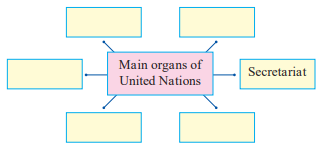
2. (A) Complete the concept map.

Answer:

  • General Assembly
  • Security Council
  • Economic and Social Council
  • Trusteeship Council
  • International Court of Justice
  • Secretariat

(B) Observe the given map and answer the following questions.

(Referring to the map of Division of Europe after World War II)

(i) Name two East European countries under the influence of Soviet Union:

Poland
Hungary

(ii) Name two West European countries under the influence of United States:

West Germany
France


3. State whether the following statements are true or false with reasons.

1. After the Bolshevik Revolution, Soviet Russia became a capitalist nation.
False.
Reason: After the Bolshevik Revolution of 1917, Soviet Russia adopted a socialist ideology and established a socialist state, not a capitalist one.

2. The Bandung Conference brought cold war in Asia.
False.
Reason: The Bandung Conference of 1955 aimed to promote goodwill, cooperation, and regionalism among Asian and African countries. It did not bring the Cold War to Asia but sought to address common issues and promote peace.


4. Answer the following.

1. Explain the term regionalism.
Answer: Regionalism refers to the process where countries from a specific geographic region cooperate to promote their collective national interests. It involves forming groups or organizations to address common issues like economic development, security, or cultural exchange, fostering a shared identity. Examples include the European Union (EU), ASEAN, and SAARC.

2. Discuss the role of United Nations.
Answer:

The United Nations (UN), established in 1945, plays a vital role in global affairs:

Maintain International Peace and Security: The UN works to prevent conflicts, mediate peace agreements, and deploy peacekeeping missions.

  • Protect Human Rights: It promotes human rights through documents like the Universal Declaration of Human Rights (1948).
  • Deliver Humanitarian Aid: The UN coordinates relief efforts during natural or man-made disasters.
  • Promote Sustainable Development: It encourages prosperity, social well-being, and environmental protection.
  • Uphold International Law: The UN supports legal frameworks through courts, treaties, and the Security Council.

5. Answer the following in detail with reference to the given points.

Elaborate the dimensions of Cold War.

The Cold War was a period of tension between the United States and the Soviet Union without direct warfare. Its dimensions include:

(a) Political:

The Cold War involved a struggle for political influence over Europe. Eastern European countries like Poland, Hungary, and East Germany were under Soviet control, while Western European nations like West Germany, France, and the UK were influenced by the United States. This led to a clear division of Europe into two blocs, with countries like Finland opting for neutrality to avoid conflict.

(b) Ideological:

The Cold War was marked by a clash between two ideologies: socialism in Eastern Europe, led by the Soviet Union, and capitalism in Western Europe, led by the United States. Eastern countries adopted socialist governments, while Western nations followed democratic systems, creating a deep ideological divide.

(c) Economic:

Economic systems differed significantly. Eastern European countries under Soviet influence followed a socialist economic model, where the government controlled major industries. In contrast, Western European countries under U.S. influence adopted a capitalist economy, where the private sector played a dominant role, leading to economic competition between the blocs.

(d) Security:

Security concerns led to the formation of military alliances. The North Atlantic Treaty Organization (NATO), formed in 1949, united Western Europe and the United States to counter Soviet threats. The Warsaw Pact, created in 1955, allied the Soviet Union and Eastern European countries to counter NATO. These alliances heightened tensions, as both sides prepared for potential conflict.

Important Question Class 11 Chapter 8 Political Science Maharashtra Board

Development Administration


Short Questions

1. What is development administration?
Answer: It is public administration focused on achieving growth and development goals.

2. What is a welfare state?
Answer: A state that promotes the economic and social well-being of its citizens.

3. What is meant by ‘red tape’?
Answer: Unnecessary delays in administrative work due to rules and procedures.

4. When was the Community Development Programme launched in India?
Answer: In 1952.

5. What is the main goal of NITI Aayog?
Answer: To promote decentralized planning and development.

6. What does the 73rd Amendment Act of 1992 provide?
Answer: Constitutional status to panchayati raj institutions.

7. What is the focus of the Green Revolution?
Answer: To increase agricultural production.

8. What is the purpose of the Mid-day Meal Scheme?
Answer: To improve nutrition, enrolment, and attendance in primary schools.

9. What is the main objective of Swachh Bharat Abhiyan?
Answer: To achieve a clean and hygienic India.

10. What does MGNREGA guarantee?
Answer: The right to work for rural citizens.


Long Questions

1. Explain the concept of development administration and its significance.
Answer: Development administration involves government actions to achieve socio-economic progress. It emphasizes planned change, innovation, and citizen participation to address issues like poverty and inequality, ensuring holistic national growth.

2. How did the welfare state concept influence public administration?
Answer: The welfare state concept shifted public administration towards promoting citizens’ well-being. It encouraged governments to focus on economic and social development, moving beyond routine functions to planned growth.

3. What challenges did newly independent countries face post-World War II?
Answer: Newly independent countries faced economic struggles, social inequalities, and poverty. They needed to build nations through development-focused governance, adopting new approaches to meet diverse societal needs.

4. Describe the role of citizen participation in development administration.
Answer: Citizen participation ensures development aligns with grassroots needs. It fosters inclusive planning, implementation, and evaluation, making programs effective and sustainable, as seen in India’s rural initiatives.

5. What are the key features of development administration?
Answer: Development administration is change-oriented, output-focused, encourages citizen participation, and requires bureaucratic commitment. These features drive progress in economic, social, and political spheres.

6. How did India’s industrialization contribute to development post-independence?
Answer: Industrialization created jobs, modernized the economy, and increased national income. Projects like Bhakra-Nangal Dam and Bhilai Steel Plant were pivotal in achieving economic self-reliance.

7. Discuss the importance of land reforms in India’s development strategy.
Answer: Land reforms redistributed land to reduce inequality and empower farmers. They aimed to boost agricultural productivity, supporting rural development and poverty reduction.

8. What was the role of the Planning Commission in India’s development?
Answer: The Planning Commission set short- and long-term development goals through Five Year Plans. It focused on agriculture, industrialization, and poverty alleviation to improve living standards.

9. How does NITI Aayog differ from the Planning Commission?
Answer: NITI Aayog promotes decentralized planning, integrating grassroots-level inputs, unlike the centralized Planning Commission. It harmonizes state and national plans for inclusive growth.

10. Evaluate the impact of the Mahatma Gandhi National Rural Employment Guarantee Act (MGNREGA).
Answer: MGNREGA guarantees rural employment, reducing poverty and improving livelihoods. It empowers communities by ensuring work opportunities, contributing to rural infrastructure and economic stability.

Notes Class 11 Chapter 8 Political Science Maharashtra Board

Development Administration


What is Development?

  • Definition: Development means growth, change, improvement, or progress in various areas like economy, society, and culture.
  • Purpose: It helps people move from one stage to a better stage, improving their quality of life.

Relation to Public Administration:

  • Public administration is about “government in action,” involving the work of legislative, executive, and judicial branches.
  • When public administration focuses on achieving growth and progress, it becomes Development Administration.

Evolution of Development Administration

Welfare State Influence:

  • A Welfare State ensures the economic and social well-being of citizens by providing basic needs like food, shelter, education, and health.
  • In the early 20th century, the idea of a welfare state changed public administration. It shifted from routine tasks to planned actions for development.

Post-World War II Context:

  • After World War II, many Asian and African countries, including India, became independent.
  • These countries faced challenges like poverty, hunger, and social inequality.
  • Their goal was nation-building, which required more than routine government work.
  • Foreign aid from developed countries was not enough, so these nations adopted new approaches to development.

Shift in Focus:

Governments became agents of change, focusing on:

  • Economic growth
  • Social progress
  • Political development
  • Cultural improvement

This holistic approach led to the rise of Development Administration.


Meaning of Development Administration

Definition: It is the process of using government actions to achieve progressive goals in political, economic, and social areas.

Key Thinkers:

  • Edward Weidner: Development Administration guides organizations toward achieving progressive objectives set by the government.
  • Merle Fairsoul: It involves new functions taken up by developing countries for modernization and industrialization.

Difference from Traditional Administration:

  • Traditional public administration follows strict rules and hierarchy, which can cause delays (called red tape).
  • Development Administration is innovative, flexible, and focused on achieving change and growth.

Traditional Public Administration vs. Development Administration

Areas of Traditional Public Administration

Organization of Government:

Studies the structure of government, like ministries, departments, and bodies such as UPSC or Election Commission.

Management of Tasks:

Focuses on leadership, planning, and coordination, e.g., NITI Aayog’s role in planning.

Personnel Administration:

Deals with recruitment, training, salaries, and pensions, e.g., UPSC recruitment process.

Financial Administration:

Involves budget-making, parliamentary committees (like Public Accounts Committee), and audits.

Administrative Law:

Covers rules made under laws and tribunals like the Income Tax Appellate Tribunal for resolving disputes.

Why Change Was Needed

Developing countries like India are post-colonial and face unique challenges:

  • Economic and social inequality
  • Need for modernization
  • Adoption of new technologies

Traditional administration was not enough to achieve these goals, so Development Administration was introduced to focus on setting and achieving development objectives.


Features of Development Administration

Change-Oriented:

  • Unlike traditional administration, which prefers stability, Development Administration aims to bring change.
  • Example: In India, the government invested in industries, dams (like Bhakra-Nangal), and power projects to fight poverty and modernize the economy.

Output-Oriented:

  • It sets clear targets (e.g., 8-10% economic growth per year) to achieve specific results.
  • These targets help the government measure progress and ensure efficiency.

Citizen Participation:

  • Development requires people’s involvement in planning, implementing, and evaluating programs.
  • In India, programs like the Community Development Programme (1952) and 73rd & 74th Constitutional Amendments (1992) promoted participation through Panchayati Raj and municipalities.
  • Participation ensures that development meets local needs, especially in a diverse country like India.

Public Commitment:

  • Bureaucrats (government officials) must be dedicated and committed to achieving development goals.
  • They need to feel a sense of responsibility to overcome challenges and work for national progress.

Aspects of Development Administration

Administration of Development:

  • Setting development goals (e.g., reducing poverty).
  • Taking steps to achieve these goals through programs and policies.

Development of Administration:

Improving the existing administrative system to make it more efficient and capable of achieving development goals.


Development Administration in India

Goals of Development Post-Independence

India faced challenges like poverty, colonial exploitation, and underdevelopment after independence. The government set the following goals:

Modernization of the Economy:

Focused on industrialization to create jobs and increase national income.

Land Reforms:

Redistributed land from large landowners to farmers to reduce inequality.

Agricultural Development:

Used high-yielding seeds to boost food production and reduce rural poverty.

Self-Reliance:

India wanted to be independent from foreign influence, accepting aid but avoiding dependence.

Socialist Pattern with Social Justice:

  • Followed a welfare state model to reduce income and wealth inequality.
  • Provided services like education and healthcare to improve living standards.

Role of Planning

Planning Commission (1950-2014):

  • Created to plan India’s development through Five-Year Plans.
  • Focused on agriculture, industry, poverty removal, and social security.

NITI Aayog (2014 onwards):

  • Replaced the Planning Commission to promote decentralized planning.
  • Encourages planning from the village to national level, involving states and local bodies.
  • Acts as a think tank to support sustainable development.

Key Development Programs in India

The government launched several programs to achieve development goals:

  • 1952: Community Development Programme (CDP) – Promoted rural development and people’s participation.
  • 1966-67: Green Revolution – Increased agricultural production using better seeds and technology.
  • 1975: Command Area Development Programme (CADP) – Improved irrigation use.
  • 1975: Twenty Point Programme (TPP) – Aimed to eradicate poverty and improve living standards.
  • 1980: Integrated Rural Development Programme (IRDP) – Focused on rural poor development.
  • 1989: Jawahar Rozgar Yojana (JRY) – Provided jobs to rural unemployed.
  • 1995: Mid-day Meal Scheme – Gave meals to schoolchildren to improve attendance and nutrition.
  • 2000: Pradhan Mantri Gram Sadak Yojana (PMGSY) – Built roads to connect villages.
  • 2005: Jawaharlal Nehru National Urban Renewal Mission (JNNURM) – Improved urban infrastructure.
  • 2005: Mahatma Gandhi National Rural Employment Guarantee Act (MGNREGA) – Guaranteed 100 days of work to rural households.
  • 2009: Aadhaar – Provided unique IDs to citizens for better access to services.
  • 2014: Pradhan Mantri Jan Dhan Yojana (PMJDY) – Promoted financial inclusion by opening bank accounts.
  • 2014: Swachh Bharat Abhiyan – Aimed for a clean and hygienic India.
  • 2017: Udaan Scheme – Encouraged girls to pursue higher technical education.

Question Answers Class 11 Chapter 8 Political Science Maharashtra Board

Development Administration


Exercise

1. State the appropriate concept for the given statement.

1. State that promotes economic and social well-being of its citizens
Answer: Welfare State
2. Unnecessary delays in administrative work is called
Answer: Red Tape


2. Complete the concept map.


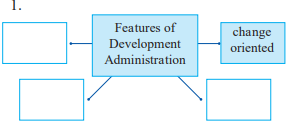
Answer:
Features of Development Administration

  • Change oriented
  • Output-oriented
  • Citizen participation
  • Public commitment

3. State whether the following statements are true or false with reasons.

1. Change and growth-oriented approach is called Development Administration.
Answer: True
Reason: Development Administration is defined as an approach that focuses on bringing about change and achieving growth-oriented goals, such as economic, social, and political development, through planned and innovative administrative actions.

2. In post-independent India, government deliberately invested in public sector.
Answer: True
Reason: After independence, the Indian government deliberately invested in the public sector to promote industrialisation and development, as seen in projects like the Bhakra-Nangal Dam and Bhilai Steel Plant, which were referred to as the “Temples of Modern India” by Pandit Jawaharlal Nehru.

3. The 73rd amendment act gave constitutional status to municipalities.
Answer: False
Reason: The 73rd Amendment Act of 1992 gave constitutional status to Panchayati Raj institutions, not municipalities. The 74th Amendment Act of 1992 gave constitutional status to municipalities to strengthen urban local governments.


4. Explain the co-relation between the following.

Citizen participation and Development
Answer: Citizen participation is closely related to development in Development Administration. For development to be successful, active involvement of people is essential. When citizens participate in planning, implementing, and evaluating development programs, it ensures that the initiatives meet the actual needs of the community. In a diverse country like India, where needs vary across regions, participation ensures that programs are inclusive and effective. For example, the 73rd and 74th Constitutional Amendment Acts promoted grassroots participation through Panchayati Raj institutions and municipalities, enabling local people to contribute to development. This participation strengthens democracy and helps achieve developmental goals like poverty reduction and infrastructure improvement.


5. Answer the following.
1. Discuss any 4 areas of study in traditional public administration.
Answer: The four areas of study in traditional public administration are:

  • Organisation of the governmental machinery: This focuses on the structure of government, including ministries, departments, and bodies like the UPSC and Election Commission.
  • Management of different tasks: This involves leadership, planning, and coordination between departments, such as the role of NITI Aayog in planning.
  • Personnel Administration: This covers recruitment, training, promotions, salaries, and pensions, for example, recruitment through UPSC or State Civil Service Commissions.
  • Financial Administration: This deals with budget-making, parliamentary financial committees like the Public Accounts Committee, and auditing processes.

2. Write in brief about NITI Aayog.
Answer: NITI Aayog (National Institution for Transforming India) was established in 2014 to replace the Planning Commission. It serves as a think tank for the Government of India, promoting cooperative federalism and decentralized planning. Unlike the Planning Commission’s centralized approach, NITI Aayog focuses on grassroots planning, starting from villages, blocks, and districts, which is then harmonized at the state and national levels. It aims to foster sustainable development by involving states and local bodies in the planning process and addressing issues like poverty, agriculture, and infrastructure development.


6. Express your opinion of the following.

Citizen participation is necessary in development administration.
Answer: I believe citizen participation is essential in Development Administration because it ensures that development programs reflect the real needs and aspirations of the people. When citizens are involved in planning and implementing projects, it increases transparency, accountability, and the chances of success. For instance, in India, programs like the Community Development Programme and the 73rd and 74th Amendments have shown that involving people at the grassroots level leads to better outcomes in rural and urban development. Without citizen participation, development efforts may fail to address local issues, leading to inefficiency and wasted resources.

Important Question Class 11 Chapter 7 Political Science Maharashtra Board

Public Administration


Short Questions

1. What is Public Administration?
Answer: It’s the management of government resources to achieve public goals.

2. Name the three branches of government.
Answer: Legislature, Executive, Judiciary.

3. What does POSDCORB stand for?
Answer: Planning, Organizing, Staffing, Directing, Coordinating, Reporting, Budgeting.

4. Who wrote Arthashastra?
Answer: Kautilya.

5. What is NITI Aayog’s role?
Answer: It’s a policy think tank for planning and advising the government.

6. Who conducts UPSC exams?
Answer: Union Public Service Commission.

7. What is the highest administrative officer at the district level?
Answer: Collector.

8. What is Corporate Social Responsibility (CSR)?
Answer: Companies working on social and environmental issues.

9. Who heads a Municipal Corporation?
Answer: Municipal Commissioner and Mayor.

10. What is the first step in public policy-making?
Answer: Policy Choice.


Long Questions

1. How is Public Administration different from Political Science?
Answer: Political Science studies how policies and laws are made, while Public Administration focuses on implementing them. It deals with the executive branch’s actions to achieve government goals.

2. What is the role of bureaucracy in Public Administration?
Answer: Bureaucracy implements government policies and programs. They are hired through competitive exams like UPSC and maintain political neutrality.

3. Explain the narrow perspective of Public Administration.
Answer: The narrow perspective, based on POSDCORB, focuses only on the executive branch’s tasks like planning, organizing, staffing, and budgeting to manage government work.

4. How does the broad perspective of Public Administration differ from the narrow one?
Answer: The broad perspective includes all three government branches (Legislature, Executive, Judiciary) and their interactions, unlike the narrow focus on just the executive branch.

5. What is the significance of Kautilya’s Arthashastra in Public Administration?
Answer: Arthashastra is an ancient text on administration, detailing governance and management during Chandragupta Maurya’s rule, influencing modern administrative thought.

6. How did Woodrow Wilson contribute to Public Administration?
Answer: Woodrow Wilson’s 1887 essay, The Study of Public Administration, laid the foundation for it as an academic discipline, emphasizing government efficiency.

7. What are the three steps in public policy-making?
Answer: Policy Choice (deciding the issue and solution), Policy Output (implementing the plan), and Policy Impact (evaluating the results to improve the policy).

8. Describe the structure of local government administration in rural India.
Answer: Rural administration includes Zilla Parishad (district), Panchayat Samiti (block), and Gram Panchayat (village), led by officials like Collectors, BDOs, and Sarpanch.

9. What is the role of the Union Public Service Commission (UPSC)?
Answer: UPSC conducts exams to recruit bureaucrats for All India Services and Central Services, ensuring a competent and neutral administrative workforce.

10. How does the Indian Constitution guide Public Administration?
Answer: The Constitution provides values like Liberty, Equality, and Justice, which guide politicians and bureaucrats in administering policies for public welfare.

Ads

HSC आणि SSC महाराष्ट्र – मराठी माध्यम – महाराष्ट्र बोर्ड

📘 महाराष्ट्र बोर्ड परीक्षा साहित्य (मराठी माध्यम)

  • HSC आणि SSC प्रश्नसंच – मराठी माध्यमातील PDF
  • महाराष्ट्र बोर्ड नमुना प्रश्नपत्रिका व मॉडेल पेपर्स (मराठी माध्यमात)
  • SSC आणि HSC च्या मागील वर्षांच्या प्रश्नपत्रिका – मराठी माध्यम
  • SSC/HSC साठी मराठी माध्यमातील नोट्स आणि सराव चाचण्या (मॉक टेस्ट)
  • मराठी माध्यमातील MCQs (बहुपर्यायी प्रश्न) समाविष्ट
  • सर्व परीक्षा साहित्य मराठी माध्यमात उपलब्ध

📗 महाराष्ट्र बोर्ड पाठ्यपुस्तके व PDF (मराठी माध्यम)

  • इयत्ता 10 वी (SSC) चे पाठ्यपुस्तक PDF – मराठी माध्यमात
  • इयत्ता 12 वी (HSC) चे पाठ्यपुस्तक PDF – मराठी माध्यमात
  • मराठी डायजेस्ट – PDF डाउनलोड
  • SSC आणि HSC इयत्तांची पुस्तके – मराठी माध्यमातील PDF
  • डाउनलोडसाठी उपलब्ध पाठ्यपुस्तके व PDF – महाराष्ट्र बोर्ड

📒 महाराष्ट्र बोर्डासाठी मराठी अभ्यास साहित्य

  • प्रकरणनिहाय नोट्स – मराठी माध्यमात
  • प्रकरणनिहाय प्रश्नोत्तरे (प्रश्न व उत्तरे) – मराठी माध्यमात
  • SSC आणि HSC साठी महत्त्वाचे प्रश्न – मराठी माध्यम
  • महत्त्वाच्या सूत्रांचा सारांश (इयत्ता 6 वी ते 12 वी)
  • MCQs, प्रश्नसंच, नमुना प्रश्नपत्रिका आणि मागील वर्षांच्या प्रश्नपत्रिका

CBSE Board Englsih and हिंदी माध्यम

CBSE Board

Mathematics Class 6
Science Class 6
Social Science Class 6
हिन्दी Class 6
सामाजिक विज्ञान कक्षा 6
विज्ञान कक्षा 6

Mathematics Class 7
Science Class 7
SST Class 7
सामाजिक विज्ञान कक्षा 7
हिन्दी Class 7

Mathematics Class 8
Science Class 8
Social Science Class 8
हिन्दी Class 8

Mathematics Class 9
Science Class 9
English Class 9

Mathematics Class 10
SST Class 10
English Class 10

Mathematics Class XI
Chemistry Class XI
Accountancy Class 11

Accountancy Class 12
Mathematics Class 12

Learn English
English Through हिन्दी
Job Interview Skills
English Grammar
हिंदी व्याकरण - Vyakaran
Microsoft Word
Adobe PhotoShop
Adobe Illustrator
Learn German
Learn French
IIT JEE
Privacy Policies, Terms and Conditions, About Us, Contact Us
Copyright © 2026 eVidyarthi and its licensors. All Rights Reserved.