eVidyarthi
Menu
  • School
    • Close
    • CBSE English Medium
    • CBSE Hindi Medium
    • UP Board
    • Bihar Board
    • Maharashtra Board
    • MP Board
    • Close
  • English
    • Close
    • English Grammar for School
    • Basic English Grammar
    • Basic English Speaking
    • English Vocabulary
    • English Idioms & Phrases
    • Personality Enhancement
    • Interview Skills
    • Close
  • Sarkari Exam Preparation
    • Close
    • All Govt Exams Preparation
    • State Wise Competitive Exam Preparation
    • India – Notes for All Competitive Exams
    • MCQs & Notes for Competitive Exams
    • NCERT Syllabus for Competitive Exam
    • Close
  • Study Abroad
    • Close
    • Study in Australia
    • Study in Canada
    • Study in UK
    • Study in Germany
    • Study in USA
    • Close
  • Current Affairs
    • Close
    • Current Affairs
    • Current Affairs Quizzes
    • State Wise Current Affairs
    • Monthly Current Affairs
    • Close
Sociology Class 11 Maharashtra Board | Menu
  • MCQ Sociology Class 11 Maharashtra Board
  • Question Answer Sociology Class 11 Maharashtra Board
  • Notes Sociology Class 11 Maharashtra Board
  • Important Questions Sociology Class 11 Maharashtra Board
  • Book Sociology Class 11 Maharashtra Board
  • Sociology Class 11

Important Questions Class 11 Chapter 8 Sociology Maharashtra Board

Social Change

Short Questions

1. What does social change mean according to Harry Johnson?

Answer: Social change means a change in social structure.

2. Who proposed the Theory of Three Stages of human thought?

Answer: Auguste Comte proposed the Theory of Three Stages.

3. What is an example of cyclical social change?

Answer: The return of old fashion styles like punk hairstyles is an example.

4. What approach compares society to a biological organism?

Answer: The structural-functional approach, inspired by Herbert Spencer’s Organic Analogy, compares society to a biological organism.

5. What is an example of a planned social change?

Answer: The development of planned cities is an example of planned social change.

6. Which factor is responsible for changes due to natural calamities like earthquakes?

Answer: The physical factor is responsible for changes due to natural calamities.

7. What does demography study in the context of biological factors?

Answer: Demography studies the size, structure, and distribution of the population.

8. Who linked Protestant ethics to the spread of capitalism?

Answer: Max Weber linked Protestant ethics to the spread of capitalism.

9. What economic policy of 1991 impacted Indian society?

Answer: The LPG (Liberalization, Privatization, Globalization) Policy of 1991 impacted Indian society.

10. Which factor is driven by technological innovations like e-governance?

Answer: The technological factor is driven by innovations like e-governance.

11. What is the role of education in social change?

Answer: Education develops skills and transforms lives to drive social change.

12. What is an example of a short-term social change?

Answer: Purchasing a home theatre is an example of short-term social change.

13. What is an example of a long-term social change?

Answer: Eradicating dowry practices is an example of long-term social change.

14. What does the term “neutrality” mean in social change?

Answer: Neutrality means social change is ethically neutral and amoral.

15. What is anomic suicide according to Emile Durkheim?

Answer: Anomic suicide is a state of normlessness or chaos that triggers suicidal feelings.

Long Questions

1. Explain the nature of social change with examples.

Answer: The nature of social change is universal and inevitable, occurring in all societies whether tribal, rural, or urban, as no society remains static. It can be linear (e.g., Auguste Comte’s Three Stages), multilinear, or cyclical (e.g., fashion trends like punk hairstyles returning), with varying speeds. The direction and consequences may be positive (e.g., technological progress) or negative (e.g., natural disasters), making it a continuous and complex process.

2. Describe the structural-functional approach to understanding society.

Answer: The structural-functional approach views society as a system with interrelated parts like education and government, each performing specific functions, inspired by Herbert Spencer’s Organic Analogy. It suggests that changes in one part (e.g., family structure shifting from joint to nuclear) affect the whole system, maintaining or disrupting equilibrium. Dysfunction, such as normlessness leading to anomic suicide (Durkheim), requires conscious efforts to restore balance.

3. What are the characteristics of social change?

Answer: Social change is universal, occurring in all societies with varying speeds in aspects like population and customs, and is a continuous process from nomadic times to the present. It is temporal, taking place over time, and involves an interactional chain reaction where one factor (e.g., rising school fees) triggers others (e.g., dropouts). It is neutral, short-term or long-term, and can be planned (e.g., city planning) or unplanned (e.g., earthquakes).

4. Discuss the physical factors responsible for social change.

Answer: Physical factors, including climatic conditions, natural resources, and geography, significantly influence social change by shaping human settlements and lifestyles. Natural calamities like the 1993 Latur earthquake cause displacement and long-term societal shifts, while fertile lands or mineral-rich areas promote development. However, human activities like industrial pollution leading to global warming highlight the need for sustainable development.

5. Explain the role of biological factors in social change.

Answer: Biological factors, or demographic changes, involve population dynamics such as birth rates, death rates, and sex ratios, which impact society’s structure and resources. Overpopulation or under-population leads to issues like unemployment and housing shortages, while a declining sex ratio affects socio-economic opportunities. The growing number of senior citizens or youth decline poses new challenges, requiring adaptive societal responses.

6. How do socio-cultural factors contribute to social change?

Answer: Socio-cultural factors involve changes in values, beliefs, and ideologies, driving social change through cultural diffusion when cultures interact or clash. Max Weber’s link between Protestant ethics and capitalism, or the global impact of ideas from Darwin and Marx, exemplifies this influence. Negative aspects like fundamentalism or superstition can hinder progress, creating barriers to societal transformation.

7. What is the significance of economic factors in social change?

Answer: Economic factors, such as industrial revolutions and globalization (e.g., India’s 1991 LPG Policy), drive large-scale social and political transformations by affecting institutions like family and education. They lead to urbanization, employment, and class conflicts (as per Marx’s conflict theory), fostering movements like labor or women’s rights. However, economic competition also widens class divides, necessitating welfare-focused development.

8. Discuss the impact of technological factors on social change.

Answer: Technological factors, marked by innovations like e-governance and e-learning, create new life conditions and measure societal progress, transforming economic, cultural, and political spheres. Historical developments, such as British-era transportation systems expanded by India, continue to benefit modern society, while digitization aids governance. Yet, it coexists with inequalities, as many lack access to healthcare or education despite technological advances.

9. How does education act as a factor of social change?

Answer: Education, through formal, informal, and online means (e.g., MOOCs, Right to Education), equips individuals with skills and awareness to drive societal transformation. It includes inclusive efforts like admitting transgender students and providing scholarships, adapting pedagogy with technology like smart boards. This empowers people to solve problems and seek employment, fostering long-term societal progress.

10. Differentiate between planned and unplanned social change with examples.

Answer: Planned social change is intentional, driven by governments or agencies, such as the development of planned cities with designated zones for residences and parks. Unplanned social change occurs suddenly due to external events, like earthquakes or floods causing loss of life and requiring immediate rehabilitation. Both types shape society, but planned changes aim for stability, while unplanned changes often lead to unpredictable outcomes.
Notes Class 11 Chapter 8 Sociology Maharashtra Board

Social Change

Introduction

Society is dynamic and undergoes continuous change.

Questions like “Has society remained the same always?” or “Are employment opportunities the same as before 1991?” highlight that change is inevitable.

Examples:

  • Differences in transport development between Nashik and Pune.
  • Absence of coalition politics four decades ago.

This chapter explores the meaning, nature, characteristics, and factors responsible for social change.


8.1 Social Change: Meaning, Nature, and Characteristics

8.1.1 Definitions

  • Harry Johnson: “In its basic sense, social change means change in social structure.”
  • Horton and Hunt: “Social change is a change in the social structure and social relationships of the society.”
  • Kingsley Davis: “By social change is meant only such alterations as occur in social organizations, that is, structure and functions of society.”
  • Key Insight: These definitions adopt a structural-functional approach, emphasizing that changes in society’s structure (e.g., institutions) impact social relationships.

8.1.2 Nature of Social Change

Change is Universal: Occurs in all human societies (tribal, rural, urban, simple, or complex) and the natural world.

Inevitable: No society remains static; change is a constant process.

Varied Nature and Direction:

  • Linear Change: Proceeds in a single direction (e.g., Auguste Comte’s Theory of Three Stages: Theological, Metaphysical, Positive).
  • Multilinear Change: Occurs in multiple directions simultaneously.
  • Cyclical Change: Repeats over time (e.g., fashion trends like punk hairstyles returning).

Speed of Change: Can be slow or rapid; terms like “slow” or “fast” are relative and not measurable with precision like in natural sciences.

Structural-Functionalism:

  • Society is viewed as a system with interrelated parts (e.g., education, government, economy), each with specific functions.
  • Inspired by Herbert Spencer’s Organic Analogy, comparing society to a biological organism.
  • Dysfunction (e.g., normlessness or “anomic suicide” as per Emile Durkheim) disrupts stability, requiring conscious efforts to restore equilibrium.

Examples of Change:

  • Structural: Shift from joint families to nuclear families.
  • Functional: Education moving from a family responsibility to a formalized system (schools, universities).

Complexity: Involves direction, form, sources, causes, and consequences of change over time.

8.1.3 Characteristics of Social Change

Universality: All societies experience change in population, beliefs, tools, attire, customs, roles, music, art, and architecture. The speed varies but change is constant.

Continuous Process: An endless phenomenon; society is in a permanent state of flux from nomadic times to the present.

Temporal: Occurs over time; innovations, modifications, or discarding old practices are gradual and context-specific.

Interactional Chain Reaction: A single factor (e.g., increased school fees) triggers changes (e.g., higher dropouts, especially among girls), influenced by interdependent physical, biological, technological, cultural, and economic factors.

Neutrality: Amoral and ethically neutral; it is an objective phenomenon without moral judgment.

Short-term and Long-term Change:

  • Short-term: Immediate results (e.g., buying a home theatre).
  • Long-term: Gradual results (e.g., eradicating dowry or domestic violence).

Planned or Unplanned Change:

  • Unplanned: Sudden, e.g., natural calamities (famines, earthquakes, tsunamis) causing loss of life and property, requiring immediate rehabilitation.
  • Planned: Intentional, e.g., development of planned cities with designated spaces for residences, parks, and economic zones.

8.2 Factors Responsible for Social Change

Social change results from the interaction of multiple factors, not a single cause. Key factors include:

1. Physical Factor (Geographical/Natural Factor)

Definition: Influenced by climatic conditions, physical environment (rivers, mountains, biodiversity), and natural resources.

Impact: Governs the rate and direction of social change.

Examples:

  • Natural calamities (e.g., 1993 Latur earthquake) cause displacement and long-term societal shifts.
  • Favorable environments (e.g., fertile land, mineral-rich areas) promote human settlements.

Negative Effects: Industrial pollution leads to global warming, rising sea levels, and coastal submergence, necessitating sustainable development.

2. Biological Factor (Demographic Factor)

Definition: Relates to population dynamics (size, structure, distribution) studied through demography (birth, migration, aging, death).

Influence: Affects population size, sex ratio, birth/death rates, and hereditary quality.

Consequences:

  • Overpopulation or under-population leads to food, housing, unemployment, and health issues.
  • Declining youth or growing senior citizen populations create new societal challenges.
  • Skewed sex ratios impact socio-economic development.

Example: Regional imbalances due to population density changes.

3. Socio-cultural Factor

Definition: Changes in culture (values, beliefs, ideologies, customs) drive social change.

Mechanism: Cultural diffusion occurs when cultures meet or clash.

Examples:

  • Max Weber’s link between Protestant ethics and the spread of capitalism in Europe.
  • Ideas from Darwin, Freud, and Marx have global impacts.

Negative Aspects: Religious fundamentalism, superstition, and materialism can hinder progress and cause hardships.

4. Economic Factor

Definition: Economic development drives political and social transformations.

Impact: Affects institutions like family, education, and government.

Examples:

  • Industrial Revolution led to urbanization, employment, and trade unionism.
  • Globalization (LPG Policy, 1991) transformed India’s economy, politics, and education.

Conflict Approach: Karl Marx’s theory highlights class conflict as a basis for change, unlike functionalism’s focus on stability.

5. Technological Factor

Definition: Technological development is a benchmark of a civilized society.

Impact: Creates new life conditions and adaptation needs.

Examples:

  • British-era transportation and communication systems, expanded by Indian governments.
  • Modern innovations: e-learning, e-commerce, e-governance, digitization.

Challenges: Technological progress coexists with poverty, lack of healthcare, and education access, highlighting inequality.

6. Educational Factor

Definition: Education (formal, informal, non-formal, open learning) is key to change.

Role: Develops skills, solves problems, and transforms lives.

Examples:

  • Right to Education (RTE) and initiatives like National Digital Library.
  • Inclusion of transgender students in universities and scholarships for the needy.

Transformation: Pedagogy, content, and technology (e.g., MOOCs, smart boards) are evolving.


Summary

  • Society is dynamic; change is inevitable and universal.
  • Sociology studies both static and dynamic aspects, focusing on structural and functional changes.
  • Characteristics: Continuous, temporal, interdependent, neutral, short-term/long-term, planned/unplanned.
  • Factors: Physical, biological, socio-cultural, economic, technological, and educational.

Questions Answers Class 11 Chapter 8 Sociology Maharashtra Board

Social Change – Solutions

1. (A) Choose the correct alternative and complete the statements.

(1) Social change as a term is ___. (value loaded, ethically neutral, prejudiced)

Answer: ethically neutral.

(2) The effects of an earthquake on people is a ___ factor of change. (geographical, biological, cultural)

Answer: geographical

(3) The study of sex ratio is a ___ factor of change. (biological, technological, natural)

Answer: biological

(4) The Slum Rehabilitation programme within a city is an example of ___ social change. (planned, unplanned, revolutionary)

Answer: planned


1. (B) Correct the incorrect pair.

(1) (i) Earthquake – Physical
(ii) Fundamentalism – Biological
(iii) Growing urbanization – Economic
(iv) E-governance – Technological

Answer: (ii) Fundamentalism – Socio-cultural


1. (C) Identify the appropriate term from the given options.

Physical factor, Educational factor, Economic factor

1. Impact of rising sea water level on coastal regions: Physical factor

2. Creating awareness about the problem of sexual abuse: Educational factor


1. (D) Correct underlined words and complete the sentence.

1. Social change is not always a linear process.

Answer: Social change can be linear, multilinear, or cyclical process.

2. All teachers are expected to think about how they will teach a unit in the classroom. This is an example of unplanned change.

Answer: All teachers are expected to think about how they will teach a unit in the classroom. This is an example of planned change.


2. Write differences.

(1) Planned change and Unplanned Change.

AspectPlanned ChangeUnplanned Change
DefinitionDeliberate and intentional changes promoted by governments or agencies.Changes that occur suddenly without deliberate intent.
NaturePurposeful, with specific goals and structured implementation.Spontaneous, often triggered by unexpected events.
ExampleDevelopment of planned cities with designated areas for residences, parks, etc.Natural calamities like earthquakes or floods causing societal disruptions.
ControlControlled and directed by human intervention or policy.Uncontrolled, often a reaction to external forces like natural disasters.
Outcome PredictabilityOutcomes are generally anticipated and designed.Outcomes are uncertain and may lead to unforeseen consequences.

(2) Short-term and Long-term change

AspectShort-term ChangeLong-term Change
DefinitionChanges that produce immediate or quick results.Changes that take years or decades to show significant results.
Time FrameOccurs over a short period, often noticeable instantly or within months.Occurs over an extended period, sometimes spanning generations.
ExamplePurchasing new gadgets like a home theatre for entertainment.Eradicating social evils like dowry or early marriage.
Impact DepthOften superficial or limited to specific areas of life.Deep-rooted, affecting societal structures and cultural norms.
Effort RequiredRequires less sustained effort, often driven by immediate resources or decisions.Requires continuous effort and systemic changes to achieve lasting impa

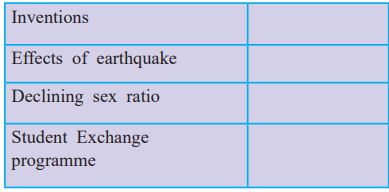
4. (A) Complete the concept map.

Identify the significant factor of change for each:

ItemSignificant Factor of Change
InventionsTechnological factor
Effects of earthquakePhysical factor
Declining sex ratioBiological factor
Student Exchange programmeEducational factor

4. (B) State whether the following statements are True or False with reasons.

1. Prejudice and fear of the unknown is an obstacle to change.

Answer: True

  • Reason: The document mentions negative consequences of ideologies like superstitious beliefs and blind faith, which can hinder social progress. Prejudice and fear resist new ideas, making change difficult.

2. Social change can be predicted accurately.

Answer: False

  • Reason: Social change is complex and influenced by multiple interdependent factors (physical, biological, socio-cultural, etc.). While trends can be observed, the document does not suggest that social change can be predicted with precision due to its dynamic nature.

5. Give your personal response.

1. Do you think people accept social change easily? Why?

Answer: People do not always accept social change easily. Resistance often stems from fear of the unknown, attachment to traditions, or perceived threats to identity, as highlighted by socio-cultural factors in the document. For example, changes like the adoption of e-governance may face pushback from those unfamiliar with technology. However, younger generations or those exposed to education may embrace change faster due to awareness and adaptability.

2. Do you think the ‘Swachh Bharat Abhiyan’ has had a positive impact on society? Justify your response.

Answer: Yes, the ‘Swachh Bharat Abhiyan’ has had a positive impact on society. As a planned change initiative, it aligns with the document’s description of government-driven efforts to improve societal conditions. It has raised awareness about cleanliness, improved sanitation infrastructure, and encouraged community participation. For instance, the construction of toilets in rural areas has enhanced public health and dignity, especially for women. However, challenges like sustaining behavioral change remain, indicating it is a long-term process.

Important Questions Class 11 Chapter 7 Sociology Maharashtra Board

Social Stratification

Short Questions

1. What is social stratification?

Answer: Social stratification is the process of ranking individuals or groups in a hierarchical order based on status.

2. How does social stratification differ from social differentiation?

Answer: Social stratification involves vertical hierarchical ranking, while social differentiation is horizontal division.

3. What is the basis of the caste system?

Answer: The caste system is based on birth and the principles of purity and pollution.

4. What type of stratification allows social mobility?

Answer: Open stratification allows social mobility between social strata.

5. Name one characteristic of the caste system according to G. S. Ghurye.

Answer: Segmental division of society is a characteristic of the caste system.

6. What determines social class status?

Answer: Social class status is determined by wealth, occupation, education, and prestige.

7. What is gender stratification?

Answer: Gender stratification is the unequal distribution of wealth, power, and privilege between sexes.

8. What is horizontal mobility?

Answer: Horizontal mobility is a change in job or residence without a status shift.

9. Give an example of intergenerational mobility.

Answer: A farmer’s child becoming a doctor is an example of intergenerational mobility.

10. What role does education play in class stratification?

Answer: Education enables upward mobility and influences class rank.

11. What is the origin of the term “caste”?

Answer: The term “caste” originates from the Spanish word “casta,” meaning breed or race.

12. What is patriarchy in the context of gender?

Answer: Patriarchy is a social organization where men dominate, oppress, and exploit women.

13. What is the key feature of closed stratification?

Answer: The key feature of closed stratification is the lack of social mobility.

14. Who introduced the concept of different types of capital in class analysis?

Answer: Pierre Bourdieu introduced the concept of economic, social, cultural, and symbolic capital.

15. What is intragenerational mobility?

Answer: Intragenerational mobility is a status change within an individual’s lifetime.

Long Questions

1. Explain the concept of social stratification with its basic characteristics.

Answer: Social stratification is the hierarchical ranking of individuals or groups based on unequal access to resources and status. It is social in nature, persists across generations, is universal yet variable, involves inequality, and has significant consequences on life chances and lifestyles. These characteristics shape societal structures and individual experiences globally.

2. Discuss the caste system as a closed form of stratification with its key features.

Answer: The caste system is a closed stratification where status is fixed by birth, with no mobility between strata, as seen in traditional Indian society. Key features include segmental division, hierarchy based on purity and pollution, restrictions on feeding and social intercourse, differential privileges, hereditary occupations, and endogamy. These elements reinforce a rigid social order that is gradually changing in modern times.

3. Describe the class system as an open form of stratification and its determinants.

Answer: The class system is an open stratification allowing mobility based on achieved status, differing from the rigid caste structure. Its determinants include wealth, occupation, education, and prestige, which influence an individual’s rank and lifestyle. This flexibility enables upward or downward movement, as seen in industrial societies with upper, middle, and lower classes.

4. What is gender stratification, and how does it manifest in society?

Answer: Gender stratification refers to the unequal distribution of wealth, power, and privilege between men and women, a universal societal feature. It manifests through sexism and patriarchy, where men dominate, as seen in lower pay for women or gendered roles like caregiving for females. This inequality affects opportunities and social status across various domains like economy and polity.

5. Explain the types of social mobility with suitable examples.

Answer: Social mobility includes horizontal mobility (e.g., a doctor becoming a professor without status change), vertical mobility (e.g., a clerk becoming a manager), intergenerational mobility (e.g., a laborer’s child becoming a doctor), and intragenerational mobility (e.g., a teacher rising to principal). These types reflect shifts in social position, either within a lifetime or across generations, influenced by education and opportunity. Each type highlights the dynamic nature of social hierarchies.

6. How does education impact class and gender stratification?

Answer: Education serves as a lever for upward mobility in class stratification, enabling individuals to improve their status through better jobs and skills. In gender stratification, it empowers women by challenging stereotypes, increasing workforce participation, and fostering independence. However, access to quality education often remains unequal, perpetuating existing disparities.

7. Analyze the role of purity and pollution in the caste hierarchy.

Answer: The concept of purity and pollution forms the basis of caste hierarchy, ranking groups as superior or inferior based on ritual cleanliness. Higher castes are deemed purer, enjoying privileges, while lower castes face pollution-related restrictions on interactions and occupations. This ideology, though weakening, historically reinforced caste segregation in Indian society.

8. Discuss Pierre Bourdieu’s contribution to understanding class stratification.

Answer: Pierre Bourdieu expanded class analysis by introducing four types of capital: economic (wealth), social (networks), cultural (education), and symbolic (prestige). These capitals explain how the upper class maintains dominance beyond mere money, influencing lifestyle and opportunities. His framework highlights the interconnectedness of social factors in sustaining inequality.

9. How do traditional gender roles contribute to gender stratification?

Answer: Traditional gender roles assign masculinity (e.g., bravery, dominance) to men and femininity (e.g., nurturance, submission) to women, creating a hierarchical social structure. This socialization, evident in toys like cars for boys and dolls for girls, limits women’s access to power and resources. Such roles perpetuate gender inequality across family, work, and public spheres.

10. Evaluate the changing nature of the caste system in contemporary India.

Answer: The caste system in contemporary India is evolving due to education, urbanization, and legal reforms, reducing rigid barriers like endogamy and occupational restrictions. Inter-caste marriages and job diversification are increasing, though hierarchy and discrimination persist in rural areas. This gradual shift reflects a move toward a more open society, yet caste identity remains a significant social factor.

Notes Class 11 Chapter 7 Sociology Maharashtra Board

Social Stratification

Introduction

  • Societies are heterogeneous, divided into various strata or groups based on social systems of division and stratification.
  • Social Stratification: The process by which individuals and groups are ranked in a more or less enduring hierarchy of status. It refers to structured inequalities between groups in society, arising from unequal distribution of resources, power, and prestige.
  • Social Inequality: Socially created inequalities that distinguish stratification from mere social differentiation (horizontal divisions) or division (vertical hierarchical ranking).

7.1 Social Stratification: Definitions and Characteristics

7.1.1 Definitions

  1. Oxford Dictionary: “The division of society into strata based on social position or class.”
  2. Pascual Gisbert: “Social stratification is the division of society into permanent groups or categories linked with each other by the relationship of superiority and subordination.”
  3. Harry Johnson: “Social stratification is the process in which layers of persons or groups are ranked differently so that any one stratum contains many persons or groups of roughly the same rank.”

7.1.2 Basic Characteristics of Social Stratification

  1. Social Nature: Stratification is a societal feature, not a result of individual or biological differences. It is influenced by social norms, sanctions, and interconnected with political, economic, and religious systems.
  2. Persistence Over Generations: Social status is inherited from parents, maintaining inequality across generations.
  3. Universality with Variability: Found in all societies, but the nature and extent of inequality differ (e.g., caste in India vs. class in Western societies).
  4. Involves Inequality: Stratified systems distribute resources unevenly, justifying this as fair within societal norms (e.g., higher castes having more privileges).
  5. Consequential: Affects all aspects of life, including life chances (opportunities) and lifestyles (cultural practices), with positive or negative outcomes based on one’s position.

7.2 Types of Social Stratification

Types of Stratification

  1. Closed Stratification: No freedom to change social strata; status is fixed by birth with no social mobility. Examples include the Varna and caste systems in India.
  2. Open Stratification: Allows mobility between strata based on factors like power, property, intelligence, and skills. The class system (upper, middle, lower) in modern industrial societies is an example.

7.2.1 Caste System

Definition and Origin: Derived from the Spanish word “casta” (breed/race), applied by Portuguese to Indian “jati.” A closed system where status is ascribed by birth.

Definitions:

  1. H. H. Risley: “Caste is a collection of families bearing a common name, claiming descent from a mythical ancestor, following hereditary calling, forming a homogeneous community.”
  2. George Lundberg: “A caste is a rigid social class into which members are born, with extreme difficulty to escape.”
  3. S. V. Ketkar: “A caste is a group where membership is by birth only, with no external entry allowed.”

Characteristics (G. S. Ghurye):

  1. Segmental Division: Society splits into hereditary castes, status determined by birth, not wealth or vocation.
  2. Hierarchy: Based on “purity and pollution,” ranking castes as superior or inferior (varies by region).
  3. Restrictions on Feeding and Social Intercourse: Rules enforce separation, reinforced by purity/pollution notions.
  4. Differential Privileges and Disabilities: Higher castes enjoy privileges; lower castes face restrictions.
  5. Restricted Occupation: Hereditary occupations tied to specific castes.
  6. Endogamy: Marriage restricted within the caste/sub-caste.

Modern Changes: Caste is evolving, with some characteristics weakening due to education and urbanization.

7.2.2 Class

Definition: A group of people with similar social status, regarded as equals, sharing values, attitudes, and behaviors.

Basis: Achieved status (not ascribed), determined by wealth, occupation, education, and prestige.

Definitions:

  1. Ogburn and Nimkoff: “A social class is one or two broad groups ranked as superior or inferior by the community.”
  2. Max Weber: “Classes are aggregates with the same opportunities for goods and standard of living.”
  3. Morris Ginsberg: “A class is a group with common descent, occupation, wealth, and education, sharing a similar lifestyle and ideas.”

Characteristics:

  1. Wealth and Income: Upper class distinguished by substantial wealth, though status isn’t always income-proportional (e.g., a mechanic may earn more than a teacher but have lower status).
  2. Occupation: High-status professions (e.g., doctors, engineers) rank higher than labor-intensive jobs.
  3. Education: Higher education enables upward mobility and influences class rank.
  4. Prestige: Respect for an occupation, influenced by family background, kinship, and residence.

Pierre Bourdieu’s Contribution: Highlights four types of capital (economic, social, cultural, symbolic) sustaining upper-class dominance.

7.2.3 Gender

Definition: Gender stratification is the unequal distribution of wealth, power, and privilege between sexes, a universal basis of stratification.

Sex vs. Gender: Sex is biological (male/female); gender is a social construct (masculinity/femininity), learned through socialization (e.g., toys like cars for boys, dolls for girls).

Gender Discrimination: Stemming from sexism (belief in male superiority) and patriarchy (male dominance), women receive fewer resources globally.

Examples for Analysis:

  • Economy: Lower pay, unpaid domestic work (e.g., childcare).
  • Polity: Fewer women in power roles or leadership.
  • Crime: Lower female crime rates, different legal handling.
  • Religion: Few female gods or leaders, restrictions on women.
  • Family: Gendered division of labor (e.g., women as primary caregivers).
  • Health: Women’s health issues often neglected.

Traditional Traits: Feminine (submissive, nurturing) vs. Masculine (dominant, brave), though these are challenged today.


7.3 Social Mobility

Definition: Movement or change in an individual’s or group’s social position.

Types:

  1. Horizontal Mobility: Job or residence change without status shift (e.g., a doctor becoming a professor).
  2. Vertical Mobility: Upward or downward status change (e.g., a clerk becoming a manager).
  3. Intergenerational Mobility: Status change between generations (e.g., a laborer’s child becoming a doctor).
  4. Intragenerational Mobility: Status change within one’s lifetime (e.g., a teacher becoming a principal).

Summary

  • Societies are stratified into strata based on caste, class, or gender.
  • Caste: Closed system, based on birth, with no mobility.
  • Class: Open system, based on achievement, allowing mobility.
  • Gender: Universal stratification, favoring men over women.
  • Social Mobility: Movement between strata, enhancing or reducing status.

Questions Answers Class 11 Chapter 7 Sociology Maharashtra Board

Social Stratification – Solutions

1. (A) Choose the correct alternative and complete the statements.

(1) Social stratification is ___. (local, national, universal)

Answer: universal

(2) Class is a ___ form of stratification. (open, closed, rigid)

Answer: open

(3) Gender based stratification has led to ___ in society. (justice, exploitation, equality)

Answer: exploitation

(4) Social stratification of ___ is based on the principle of purity and pollution. (class, gender, caste)

Answer: caste


1. (B) Correct the incorrect pair.

(1) (i) Ownership of wealth – Economic capital
(ii) Membership and involvement in social network – Social capital
(iii) Gained through education – Cultural capital
(iv) Prestige, status and social honour – Economic capital

Answer: (iv) Prestige, status and social honour – Symbolic capital


1. (C) Correct underlined words and complete the sentence.

(1) Caste is based on wealth.

Answer: Class is based on wealth.

(2) A hierarchical system where women are given a lower social status is stratification based on class.

Answer: A hierarchical system where women are given a lower social status is stratification based on gender.


2. Write short notes.

(1) Principles of social stratification

Answer: Social stratification refers to the hierarchical arrangement of individuals or groups in a society based on unequal access to resources, power, and prestige. Its key principles include:

  • Social nature: Stratification is governed by social norms, not biological differences, and is linked to political, economic, and religious systems.
  • Persistence over generations: Social status is often inherited, maintaining patterns of inequality across generations.
  • Universality with variability: Stratification exists in all societies, but the nature and degree of inequality vary.
  • Inequality: It involves unequal distribution of resources, justified by societal norms.
  • Consequentiality: Stratification impacts life chances (access to opportunities) and lifestyles (cultural preferences).

(2) Characteristics of caste according to Dr. G. S. Ghurye

Answer: Dr. G. S. Ghurye outlined the following characteristics of the caste system:

  • Segmental division: Society is divided into hereditary castes, with membership determined by birth, restricting mobility.
  • Hierarchy: Castes are ranked based on the concept of purity and pollution, creating superior and inferior statuses.
  • Restrictions on feeding and social intercourse: Castes enforce rules on food and social interactions to maintain separation.
  • Differential privileges and disabilities: Higher castes enjoy privileges, while lower castes face restrictions.
  • Restricted choice of occupation: Occupations are hereditary, tied to specific castes.
  • Endogamy: Marriage is restricted within the caste or sub-caste, reinforcing group boundaries.

(3) Types of mobility

Answer: Social mobility refers to the movement of individuals or groups between social strata. Its types include:

  • Horizontal mobility: Changing jobs or residence without altering social status, e.g., a doctor becoming a medical professor.
  • Vertical mobility: Moving up or down the social hierarchy, e.g., a clerk becoming a manager (upward) or a manager losing status (downward).
  • Intergenerational mobility: A change in social status between generations, e.g., a laborer’s child becoming a doctor.
  • Intragenerational mobility: A change in an individual’s status within their lifetime, e.g., a teacher rising to a principal’s position.

3. Write differences.

(1) Caste and Class

Answer:

  • Basis: Caste is based on birth and hereditary status, while class is based on achieved factors like wealth, occupation, and education.
  • Mobility: Caste is a closed system with no mobility, whereas class is an open system allowing vertical mobility.
  • Hierarchy: Caste hierarchy is rigid, based on purity and pollution, while class hierarchy is fluid, based on economic and social factors.
  • Occupation: Castes have hereditary occupations, while class allows freedom to choose occupations.
  • Marriage: Caste enforces endogamy, while class has no strict marriage rules.

(2) Intragenerational mobility and Intergenerational mobility.

Answer:

  • Timeframe: Intragenerational mobility occurs within an individual’s lifetime, while intergenerational mobility occurs across generations.
  • Example: A clerk becoming a CEO is intragenerational; a farmer’s child becoming a CEO is intergenerational.
  • Scope: Intragenerational focuses on personal career changes, while intergenerational involves family status changes over time.
  • Impact: Intragenerational affects the individual directly, while intergenerational impacts the next generation’s opportunities.

4. Explain the following concept with an example.

(1) Vertical mobility

Answer: Vertical mobility refers to a change in an individual’s or group’s social, economic, or political status, leading to a higher or lower position in the social hierarchy. It can be upward (ascending) or downward (descending).

  • Example: A factory worker studies part-time, earns a degree, and becomes a corporate manager, moving from a lower to a higher class (upward mobility). Conversely, a business owner who faces bankruptcy and takes up a low-paying job experiences downward mobility.

(2) Intergenerational mobility

Answer: Intergenerational mobility refers to a change in social status between one generation and the next, where the younger generation achieves a different status than their parents.

  • Example: A tailor’s daughter receives higher education and becomes a software engineer, achieving a higher social and economic status than her parents, demonstrating upward intergenerational mobility.

5. (A) Complete the concept map.

Answer: Caste stratification

  • Segmental division of society
  • Hierarchy
  • Restriction on feeding and social intercourse
  • Differential civil and religious privileges and disabilities

5. (B) State whether the following statements are True or False with reasons.

(1) There is no mobility in the class system.

Answer: False.

  • Reason: The class system is an open form of stratification that allows social mobility. Individuals can move between classes through achievements like education, wealth accumulation, or career advancement. For example, a person from a lower class can become middle class by gaining higher education and a better job.

(2) Education has led to women’s empowerment.

Answer: True.

  • Reason: Education has played a significant role in empowering women by providing access to better jobs, financial independence, and awareness of rights. For instance, educated women are more likely to challenge gender stereotypes, participate in decision-making, and secure leadership roles, reducing gender-based stratification.

6. Answer the following question in detail (about 150-200 words).

Discuss class and gender as forms of social stratification with suitable examples of your own.

Answer: Class and gender are significant forms of social stratification, creating structured inequalities in society. Class stratification divides society into groups based on wealth, occupation, education, and prestige, forming an open system where mobility is possible. For example, a person born into a lower-class family may become a doctor through education and hard work, moving to the middle or upper class. However, class affects access to resources, with the upper class enjoying better healthcare and education compared to the lower class, as seen in urban slums versus affluent neighborhoods.

Gender stratification ranks individuals based on gender, often placing men above women in terms of power, wealth, and opportunities. This is evident in workplaces where women may earn less than men for similar roles, such as female teachers receiving lower pay than male counterparts in some private schools. Gender norms also dictate roles, like women being expected to prioritize domestic work over careers, limiting their upward mobility. Both class and gender stratification shape life chances and lifestyles, reinforcing inequalities, though education and social reforms are gradually reducing these gaps.

Important Questions Class 11 Chapter 6 Sociology Maharashtra Board

Socialization

Short Questions

1. What is the process of learning societal norms called?

Answer: The process of learning societal norms is called socialization.

2. Which agency is the primary source of early learning?

Answer: The family is the primary source of early learning.

3. What role does school play in socialization?

Answer: School imparts discipline, teamwork, and formal education in socialization.

4. How does the peer group influence individuals?

Answer: The peer group influences individuals by shaping social values like friendship and acceptance.

5. What type of medium is television?

Answer: Television is an audiovisual medium.

6. What is resocialization?

Answer: Resocialization is the process of unlearning old norms and adopting new ones in controlled settings.

7. Who proposed the theory of the formation of the ‘self’?

Answer: George Herbert Mead proposed the theory of the formation of the ‘self’.

8. What are the stages of self-development according to Mead?

Answer: The stages of self-development according to Mead are imitation, play, and game.

9. Give an example of a secondary agency of socialization.

Answer: An example of a secondary agency of socialization is the school.

10. How does mass media impact behavior?

Answer: Mass media impacts behavior by shaping opinions and consumer habits through advertisements.

11. What is primary socialization?

Answer: Primary socialization is the early learning of basic norms within the family.

12. What is the role of the ‘generalized other’ in Mead’s theory?

Answer: The ‘generalized other’ in Mead’s theory represents society’s collective expectations shaping the ‘me’.

13. How does the internet influence modern socialization?

Answer: The internet influences modern socialization by providing global connectivity and information access.

14. What is an example of anticipatory socialization?

Answer: An example of anticipatory socialization is a student preparing for a future career.

15. Why is socialization considered a lifelong process?

Answer: Socialization is considered a lifelong process because it adapts individuals to new roles and societal changes.

Long Questions

1. Explain the concept of socialization and its importance in society.

Answer: Socialization is the lifelong process through which individuals learn societal norms, values, and behaviors to function as members. It is crucial for developing a sense of self, ensuring social integration, and maintaining cultural continuity across generations. Without socialization, individuals would struggle to adapt to societal expectations and roles.

2. Describe the role of the family as a primary agency of socialization.

Answer: The family is the first agency of socialization, where children learn language, behavior, and basic values like respect and love through direct interaction with parents. It lays the foundation for personality and identity during early childhood, influencing attitudes that persist throughout life. This early influence shapes how individuals perceive and interact with the wider society.

3. Discuss the stages of self-development according to George Herbert Mead.

Answer: Mead’s theory outlines three stages: imitation (infants mimic others), play (children take specific roles), and game (understanding multiple roles via the generalized other). The ‘I’ represents the spontaneous self, while the ‘me’ reflects the socialized self shaped by societal expectations. This process illustrates how the self emerges through social interaction over time.

4. What is the difference between primary and secondary socialization with examples?

Answer: Primary socialization occurs in early childhood within the family, teaching basics like manners (e.g., saying “please”), while secondary socialization happens later through schools or peers, refining skills like teamwork. The former is intimate and foundational, whereas the latter is broader, preparing individuals for societal roles. Both are essential for holistic development.

5. Explain the concept of resocialization with an example from real life.

Answer: Resocialization involves unlearning old behaviors and adopting new norms, often in controlled environments like prisons or monasteries. For example, a prisoner undergoes resocialization to adapt to strict rules and reform behavior for reintegration into society. This process highlights the adaptability of human behavior under new circumstances.

6. How does mass media act as an agency of socialization in the modern world?

Answer: Mass media, including television and the internet, shapes opinions and behaviors by exposing individuals to diverse ideas and advertisements, influencing consumer habits. It plays a significant role in modern socialization by spreading global culture and trends, such as fashion or social movements. However, it can also lead to misinformation or emotional responses, requiring critical engagement.

7. Discuss the positive and negative impacts of the internet on socialization.

Answer: The internet positively enhances socialization by providing access to education, global connectivity, and online communities, enriching knowledge and relationships. Negatively, it can cause addiction, spread misinformation, and expose users to cyberbullying, impacting mental health. Balanced usage is essential to maximize benefits and minimize harm.

8. What is the role of the peer group in shaping an individual’s identity?

Answer: The peer group influences identity by offering a sense of belonging and acceptance, especially during adolescence, where individuals adopt values like friendship or slang. It provides a space to experiment with roles outside family norms, shaping self-esteem and social skills. However, peer pressure can also lead to negative behaviors if not guided properly.

9. Explain how ‘breaking news’ on media can create panic with relevant examples.

Answer: ‘Breaking news’ creates panic by highlighting sudden, dramatic events like natural disasters or terrorist attacks, triggering fear through repetitive coverage. For instance, earthquake alerts can lead to hoarding, while health crisis reports (e.g., pandemics) may cause public overreaction. The urgency and sensationalism amplify emotional responses, often overshadowing factual context.

10. How might children pick up ‘unacceptable language’ despite not using it at home?

Answer: Children may adopt ‘unacceptable language’ from peer groups or mass media, such as movies or social platforms, where such language is normalized. This occurs during secondary socialization, where they seek acceptance or mimic popular trends, overriding home-taught values. Parental guidance and media literacy can help mitigate this influence.

Notes Class 11 Chapter 6 Sociology Maharashtra Board

Socialization

Introduction

  • Socialization is the lifelong process through which individuals learn and internalize the norms, values, beliefs, and behaviors of their society to function as members.
  • It shapes an individual’s personality, identity, and role in society, distinguishing humans from other species due to their reliance on learned behavior.
  • The process begins at birth and continues throughout life, influenced by various agencies like family, school, peer groups, and mass media.

1. Definition and Process of Socialization

Definition: Socialization is the mechanism by which individuals acquire the knowledge, skills, and attitudes necessary to participate in society.

Process:

  • Primary Socialization: Occurs in early childhood, primarily within the family, where basic norms (e.g., language, manners) are learned.
  • Secondary Socialization: Takes place later through institutions like schools and peer groups, refining social skills and roles.
  • Resocialization: Involves unlearning old behaviors and adopting new ones, often in controlled settings (e.g., prisons, military).

Theories:

  • George Herbert Mead: The “self” develops through stages-imitation, play, and game-via the “I” (spontaneous self) and “me” (socialized self), influenced by the generalized other.

2. Agencies of Socialization

Agencies are the social institutions or groups that facilitate socialization. They are categorized as primary and secondary.

Primary Agencies:

  • Family: The first and most influential agency, teaching language, behavior, and values (e.g., respect, love) through direct interaction.

Secondary Agencies:

  • School: Imparts formal education, discipline, teamwork, and societal norms (e.g., punctuality, cooperation).
  • Peer Group: Influences social values like friendship, acceptance, and identity, especially during adolescence.
  • Mass Media: Shapes opinions and behaviors through television, internet, and advertisements, impacting consumer habits and worldviews.
  • Neighborhood/Community: Offers informal learning through local customs and interactions, though less structured.

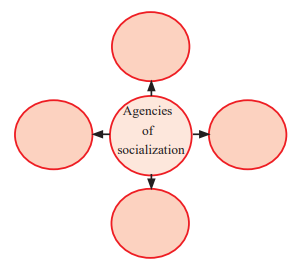
Concept Map:

  • Agencies of socialization: Family, School, Peer group, Mass media.

3. Types of Socialization

  • Childhood Socialization: Occurs in early years, laying the foundation for personality and social behavior.
  • Adult Socialization: Continues as individuals adapt to new roles (e.g., marriage, parenthood) or societal changes.
  • Anticipatory Socialization: Preparing for future roles (e.g., students learning job skills).
  • Resocialization: A deliberate process to replace old norms with new ones, as in rehabilitation programs.

4. Importance of Socialization

  • Enables individuals to develop a sense of self and identity.
  • Facilitates social integration by teaching societal norms and values.
  • Ensures cultural continuity by passing traditions across generations.
  • Prepares individuals for various social roles and responsibilities.

5. Impact of Modern Influences

  • Internet: A global medium with positive effects (e.g., access to education, connectivity) and negatives (e.g., misinformation, addiction).
  • Mass Media: Influences consumer behavior and public opinion, sometimes creating emotional responses like panic through “breaking news.”
  • Peer Influence: Can lead to adoption of behaviors (e.g., language) outside home norms, shaping identity.

6. Challenges and Contemporary Issues

  • Over-reliance on Media: Excessive exposure can lead to reduced face-to-face interaction and mental health issues.
  • Cultural Conflicts: Globalization and internet exposure may create clashes between traditional and modern values.
  • Cyberbullying: Online platforms pose risks to social and emotional well-being.

Summary

  • Socialization is a lifelong process of learning societal norms, beginning with primary agencies like family and extending to secondary agencies like school and mass media.
  • It shapes the “self” (Mead’s theory), ensures social order, and adapts individuals to changing environments through resocialization.
  • Modern tools like the internet and media enhance connectivity but also introduce challenges like misinformation and behavioral shifts.

Questions Answers Class 11 Chapter 6 Sociology Maharashtra Board

Socialization

1. (A) Choose the correct alternative and complete the statements.

(1) The process whereby an individual learns to conform to the norms of society is04huj called ___. (assimilation, socialization, cooperation)

Answer: socialization

(2) Family is a ___ agency of socialization. (primary, secondary, tertiary)

Answer: primary

(3) School is a/an ____ agency of socialization. (primary, secondary, tertiary)

Answer: secondary

(4) Television is a/an ___ medium of communication. (audio, visual, audiovisual)

Answer: audiovisual


1. (B) Correct the incorrect pair.

(1) (i) Language, behaviour – family
(ii) Social values like friendship – peer group
(iii) Teamwork, discipline – neighborhood
(iv) To build opinion – mass media

Answer: Corrected pair: Teamwork, discipline – school


1. (C) Identify the appropriate term from the given options.

Internet, Peer group, Childhood socialization

1. Takes place in the early years of life: Childhood socialization

2. Global impact in today’s world: Internet


1. (D) Correct underlined words and complete the sentence

(1) Radio is an audiovisual medium.

Answer: Radio is an audio medium.

(2) Peer group is an example of an authoritarian agency.

Answer: Peer group is an example of an informal agency.


2. Write short notes.

(1) Formation of ‘self’ according to Mead

Answer: George Herbert Mead proposed that the “self” develops through social interaction, divided into the “I” (spontaneous self) and the “me” (socialized self). The process occurs in stages: imitation (infancy), play (taking others’ roles), and game (understanding multiple roles), shaped by the generalized other. This reflects how individuals internalize societal norms to form identity.

(2) Agencies of socialization

Answer: Agencies of socialization are institutions or groups that teach individuals societal norms. Primary agencies (e.g., family) influence early learning, while secondary agencies (e.g., school, peer group, mass media) shape later development. They collectively mold behavior, values, and identity through interaction.

(3) Resocialization

Answer: Resocialization is the process of unlearning old norms and adopting new ones, often in controlled settings like prisons or monasteries. It involves a break from past identity, followed by retraining, ensuring adaptation to new roles or environments.


3. Explain the following concept with an example.

(1) Primary socialization

Answer: Primary socialization occurs in early childhood within the family, where basic values, language, and behavior are learned. For example, a child learns to say “please” and “thank you” from parents, forming the foundation of social interaction.

(2) Secondary socialization

Answer: Secondary socialization happens later through institutions like schools or peer groups, refining social skills and norms. For instance, a student learns teamwork and discipline in school through group projects, extending beyond family influence.


4. (A) Complete the concept map.

Answer: Agencies of socialization

  • Family
  • School
  • Peer group
  • Mass media

4. (B) State whether the following statements are True or False with reasons.

(1) Socialization is a life-long process.

Answer: True

  • Reason : Socialization continues throughout life as individuals adapt to new roles (e.g., parenthood, retirement) and societal changes, reinforced by ongoing interactions with agencies like media.

(2) Advertisements influence consumer behaviour.

Answer: True

  • Reason: Advertisements shape preferences and purchasing decisions by promoting products through persuasive visuals and slogans, as seen in increased sales of advertised brands.

5. Give your personal response.

(1) ‘Breaking News’ tends to create panic or emotional responses. Why do you think this happens? Give relevant examples to illustrate.

Answer: I believe “Breaking News” creates panic or emotional responses because it often highlights sudden, dramatic events like natural disasters or crimes, triggering fear or anxiety. For example, continuous coverage of a terrorist attack can lead to public unease, while sensationalized health alerts (e.g., a new virus outbreak) may cause overreactions like hoarding supplies. The urgency and repetition amplify emotions, often overshadowing balanced reporting.

(2) The use of ‘unacceptable language’ is often picked up by children even if this kind of language is not used within the home. Explain how this might happen.

Answer: This can happen through secondary socialization, where children are exposed to peer groups or mass media, like movies or social media, using such language. For instance, a child might adopt slang or profanity heard from friends at school or on TV shows, as they seek acceptance or mimic popular trends, overriding home-taught values.


6. Answer the following question in detail (about 150-200 words)

You belong to a generation that has been exposed to the internet. Discuss how the internet has brought about positive and negative results.

Answer: The internet has profoundly shaped my generation, bringing both positive and negative outcomes. On the positive side, it has revolutionized access to information, enabling instant learning through online courses, research, and global news, which enhances education and awareness. Social connectivity has improved, with platforms like social media allowing me to maintain relationships across distances and engage in diverse communities, fostering cultural exchange. Economically, it has opened opportunities like e-commerce and remote work, empowering entrepreneurship and flexibility. However, the negative impacts are significant. Excessive screen time can lead to addiction, reducing face-to-face interactions and affecting mental health, as seen with increased anxiety among peers. Misinformation spreads rapidly, with fake news influencing opinions, such as during elections or health crises like COVID-19, causing confusion. Privacy concerns arise from data breaches and online tracking, compromising personal security. Additionally, cyberbullying and exposure to inappropriate content pose risks, especially to younger users. In conclusion, while the internet offers unparalleled benefits like knowledge and connectivity, its challenges—addiction, misinformation, and privacy issues—require balanced usage and digital literacy to mitigate its downsides effectively.

Important Questions Class 11 Chapter 5 Sociology Maharashtra Board

Culture

Short Questions

1. Who first used the term “culture” in 1871?

Answer: Edward Tylor first used the term “culture” in 1871.

2. What does material culture consist of?

Answer: Material culture consists of tangible, man-made objects like clothing and computers.

3. Define non-material culture.

Answer: Non-material culture refers to abstract ideas such as norms, values, and beliefs.

4. What is cultural lag?

Answer: Cultural lag is the gap between the rapid change in material culture and the slow change in non-material culture.

5. Give an example of high culture.

Answer: An example of high culture is the classical music of Mozart.

6. What is folk culture?

Answer: Folk culture is the traditional culture of ordinary people, like Lavani in Maharashtra.

7. Name a component of culture.

Answer: A component of culture is language.

8. What are symbols in culture?

Answer: Symbols are objects or gestures representing something else, like a national flag.

9. What is the difference between folkways and mores?

Answer: Folkways are mild customs, while mores are strictly held moral beliefs.

10. How is culture transmitted?

Answer: Culture is transmitted through language, elders, and social interactions.

11. What is ethnocentrism?

Answer: Ethnocentrism is the belief that one’s own culture is superior to others.

12. Give an example of cultural hybridization.

Answer: An example of cultural hybridization is Italian pizza with tandoori paneer topping.

13. What is the importance of language in culture?

Answer: Language is the chief vehicle for transmitting and preserving culture.

14. How does culture benefit society?

Answer: Culture benefits society by fostering social solidarity and economic growth through tourism.

15. What is glocalization?

Answer: Glocalization is the adaptation of global products to local cultures, like Indianized McDonald’s burgers.

Long Questions

1. Explain the concept of material and non-material culture with examples.

Answer: Material culture includes tangible objects created by humans, such as roads, jewelry, and smartphones, which enhance daily life and change rapidly. Non-material culture comprises abstract elements like norms, values, and beliefs, such as respect for elders or religious practices, which evolve slowly. The difference lies in their tangibility and rate of change, with material culture adapting faster than non-material culture, leading to cultural lag.

2. Describe the characteristics of culture.

Answer: Culture is acquired through socialization and not inherited biologically, making it a learned behavior passed down generations. It is abstract, existing in the minds and habits of people, and shared among a group to foster unity and identity. Additionally, it is man-made, continually changing, and varies across societies, with language serving as its primary transmission tool.

3. What is cultural hybridization, and how does globalization contribute to it?

Answer: Cultural hybridization is the blending of different cultural elements to create new practices, such as celebrating Valentine’s Day with Indian traditions or fusion food like tandoori pizza. Globalization accelerates this process by enabling the easy flow of migration, information, and goods, allowing cultures to interact and mix. This results in diverse, innovative cultural expressions that reflect both global and local influences.

4. Discuss the social benefits of culture with examples.

Answer: Culture promotes social solidarity by bringing communities together through festivals and fairs, enhancing cohesion and tolerance, as seen in events like Diwali. It also boosts economic growth through cultural tourism, with attractions like the Taj Mahal creating jobs and infrastructure. Furthermore, it fosters pride and belonging by preserving shared heritage, strengthening societal bonds.

5. Explain the concept of ethnocentrism and its positive and negative aspects.

Answer: Ethnocentrism is the tendency to view one’s own culture as superior and judge others by its standards, a concept coined by William Graham Sumner. Positively, it boosts group cohesion and pride, reinforcing cultural identity, while negatively, it can lead to arrogance and bias, ignoring valuable aspects of other cultures. This dual nature makes it a significant factor in intercultural relations.

6. What are the components of culture, and how do they function in society?

Answer: The components of culture include symbols (e.g., flags), language (a communication tool), knowledge (coping skills), values and beliefs (moral standards), and norms (behavioral rules). These elements function together to enable social interaction, transmit cultural heritage, and regulate behavior, ensuring a cohesive societal structure. For instance, language helps pass down knowledge, while norms guide daily conduct.

7. Differentiate between high culture and popular culture with examples.

Answer: High culture refers to elite, aesthetically superior creations like classical music by Beethoven or Shakespeare’s literature, appreciated by a refined audience. Popular culture, in contrast, is widely enjoyed by the masses without expertise, such as Star Wars films or Harry Potter books. The distinction lies in status and accessibility, with high culture being exclusive and popular culture being inclusive.

8. How does culture change over time, and what factors influence this change?

Answer: Culture changes gradually as beliefs, traditions, and languages evolve, influenced by migration, globalization, and technological advancements like mobile phones altering communication etiquette. Education and awareness make newer generations more adaptable, leading to the discontinuation or simplification of rituals. This dynamic process reflects society’s response to internal and external pressures.

9. What is the role of language in the transmission of culture?

Answer: Language serves as the chief vehicle of culture by enabling the transmission of accumulated knowledge and traditions from past generations to the future, as seen in storytelling or proverbs. It acts as a common bond within groups, facilitating social activities and preserving cultural identity, unlike animals lacking specific language. Its evolution, such as through WhatsApp, further shapes cultural expressions.

10. Explain the concept of subculture with an example and its significance.

Answer: A subculture is a group within a larger society with distinct values and behaviors, such as the punk subculture with its unique fashion and music, setting it apart from mainstream norms. Its significance lies in providing identity and belonging to members, enriching cultural diversity, and reflecting societal variations. This diversity contributes to a broader understanding of human experiences within a culture.

Ads

HSC आणि SSC महाराष्ट्र – मराठी माध्यम – महाराष्ट्र बोर्ड

📘 महाराष्ट्र बोर्ड परीक्षा साहित्य (मराठी माध्यम)

  • HSC आणि SSC प्रश्नसंच – मराठी माध्यमातील PDF
  • महाराष्ट्र बोर्ड नमुना प्रश्नपत्रिका व मॉडेल पेपर्स (मराठी माध्यमात)
  • SSC आणि HSC च्या मागील वर्षांच्या प्रश्नपत्रिका – मराठी माध्यम
  • SSC/HSC साठी मराठी माध्यमातील नोट्स आणि सराव चाचण्या (मॉक टेस्ट)
  • मराठी माध्यमातील MCQs (बहुपर्यायी प्रश्न) समाविष्ट
  • सर्व परीक्षा साहित्य मराठी माध्यमात उपलब्ध

📗 महाराष्ट्र बोर्ड पाठ्यपुस्तके व PDF (मराठी माध्यम)

  • इयत्ता 10 वी (SSC) चे पाठ्यपुस्तक PDF – मराठी माध्यमात
  • इयत्ता 12 वी (HSC) चे पाठ्यपुस्तक PDF – मराठी माध्यमात
  • मराठी डायजेस्ट – PDF डाउनलोड
  • SSC आणि HSC इयत्तांची पुस्तके – मराठी माध्यमातील PDF
  • डाउनलोडसाठी उपलब्ध पाठ्यपुस्तके व PDF – महाराष्ट्र बोर्ड

📒 महाराष्ट्र बोर्डासाठी मराठी अभ्यास साहित्य

  • प्रकरणनिहाय नोट्स – मराठी माध्यमात
  • प्रकरणनिहाय प्रश्नोत्तरे (प्रश्न व उत्तरे) – मराठी माध्यमात
  • SSC आणि HSC साठी महत्त्वाचे प्रश्न – मराठी माध्यम
  • महत्त्वाच्या सूत्रांचा सारांश (इयत्ता 6 वी ते 12 वी)
  • MCQs, प्रश्नसंच, नमुना प्रश्नपत्रिका आणि मागील वर्षांच्या प्रश्नपत्रिका

CBSE Board Englsih and हिंदी माध्यम

CBSE Board

Mathematics Class 6
Science Class 6
Social Science Class 6
हिन्दी Class 6
सामाजिक विज्ञान कक्षा 6
विज्ञान कक्षा 6

Mathematics Class 7
Science Class 7
SST Class 7
सामाजिक विज्ञान कक्षा 7
हिन्दी Class 7

Mathematics Class 8
Science Class 8
Social Science Class 8
हिन्दी Class 8

Mathematics Class 9
Science Class 9
English Class 9

Mathematics Class 10
SST Class 10
English Class 10

Mathematics Class XI
Chemistry Class XI
Accountancy Class 11

Accountancy Class 12
Mathematics Class 12

Learn English
English Through हिन्दी
Job Interview Skills
English Grammar
हिंदी व्याकरण - Vyakaran
Microsoft Word
Adobe PhotoShop
Adobe Illustrator
Learn German
Learn French
IIT JEE
Privacy Policies, Terms and Conditions, About Us, Contact Us
Copyright © 2026 eVidyarthi and its licensors. All Rights Reserved.