
eVidyarthi
Menu
  • School
    • Close
    • CBSE English Medium
    • CBSE Hindi Medium
    • UP Board
    • Bihar Board
    • Maharashtra Board
    • MP Board
    • Close
  • English
    • Close
    • English Grammar for School
    • Basic English Grammar
    • Basic English Speaking
    • English Vocabulary
    • English Idioms & Phrases
    • Personality Enhancement
    • Interview Skills
    • Close
  • Sarkari Exam Preparation
    • Close
    • All Govt Exams Preparation
    • State Wise Competitive Exam Preparation
    • India – Notes for All Competitive Exams
    • MCQs & Notes for Competitive Exams
    • NCERT Syllabus for Competitive Exam
    • Close
  • Study Abroad
    • Close
    • Study in Australia
    • Study in Canada
    • Study in UK
    • Study in Germany
    • Study in USA
    • Close
  • Current Affairs
    • Close
    • Current Affairs
    • Current Affairs Quizzes
    • State Wise Current Affairs
    • Monthly Current Affairs
    • Close
Political Science Class 12 Maharashtra Board | Menu
  • MCQ Political Science Class 12 Maharashtra Board
  • Book Political Science Class 12 Maharashtra Board
  • Question Answers Political Science Class 12 Maharashtra Board
  • Notes Political Science Class 12 Maharashtra Board
  • Important Questions Political Science Class 12 Maharashtra Board
  • Political Science Class 12

Political Science Important Questions Chapter 6 Class 12 Maharashtra Board

Important Questions For All Chapters – Political Science Class 12

India and the World


Short Questions


1. What is the main goal of Indian foreign policy?
Answer: International peace and security

2. Which article of the Constitution mentions foreign policy?
Answer: Article 51

3. What is Non-Alignment?
Answer: Not joining any military alliance

4. Who gave the first speech on Indian foreign policy in 1946?
Answer: Jawaharlal Nehru

5. When was the first NAM summit held?
Answer: 1961

6. What does ASEAN stand for?
Answer: Association of Southeast Asian Nations

7. Which two countries signed a treaty in 1971 with India?
Answer: Soviet Union (Friendship Treaty)

8. What does ‘Look East Policy’ aim for?
Answer: Strengthening ties with East Asian countries

9. Which sea route project focuses on port development in India?
Answer: Sagarmala

10. Name India’s main trading partner in Southeast Asia.
Answer: Singapore

11. Which country supported India in the 1971 Bangladesh war?
Answer: Soviet Union

12. Which organisation was created for Indian Ocean cooperation?
Answer: IORA (Indian Ocean Rim Association)

13. Which country does not share a direct border with India?
Answer: Afghanistan

14. What kind of government did India help Bhutan establish?
Answer: Constitutional monarchy

15. What does the Bharatmala project focus on?
Answer: Road connectivity


Long Questions


1. What are the main objectives of Indian foreign policy?
Answer: The objectives include promoting peace, protecting sovereignty, boosting economic growth, and ensuring national security. Since the 1990s, integration with the global economy has also been a priority.

2. Explain the principle of Non-Alignment.
Answer: India followed a policy of staying neutral in Cold War politics. It avoided military alliances and promoted peaceful co-existence and independent foreign policy.

3. What were Nehru’s views on foreign policy in his 1946 speech?
Answer: Nehru emphasized peace, non-alignment, and friendly ties with major powers like the US, USSR, and China. He highlighted Asia’s importance in India’s foreign policy.

4. How did geography influence India’s foreign policy?
Answer: India’s long coastline, mountain borders, and central location in South Asia shaped its focus on regional security and oceanic control.

5. Describe India’s relations with the United States.
Answer: Initially tense during the Cold War, relations improved after 2000, especially post the 2008 Civil Nuclear Agreement. Today, India and the US are strategic and trade partners.

6. What is the nature of India-China relations?
Answer: The relationship has been both cooperative and tense. Despite trade and diplomatic efforts, border disputes and China’s support to Pakistan remain major issues.

7. What role does India play in the Indian Ocean region?
Answer: India ensures security of trade routes, protects maritime borders, and uses naval power to support foreign policy goals. Projects like Sagarmala enhance this role.

8. How has India’s foreign policy changed after 1991?
Answer: After liberalisation, India adopted a more interest-based foreign policy. It formed new trade, strategic and technological ties with major global powers.

9. What are India’s relations with its neighbours like?
Answer: India maintains mixed relations with neighbours. Ties with Bhutan and Bangladesh are friendly, but issues persist with Pakistan, China, and Sri Lanka.

10. Why is Africa important in India’s foreign policy?
Answer: Africa is vital for energy security, trade, strategic relations, and due to the Indian diaspora. India supports development and anti-colonial movements in Africa.
Political Science Notes Chapter 6 Class 12 Maharashtra Board

Notes For All Chapters – Political Science Class 12

India and the World


Objectives of India’s Foreign Policy

  • World Peace – India wants peace and safety in the whole world.
  • Sovereignty and Security – Protect India’s independence and borders.
  • Development – Grow the economy and create strong international relations.
  • Good Relations – Build strong ties with neighbors and important countries.
  • International Cooperation – Work together with other countries on global issues.

Principles of India’s Foreign Policy

  • Respect for all countries’ sovereignty.
  • Non-interference in other countries’ internal matters.
  • Peaceful co-existence and solving issues without war.
  • Follow international law.
  • Join and support international organizations like the UN.

Non-Alignment Movement (NAM)

  • India did not join any military alliance during the Cold War.
  • It kept equal distance from the USA and USSR.
  • Jawaharlal Nehru was one of the founders of NAM.

Factors Influencing India’s Foreign Policy

  • Geography – Long coastline, Himalayan borders, and being central in South Asia.
  • History – Culture of peace, past relations with neighbors, colonial experience.
  • Economy – Desire to develop and reduce poverty; started liberalization in 1991.
  • Politics – Leaders and Prime Ministers like Nehru, Indira Gandhi, Modi play a big role.
  • World Politics – Cold War, superpower rivalry, and now global alliances affect policy.

India’s Relations with Major Countries

USA

  • Not friendly during the Cold War.
  • Relations improved after 2000.
  • Signed Nuclear Deal in 2008.
  • Important trade and defense partner.

Russia (Earlier USSR)

  • Very close during Cold War.
  • Helped in defense and technology.
  • After 1990, relations continued with cooperation in weapons, oil, and nuclear energy.

China

  • Early friendship turned into conflict (1962 war).
  • Border issues continue.
  • Strong trade ties, but issues like Tibet, BRI, and China-Pakistan relations create tension.

India and Neighbors

Pakistan

  • Conflict since 1947 over Kashmir.
  • Wars in 1947, 1965, and 1971.
  • Terrorism and cross-border tensions continue.

Bangladesh

  • Created in 1971 with India’s help.
  • Friendly relations, though some border and water issues.

Nepal

  • Cultural and geographical ties.
  • Some tensions, but overall cooperation.

Bhutan

  • Very close and friendly relations.
  • India helps in Bhutan’s development.

Sri Lanka

  • Problem over Tamil issue and fishermen.
  • India helped with peacekeeping and has friendly ties now.

Myanmar

  • Relations improved after 1990s.
  • Important for handling insurgents and border security.

India and Other Regions

Africa

  • Supported freedom movements and anti-apartheid.
  • Focus on oil, trade, and Indian community.

Southeast Asia (Look East / Act East Policy)

  • Improved ties with Vietnam, Singapore, Indonesia, Thailand, Japan.
  • Focus on trade, defense, and regional security.

Indian Ocean Region

  • India’s long coastline gives strategic importance.
  • Most of India’s trade happens through the ocean.
  • Projects like Sagarmala aim to improve ports and shipping.
  • Member of Indian Ocean Rim Association (IORA) for cooperation.

India as an Emerging Power

  • Large population, fast-growing economy.
  • Nuclear and space power.
  • Important member of G20 and BRICS.
  • Active in world politics and diplomacy.

Political Science Question Answers Chapter 6 Class 12 Maharashtra Board

Question Answers For All Chapters – Political Science Class 12

India and the World


Exercise


Q.1 (A) Choose the correct alternative and complete the following statements:
Answer: 1. Nepal, Sikkim, Bhutan are known as Himalayan kingdoms.
2. The US regards India as a major partner in the Indo-Pacific region.

Q.1 (B) Identify the incorrect pair in the set. Correct it and rewrite.
Answer: Incorrect Pair: (b) ANZUS – Africa
Correct Pair: (b) ANZUS – Australia, New Zealand, United States
Explanation: ANZUS as a military alliance between the United States, Australia, and New Zealand (formed in 1951), not Africa. NATO pertains to Europe, and SEATO relates to Southeast Asia, which are correct.


Q.2 State whether the following statements are true or false with reason.
(1) Iran has been a traditional friend of India.
Answer: True – Iran has been a traditional friend of India.
Reason: India and Iran share historical, cultural and political ties dating back to the medieval period. Iran has supported India at various forums and has been a reliable partner in energy and regional connectivity.
(2) In changing world order of 1990s, the issue of terrorism has been dominant
Answer: False – In the changing world order of the 1990s, the issue of energy security and economic development became dominant, not terrorism (although terrorism did become a concern later).
(3) The Sagarmala project is a more comprehensive road connectivity plan.
Answer: False – The Sagarmala project is not a road connectivity plan; it is aimed at promoting port-led development. The Bharatmala project is focused on comprehensive road connectivity.


Q.3 Express your opinion.
India’s role in the Indian Ocean.
Answer: India plays a crucial role in the Indian Ocean region due to its strategic location. It has one of the longest coastlines and access to important sea routes. India ensures maritime security, anti-piracy operations, and safe trade passage through initiatives like the Sagarmala Programme. It also participates actively in the Indian Ocean Rim Association (IORA) and promotes regional cooperation. India’s Navy plays a significant role in projecting power and supporting peace in the region.


Q.4 Answer the following.
(1) Write a note on India’s relations with Africa.
Answer: India supported anti-colonial struggles and the fight against apartheid in Africa.
Indian oil companies have invested in African countries for energy security.
There is a large Indian diaspora in Eastern and Southern Africa.
India offers military training to African countries and contributes to peace in the Indian Ocean region.
India aims to increase technological, trade, and development cooperation with Africa.

(2) Discuss briefly India-China relations.
Answer: India and China initially had friendly relations and signed agreements in the 1950s.
Tensions rose due to border disputes in Aksai Chin and Arunachal Pradesh, leading to the 1962 war.
Relations improved with diplomatic efforts in the 1970s and 1980s.
Recent relations are complex – economic ties have grown, but border issues and China’s support to Pakistan remain major concerns.
Both nations cooperate in forums like WTO and on climate change, but competition and mistrust persist.


Q.5 Answer the following question in detail with help of the given points.
Explain the factors influencing India’s foreign policy.
Answer: (a) Geographical factors:
India’s location with vast coastlines and borders with countries like China affects security and foreign relations.
Dominance in the Indian Ocean gives India strategic maritime advantages.

(b) Historical factors:
India’s cultural tradition of peace, anti-colonialism, and past ties with Asian and African civilizations shape its foreign policy.

(c) Economical factors:
Post-independence, India focused on economic self-reliance.
Post-1991 liberalization connected India’s foreign policy with global trade, investment, and energy security.

(d) Political factors:
Leaders like Nehru, Indira Gandhi, and Modi have influenced foreign policy directions.
Institutions like the Ministry of External Affairs and National Security Advisor play key roles.

(e) International System:
During the Cold War, India followed non-alignment.
Post-Cold War, India pursued pragmatic relations based on national interest, adapting to changes in global power dynamics.

Political Science Important Questions Chapter 5 Class 12 Maharashtra Board

Important Questions For All Chapters – Political Science Class 12

Contemporary India: Good Governance


Short Questions


1. What is governance?
Answer: A cooperative effort of government and civil society.

2. What is good governance?
Answer: Citizen-centric and effective administration.

3. Which act gives citizens the right to seek government information?
Answer: Right to Information Act, 2005.

4. Name the country from which the idea of Lokpal came.
Answer: Sweden.

5. What is civil society?
Answer: NGOs, community groups, unions, etc.

6. What does RTI stand for?
Answer: Right to Information.

7. What does e-governance use?
Answer: Information and Communication Technology (ICT).

8. Which is the key value of good governance?
Answer: Accountability.

9. What does “suo moto” mean?
Answer: On its own motion.

10. What is a Citizens’ Charter?
Answer: A document of promised services by the government.

11. What makes governance citizen-centric?
Answer: People’s participation.

12. Name any one institution that protects human rights.
Answer: National Human Rights Commission.

13. Which state first introduced Lokayukta?
Answer: Maharashtra.

14. What is the main goal of good governance?
Answer: Public welfare.

15. What ensures equality under good governance?
Answer: Rule of Law.


Long Questions


1. What is the difference between government and governance?
Answer: Government is the official body to rule a country. Governance is a wider term including both government and civil society to ensure people’s welfare.

2. What are the core values of good governance?
Answer: Participation, transparency, accountability, responsiveness, efficiency, rule of law, equity, and consensus.

3. Why is the Right to Information important?
Answer: It helps citizens access government information and ensures transparency and accountability.

4. What is the function of the Lokpal?
Answer: Lokpal investigates complaints of corruption against government officials to promote clean governance.

5. What is the aim of e-governance?
Answer: To make services faster, transparent, and accessible using technology.

6. What is the role of the Second Administrative Reforms Commission?
Answer: It suggested reforms for a responsive, efficient, and citizen-centric administration.

7. What is meant by citizen-centric administration?
Answer: Administration that focuses on people’s needs, participation, and satisfaction.

8. What does the Citizens’ Charter provide?
Answer: Details about public services and their time limits to make administration accountable.

9. How does civil society help in governance?
Answer: Civil society supports the government in reaching and solving public issues.

10. What is the role of the National Commission for Women?
Answer: It addresses grievances and promotes development for women.

Political Science Notes Chapter 5 Class 12 Maharashtra Board

Notes For All Chapters – Political Science Class 12

Contemporary India: Good Governance


1. What is Good Governance?

  • Governance means managing public affairs by involving both government and non-government actors.
  • Good Governance focuses on making the system citizen-friendly, transparent, responsive, and accountable.
  • It’s more than just the government—it includes NGOs, private companies, and civil society.

2. Why the Need for Good Governance?

  • Due to globalization, tech revolution, and international pressure, public administration had to change.
  • Citizens today expect better, faster services.
  • Traditional systems were slow, full of delays and corruption. Reforms were needed.

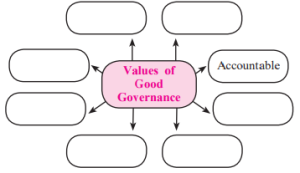
3. Values of Good Governance

ValueMeaning
ParticipationCitizens take part in decision-making.
Rule of LawEveryone is equal before the law.
TransparencyClear, open government actions.
ResponsivenessQuick and timely action by government.
Consensus OrientedAll sections work together for common goals.
Equity & InclusivenessNo one should feel left out.
Effectiveness & EfficiencyUse resources wisely and deliver results.
AccountabilityGovt. and officials answerable for actions.

4. Reforms & Initiatives in India

Key Initiatives:

  • Lokpal & Lokayukta Act (2013):
    • For fighting corruption.
    • Lokpal at national level, Lokayukta at state level.
    • Inspired by Sweden’s Ombudsman system.
  • Citizens’ Charter (1996):
    • Declares what services govt. offices provide, and in how much time.
    • Example: Passport in X days, Birth Certificate in Y days.
  • E-Governance:
    • Use of technology for faster, transparent service.
    • Ex: Online services like Aadhar, PAN, Driving Licence, etc.
  • Right to Information Act (2005):
    • Citizens can ask for any govt. information.
    • Promotes transparency and reduces corruption.
  • Citizen Participation:
    • People actively involved in governance.
    • Focus is on bottom-up approach (public voices matter).

5. Six Pillars of e-Governance (Maharashtra)

  • 1. Policy/Legal Framework
  • 2. Capacity Building of Staff
  • 3. Funding Mechanism
  • 4. Institutional Framework
  • 5. Core e-Governance Infrastructure (Data centers, etc.)
  • 6. Common Projects (e-Office, e-Tendering)

6. Institutions Protecting Citizens’ Rights

CommissionPurpose
National Commission for SCs/STsProtect rights of Dalits and Tribals.
National Human Rights Commission (NHRC)Safeguard human rights.
National Commission for Women (NCW)Protect and promote women’s rights.
National Commission for Protection of Child Rights (NCPCR)Safeguards child rights.
National Commission for Minorities (NCM)Protect rights of minority religions.
National Commission for Backward ClassesWelfare of socially & economically backward groups.
National Consumer Disputes Redressal Commission (NCDRC)Solves consumer complaints.

Political Science Question Answers Chapter 5 Class 12 Maharashtra Board

Question Answers For All Chapters – Political Science Class 12

Contemporary India: Good Governance


Exercise


Q.1 (A) Choose the correct alternative and complete the statements.
Answer: 1. The concept of Lokpal has been taken from Sweden.
2. Right to Information is one of the important aspects of Good Governance.

(B) State the appropriate concept for the given concept.
Person investigating complaints against government officials –
Answer: Ombudsman (or Lokpal/Lokayukta in the Indian context)
Explanation: An Ombudsman, such as the Lokpal at the national level or Lokayukta at the state level, is responsible for investigating complaints against government officials.


Q.2 (A) Compete the concept map.


Answer : Values of Good Governance
Participatory
Transparent
Responsive
Accountable
Follows Rule of Law
Consensus Oriented
Equitable and Inclusive
Effective and Efficient

(B) State whether the following statements are true or false with reason.
(1) Lokayukta can investigate complaints against political executives.
Answer : True – Lokayukta has the authority to investigate complaints against public servants, including political executives.

(2) Good Governance aims at efficient use of natural resources.
Answer : True – One of the values of Good Governance is “effectiveness and efficiency”, which includes sustainable use of resources.


Q.3 Explain co-relation between the following.
Good Governance and E-Governance.
Answer : Good governance and e-governance are closely related as e-governance serves as a tool to achieve the objectives of good governance. Good governance emphasizes values like transparency, accountability, responsiveness, and citizen participation in administration. E-governance, through the use of Information and Communications Technology (ICT), enhances these values by speeding up governmental processes, improving access to services, and increasing transparency. For instance, e-governance initiatives like online applications for certificates or the National e-Governance Plan make administration more efficient and citizen-centric, aligning with good governance goals. It reduces delays, minimizes corruption, and ensures that citizens can interact with the government more effectively, thus strengthening the principles of good governance.


Q.4 Express your opinion.
(a) E-governance speeds up governmental processes.
Answer : Yes, E-Governance allows for quick communication, easy storage and retrieval of data, and faster decision-making. This makes administrative work more efficient.

(b) E-governance brought administration closer to people.
Answer : Yes, with services like online applications for documents (PAN, Aadhaar, Birth Certificates), citizens can access government services easily from home, making administration more accessible.


Q.5 Answer the following in 80 to 100 words.
Explain various institutions protecting rights of different sections in India.
Answer :  In India, several institutions safeguard the rights of different sections of society. The National Commission for Scheduled Castes and Scheduled Tribes protect the constitutional rights of SCs and STs, addressing deprivation complaints. The National Human Rights Commission ensures protection of life, liberty, and dignity for all. The National Commission for Women promotes women’s socio-economic development, while the National Commission for Protection of Child Rights defends child rights (0-18 years). The National Commission for Minorities safeguards minority communities (e.g., Muslims, Sikhs), and the National Commission for Backward Classes focuses on the welfare of backward classes. These bodies ensure inclusivity and justice.


Q.6 Answer the following question in detail with help of given points.
Explain in detail the following values of Good Governance.
(a) Participation:
Participation is a cornerstone of good governance, ensuring that citizens actively engage in decision-making and implementation processes. It strengthens democracy by giving people a voice in policies affecting them. The document emphasizes that effective governance requires people’s involvement, as seen in initiatives like citizen participation programs, which transform traditional representative democracy into a participative one. This “bottom-up” approach empowers citizens to influence development.

(b) Transparency:
Transparency means openness in government functioning, allowing public scrutiny. The document notes that the Right to Information Act, 2005, challenges the culture of secrecy by enabling citizens to access information about policies and actions. This fosters trust, reduces corruption, and ensures that administrative decisions are predictable and objective, aligning with good governance principles.

(c) Responsiveness:
Responsiveness requires institutions to address stakeholders’ needs promptly. According to the document, good governance demands that the government listens to citizens’ problems and designs timely policies. For example, quick grievance redressal and efficient service delivery (e.g., through e-governance) reflect responsiveness, ensuring administration meets public expectations effectively.

(d) Accountability:
Accountability ensures that government, private sector, and civil society organizations are answerable to the public. The document explains that it depends on transparency and the rule of law. For instance, the Lokpal and Citizens’ Charters hold officials accountable by setting service standards and investigating corruption. This ensures decisions benefit citizens and promotes trust in governance.

Political Science Important Questions Chapter 4 Class 12 Maharashtra Board

Important Questions For All Chapters – Political Science Class 12

Contemporary India: Challenges to Peace, Stability and National Integration


Short Questions


1. What is a nation?
Answer: A community with a sense of unity.

2. What does nationalism mean?
Answer: A feeling of political identity.

3. What is the main job of the State?
Answer: Maintaining peace and order.

4. What is national integration?
Answer: Uniting diverse groups into one identity.

5. Name one challenge to India’s peace.
Answer: Cross-border terrorism.

6. What is the ‘Salad Bowl’ concept?
Answer: A society with diverse cultures coexisting.

7. When did India become independent?
Answer: 1947.

8. What is Left Wing Extremism?
Answer: Violent communist movements.

9. What does secularism promote?
Answer: Religious equality.

10. What is the role of democracy in India?
Answer: Promotes national integration.

11. Name one symbol of Indian unity.
Answer: National Flag.

12. What caused the Kashmir conflict in 1947?
Answer: Pakistan sent tribal raiders.

13. What is the Naxalite movement?
Answer: A peasant uprising against feudalism.

14. What is terrorism?
Answer: Violence to create panic.

15. What replaced the Planning Commission?
Answer: NITI Aayog.


Long Questions


1. What are the main challenges to peace in India?
Answer: India faces challenges like communal riots, caste violence, terrorism, and Naxalism due to diversity, poverty, and poor governance.

2. How does the State ensure national integration?
Answer: The State promotes unity through democracy, dialogue with diverse groups, and constitutional measures like federalism and language recognition.

3. What is the difference between a ‘Melting Pot’ and a ‘Salad Bowl’?
Answer: A ‘Melting Pot’ blends cultures into one, while a ‘Salad Bowl’ keeps cultural identities distinct but united in a plural society.

4. Why is peace important for a nation’s progress?
Answer: Peace ensures stability, economic growth, and social harmony, allowing development without disruptions from violence or unrest.

5. How did the Indian Constitution help national integration?
Answer: It provided democracy, federal structure, and recognized regional languages, balancing unity with diversity.

6. What is the role of the State in economic development?
Answer: The State facilitates industrial and agricultural growth, ensuring economic stability and well-being for citizens.

7. What was the first major challenge India faced after independence?
Answer: Integrating princely states like Jammu and Kashmir into the Indian Union was a key challenge.

8. How did the freedom movement help national integration?
Answer: It united diverse groups under Indian nationalism, creating a shared political identity and emotional bond.

9. What is Cross Border Terrorism in Jammu and Kashmir?
Answer: It involves Pakistan-sponsored militants crossing into India to create violence and instability in Jammu and Kashmir.

10. What are the goals of Left Wing Extremism in India?
Answer: Left Wing Extremists aim to overthrow the government through armed insurgency, targeting rural and underdeveloped areas.

Political Science Notes Chapter 4 Class 12 Maharashtra Board

Notes For All Chapters – Political Science Class 12

Contemporary India: Challenges to Peace, Stability and National Integration


1. Introduction

  • India is a democratic country with many different views due to its diverse society (caste, religion, poverty, illiteracy, languages, etc.).
  • Problems like riots, caste violence, and protests disturb peace.
  • Poor governance and weak law enforcement make these issues worse.
  • Peace and stability are important for a country’s growth and unity.

2. Key Concepts

Nation: A group of people who feel united due to shared culture, history, language, or religion.
Nationalism: A feeling of pride and identity that unites people in a nation.
State: A nation becomes a state when it has a government, land, people, and power (sovereignty).
National Integration: Bringing all diverse groups together to form one united nation without erasing their differences.


3. Role of the State

The State has five main roles to keep the country united and peaceful:

1. Peace and Order: Protects people and maintains law to keep society stable.
2. Economic Development: Helps industries and farming grow to improve people’s lives.
3. Nation Building: Ensures diversity doesn’t break the country apart; promotes unity.
4. Governance: Involves people in decision-making (democracy).
5. Welfare: Works for fairness and supports weaker sections of society.

These roles are based on values like nationalism, secularism, and democracy.


4. National Integration

It means creating a common identity (e.g., “Indian”) while respecting differences (like being Marathi, Tamil, Hindu, Muslim, etc.).

It’s like a “Salad Bowl”: Every group keeps its own identity but adds to the whole (unlike a “Melting Pot,” where all identities mix into one).

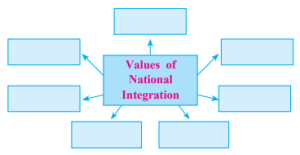
Values of National Integration:

  • Common citizenship
  • Unity in diversity
  • Loyalty to the nation
  • Brotherhood among all groups
  • Secularism (no religion favored)
  • Justice and equality

5. India’s Efforts After Independence (1947)

Challenges: Poverty, illiteracy, inequality, and uniting diverse groups.
Goals: Nationalism, democracy, secularism, economic growth, and social change.
Steps Taken:

  • Structural:
    • Constitution gave voting rights to all (democracy).
    • Federal system: Strong central government + state powers.
    • Recognized many languages and reorganized states based on them.
    • Created National Integration Council (1961) to fight communalism and regionalism.
  • Psychological:
    • Freedom movement united people as “Indians.”
    • Symbols like the National Flag, Anthem, and Emblem built emotional unity.

6. Challenges to Peace and Stability

India faced many issues that threatened its unity:

a. Integration of Princely States

  • After 1947, princely states like Jammu & Kashmir, Hyderabad, and Junagadh had to join India or Pakistan. Some caused conflicts.

b. Regional and Militant Movements

  • Naxalism (Left Wing Extremism):
    • Started in 1967 in Naxalbari (West Bengal) as a peasant protest.
    • Now called CPI (Maoist), it uses violence to overthrow the government.
    • Active in rural, poor areas; supported by tribals, dalits, and landless workers.
  • North East Issues:
    • States like Nagaland, Manipur, and Assam faced militancy due to cultural diversity and lack of development.
  • Khalistan Movement:
    • In Punjab, a violent demand for a separate Sikh state in the 1980s led to Indira Gandhi’s assassination.

c. Cross Border Terrorism in Jammu & Kashmir

  • Started with Pakistan sending raiders in 1947 to force Kashmir to join them.
  • Groups like JKLF and Hizb-ul-Mujahideen demanded independence or merger with Pakistan.
  • 1990s: Islamic militancy grew, forcing Kashmiri Pandits to leave.
  • 2019: Article 370 removed; Jammu & Kashmir split into two Union Territories.

d. Terrorism

  • Violent attacks on civilians to create fear (e.g., Mumbai blasts 1993, 2008; Parliament attack 2001).
  • Old Terrorism: Fought for specific rights (e.g., LTTE in Sri Lanka).
  • Modern Terrorism: Fights for global ideological goals (e.g., 9/11 attack).

7. Role of the State in Crisis

  • Basic Level: Ensures stability, growth, and welfare using the Constitution.
  • Second Level: Solves early problems (e.g., demands for language-based states) by giving more representation or jobs.
  • Third Level: Handles violent crises (e.g., Gorkhaland) with force, development boards, or autonomy.

8. Conclusion

  • Peace, stability, and national integration are vital for India’s progress.
  • The State must balance unity and diversity while tackling challenges like terrorism, extremism, and regional demands.

Political Science Question Answers Chapter 4 Class 12 Maharashtra Board

Question Answers For All Chapters – Political Science Class 12

Contemporary India: Challenges to Peace, Stability and National Integration


Exercise


Q.1 (A) Choose the correct alternative and complete the following statements.
Answer : (1) Rajiv Gandhi was assassinated for having taken decision of the Tamil question in Sri Lanka.
(2) The first national integration conference was held in 1961.

(B) Identify incorrect pair in every set, correct it and rewrite.
Answer : 1. Incorrect Pair: (iii) Basque Fatherland and Liberty (CTA) – Portugal
Correct Pair: (iii) Basque Fatherland and Liberty (ETA) – Spain

2. Incorrect Pair: (i) Boko Haram – Bangladesh
Correct Pair: (i) Boko Haram – Nigeria

(C) Complete the following statements by using appropriate reason.
(1) The left wing extemists prevent execution and implementation of developmental work, because –
Answer : (iii) they want to show that the government structure at field level is ineffective.

(2) In 1990’s Kashmiri Pandits migrated from Kashmir valley, because –
Answer : (ii) there was growth in Islamic militancy.


Q.2 (A) Find the odd word in the given set.
Terrorism, Naxalism, Nationalism, Extremism
Answer : Nationalism (Because the others involve violent or extremist ideologies.)

(B) State the appropriate concept for the given statement.
Answer : (1) Threat use violence with an intention to create panic in the society – Terrorism
(2) Involvement of people in decision making process of state – Governance


Q.3 (A) Complete the concept map.

Answer : Common Citizenship
Unity in Diversity
Loyalty to the Nation
Sense of Fraternity
Secularism
Socio-Economic and Political Justice
Equality

(B) State whether the following statements are true or false with reason.
(1) Democracy is required to establish national integration and social transformation.
Answer : True – Democracy ensures participation of all communities, promoting unity and reducing inequality.
(2) National movement in India played an important role in national integration.
Answer : True – The freedom struggle helped unite people with diverse backgrounds under the identity of being Indian.


Q.4 Explain the co-relation between the following.
National Unity and Regional Aspirations
Answer : National unity aims to bring diverse communities under a common identity, while regional aspirations reflect the desire for recognition and development of specific cultural, linguistic, or ethnic groups. A strong democracy accommodates these aspirations through federalism, ensuring that unity does not mean uniformity but mutual respect and cooperation.


Q.5 Express your opinion.
Peace and stability are needed for the nation’s progress.
Answer : Peace and stability are essential for any nation’s development. Without them, there can be no sustained economic growth, political governance, or social justice. Public disorder hampers productivity and weakens institutions, making it harder to address issues like poverty, inequality, and education. Stability builds trust and encourages investment and innovation.


Q.6 Answer the following in 80 to 100 words.
(1) What is left wing extremism in India?
Answer : Left Wing Extremism (LWE), also known as Naxalism or Maoism, is an armed insurgency aimed at overthrowing the government. Originating in 1967 at Naxalbari, West Bengal, it draws support from landless laborers, Dalits, and tribals who feel neglected by the state. Inspired by Marxist-Leninist-Maoist ideology, it gained momentum with the formation of the CPI (Maoist) in 2004. Operating in rural, underdeveloped areas, LWE disrupts development projects to weaken governance, using violence, propaganda, and mobilization of marginalized groups, posing a significant challenge to India’s stability.

(2) Explain cross border terrorism in Jammu and Kashmir.
Answer :  Cross-border terrorism in Jammu and Kashmir refers to violence sponsored by Pakistan to destabilize the region. It began in 1947 with tribal raiders, escalating in the 1980s-90s with groups like JKLF and Hizb-ul-Mujahideen, backed by Pakistan’s ISI. The insurgency turned Islamic, causing the Kashmiri Pandit migration. Tactics include infiltration, attacks on security forces, stone-throwing, and school burnings. Key events include the 2016 Uri attack and 2019 Pulwama bombing by Pakistan-based Jaish-e-Mohammed. India views this as a core issue in Indo-Pak relations, impacting regional peace.


Q.7 Answer the following in 150 to 200 words.
Explain the role of the State with help of given points.
Answer : (a) Peace and Order: The primary role of the State is to maintain peace, law, and order within its territory. A peaceful society provides the foundation for all other aspects of development – political, economic, and social. Without peace, governance becomes ineffective, and citizens suffer from insecurity and fear.

Maintaining public order involves preventing riots, communal violence, terrorism, and insurgency. The State achieves this by enforcing laws, using police and security forces, and promoting justice. A secure environment encourages investment, boosts productivity, and helps ensure social harmony.

Peace is not only about the absence of conflict, but also about resolving disputes through dialogue, negotiations, and constitutional means. When citizens believe in the justice system and the rule of law, they are less likely to resort to violence.

The Indian Constitution empowers the State to protect its people and uphold democratic values. During times of crisis—like terrorism in Jammu & Kashmir or Left-Wing Extremism—the State uses both preventive and corrective measures to restore peace.

Thus, peace and order are crucial responsibilities of the State, and their successful maintenance ensures national integration, unity, and progress.

(b) Economic Development: Economic development is one of the most vital responsibilities of the State. It ensures the overall progress and prosperity of the nation by improving living standards, generating employment, and reducing poverty and inequality. The State plays the role of a facilitator and regulator in the economy, providing infrastructure, formulating policies, and supporting industries, agriculture, and services.

After independence, India adopted a mixed economy, where both the public and private sectors contribute to growth. The Planning Commission (now replaced by NITI Aayog) was established to guide economic planning through Five-Year Plans. The government invested heavily in industries, transport, energy, and education to lay the foundation for self-reliance.

In recent years, the focus has shifted towards liberalisation, privatisation, and globalisation (LPG), allowing more private and foreign investment. The State still plays a key role by launching schemes like Skill India, Make in India, and Digital India to boost employment and innovation.

Additionally, the State aims to reduce regional imbalances by promoting development in backward areas and encouraging public-private partnerships. Inclusive economic development not only strengthens the economy but also contributes to social stability and national integration.

(c) National Building: Nation building refers to the process of uniting diverse groups of people into a single national identity. In a country like India, with its vast diversity in language, religion, ethnicity, and culture, the role of the State in nation building becomes extremely important.

The State ensures that diversity does not lead to division. It does this by promoting values such as unity in diversity, secularism, democracy, and social justice. Nation building is closely linked to national integration, which means creating a sense of belonging and loyalty among all citizens, regardless of their background.

The Indian Constitution plays a vital role in nation building by guaranteeing fundamental rights, equality, and justice to all. Through the democratic process, the State involves people in governance, enabling every group to express its identity within a shared national framework.

Policies like language recognition, state reorganization, reservation for marginalized communities, and the establishment of institutions like the National Integration Council have helped India preserve unity.

In essence, the State fosters a national identity that respects regional and cultural diversity while promoting a shared sense of belonging. This is the true spirit of nation building.

(d) Governance: Governance refers to the process of decision-making and the way those decisions are implemented in a democratic system. Good governance ensures transparency, accountability, responsiveness, and participation of citizens in the functioning of the State.

In India, democratic governance allows people to elect their representatives and be part of policymaking. The State is responsible for creating structures and institutions that empower citizens and encourage their involvement. This includes decentralisation of power through Panchayati Raj Institutions, urban local bodies, and participatory planning processes.

Good governance means more than just functioning government—it includes the delivery of public services, protection of rights, and ensuring social and economic justice. Initiatives like Digital India, RTI (Right to Information), e-governance, and citizen charters have been launched to bring the government closer to the people.

Governance is crucial for addressing the needs of different sections of society, especially the marginalised. When people feel heard and respected, it strengthens their trust in the system and promotes national unity.

Therefore, governance is not only about administration but about involving citizens in building a better and more inclusive nation.

(e) Welfare: Welfare refers to the well-being of the citizens, and the State plays a crucial role in ensuring the social and economic welfare of its people. The State’s role in welfare is grounded in the principles of social justice, equality, and fairness, ensuring that every citizen, particularly the marginalized and vulnerable groups, has access to essential services like education, healthcare, housing, and employment.

In India, welfare is enshrined in the Constitution, which provides for fundamental rights and directive principles to promote the welfare of the people. Various social welfare schemes are implemented by the State to reduce poverty, inequality, and unemployment. Programs like National Rural Employment Guarantee Act (NREGA), Mid-Day Meal Scheme, Public Distribution System (PDS), and Right to Education (RTE) aim to improve the quality of life for citizens, especially those in rural and economically backward areas.

The welfare State also ensures that the resources of the nation are distributed equitably, and no group is left behind. This fosters social harmony and promotes national integration by reducing disparities.

Thus, the welfare function of the State is critical for ensuring a just society where every individual has the opportunity to lead a dignified life.

Political Science Important Questions Chapter 3 Class 12 Maharashtra Board

Important Questions For All Chapters – Political Science Class 12

Key Concepts and Issues since 1991: Humanitarian Issues


Short Questions


1. What is the environment?
Answer: Everything around us.

2. When was the UN Conference on Human Environment held?
Answer: 1972.

3. Where was the Rio Earth Summit held?
Answer: Rio de Janeiro.

4. What does sustainable development focus on?
Answer: Future needs.

5. What causes climate change?
Answer: Greenhouse gases.

6. What is deforestation?
Answer: Cutting trees.

7. What is water scarcity?
Answer: Lack of water.

8. What is the goal of environmental sustainability?
Answer: Protect resources.

9. What is poverty according to tradition?
Answer: Lack of basics.

10. When was MGNREGA launched?
Answer: 2005.

11. What does women empowerment mean?
Answer: Gaining control.

12. When did the UN Decade for Women start?
Answer: 1975.

13. What is gender inequality?
Answer: Unequal treatment.

14. When was the National Commission for Women set up?
Answer: 1990.

15. What is the Planning Commission replaced by?
Answer: NITI Aayog.


Long Questions


1. What was the purpose of the 1972 UN Conference on Human Environment?
Answer: It aimed to encourage protection and improvement of the human environment by setting guidelines for nations.

2. How does deforestation affect the environment?
Answer: It increases CO2 in the atmosphere, worsens global warming, and threatens animals and humans who depend on forests.

3. What is the difference between traditional and non-traditional views of poverty?
Answer: Traditional poverty focuses on lack of food and shelter, while non-traditional includes wellbeing, participation, and sustainability.

4. What was the goal of the Rio Earth Summit in 1992?
Answer: It sought international cooperation to integrate environment and development for a healthy planet.

5. How does the Indian government tackle environmental issues?
Answer: The Ministry of Environment, Forest and Climate Change makes policies to conserve resources and reduce pollution.

6. What is the role of the Green Revolution in India?
Answer: It introduced high-yielding seeds and better farming methods in the 1960s to make India self-sufficient in food grains.

7. How has India’s development strategy changed since 1991?
Answer: India shifted from a socialist approach to economic liberalization, encouraging private sector growth and reforms.

8. Why is women’s empowerment important for sustainable development?
Answer: Empowering women ensures equal participation in society, which supports balanced growth and resource use.

9. What are some poverty alleviation programs in India?
Answer: Programs like MGNREGA and Pradhan Mantri Gramin Awaas Yojana provide jobs and housing to reduce poverty.

10. What are the key gender issues faced by women in India?
Answer: Women face economic inequality, low literacy, trafficking, and poor political representation despite legal rights.

Ads

HSC आणि SSC महाराष्ट्र – मराठी माध्यम – महाराष्ट्र बोर्ड

📘 महाराष्ट्र बोर्ड परीक्षा साहित्य (मराठी माध्यम)

  • HSC आणि SSC प्रश्नसंच – मराठी माध्यमातील PDF
  • महाराष्ट्र बोर्ड नमुना प्रश्नपत्रिका व मॉडेल पेपर्स (मराठी माध्यमात)
  • SSC आणि HSC च्या मागील वर्षांच्या प्रश्नपत्रिका – मराठी माध्यम
  • SSC/HSC साठी मराठी माध्यमातील नोट्स आणि सराव चाचण्या (मॉक टेस्ट)
  • मराठी माध्यमातील MCQs (बहुपर्यायी प्रश्न) समाविष्ट
  • सर्व परीक्षा साहित्य मराठी माध्यमात उपलब्ध

📗 महाराष्ट्र बोर्ड पाठ्यपुस्तके व PDF (मराठी माध्यम)

  • इयत्ता 10 वी (SSC) चे पाठ्यपुस्तक PDF – मराठी माध्यमात
  • इयत्ता 12 वी (HSC) चे पाठ्यपुस्तक PDF – मराठी माध्यमात
  • मराठी डायजेस्ट – PDF डाउनलोड
  • SSC आणि HSC इयत्तांची पुस्तके – मराठी माध्यमातील PDF
  • डाउनलोडसाठी उपलब्ध पाठ्यपुस्तके व PDF – महाराष्ट्र बोर्ड

📒 महाराष्ट्र बोर्डासाठी मराठी अभ्यास साहित्य

  • प्रकरणनिहाय नोट्स – मराठी माध्यमात
  • प्रकरणनिहाय प्रश्नोत्तरे (प्रश्न व उत्तरे) – मराठी माध्यमात
  • SSC आणि HSC साठी महत्त्वाचे प्रश्न – मराठी माध्यम
  • महत्त्वाच्या सूत्रांचा सारांश (इयत्ता 6 वी ते 12 वी)
  • MCQs, प्रश्नसंच, नमुना प्रश्नपत्रिका आणि मागील वर्षांच्या प्रश्नपत्रिका

CBSE Board Englsih and हिंदी माध्यम

CBSE Board

Mathematics Class 6
Science Class 6
Social Science Class 6
हिन्दी Class 6
सामाजिक विज्ञान कक्षा 6
विज्ञान कक्षा 6

Mathematics Class 7
Science Class 7
SST Class 7
सामाजिक विज्ञान कक्षा 7
हिन्दी Class 7

Mathematics Class 8
Science Class 8
Social Science Class 8
हिन्दी Class 8

Mathematics Class 9
Science Class 9
English Class 9

Mathematics Class 10
SST Class 10
English Class 10

Mathematics Class XI
Chemistry Class XI
Accountancy Class 11

Accountancy Class 12
Mathematics Class 12

Learn English
English Through हिन्दी
Job Interview Skills
English Grammar
हिंदी व्याकरण - Vyakaran
Microsoft Word
Adobe PhotoShop
Adobe Illustrator
Learn German
Learn French
IIT JEE
Privacy Policies, Terms and Conditions, About Us, Contact Us
Copyright © 2026 eVidyarthi and its licensors. All Rights Reserved.