
eVidyarthi
Menu
  • School
    • Close
    • CBSE English Medium
    • CBSE Hindi Medium
    • UP Board
    • Bihar Board
    • Maharashtra Board
    • MP Board
    • Close
  • English
    • Close
    • English Grammar for School
    • Basic English Grammar
    • Basic English Speaking
    • English Vocabulary
    • English Idioms & Phrases
    • Personality Enhancement
    • Interview Skills
    • Close
  • Sarkari Exam Preparation
    • Close
    • All Govt Exams Preparation
    • State Wise Competitive Exam Preparation
    • India – Notes for All Competitive Exams
    • MCQs & Notes for Competitive Exams
    • NCERT Syllabus for Competitive Exam
    • Close
  • Study Abroad
    • Close
    • Study in Australia
    • Study in Canada
    • Study in UK
    • Study in Germany
    • Study in USA
    • Close
  • Current Affairs
    • Close
    • Current Affairs
    • Current Affairs Quizzes
    • State Wise Current Affairs
    • Monthly Current Affairs
    • Close

Question Answers Class 8 Chapter 4.5 Balbharati English Maharashtra Board

A Battle to Baffle

English Workshop – Solutions

1. Read the following words and use them in sentences of your own.

  • Renown,
  • defiance,
  • exiled,
  • predicament,
  • diffident,
  • benign

Answer:

Renown: Pundit Shahane earned great renown across India for his mastery of scriptures.

Defiance: The emperor was surprised by Pundit Shahane’s defiance in challenging all the pundits of Vijayanagar.

Exiled: The emperor threatened to have the first scholar exiled if his suggestion was not useful.

Predicament: The courtiers found themselves in a predicament when no one dared to face Pundit Shahane.

Diffident: The pundits of Vijayanagar felt diffident about taking up the scholar’s challenge.

Benign: The emperor gave his benign permission to Mantriji to summon the scholars.


2. Read the following phrases and use them in the sentences of your own in proper form.

• voice something
• outwit
• a tight corner
• concede defeat

Answer:

Voice something: The first scholar decided to voice something helpful to save the court from embarrassment.

Outwit: Tenali Raman managed to outwit Pundit Shahane with his clever trick.

A tight corner: The pundits were in a tight corner when they couldn’t respond to the challenge.

Concede defeat: Pundit Shahane had no choice but to concede defeat when he couldn’t debate Tenali Raman.


3. Pick out dialogues of Tenali Raman that prove that he had the following qualities.

(a) Wit and wisdom
(b) Self-confidence
(c) Politeness
(d) Humility

Answer:

(a) Wit and wisdom:

  • “Let us begin by discussing the merits of ’tila-kashta-mahisha-bandhana'” – This shows his cleverness in inventing a fake scripture to confuse Pundit Shahane.
  • “Maharaj, ’til’ is sesame ‘Kashta’ is a stick… this is the ’tila-kashta-mahishabandhana'” – His explanation reveals his witty and wise wordplay.

(b) Self-confidence:

  • “Most certainly, Your Majesty. Let me assure you that I shall not let you down” – This reflects his confidence in handling the challenge.

(c) Politeness:

  • “I am at your service, Your Highness. Your wish is my command” – This shows his respectful and polite demeanor toward the emperor.

(d) Humility:

  • “Your words of praise are my greatest reward, Your Highness” – This indicates his humility in valuing praise over material rewards.

4. Answer the following questions in short.

(a) What was Pundit Shahane’s claim as a scholar?

Answer: He claimed to have mastered all scriptures and won great renown across India.

(b) Why did Pundit Shahane visit Vijaynagar?

Answer: He visited to challenge all the pundits in the kingdom.

(c) What do you learn about Pundits of Vijaynagar?

Answer: They were knowledgeable but lacked the confidence to face Pundit Shahane’s challenge.

(d) What punishment did the emperor threaten the Pundits with?

Answer: He threatened to debar them from court and exile them.

(e) Why was Tenali Raman summoned to the court?

Answer: He was summoned to outwit Pundit Shahane and save the court’s reputation.

(f) On what condition did Tenali Raman agree to take up the challenge?

Answer: He agreed on the condition that he be accepted and honored as the Chief Pundit for one day.

(g) Why was Tenali Raman taken to the court in a palanquin?

Answer: He was brought in with honors as the Chief Pundit, as per Mantriji’s arrangement.

(h) How did Tenali Raman outwit Pundit Shahane?

Answer: He invented a fake scripture name, “tila-kashta-mahisha-bandhana,” which confused Pundit Shahane into conceding defeat.

(i) What did the bundle in silken cloth contain?

Answer: It contained sticks (sesame stems) tied with a coarse rope used to tie buffaloes.

(j) Explain the significance of the title.

Answer: “A Battle to Baffle” signifies the intellectual contest where Tenali Raman baffled Pundit Shahane with his wit, turning a scholarly battle into a clever victory.


5. Fill in the elements that you find in the drama script of ‘A Battle to Baffle.’

Characters:

• Background Scene:
• Crisis:
• Steps taken to resolve the crisis:
• Climax:
• The end:

Answer:

  • Characters: Tenali Raman, Krishnadevaraya, Pundit Shahane, Mantriji, courtiers, scholars, guards.
  • Background Scene: The courtroom of Emperor Krishnadevaraya with the emperor on his throne and courtiers seated.
  • Crisis: Pundit Shahane challenges the pundits, and none are willing to face him, risking the empire’s honor.
  • Steps taken to resolve the crisis: The courtiers suggest summoning Tenali Raman, who agrees to outwit the challenger.
  • Climax: Tenali Raman introduces the fake scripture “tila-kashta-mahisha-bandhana,” causing Pundit Shahane to concede defeat.
  • The end: The emperor praises Tenali Raman, who explains his trick, and everyone laughs as the court’s honor is restored.

6. Do as directed. (Make sure you do not change the meaning and tense of the sentence).

(a) Tenali Raman proved to be wittier than Pundit Shahane.(Rewrite using ‘as witty as’)

Answer: Rewrite: Pundit Shahane was not as witty as Tenali Raman.

(b) Pundit Shahane has come here. He wishes to challenge all the Pundits in our Kingdom.(Combine the two sentences using ‘so’. Now combine the same sentence using ‘because’)

Answer:

  • Using “so”: Pundit Shahane has come here, so he wishes to challenge all the pundits in our kingdom.
  • Using “because”: Pundit Shahane has come here because he wishes to challenge all the pundits in our kingdom.

(c) How can I discuss its merits? ( Make it Assertive)

Answer: Assertive: I cannot discuss its merits.

(d) I have not read that scripture. ( Rewrite using ‘unaware’)

Answer: Rewrite: I am unaware of that scripture.

(e) Your words of praise are my greatest reward. (Begin the sentence with ‘No other …….)

Answer: Begin with “No other”: No other reward is as great as your words of praise.

(f) I am proud of you. ( Rewrite using the noun form of the underlined word).

Answer: Rewrite: My pride in you is immense.

(g) The Emperor said, ” But tell me Raman, to what great work did you refer?” (Convert into the Indirect Speech).

Answer: Indirect: The Emperor asked Raman to tell him to what great work he had referred.

(h) Tenali Raman was a poet scholar and jester in Vijaynagar in Krishnadevarayas court. (Punctuate.)

Answer: Punctuated: Tenali Raman was a poet, scholar, and jester in Vijayanagar in Krishnadevaraya’s court.

(i) Mantriji said Maharaj Pundit Shahanes visit to our court is an open challenge. (Punctuate.)

Answer: Punctuated: Mantriji said, “Maharaj, Pundit Shahane’s visit to our court is an open challenge.”


7. A past student of your school has cleared his UPSC examination and being an IAS officer, has been appointed the Collector of your district. Write a formal letter to invite him to your school to share the story of his success, at a special function.

Answer:

Formal Letter:

[Your School’s Name] [Address] [City, State, PIN] April 08, 2025

To The District Collector, [District Name], [Office Address], [City, State, PIN]

Subject: Invitation to Share Your Success Story at a Special School Function

Dear Sir/Madam,

Greetings from [Your School’s Name]! It is with immense pride and joy that we congratulate you on clearing the UPSC examination and being appointed as the Collector of our district. As a distinguished alumnus of our school, your remarkable achievement has brought honor to our institution and inspired our students.

We would be deeply honored if you could grace us with your presence at a special function organized to celebrate your success. We kindly invite you to share the story of your journey, your challenges, and your triumphs with our students and staff. Your experience would motivate our young minds to aim high and pursue their dreams with determination.

The event is tentatively scheduled for [date, e.g., April 20, 2025], at [time, e.g., 10:00 AM] in our school auditorium. We would be grateful if you could confirm your availability or suggest a suitable date and time as per your convenience.

We eagerly await your positive response. Please feel free to contact us at [phone number] or [email address] for further details.

Thank you for your time and consideration.

Yours sincerely, [Your Full Name] [Your Designation, e.g., Principal/Headmaster] [Your School’s Name]


8. Understand the quotation and expand it in a paragraph format.

‘Pride goes on horseback, but returns on foot’.

Answer: The quotation “Pride goes on horseback, but returns on foot” reflects the fleeting nature of arrogance and the humbling lessons life often teaches. When someone is filled with pride, they ride high like a person on horseback, exuding confidence and superiority. However, this overconfidence can lead to mistakes or unexpected challenges, forcing them to face reality and return humbled, as if walking back on foot. In the story “A Battle to Baffle,” Pundit Shahane arrives with pride, boasting of his scholarly achievements, only to be outwitted by Tenali Raman’s cleverness. His defeat strips him of his arrogance, illustrating how pride can elevate one momentarily but often leads to a grounded return when met with wisdom or adversity. The saying reminds us to stay humble, as pride can be a grand but temporary ride.
Question Answers Class 8 Chapter 4.4 Balbharati English Maharashtra Board

Ramanujan

English Workshop – Solutions

1. (A) Use the following words / phrases to make sentences of your own.

• Enthusiasm
• Amiable
• lope off
• come to terms with
• fraud
• conveyance
• clarity

Answer:

Enthusiasm: She danced with great enthusiasm at the party.

Amiable: His amiable nature made him popular among his classmates.

Lope off: After finishing his work, he decided to lope off to the park.

Come to terms with: She had to come to terms with the fact that she wouldn’t win the competition.

Fraud: The man was arrested for committing fraud by selling fake tickets.

Conveyance: The bicycle was his favorite mode of conveyance to school.

Clarity: The teacher explained the concept with such clarity that everyone understood it.

(B) The following words can be used as Nouns as well as Verbs.

(Visit / honour / report / watch / form / surprise.)

Make pairs of sentences of your own, using them as a Noun in one and as a Verb in the other.

For example: (i) She gave a smile -Noun.

(ii) Babies smile when they see their mother – Verb.

Answer:

Visit: (i) Noun: His visit to the museum was unforgettable. (ii) Verb: She plans to visit her grandparents next weekend.

Honour: (i) Noun: Receiving the award was a great honour for him. (ii) Verb: They honour their teachers every year on Teachers’ Day.

Report: (i) Noun: The report on climate change was submitted yesterday. (ii) Verb: He will report the issue to the principal tomorrow.

Watch: (i) Noun: His new watch stopped working after a week. (ii) Verb: They watch movies every Friday night.

Form: (i) Noun: The form for the competition is available online. (ii) Verb: Clouds began to form in the sky before the rain.

Surprise: (i) Noun: The gift was a pleasant surprise for her. (ii) Verb: He wanted to surprise his friend with a birthday cake.


2. Say WHY. . . . . .

(a) Ramanujan’s letter bored and irritated Hardy, at first.

Answer: Because it was written in halting English, contained wild and fantastic-looking theorems with no proofs, and seemed like a curious kind of fraud to Hardy.

(b) Hardy invited Littlewood for a discussion.

Answer: Because the Indian manuscript kept nagging at him, and he wanted to discuss the wild theorems and determine if the writer was a fraud or a genius.

(c) Mother agreed to send Ramanujan to England.

Answer: Because she had a dream where the goddess of Namakkal commanded her not to stand in the way of her son fulfilling his life’s purpose.

(d) Hardy and Ramanujan could not talk freely with each other.

Answer: Because Ramanujan’s lack of formal education and Hardy’s different conversational style outside mathematics created a gap, and Ramanujan sometimes found Hardy’s topics baffling.

(e) Ramanujan had to be hospitalized.

Answer: Because he became ill, eventually dying of tuberculosis.

(f) Ramanujan found the number 1729 very interesting

Answer: Because it is the smallest number expressible as the sum of two cubes in two different ways (10³ + 9³ = 1³ + 12³ = 1729).


3. Read the text and enlist the achievements and honours of Ramanujan, received in England.

Answer:

Achievements and honours of Ramanujan received in England.

  • Elected a Fellow of the Royal Society at the age of thirty.
  • Elected a Fellow of Trinity College in the same year.
  • First Indian to receive these distinctions.

4. Voice – Active and Passive

The form of a verb shows whether the doer of an action is in the Subject (Active voice) or the Subject has an action done to it (Passive voice).

For example: The thief stole the jewels. (Active voice).

                       The jewels were stolen by the thief. (Passive voice)

Note : While changing from the Active to the Passive voice, the verb form includes be + past participle.

In a sentence, when the doer of an action is significant, we use the Active voice. In the Passive voice the doer of an action may not be mentioned.

For example: The thief was caught. (by the police)

(A) Underline the verbs in the following sentences and state whether the sentences are in the Active or the Passive voice.

(a) England gave Ramanujan great honours.

(b) A large untidy envelope was decorated with Indian stamps.

(c) The timetable was not altered.

(d) She saw her son in a big hall.

(e) Hardy corrected his statement.

(f) Ramanujan was brought to England.

Answer:

(a) England gave Ramanujan great honours. → Active

(b) A large untidy envelope was decorated with Indian stamps. → Passive

(c) The timetable was not altered. → Passive

(d) She saw her son in a big hall. → Active

(e) Hardy corrected his statement. → Active

(f) Ramanujan was brought to England. → Passive

(B) Change the voice in the following sentences.

Answer:

(a) Hardy taught Ramanujan. → Ramanujan was taught by Hardy.

(b) He knew nothing of the modern rigour. → Nothing of the modern rigour was known by him.

(c) Sheets of paper were found in it, by Hardy. → Hardy found sheets of paper in it.

(d) Hardy was bored by that manuscript. → That manuscript bored Hardy.

(e) Trinity supported unorthodox talent. → Unorthodox talent was supported by Trinity.

(f) He could not break the ban. → The ban could not be broken by him.


5. Identify whether the following are Simple, Complex and Compound sentences.

Answer:

(a) When he opened it, he found sheets of paper. → Complex (one main clause, one subordinate clause).

(b) He glanced at a letter. → Simple (one subject, one predicate).

(c) Hardy was not only bored but he was also irritated. → Compound (two independent clauses joined by “but”).

(d) Ramanujan turned out to be a poor clerk. → Simple (one subject, one predicate).

(e) If Ramanujan had been better educated, he would have been even more wonderful than he was. → Complex (one main clause, one subordinate clause).

(f) Ramanujan was self-taught: he knew nothing of the modern rigour. → Compound (two independent clauses joined by a colon).


6. Interview Question.

A brilliant student from your school has won a Mathematics Quiz at the National Level. Frame questions to interview him / her when the school felicitates him / her. Follow the steps given below.

(1) Greeting

(2) Introduction of the interviewee and achievements

(3) 2 or 3 questions about the growing years

(4) 4 to 6 questions about the achievements

(5) 2 or 3 questions about future plans and prospects

(6) Expression of thanks and good wishes

Answer:

(1) Greeting: Good morning! It’s a pleasure to speak with you today.

(2) Introduction: We’re here with [Student’s Name], a brilliant student from our school who has won the National Mathematics Quiz. Congratulations on this amazing achievement!

(3) Growing Years:

  • When did you first realize you had a passion for mathematics?
  • Who or what inspired you to excel in this subject during your school years?

(4) Achievements:

  • How did it feel to win the National Mathematics Quiz?
  • What was the toughest question you faced in the competition?
  • How did you prepare for such a challenging event?
  • Did you expect to win, or was it a surprise?
  • What role did your teachers play in this success?

(5) Future Plans:

  • What are your plans now that you’ve achieved this milestone?
  • Do you see yourself pursuing a career in mathematics?
  • How do you hope to inspire other students with your success?

(6) Thanks and Wishes: Thank you for sharing your journey with us! We wish you continued success and brilliance in all your future endeavors!


7. Summary

• Read the first three paragraphs on Page 92. (From……… ‘One morning ………….. upto ………… a discussion after hall)

• Re-read the same noting down only the important points.

• Rewrite the important points in your own simple language, in you notebook.

• Make certain that your summary is less than half the length of the original passage.

Answer:

Original Text (First Three Paragraphs): From “One morning early in 1913…” to “…they must have a discussion after hall.”

Important Points:

  • Hardy received an untidy letter from an unknown Indian (Ramanujan) with wild mathematical theorems and no proofs.
  • At first, Hardy was bored and irritated, thinking it might be a fraud.
  • Later, the unusual theorems intrigued him, and he wondered if the writer was a genius.
  • Hardy decided to discuss the manuscript with Littlewood that night.

Summary (in simple language): One morning in 1913, Hardy got a messy letter from an Indian named Ramanujan, full of strange math ideas but no proofs. Hardy found it boring and annoying at first, thinking it was fake. But the odd theorems stuck in his mind, making him curious if the writer was a genius. That night, he planned to talk about it with Littlewood.

(Length reduced to less than half the original.)

Question Answers Class 8 Chapter 4.3 Balbharati English Maharashtra Board

The Bees

English Workshop – Solutions

1. Honey-bees live an organised life like human beings. Discuss what work the following honey-bees do, as per the poem. Write it down in your own words in your notebook.

(a) King / Emperor bee
(b) Magistrate bees
(c) Merchant bees
(d) Soldier bees
(e) Mason bees
(f) Civilian bees
(g) Porter bees
(h) Judge bee

Answer:

(a) King / Emperor bee: The emperor bee is the leader who oversees all the activities in the hive. He stays busy in his royal tent, observing and managing the work of the other bees, like a ruler ensuring everything runs smoothly.

(b) Magistrate bees: These bees maintain order within the hive. They correct and discipline the bees at home, similar to how magistrates enforce laws and rules.

(c) Merchant bees: These bees go out into the world to gather resources. They venture abroad to trade, collecting nectar and other materials to bring back to the hive.

(d) Soldier bees: The soldier bees protect the hive and gather resources by force if needed. They use their stings as weapons to raid flowers for nectar, which they bring back home.

(e) Mason bees: These bees are the builders of the hive. They construct the golden roofs, shaping the structure of the hive with their skills.

(f) Civilian bees: The civilian bees are responsible for processing the nectar. They knead it into honey, working together as productive members of the hive.

(g) Porter bees: These bees act as carriers, bringing heavy loads of resources into the hive. They crowd around the narrow gate, delivering their burdens to support the community.

(h) Judge bee: The judge bee enforces justice in the hive. With a serious attitude, it hands over the lazy drone to the executors for punishment.


2. Complete the following choosing the appropriate option.

(a) Human beings can learn from honey bees ………

(i) how too make food
(ii) how to live joyfully
(iii) how to lead an organised nation.

Answer: (iii) how to lead an organised nation.

(b) The soldier-bees carry home ………….

(i) the velvet buds
(ii) nectar looted from flowers
(iii) their weapons.

Answer: (ii) nectar looted from flowers.

(c) The emperor-bee supervises the building of …………

(i) the bee hive
(ii) bridges
(iii) a tower.

Answer: (i) the bee hive.

(d) The ……………. bees make honey from nectar.

(i) officer
(ii) civilian citizen
(iii) magistrate

Answer: (ii) civilian citizen.

(e) The drone is given a death sentence because he ……..

(i) attacked the emperor
(ii) killed other bees
(iii) does not do any work.

Answer: (iii) does not do any work.


3. (A) Complete the phrases using words from the poem.

(i) ……… march
(ii) ……… tent
(iii) ….. masons
(iv) ……… porters
(v) ……. burdens
(vi) ………. executors       

Answer:

(i) merry march

(ii) tent royal tent

(iii) singing masons

(iv) mechanic porters

(v) heavy burdens

(vi) pale executors

(B) (i) Find any two Alliterative lines.

Answer:

  • “Make boot upon the summer’s velvet buds” (repetition of “b” sound).
  • “The singing masons building roofs of gold” (repetition of “s” sound).

(ii) Pick out the line that contains an Onomatopoetic word.

Answer: “The sad eyed Justice, with his surly hum” (“hum” mimics a sound).

(C) Pick out three lines that create an image in your mind of bees busy at work.

Answer:

  • “The singing masons building roofs of gold” (bees constructing the hive).
  • “The civil citizens kneading up the honey” (bees processing nectar).
  • “The poor mechanic porters crowding in” (bees carrying loads into the hive).

4. (A) Refer to a good dictionary that carries phonetic transcriptions printed next to words. The words below are familiar to you. Copy their phonetic transcriptions from the dictionary and say them aloud as you write. (You may take your teacher’s help, if needed.)

(1) work ……..
(2) bees ……..
(3) boot ……..
(4) home ……..
(5) mason ……..
(6) citizen …….
(7) porters ……..

Stress – Stress is the extra force we use when pronouncing a syllable in a word.

For example: In the word ‘king-dom’ the syllable ‘king’ is stressed.

In the word ‘re-li-gion’ the second syllable is stressed.

The stress upon a syllable can be shown with a short vertical line above the

syllable that is stressed.

For example: com-pu-ter / ‘fa-ther/ en-cou-rage

Answer:

  • work: /wɝːk/
  • bees: /biːz/
  • boot: /buːt/
  • home: /hoʊm/
  • mason: /ˈmeɪ.sən/
  • citizen: /ˈsɪt.ɪ.zən/
  • porters: /ˈpɔːr.tɚz/

(B) Say the following words aloud and put the stress mark on the stressed syllables.

crea-tures
me-cha-nic
de-li-ve-ring
bur-den
e-xe-cu-tor
ma-gis-trate

Answer:

  • crea-tures: ˈcrea-tures
  • me-cha-nic: me-ˈcha-nic
  • de-li-ve-ring: de-ˈli-ve-ring
  • bur-den: ˈbur-den
  • e-xe-cu-tor: ˈe-xe-cu-tor
  • ma-gis-trate: ˈma-gis-trate

Question Answers Class 8 Chapter 4.2 Balbharati English Maharashtra Board

Revolutionary Steps in Surgery

English Workshop – Solutions

1. Read the lesson and name the following.

Answer:

(a) The first surgeon to perform operations: Sushruta

(b) Anaesthetics used from mid 19th century: Ether or chloroform

(c) The first successful Cardiac Surgeon: Daniel Hale Williams

(d) A sack around the heart: Pericardium

(e) The father of modern neurosurgery: Harvey Cushing

(f) The world’s most advanced surgical robot: Da Vinci


2. Match the terms in ‘A’ with their explanation in ‘B’.

  ‘A’                                                                        ‘B’

(1) tooth- extraction                                     (a) a cut made for surgery

(2) cardiac                                                      (b) having length, breadth and depth

(3) sedative                                                    (c) plastic surgery

(4) tumour                                                      (d) related to the heart  

(5) incision                                                      (e) a control unit for a robotic surgery

(6) a console                                                   (f) removing a decayed tooth

(7) 3-D                                                               (g) substance that makes a person sleep

(8) Cushing clip                                                (h) an extra growth in the body

                                                                 (i) a device to stop blood loss in neurosurgery

Answer:

(1) tooth-extraction – (f) removing a decayed tooth

(2) cardiac –                (d) related to the heart

(3) sedative –             (g) substance that makes a person sleep

(4) tumour –               (h) an extra growth in the body

(5) incision –               (a) a cut made for surgery

(6) a console –            (e) a control unit for a robotic surgery

(7) 3-D –                      (b) having length, breadth and depth

(8) Cushing clip –     (i) a device to stop blood loss in neurosurgery


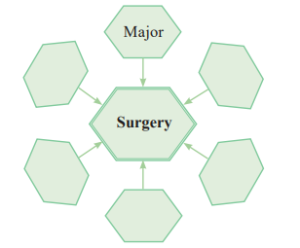
3. Fill in the web with words related to ‘Surgery’.

Screenshot-2025-04-08-105423-300x248

Answer:

  • Major
  • Minor
  • Operation
  • Procedure
  • Medical
  • Recovery

4. Write 3 to 4 lines about each of the following in your own words.

(a) ‘Sushruta Samhita’ ……………

Answer: ‘Sushruta Samhita’: The ‘Sushruta Samhita’ is an ancient text from around 600 BC that focuses on surgery. It was written by Sushruta, who is believed to be the first surgeon to perform operations, particularly in plastic surgery. This work is one of the earliest records of surgical practices in the world.

(b) First Cardiac Surgery ……………

Answer: First Cardiac Surgery: The first successful cardiac surgery was performed by Daniel Hale Williams in 1893. He operated on a patient named James Cornish, who had a knife wound near his heart, and repaired the damaged artery and pericardium. This daring operation marked a major milestone in heart surgery history.

(c) First Neurosurgeon ……………

Answer: First Neurosurgeon: Harvey Cushing, known as the father of modern neurosurgery, developed key techniques and tools for brain surgery in the early 1900s. He reduced the death rate in neurosurgery from 90% to under 10% by inventing the ‘Cushing clip’ to control blood loss. His work made neurosurgery a recognized medical field.

(d) The Robotic Surgery ………….

Answer: The Robotic Surgery: Robotic surgery uses advanced robots like the Da Vinci to perform minimally invasive operations. Surgeons control tiny instruments and a 3-D camera through a console, allowing precise movements through small incisions. This technology improves accuracy and helps patients recover faster compared to traditional open surgery.


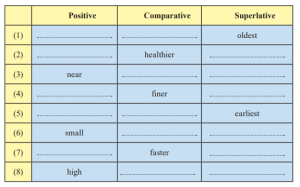
5. (A) Fill in the gaps in the table of Degrees of Comparison.

Screenshot-2025-04-08-105809-300x187

Answer:

PositiveComparativeSuperlative
oldolderoldest
healthyhealthierhealthiest
nearnearernearest
finefinerfinest
earlyearlierearliest
smallsmallersmallest
fastfasterfastest
highhigherhighest

(B) Adjectives that have more than two syllables (long words) take ‘more’ and ‘most’ before them to form Comparative and Superlative degrees.

For example: successful – Positive Degree

                       more successful – Comparative Degree

                        most successful – Superlative Degree


  • Give the Comparative and Superlative forms of –

Positive                                     Comparative                            Superlative

(1) ancient                           …………………………                ………………………….

(2) special                             …………………………              ………………………….

(3) significant                       …………………………             ………………………….

(4) advanced                         …………………………              …………………………         

Answer:

PositiveComparativeSuperlative
(1) ancientmore ancientmost ancient
(2) specialmore specialmost special
(3) significantmore significantmost significant
(4) advancedmore advancedmost advanced
(5) accuratemore accuratemost accurate

6. Join the sentences using appropriate Co-ordinators. (but, or, so, and)

(a) There was lack of technology. Major surgery could not develop for centuries.

Answer: (a) There was a lack of technology, so major surgery could not develop for centuries.

(b) Cardiac Surgery was tried in the past. Patients did not survive.

Answer: (b) Cardiac surgery was tried in the past, but patients did not survive.

(c) He places his fingers into the master controls. He operates all four arms of the Da vinci.

Answer: (c) He places his fingers into the master controls, and he operates all four arms of the Da Vinci.

(d) Open heart surgery can help to repair heart valves. It can also replce them.

Answer: (d) Open heart surgery can help to repair heart valves, or it can also replace them.

(e) Heart patients were treated with sedatives. They did not survive.

Answer: (e) Heart patients were treated with sedatives, but they did not survive.

(f) These procedures can be performed through very small incisions. Our patients experience a number of benefits.

Answer: (f) These procedures can be performed through very small incisions, so our patients experience a number of benefits.


7. Write in your notebook an imaginary telephonic conversation between you and your family doctor’s secretary, asking for an appointment to consult the doctor for a health problem you are suffering from. Begin with ……….

Secretary: Good morning ! This is XYZ Clinic.

                       How can I help you?

Myself: Good morning! I am ……………………………………..

                  (Now continue……)

Answer:

Secretary: Good morning! This is XYZ Clinic. How can I help you?

Myself: Good morning! I am Priya Sharma. I’d like to book an appointment with Dr. Patel for a health issue I’ve been having. I’ve been feeling a sharp pain in my stomach for two days now.

Secretary: I’m sorry to hear that, Priya. Let me check Dr. Patel’s schedule. Could you please tell me if you’re available tomorrow morning at 10 AM?

Myself: Yes, that works for me. Thank you!

Secretary: Great, I’ve booked you for 10 AM tomorrow. Please arrive 10 minutes early to fill out some paperwork. Feel better soon!

Myself: Thank you so much! Have a good day!

Secretary: You too! Goodbye.

Notes Class 8 Chapter 4.5 Balbharati English Maharashtra Board

A Battle to Baffle


1. About the Skit

  • It is a short, humorous skit involving Tenali Raman.
  • The skit is set in the royal court of Emperor Krishnadevaraya.
  • Shows Tenali Raman’s wit, wisdom, and presence of mind.

2. Characters

  1. Tenali Raman – Witty poet, scholar, and jester in the court.
  2. Emperor Krishnadevaraya – Ruler of Vijayanagar Empire.
  3. Pundit Shahane – Renowned scholar visiting the court.
  4. Mantriji – Chief Minister of the royal court.
  5. Court Scholars and Courtiers – Ministers and learned men of the court.

3. Setting

  • Scene takes place in the courtroom of Emperor Krishnadevaraya.
  • Scholars are seated, discussing softly when the skit begins.

4. Problem Introduced

  • Pundit Shahane arrives to challenge all court scholars.
  • He is known for mastering all scriptures and is famous across India.
  • None of the court scholars dare to accept the challenge.
  • Emperor becomes angry and disappointed with his scholars.

5. Suggested Solution

  • A scholar suggests calling Tenali Raman.
  • All agree and recommend Tenali to solve the problem.
  • Tenali is summoned by the emperor.

6. Tenali Raman’s Entry & Condition

  • Tenali agrees to help but puts forth a condition:
    • He must be treated as Chief Pundit for one day.
  • Everyone agrees to honour him.
  • He is brought into the court carried on a palanquin the next day.

7. Debate Begins

  • Tenali brings a mysterious bundle wrapped in silk.
  • He asks to debate on “tila-kashta-mahisha-bandhana”.
  • Pundit Shahane is confused and scared.
  • He admits defeat as he has never heard of such a scripture.

8. The Reveal

  • Emperor is happy and praises Tenali Raman.
  • Tenali explains the real meaning of the phrase:
    • ‘Til’ – Sesame
    • ‘Kashta’ – Stick
    • ‘Mahisha’ – Buffalo
    • ‘Bandhana’ – Rope
  • The phrase means “Rope to tie a buffalo with sesame sticks”.
  • It was just a clever play on Sanskrit words, not a real scripture.

9. Ending

  • The emperor and the court laugh heartily.
  • Pundit Shahane is outwitted.
  • Tenali Raman saves the court’s honour using wit and presence of mind.
  • He politely says the emperor’s praise is the greatest reward.

Notes Class 8 Chapter 4.4 Balbharati English Maharashtra Board

Ramanujan


1. About the Chapter

  • Biographical sketch of Srinivasa Ramanujan, a self-taught Indian mathematical genius.
  • Focuses on his discovery by G.H. Hardy, his struggles, achievements, and contribution to mathematics.

2. Discovery by G.H. Hardy

  • In 1913, Hardy received a letter with unusual mathematical theorems from India.
  • The letter was untidy, written in broken English, with no proofs.
  • Initially, Hardy thought it was boring, irritating, and possibly a fraud.
  • The theorems kept bothering him due to their uniqueness.
  • He discussed them with Littlewood that night.
  • They realized the author was a genius.

3. Ramanujan’s Background

  • A poor clerk in Madras (now Chennai).
  • Lived with his wife and mother on £20 a year.
  • Deeply religious and followed strict caste laws.
  • His mother was strongly opposed to him crossing the sea.

4. Divine Intervention

  • His mother had a dream of the goddess of Namakkal telling her not to stop Ramanujan.
  • This convinced her to allow him to go to England.

5. Life in England

  • Ramanujan reached England in 1914.
  • Lived in Trinity College, Cambridge.
  • Followed his religious rituals strictly.
  • Cooked his own food in his room.
  • Despite cultural and educational differences, he and Hardy had a touching friendship.

6. Challenges Faced

  • Ramanujan was self-taught, unaware of modern proofs and mathematical rigor.
  • Couldn’t enter Madras University due to failing English.
  • Hardy had to teach him formal mathematics like a school student.
  • Ramanujan’s work amazed even the most educated mathematicians.

7. Achievements in England

  • Became a Fellow of the Royal Society at age 30 (a rare honour).
  • Also elected Fellow of Trinity College.
  • First Indian to receive both distinctions.
  • Admired and respected by the academic community.

8. Decline in Health

  • Fell seriously ill in England.
  • Was later hospitalized at Putney.
  • Hardy visited him regularly.

9. Famous 1729 Incident

  • Hardy said the taxi number 1729 was dull.
  • Ramanujan replied:
    • It is the smallest number that can be expressed as the sum of two cubes in two different ways:
      • 13+123=17291^3 + 12^3 = 172913+123=1729
      • 93+103=17299^3 + 10^3 = 172993+103=1729

10. Death

  • Could not be moved to a warmer climate due to World War restrictions.
  • Returned to India and died of tuberculosis in 1920, at the age of 33.

11. Hardy’s Reflection

  • Hardy compared Ramanujan’s genius to Gauss and Euler.
  • Called his teaching experience with Ramanujan the most singular in his life.
  • Believed if Ramanujan had formal education, he could have achieved even more.

Notes Class 8 Chapter 4.2 Balbharati English Maharashtra Board

Revolutionary Steps in Surgery


1. History of Surgery

  • Surgery dates back to 600 BC.
  • ‘Sushruta Samhita’ is one of the oldest surgical texts in the world.
  • Sushruta is considered the first surgeon to perform plastic surgery.
  • Ancient surgeries included tooth extraction and bloodletting.
  • Lack of knowledge and tools prevented the development of major surgeries for centuries.

2. Anaesthesia in Surgery

  • Before anaesthesia, surgeries were extremely painful.
  • General anaesthetics like ether and chloroform were developed in the mid-19th century.
  • General anaesthesia numbs the entire body.
  • Local anaesthesia is used for specific parts and is injected near nerves or surgical spots.
  • Anaesthesia made painless surgeries possible and safer.

3. Cardiac Surgery (Heart Surgery)

  • Unknown before 1893 due to lack of tools and knowledge.
  • Heart patients were treated with sedatives and often did not survive.
  • In 1893, Dr. Daniel Hale Williams, an African-American surgeon, performed the first successful heart surgery.
  • He treated James Cornish, who had a knife wound near his heart.
  • The wound had cut an artery and punctured the pericardium (the sack around the heart).
  • Dr. Williams operated with six doctors and saved the patient’s life.
  • Now, open-heart surgery helps in:
    • Repairing heart defects.
    • Repairing or replacing heart valves.
    • Improving recovery with advanced techniques.

4. Neurosurgery (Brain and Nerve Surgery)

  • Became a specialty in early 1900s.
  • Deals with disorders of the nervous system, including:
    • Brain,
    • Spine,
    • Nerves.
  • Treats people of all ages, including stroke patients.
  • Dr. Harvey Cushing (1869-1939) is called the father of modern neurosurgery.
  • Reduced neurosurgery mortality rate from 90% to less than 10%.
  • Invented the ‘Cushing clip’ (a silver clip) to stop blood loss.
  • Successfully removed over 2000 brain tumors before retiring in 1937.
  • Neurosurgery is now one of the most advanced fields of medicine.

5. Robotic Surgery

  • A type of minimally invasive surgery.
  • Uses tiny instruments through small quarter-inch incisions.
  • Performed with Da Vinci robot – the world’s most advanced surgical robot.
  • Da Vinci robot has:
    • Three robotic arms for surgical tools.
    • One arm with a 3D high-definition camera.
  • The surgeon controls the robot from a console in the operation room.
  • The robot:
    • Copies every movement of the surgeon’s hands.
    • Offers better 3D view than the human eye.
    • Allows precision and control of movement scale.
  • Benefits of robotic surgery:
    • Less blood loss,
    • Smaller cuts,
    • Faster recovery,
    • Reduced pain.

Notes Class 8 Chapter 3.3 Balbharati English Maharashtra Board

The Last Leaf


1. Characters:

Sue – Artist, kind-hearted, practical, and caring friend.

Johnsy – Sue’s roommate, artist, emotionally weak, falls seriously ill.

Mr. Behrman – Old artist, poor, alcoholic, always spoke of painting a “masterpiece”.


2. Setting:

  • Location: Poor artist colony in New York City
  • Time: Cold autumn and winter season
  • Environment: Small studio apartment, sickroom with window facing a wall with an ivy vine

3. Johnsy’s Illness:

  • Catches pneumonia, becomes very weak.
  • Mentally affected – loses the will to live.
  • Believes she will die when the last ivy leaf falls from the vine outside the window.

4. Sue’s Role:

  • Takes care of Johnsy day and night.
  • Tries to cheer her up and encourage her.
  • Continues working as an artist to make money and manage household duties.
  • Consults Dr. and Behrman for help.

5. Ivy Leaf Belief:

  • Johnsy counts the falling leaves daily.
  • She strongly believes her life is tied to the last leaf.
  • She says: “When the last leaf falls, I must go too.”

6. Behrman’s Sacrifice:

  • Learns about Johnsy’s belief from Sue.
  • Shocked and upset at the idea.
  • In the middle of a cold night, paints a realistic leaf on the wall after the last one has fallen.
  • Gets soaked in the rain, catches pneumonia, and dies two days later.
  • His painting becomes his true masterpiece.

7. Turning Point / Climax:

  • The painted leaf never falls.
  • Johnsy regains hope and the will to live.
  • She starts recovering after realizing how foolish her belief was.

8. The Last Leaf (Painting):

  • Painted by Behrman to give hope to Johnsy.
  • Symbol of courage, hope, and sacrifice.
  • Doesn’t move in storm or wind – convinces Johnsy that it’s a real leaf.
  • Becomes Behrman’s first and final masterpiece.

9. Moral of the Story:

  • Never give up on life.
  • Even one act of kindness or sacrifice can save a life.
  • True art inspires and transforms.
  • Caring and compassion are stronger than medicine.

Notes Class 8 Chapter 3.2 Balbharati English Maharashtra Board

The Kite Festival


1. Introduction to Kite Flying

  • In earlier times, children flew kites for fun, especially during holidays.
  • Traditional kites were made of kite paper and thin wooden frames.
  • Modern kites include motorised and fibreglass kites.
  • Kite-flying has become an activity enjoyed worldwide.

2. History and Origin

  • Inspired by Greek, Indian, and other mythological stories.
  • Represents the human desire to fly.
  • Box kites invented over 100 years ago.
  • These may have inspired the design of power-driven aeroplanes.

3. Kite Flying in India

  • Kite flying is a traditional sport in India.
  • Popular during Spring (Basant) and Makar Sankranti.
  • Celebrated across India by people of all ages.
  • In cities, terraces and rooftops are used due to lack of open spaces.

4. Makar Sankranti – Gujarat Celebration

  • Celebrated on January 13 or 14.
  • Coincides with Uttarayan (sun begins journey northward).
  • Marks the end of winter.
  • Considered a holiday in Gujarat; business stops.
  • Kite flying begins at dawn and continues all day.
  • People of all ages participate.
  • Celebrated with music, food, and excitement.
  • Objective: To cut rival kites using special threads.

5. International Kite Festival – Ahmedabad

  • Organised by Gujarat State Tourism Corporation.
  • Held at Sardar Patel Stadium or Police Stadium.
  • Attracts kite flyers from countries like Japan, USA, UK, etc.
  • Displays exotic and creative kites (e.g., eagle, snake shapes).
  • Indian paper kites compete with international designs.
  • Spectators watch in amazement.

6. The Kite Bazar (Patang Bazar)

  • Located in the heart of Ahmedabad.
  • Open 24×7 for a whole week.
  • Streets are crowded all night with kite buyers.
  • Haggling (bargaining) is common.
  • Skilled craftsmen demonstrate:
    • Kite-making techniques.
    • Preparation of special kite thread.
  • Thread is coated with glue and ground glass.
  • Thread is wound on ‘firkees’ (reels).
  • Threads are very sharp, can cut fingers if handled carelessly.

7. Night Celebrations

  • Nighttime flying involves illuminated box-kites called Tukals.
  • Tukals are strung together and flown in groups.
  • They light up the sky and compete with stars.

Important Questions Class 8 Chapter 4.5 Balbharati English Maharashtra Board

A Battle to Baffle


Short Questions


1. What is the title of the lesson?

  • The title of the lesson is “A Battle to Baffle.”

2. Who is the main character in the story?

  • The main character is Tenali Raman.

3. Where does the story take place?

  • The story is set in the court of King Krishnadevaraya.

4. What problem does the king face?

  • The king is troubled by a mysterious thief.

5. Why was Tenali Raman called?

  • He was called to help solve the mystery of the thefts.

6. What plan did Tenali Raman make?

  • He spread rumours about a valuable item in his well.

7. How did the thief fall into the trap?

  • He tried to steal from the well and got caught.

8. What was hidden in the well?

  • Only stones and junk were placed inside the well.

9. How did the king react to the plan?

  • The king was impressed and praised Tenali Raman.

10. What lesson does the story teach?

  • It teaches that intelligence and wit can solve problems smartly.

Long Questions


1. How did the thefts in the kingdom create concern for the king?

  • The frequent thefts in the kingdom disturbed the peace and security. The king was worried and wanted to catch the thief quickly.

2. Why did the king trust Tenali Raman with the case?

  • Tenali Raman was known for his cleverness and intelligence. The king believed he could come up with a smart solution.

3. What was the clever trick used by Tenali Raman?

  • Tenali spread a rumour about valuable items hidden in his well. This lured the thief into attempting to steal from there.

4. Describe how Tenali Raman trapped the thief.

  • He placed guards around the well at night in disguise. When the thief came, he was caught red-handed while trying to steal.

5. Why did Tenali choose the well for the trap?

  • He knew a rumour about hidden treasures would attract attention. The well was a perfect place to create curiosity and set a trap.

6. What role did the fake story play in catching the thief?

  • The story acted as bait to tempt the thief. It cleverly misled him into believing there was something worth stealing.

7. What does this story reveal about Tenali Raman’s personality?

  • It shows he is quick-witted, intelligent, and thinks creatively. He always uses his brain to solve problems without violence.

8. How did the king reward Tenali Raman’s cleverness?

  • The king appreciated his smart thinking and praised him publicly. It added to Tenali Raman’s fame as a wise man.

9. How is the title ‘A Battle to Baffle’ suitable for the story?

  • The title reflects the clever mental battle Tenali fought to confuse and trap the thief. It captures the essence of the witty trick.

10. What can students learn from Tenali Raman’s method of solving problems?

  • Students learn that problems don’t always need force to be solved. Intelligence, observation, and planning are often the best tools.

Ads

HSC आणि SSC महाराष्ट्र – मराठी माध्यम – महाराष्ट्र बोर्ड

📘 महाराष्ट्र बोर्ड परीक्षा साहित्य (मराठी माध्यम)

  • HSC आणि SSC प्रश्नसंच – मराठी माध्यमातील PDF
  • महाराष्ट्र बोर्ड नमुना प्रश्नपत्रिका व मॉडेल पेपर्स (मराठी माध्यमात)
  • SSC आणि HSC च्या मागील वर्षांच्या प्रश्नपत्रिका – मराठी माध्यम
  • SSC/HSC साठी मराठी माध्यमातील नोट्स आणि सराव चाचण्या (मॉक टेस्ट)
  • मराठी माध्यमातील MCQs (बहुपर्यायी प्रश्न) समाविष्ट
  • सर्व परीक्षा साहित्य मराठी माध्यमात उपलब्ध

📗 महाराष्ट्र बोर्ड पाठ्यपुस्तके व PDF (मराठी माध्यम)

  • इयत्ता 10 वी (SSC) चे पाठ्यपुस्तक PDF – मराठी माध्यमात
  • इयत्ता 12 वी (HSC) चे पाठ्यपुस्तक PDF – मराठी माध्यमात
  • मराठी डायजेस्ट – PDF डाउनलोड
  • SSC आणि HSC इयत्तांची पुस्तके – मराठी माध्यमातील PDF
  • डाउनलोडसाठी उपलब्ध पाठ्यपुस्तके व PDF – महाराष्ट्र बोर्ड

📒 महाराष्ट्र बोर्डासाठी मराठी अभ्यास साहित्य

  • प्रकरणनिहाय नोट्स – मराठी माध्यमात
  • प्रकरणनिहाय प्रश्नोत्तरे (प्रश्न व उत्तरे) – मराठी माध्यमात
  • SSC आणि HSC साठी महत्त्वाचे प्रश्न – मराठी माध्यम
  • महत्त्वाच्या सूत्रांचा सारांश (इयत्ता 6 वी ते 12 वी)
  • MCQs, प्रश्नसंच, नमुना प्रश्नपत्रिका आणि मागील वर्षांच्या प्रश्नपत्रिका

CBSE Board Englsih and हिंदी माध्यम

CBSE Board

Mathematics Class 6
Science Class 6
Social Science Class 6
हिन्दी Class 6
सामाजिक विज्ञान कक्षा 6
विज्ञान कक्षा 6

Mathematics Class 7
Science Class 7
SST Class 7
सामाजिक विज्ञान कक्षा 7
हिन्दी Class 7

Mathematics Class 8
Science Class 8
Social Science Class 8
हिन्दी Class 8

Mathematics Class 9
Science Class 9
English Class 9

Mathematics Class 10
SST Class 10
English Class 10

Mathematics Class XI
Chemistry Class XI
Accountancy Class 11

Accountancy Class 12
Mathematics Class 12

Learn English
English Through हिन्दी
Job Interview Skills
English Grammar
हिंदी व्याकरण - Vyakaran
Microsoft Word
Adobe PhotoShop
Adobe Illustrator
Learn German
Learn French
IIT JEE

उत्तर प्रदेश, मध्य प्रदेश, बिहार, राजस्थान & हरियाणा Board हिंदी माध्यम

कक्षा 6 to 8 हिंदी माध्यम
कक्षा 9 & 10 हिंदी माध्यम
कक्षा 11 हिंदी माध्यम

State Board

यूपी बोर्ड 6,7 & 8
बिहार बोर्ड हिंदी माध्यम

Privacy Policies, Terms and Conditions, About Us, Contact Us
Copyright © 2026 eVidyarthi and its licensors. All Rights Reserved.