eVidyarthi
Menu
  • School
    • Close
    • CBSE English Medium
    • CBSE Hindi Medium
    • UP Board
    • Bihar Board
    • Maharashtra Board
    • MP Board
    • Close
  • English
    • Close
    • English Grammar for School
    • Basic English Grammar
    • Basic English Speaking
    • English Vocabulary
    • English Idioms & Phrases
    • Personality Enhancement
    • Interview Skills
    • Close
  • Sarkari Exam Preparation
    • Close
    • All Govt Exams Preparation
    • State Wise Competitive Exam Preparation
    • India – Notes for All Competitive Exams
    • MCQs & Notes for Competitive Exams
    • NCERT Syllabus for Competitive Exam
    • Close
  • Study Abroad
    • Close
    • Study in Australia
    • Study in Canada
    • Study in UK
    • Study in Germany
    • Study in USA
    • Close
  • Current Affairs
    • Close
    • Current Affairs
    • Current Affairs Quizzes
    • State Wise Current Affairs
    • Monthly Current Affairs
    • Close
Civics Class 8 Maharashtra Board | Menu
  • MCQ Civics Class 8 Maharashtra Board
  • Question Answer Civics Class 8 Maharashtra Board
  • Notes Civics Class 8 Maharashtra Board
  • Important Questions Civics Class 8 Maharashtra Board
  • Book Civics Class 8 Maharashtra Board
  • Civics Class 8

Notes Civics Chapter 6 Class 8 Maharashtra Board

Notes For All Chapters – Civics Class 8

Bureaucracy


Introduction to Bureaucracy

  • Bureaucracy is the administrative system responsible for implementing government policies.
  • It works under the Union Executive and ensures smooth governance.
  • It consists of civil servants who help execute laws and policies.
  • Examples of important bureaucratic posts:
    • District Collector – Implements government policies at the district level and maintains law and order.
    • Municipal Commissioner – Prepares the municipal budget and oversees urban administration.
    • Finance Secretary – Manages financial matters of the government.
    • Divisional Commissioner – Reviews revenue collection and administration in a division.

Functions of the Government

The government performs two main functions:

1. Ensuring National Security and Internal Safety

  • Defending the country from external threats.
  • Maintaining internal security with the help of the police force and civil services.
  • Supporting law enforcement agencies for public safety.

2. Providing Public Services to Citizens

  • Infrastructure development (roads, electricity, water supply).
  • Ensuring social welfare (education, healthcare, employment schemes).
  • Implementing economic and social development programs.

Understanding Civil Services

  • The administrative system of the government is known as the civil service.
  • It is also referred to as bureaucracy.
  • Ministers are the political heads of government departments.
  • Civil servants assist ministers by offering expertise and executing policies.
  • The balance between ministers and civil servants ensures smooth governance.

Characteristics of Bureaucracy

Bureaucracy has the following key characteristics:

1. Permanence

  • Unlike elected representatives, bureaucrats remain in office regardless of political changes.
  • Essential services such as tax collection, law enforcement, and environmental protection continue without interruption.

2. Political Neutrality

  • Bureaucrats do not belong to any political party.
  • They must work efficiently under any government in power.
  • Even if a new government changes policies, bureaucracy must remain neutral and follow new instructions.

3. Anonymity

  • Bureaucrats do not take credit or blame for government decisions.
  • Ministers are held accountable for the department’s performance.
  • If a policy fails, the minister, not the bureaucrats, is answerable to the public and Parliament.

Significance of Indian Bureaucracy

The Indian bureaucracy plays a crucial role in governance.

1. Ensures Stability

  • Bureaucracy ensures the smooth functioning of government services like:
    • Water supply
    • Transport
    • Electricity
    • Public cleanliness
    • Health services
    • Agricultural reforms

2. Instrument of Social Change

  • Bureaucracy implements government laws and policies for social transformation.
  • Examples:
    • Women empowerment laws (e.g., Beti Bachao Beti Padhao scheme).
    • Child security programs (e.g., Mid-Day Meal scheme).
    • Welfare schemes for marginalized groups (e.g., reservation in education and jobs).

3. Promotes Democracy

  • Bureaucracy ensures equal participation of all sections of society in governance.
  • It implements policies like reservation for backward communities to bring them into mainstream society.
  • Helps in decision-making by providing expertise to elected representatives.

Types of Civil Services in India

There are three main types of civil services in India:

1. All-India Services (Work under both Union & State Governments)

  • Indian Administrative Service (IAS) – Handles policy-making and administration.
  • Indian Police Service (IPS) – Manages law enforcement and internal security.
  • Indian Forest Service (IFS) – Deals with environmental and forest conservation.

2. Union or Central Services (Work under the Union Government)

  • Indian Foreign Service (IFS) – Represents India in diplomatic affairs.
  • Indian Revenue Service (IRS) – Manages taxation and revenue collection.

3. State Civil Services (Work under the State Government)

  • Deputy District Collector – Assists in district administration.
  • Block Development Officer (BDO) – Oversees rural development.
  • Tehsildar (Executive Magistrate) – Handles land revenue administration.

Recruitment Process for Civil Services

  • Civil servants are selected through competitive examinations.
  • Union Public Service Commission (UPSC) conducts exams for All-India and Central Services.
  • State Public Service Commissions (e.g., MPSC) conduct exams for State Civil Services.
  • Reservation policy ensures fair representation of:
    • Scheduled Castes (SCs)
    • Scheduled Tribes (STs)
    • Other Backward Classes (OBCs)
    • Women and specially-abled individuals

Relationship Between Ministers and Civil Servants

  • Ministers make policy decisions and provide political leadership.
  • Civil servants (bureaucrats) provide expert advice and manage daily administration.
  • Key Responsibilities:
    • Ministers decide on new policies based on public interest.
    • Civil servants give necessary data and information to ministers.
    • Civil servants know financial provisions and past policies, helping ministers make informed decisions.
  • Effective governance requires mutual trust and transparency between ministers and bureaucrats.
Important Questions Civics Chapter 6 Class 8 Maharashtra Board

Imp Questions For All Chapters – Civics Class 8

Bureaucracy


Short Questions

1. What is the main function of bureaucracy in a parliamentary democracy?

  • To implement the government’s policies and ensure efficient administration.

2. Who is responsible for administrative decisions in a parliamentary democracy?

  • The minister of the concerned department.

3. What are the three types of civil services in India?

  • All-India Services, Union Services, and State Services.

4. Name two examples of All-India Services.

  • Indian Administrative Service (IAS) and Indian Police Service (IPS).

5. What role does the UPSC play in civil services?

  • It conducts exams for All-India and Central Services recruitment.

6. What does political neutrality mean in bureaucracy?

  • Bureaucracy should implement policies without political bias.

7. Who is held accountable for the success or failure of a policy?

  • The minister of the concerned department.

8. Why are reservations followed in civil services?

  • To ensure equal opportunities for all sections of society.

9. What is the role of a Secretary in a government department?

  • To advise ministers and provide expert guidance.

10. What type of services do the State Civil Services include?

  • Deputy District Collector, Block Development Officer, and Tehsildar.

Long Questions 

1. Explain the significance of bureaucracy in the Indian political system.

  • Bureaucracy provides stability to the political system by ensuring the consistent delivery of services like water supply, health, and transport. It also plays a key role in implementing social reforms and empowering marginalized communities.

2. Why is political neutrality important for bureaucracy?

  • Political neutrality ensures that the bureaucracy functions efficiently regardless of which political party is in power. This helps maintain consistency in governance and policy implementation.

3. How does the bureaucracy contribute to social change in India?

  • Bureaucracy implements policies related to empowerment of women, child protection, and reservations for marginalized communities. This enables social transformation and greater inclusion in decision-making.

4. What is the relationship between ministers and civil servants in administration?

  • Ministers make decisions based on public interest, while civil servants provide expert advice and information. This interdependence ensures efficient governance.

5. Why is bureaucracy described as a permanent mechanism?

  • Bureaucracy continues functioning even when the political leadership changes, ensuring that essential services and administrative functions remain unaffected.

6. How does bureaucracy help in maintaining law and order?

  • Bureaucracy ensures that rules and regulations are followed and supports the police and administrative authorities in maintaining peace and order.

7. What is the role of the State Public Service Commission (MPSC)?

  • MPSC conducts state-level competitive exams and recommends candidates for state administrative posts, ensuring merit-based recruitment.

8. How does the reservation policy impact civil services?

  • Reservation policy allows candidates from Scheduled Castes, Scheduled Tribes, and Other Backward Classes to have fair opportunities in civil services, promoting social justice.

9. What is the importance of transparency between ministers and civil servants?

  • Transparency ensures that ministers can make informed decisions based on accurate information provided by civil servants, leading to better governance.

10. How do civil servants contribute to decision-making in governance?

  • Civil servants provide data, policy history, and financial details to ministers, helping them make informed decisions for public welfare.

Questions Answers Civics Chapter 6 Class 8 Maharashtra Board

Questions Answers For All Chapters – Civics Class 8

Solutions

Bureaucracy


Q 1. Identify if the following statements are correct or wrong and rewrite the wrong sentences in their correct form.

(1) In a parliamentary democracy, representatives elected by people and ministers bear the administrative responsibility.

Answer: Correct – In a parliamentary democracy, elected representatives and ministers are responsible for administration.

(2) Union Public Service Commission (UPSC) recruits candidates for civil services in Maharashtra.

Answer: Wrong – The correct sentence is: Maharashtra Public Service Commission (MPSC) recruits candidates for civil services in Maharashtra.


Q 2. Explain the following statements with reasons.

(1) Reservation policy is followed even in civil services.

Answer: The reservation policy is followed to ensure that weaker sections of society such as Scheduled Castes, Scheduled Tribes, Other Backward Castes, women, and specially-abled individuals have equal opportunities in civil services. This helps reduce social inequality and increase representation of marginalized groups in the administration.

(2) It is necessary for civil servants to be politically neutral.

Answer: Political neutrality ensures that civil servants implement government policies efficiently, regardless of which political party is in power. It prevents bias and ensures that the administration remains stable and professional, even when governments change.


Q 3. Answer the following in 25-30 words.

(1) Explain the role of the ministers and civil servants in the efficient administration of the department.

Answer: Ministers make policy decisions and provide political leadership, while civil servants give expert advice, ensure smooth functioning, and implement policies efficiently. Mutual trust enhances departmental efficiency.

(2) Explain how the bureaucracy provides stability to the political system.

Answer: Bureaucracy ensures continuous provision of essential services like water supply, health, and transport. It implements government policies consistently, bringing stability and social change.


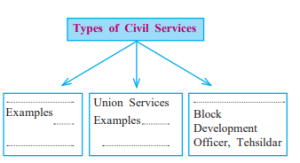
Q 4. Complete the Concept picture.

chapter-6-questions--300x163

Answer:

Types of Civil Services

1. All India Services

  • Examples: Indian Administrative Service (IAS), Indian Police Service (IPS)

2. Union Services

  • Examples: Indian Foreign Service (IFS), Indian Revenue Service (IRS)

3. State Services

  • Examples: Block Development Officer (BDO), Tehsildar

Q 5. Discuss characteristics of bureaucracy.

Answer:

  • Permanent Mechanism – Bureaucracy ensures continuity in administration even when governments change.
  • Political Neutrality – Civil servants implement policies without political bias.
  • Anonymity – Civil servants work behind the scenes; ministers bear responsibility for success or failure.
  • Expertise and Efficiency – Bureaucracy provides expert advice and efficient execution of policies.
  • Accountability – Ministers are held accountable to the Parliament for the functioning of the departments under them.

Important Questions Civics Chapter 5 Class 8 Maharashtra Board

Imp Questions For All Chapters – Civics Class 8

The State Government


Short Questions

1. How many states in India have bicameral legislatures?

  • Seven states have bicameral legislatures.

2. Who supervises the proceedings of the Vidhan Sabha?

  • The Speaker supervises the proceedings of the Vidhan Sabha.

3. What is the tenure of the Vidhan Sabha?

  • The tenure of the Vidhan Sabha is 5 years.

4. How are the members of the Vidhan Parishad elected?

  • Members are elected indirectly from various constituencies and nominated by the Governor.

5. Who is the nominal head of the state government?

  • The Governor is the nominal head of the state government.

6. Who appoints the Governor of a state?

  • The President appoints the Governor.

7. How many members are there in the Vidhan Sabha of Maharashtra?

  • There are 288 members in the Vidhan Sabha of Maharashtra.

8. How often are sessions of the Maharashtra Legislature held?

  • Three sessions are held annually – Budget, Monsoon, and Winter.

9. What is the role of the Chief Minister in portfolio distribution?

  • The Chief Minister distributes portfolios based on experience and skills.

10. What is the minimum age to contest Vidhan Sabha elections in Maharashtra?

  • The minimum age is 25 years.

Long Questions

1. Explain why the Constitution adopted a federal system for India.

  • India’s large geographical size and cultural diversity made centralized governance difficult. Hence, a federal system was adopted to allow better regional governance.

2. What are the powers of the Governor regarding bills passed by the legislature?

  • The Governor gives assent to bills passed by the state legislature, converting them into laws. The Governor can also issue ordinances when the legislature is not in session.

3. Describe the composition of the Vidhan Sabha in Maharashtra.

  • The Vidhan Sabha consists of 288 members elected from territorial constituencies. One member from the Anglo-Indian community can be nominated by the Governor.

4. What is the tenure and working of the Vidhan Parishad?

  • The Vidhan Parishad is a permanent body where one-third of its members retire every two years. New members are elected through indirect elections and nominations.

5. How is the Speaker of the Vidhan Sabha elected?

  • The Speaker is elected by the members of the Vidhan Sabha and is responsible for maintaining order and discipline during proceedings.

6. What is the role of the Chief Minister in coordinating government departments?

  • The Chief Minister ensures smooth functioning and cooperation between various ministries and departments, resolving conflicts when necessary.

7. What happens if no party secures a majority in the Vidhan Sabha elections?

  • If no party wins a clear majority, different parties may form a coalition government under a Chief Minister chosen by consensus.

8. How does the Chief Minister work toward the welfare of the state?

  • The Chief Minister formulates policies and addresses issues like education, health, and security to ensure the welfare of the people.

9. What is the role of the Deputy Speaker in the Vidhan Sabha?

  • In the absence of the Speaker, the Deputy Speaker takes over the responsibility of conducting the proceedings of the House.

10. How are the members of the Vidhan Parishad nominated?

  • Some members are nominated by the Governor from fields like literature, science, and social service, while others are elected from different constituencies.

Questions Answers Civics Chapter 5 Class 8 Maharashtra Board

Questions Answers For All Chapters – Civics Class 8

Solutions

The State Government


Q 1. Choose the correct option and complete the statements.

(1) The Winter session of Maharashtra Legislature takes place at …………. .

(a) Mumbai
(b) Nagpur
(c) Pune
(d) Aurangabad

Answer: The Winter session of Maharashtra Legislature takes place at (b) Nagpur.

(2) The …………… appoints the Governor.

(a) Chief Minister
(b) Prime Minister
(c) President
(d) Chief Justice

Answer: The (c) President appoints the Governor.

(3) The right to summon the state legislature lies with the ……………

(a) Chief Minister
(b) Governor
(c) President
(d) Speaker

Answer: The right to summon the state legislature lies with the (b) Governor.


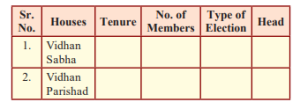
Q 2. Complete the table.

chapter-5-questions--300x109

Answer:

Sr. No.HousesTenureNo. of MembersType of ElectionHead
1.Vidhan Sabha5 years (unless dissolved earlier)288Direct election from territorial constituenciesSpeaker
2.Vidhan ParishadPermanent body; one-third members retire every 2 years78Indirect election from various constituencies and nomination by GovernorChairman

Q 3. Write short notes on.

(1) The Governor

Answer: The Governor is the nominal head of the state, similar to the President at the central level. The Governor is appointed by the President and holds office during the pleasure of the President. The Governor has legislative powers such as giving assent to bills passed by the state legislature, which converts them into laws. The Governor has the right to summon the state legislature and can issue an ordinance when the legislature is not in session but there is a need to make a law.

(2) Functions of the Chief Minister

Answer:

  • Creation of the State Executive – The Chief Minister forms the Council of Ministers after proving a majority. The Council includes representatives from various regions and social groups.
  • Distribution of Portfolios – The Chief Minister distributes portfolios based on political experience, administrative skills, awareness of public opinion, and leadership qualities.
  • Coordination between Ministries/Departments – The Chief Minister ensures cooperation among different departments and resolves conflicts to ensure smooth governance.
  • Leader of the State – The Chief Minister leads the state, makes policies, and works for the welfare of the people.

Q 4. Answer the following in brief.

(1) Enumerate the functions of the Speaker of the Vidhan Sabha (Legislative Assembly).

Answer:

  • Supervises and guides the proceedings of the Vidhan Sabha.
  • Prepares the order of business.
  • Ensures the proceedings of the House are carried out in a disciplined manner.
  • Can suspend members for misbehavior or misconduct.
  • In the absence of the Speaker, the Deputy Speaker takes over the responsibility.

(2) Why did the Constitution adopt a federal system for India?

Answer: India has a large geographical area and a multicultural population with diversity in language, religion, and regional characteristics. It would have been difficult to govern the country from a centralized place. Therefore, the Constitution adopted a federal setup, forming states based on linguistic reorganization to make governance more effective.

(3) What are the considerations of the Chief Minister while allocation of portfolios?

Answer:

While distributing portfolios, the Chief Minister considers:

  • Political experience of the ministers.
  • Administrative skills of the ministers.
  • Awareness of public opinion.
  • Leadership qualities of the ministers.

Important Questions Civics Chapter 4 Class 8 Maharashtra Board

Imp Questions For All Chapters – Civics Class 8

The Indian Judicial System


Short Questions

1. Who appoints the Chief Justice of India?

  • The President of India appoints the Chief Justice of India.

2. What is the retirement age of Supreme Court judges?

  • The retirement age of Supreme Court judges is 65 years.

3. What is the main role of the judiciary?

  • The judiciary gives justice and resolves conflicts according to the law.

4. What is the meaning of Judicial Review?

  • Judicial Review means the power of the court to declare any law unconstitutional if it violates the Constitution.

5. What is the full form of PIL?

  • PIL stands for Public Interest Litigation.

6. What are the two main branches of law in India?

  • Civil law and Criminal law.

7. How many High Courts are there in India?

  • There are 24 High Courts in India.

8. Who supervises and controls the lower courts?

  • The High Court supervises and controls the lower courts.

9. What is the role of the judiciary in democracy?

  • The judiciary protects freedom, equality, and justice in a democracy.

10. What is the punishment for contempt of court?

  • Contempt of court is considered a punishable offense.

Long Questions 

1. Why is an independent judiciary important?

  • An independent judiciary ensures that judges can make decisions without any political pressure, preserving fairness and justice for all citizens.

2. How does the judiciary protect the fundamental rights of citizens?

  • The judiciary protects fundamental rights by reviewing laws and government actions, and striking them down if they violate the Constitution.

3. What are the main functions of the Supreme Court?

  • The Supreme Court settles disputes between the Union and States, protects fundamental rights, reviews lower court decisions, and advises the President on legal matters.

4. What is the significance of judicial activism?

  • Judicial activism ensures that courts actively uphold justice and equality by supporting marginalized groups and enforcing constitutional rights.

5.What is the process for removing a judge from office?

  • A judge can only be removed through an impeachment process by the Parliament for proven misbehavior or incapacity.

6. What is the jurisdiction of the Bombay High Court?

  • The Bombay High Court has jurisdiction over Maharashtra, Goa, and the Union Territories of Dadra and Nagar Haveli and Daman and Diu.

7. What happens when the judiciary declares a law unconstitutional?

  • When the judiciary declares a law unconstitutional, it becomes null and void and cannot be enforced.

8. How does the judiciary help maintain equality before the law?

  • The judiciary ensures that all individuals, regardless of status or wealth, are treated equally under the law through impartial decisions.

9. Why are PILs important for society?

  • PILs allow citizens to seek justice for issues of public interest, giving a voice to marginalized groups and promoting social justice.

10. How does the judiciary strengthen democracy?

  • By protecting constitutional values, ensuring fairness, and resolving conflicts, the judiciary strengthens the foundation of democracy.

Questions Answers Civics Chapter 4 Class 8 Maharashtra Board

Questions Answers For All Chapters – Civics Class 8

Solutions

The Indian Judicial System


Q 1. Choose the correct option and complete the statements.

(1) Laws are made by …………… .

(a) Legislature
(b) Council of Ministers
(c) Judiciary
(d) Executive

Answer: Laws are made by (a) Legislature

(2) The Chief Justice of Supreme Court is appointed by ……………

(a) The Prime Minister
(b) The President
(c) The Home Minister
(d) The Chief Justice

Answer: The Chief Justice of Supreme Court is appointed by (b) The President


Q 2. Explain the concepts.

(1) Judicial Review

Answer: Judicial Review is the power of the Supreme Court to protect the Constitution. If any law passed by the Legislature or any act of the Executive violates the Constitution, the court can declare it illegal and strike it down. This ensures that all laws and acts are consistent with the Constitution.

(2) Public Interest Litigation

Answer: Public Interest Litigation (PIL) refers to cases filed on issues of public importance by individual citizens, social organisations, or NGOs on behalf of the public. The court considers the issues raised and gives a decision to protect the interests of society.


Q 3. Write short notes on.

(1) Civil and Criminal Law

Answer:

  • Civil Law: Deals with conflicts that affect the rights of a person, such as land and property disputes, rent agreements, and divorce. A petition is filed in the relevant court, which gives a decision.
  • Criminal Law: Deals with serious crimes such as theft, robbery, dowry, and murder. A First Information Report (FIR) is filed with the police, which investigates the matter, and if the charges are proved, severe punishment is given.

(2) Judicial Activism

Answer: Judicial Activism refers to the active role of the judiciary in ensuring justice and equality. Courts have become proactive in providing legal protection to marginalised sections of society, including women, children, tribal communities, and workers. Public Interest Litigations (PIL) have played a significant role in this process.


Q 4. Answer in brief.

(1) Why are laws necessary in society?

Answer: Laws are necessary to maintain order, resolve conflicts, and protect the rights of individuals. They help prevent the emergence of authoritarian groups and ensure that justice, equality, and freedom are maintained in society.

(2) Enumerate the functions of the Supreme Court.

Answer:

  • Settles disputes between the Union and the States.
  • Protects the fundamental rights of citizens.
  • Reviews decisions of lower courts and its own decisions.
  • Advises the President on legal matters of public importance.

(3) Which are the provisions that preserve the independence of the judiciary?

Answer:

  • Judges are appointed by the President to avoid political pressure.
  • Judges enjoy security of tenure and cannot be removed for trivial reasons.
  • Salaries are drawn from the Consolidated Fund of India, without parliamentary discussion.
  • Personal criticisms on judges are not allowed; contempt of court is punishable.
  • Parliament cannot discuss judicial decisions but can remove judges through impeachment.

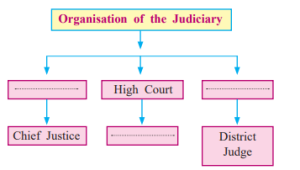
Q 5. Complete the table.

chapter-4-questions-5-300x170

Answer:

Organisation of the Judiciary
Supreme Court → High Court → District Court
Chief Justice → Judge → District Judge

Notes Civics Chapter 5 Class 8 Maharashtra Board

Notes For All Chapters – Civics Class 8

The State Government


Introduction

  • India follows a federal system of government.
  • Government exists at two levels:
    • Federal Government (Central Government) – operates at the national level.
    • State Government – operates at the state or regional level.

Background

  • India is a large and diverse country with variations in:
    • Language
    • Religion
    • Lifestyle
    • Regional characteristics
  • To manage this diversity effectively, India adopted a federal setup.
  • States were formed on the basis of language through linguistic reorganisation.
  • The government structure in all Indian states is similar, except for Jammu and Kashmir.

Number of States and Legislatures

  • India has 28 states but 31 Vidhan Sabhas (Legislative Assemblies) because:
    • Union Territories of Delhi, Puducherry, and Jammu & Kashmir also have Vidhan Sabhas.

State Legislature

  • Like the Parliament at the central level, each state has its own Legislature.
  • Bicameral Legislature – Only 7 states in India, including Maharashtra, have two Houses:
    • Vidhan Sabha (Legislative Assembly) – Lower House
    • Vidhan Parishad (Legislative Council) – Upper House

Legislature of Maharashtra

  • Maharashtra has a bicameral legislature consisting of:
    • Vidhan Sabha – 288 members
    • Vidhan Parishad – 78 members

1. Vidhan Sabha (Legislative Assembly)

  • Number of members – 288 members
  • Tenure – 5 years (unless dissolved earlier)
  • Representation:
    • Governor can nominate 1 Anglo-Indian member.
    • Seats are reserved for Scheduled Castes (SC) and Scheduled Tribes (ST).
  • Eligibility to contest elections:
    • Must be a citizen of India.
    • Must be at least 25 years old.

Speaker of Vidhan Sabha

  • Elected by the members of Vidhan Sabha.
  • Responsible for:
    • Conducting House proceedings.
    • Maintaining order and discipline.
    • Suspending members for misconduct.
  • Deputy Speaker takes over in the absence of the Speaker.

Sessions

  • Maharashtra Legislature conducts three sessions annually:
    • Budget Session – in Mumbai
    • Monsoon Session – in Mumbai
    • Winter Session – in Nagpur

2. Vidhan Parishad (Legislative Council)

  • Number of members – 78 members
  • Members are elected from:
    • Vidhan Sabha members
    • Local government institutions
    • Teacher constituencies
    • Graduate constituencies
    • Distinguished personalities (nominated by Governor)
  • Tenure – Not fully dissolved; 1/3rd of members retire every 2 years.
  • Chairman – Conducts the House proceedings.
  • Deputy Chairman – Takes over in the Chairman’s absence.

State Executive

The Executive of Maharashtra consists of:

  1. Governor – Nominal Head
  2. Chief Minister – Real Executive Head
  3. Council of Ministers – Assists the Chief Minister

1. Governor

  • Appointed by – The President of India.
  • Holds office during the pleasure of the President.
  • Powers and Functions:
    • Assent to Bills – Converts Bills into laws.
    • Can summon and prorogue the Legislature.
    • Can issue Ordinances when the Legislature is not in session.

2. Chief Minister and Council of Ministers

  • Chief Minister is the leader of the majority party in the Vidhan Sabha.
  • The CM forms a Council of Ministers from trusted party members.
  • Tenure – 5 years (or until the Assembly is dissolved).

Functions of the Chief Minister:

1. Creation of the State Executive:

  • Forms the Council of Ministers by including different regions and social groups.
  • Handles coalition government challenges (if no single party gets a majority).

2. Distribution of Portfolios:

  • Assigns departments (e.g., Home, Finance, Education) based on:
    • Political experience
    • Administrative skills
    • Public opinion

3. Coordination between Ministries:

  • Ensures smooth cooperation between departments.
  • Resolves conflicts between ministries.

4. Leader of the State:

  • Represents the state.
  • Addresses issues affecting the public.
  • Creates and implements state policies.

Challenges in Maharashtra

  • Terror attacks – Threat to security.
  • Naxalite movements – Left-wing extremism in some areas.

Functions of the State Government

BranchHeadFunction
LegislativeSpeaker and ChairmanMakes laws
ExecutiveChief Minister and GovernorImplements laws
JudiciaryHigh CourtInterprets laws

Notes Civics Chapter 4 Class 8 Maharashtra Board

Notes For All Chapters – Civics Class 8

The Indian Judicial System


1. Introduction

  • The judiciary is one of the three key organs of the government:
    • Legislature – Makes the laws.
    • Executive – Implements the laws.
    • Judiciary – Provides justice by resolving conflicts and upholding the law.

Need for Justice

  • Opinions, thoughts, beliefs, and culture differ from person to person.
  • If people are tolerant, conflicts can be avoided.
  • If differences of opinion are sharp, conflicts may arise.
  • Conflicts should be resolved:
    • Impartially.
    • According to the law.
  • An unbiased judicial system is necessary to resolve conflicts fairly.

Examples of Conflict

  • Conflict between individuals – Personal disputes.
  • Conflict between individuals and the government – A law or decision made by the government may seem unfair to people, leading them to seek justice from the court.

Role of Judiciary in Promoting Democracy

  • Helps the government to achieve social justice and equality.
  • Ensures justice for:
    • Weaker sections of society.
    • Women.
    • Children.
    • Differently-abled people.
    • Transgender people.
  • Strengthens democracy by ensuring:
    • Freedom.
    • Equality.
    • Justice.

2. Rule of Law

  • The judiciary ensures that everyone is treated equally under the law.
  • No discrimination based on:
    • Wealth – Rich and poor are treated equally.
    • Social status – Developed and backward communities are equal before the law.
    • Gender – Men and women have equal legal status.
  • The judiciary protects the rights of people and prevents:
    • Emergence of repressive groups.
    • Growth of authoritarian individuals.

3. Structure of the Judiciary

  • India has a unified judicial system.
  • No separate judiciary for the Centre and the states.
  • Hierarchy of Courts:
    1. Supreme Court – Apex court at the top.
    2. High Courts – State-level courts under the Supreme Court.
    3. District Courts – Under High Courts.
    4. Lower Courts – Village and local level courts.

4. Supreme Court of India

  • Head: Chief Justice of India (CJI).
  • Appointment:
    • The President appoints the Chief Justice and other judges.
    • By convention, the senior-most judge is appointed as the Chief Justice.

Eligibility for Supreme Court Judges

  • Legal expert.
  • Experienced advocate.
  • High Court judge.

Security of Tenure

  • Judges enjoy security of tenure:
    • Cannot be removed from the post for political reasons or personal motives.
    • Retirement age of Supreme Court judges – 65 years.
    • Retirement age of High Court judges – 62 years.

Salary and Allowances

  • Judges’ salaries and allowances are drawn from the Consolidated Fund of India.
  • Parliament cannot discuss judges’ salaries or allowances.

Protection from Criticism

  • No personal criticism of judges for their decisions.
  • Contempt of Court is punishable.
  • Protects the independence of the judiciary.

Removal of Judges

  • Judges can only be removed through impeachment:
    • Requires a two-thirds majority in both Houses of Parliament.

5. Judicial Activism

  • Traditionally, courts settled disputes only when approached.
  • In recent decades, courts have become more active:
    • Taking action to protect the constitutional goals of justice and equality.
    • Protecting the rights of marginalized groups:
      • Women.
      • Tribal people.
      • Workers.
      • Farmers.
      • Children.
  • Public Interest Litigations (PILs) – Help courts to address issues of public importance.

6. Functions of the Supreme Court

1. Federal Role

  • Settles disputes between:
    • Centre and states.
    • States and other states.

2. Protection of Fundamental Rights

  • Issues orders to protect the fundamental rights of citizens.

3. Review Power

  • Reviews the decisions of lower courts.
  • Can also review its own decisions.

4. Advisory Role

  • Provides advice to the President on legal issues of public importance.

7. Judicial Review

  • Protects the Constitution from violations.
  • Parliament cannot pass any law that:
    • Violates the Constitution.
    • Affects fundamental rights.
  • The court can:
    • Strike down unconstitutional laws.
    • Declare unconstitutional actions of the executive invalid.

Example of Judicial Review

  • The Supreme Court ordered candidates contesting elections to:
    • Declare their property and income details.
    • Provide educational qualifications.
  • Purpose – To make the election process transparent and fair.

8. Public Interest Litigation (PIL)

  • Filed by:
    • Citizens.
    • Social organizations.
    • Non-Governmental Organizations (NGOs).
  • Purpose:
    • Address issues of public importance.
    • Ensure justice for marginalized groups.
  • The court considers the issues raised and gives decisions in the public interest.

9. High Court

  • 24 High Courts in India.
  • Each High Court has:
    • Chief Justice.
    • Other Judges.

Jurisdiction of High Courts

  • Some High Courts cover multiple states/union territories.
    • Example:
      • Bombay High Court – Covers Maharashtra, Goa, Dadra & Nagar Haveli, and Daman & Diu.

Functions of High Court

1. Supervision of Lower Courts

  • Controls and supervises lower courts.

2. Protection of Fundamental Rights

  • Issues orders to protect rights.

3. Advisory Role

  • Advises the Governor on appointing district court judges.

10. District and Lower Courts

  • District Court – Headed by a District Judge.
  • Lower courts include:
    • Civil courts.
    • Criminal courts.
  • Handles:
    • Most local disputes.
    • Cases related to civil and criminal law.

11. Branches of Law in India

  1. Civil Law – Deals with personal conflicts.
    • Examples:
      • Property disputes.
      • Divorce.
      • Breach of contract.
    • Affected person files a petition.
    • The court gives a decision.
  2. Criminal Law – Deals with crimes and offenses.
    • Examples:
      • Theft.
      • Robbery.
      • Murder.
    • Process:
      1. File a First Information Report (FIR).
      2. Police investigation.
      3. Court trial.
      4. Punishment if charges are proved.

12. Contribution of Indian Judiciary

  • Protected:
    • Individual freedom.
    • Federal structure.
    • Constitution.
  • Ensured:
    • Justice.
    • Equality.
    • Protection of fundamental rights.
  • Courts have played a key role in:
    • Strengthening democracy.
    • Maintaining public trust in the legal system.

Notes Civics Chapter 2 Class 8 Maharashtra Board

Notes For All Chapters – Civics Class 8

The Indian Parliament


1. Introduction to the Indian Parliament

  • The Parliament of India is the supreme legislative body of the country.
  • Established by the Constitution of India.
  • Functions at the national level (central government).
  • Composed of:
    • President
    • Lok Sabha (House of the People) – Lower House
    • Rajya Sabha (Council of States) – Upper House

Role of the President in Parliament

  • The President of India is an integral part of the Parliament but does not participate in parliamentary discussions.
  • The President’s role includes:
    • Summoning and proroguing sessions of Parliament.
    • Giving assent to bills passed by Parliament.
    • Addressing the Parliament at the beginning of each session.

2. Structure of the Parliament

(i) Lok Sabha (House of the People)

  • Lower and first house of Parliament.
  • Directly elected by the people through general elections.

Composition of Lok Sabha

  • Maximum strength: 552 members
    • 530 members from States
    • 20 members from Union Territories
    • 2 members from Anglo-Indian community (if not represented, nominated by the President)

Representation and Reservations

  • Seats are allocated to States based on population.
  • Reserved seats:
    • For Scheduled Castes (SC) and Scheduled Tribes (ST).

Tenure of Lok Sabha

  • 5 years from the date of its first meeting.
  • Can be dissolved before the completion of the term.
  • If dissolved, elections held = Mid-term elections.

Qualifications for Membership

  • Must be an Indian citizen.
  • Minimum age = 25 years.
  • Must not hold any office of profit under the government.
  • Must be mentally sound.

Disqualification Criteria

  • If found guilty of:
    • Corruption
    • Criminal offenses
    • Holding office of profit under the government
    • Unsound mind declared by a court

(ii) Rajya Sabha (Council of States)

  • Upper and second house of Parliament.
  • Indirectly elected – Represents the states and Union Territories.

Composition of Rajya Sabha

  • Maximum strength: 250 members
    • 238 members elected from States and Union Territories.
    • 12 members nominated by the President (from fields of literature, arts, science, sports, and social work).

Representation

  • Seats are allocated to States and Union Territories based on population.
  • All States do not have equal representation.

Tenure of Rajya Sabha

  • 6 years for each member.
  • Rajya Sabha is a permanent house – never dissolved.
  • 1/3rd of members retire every 2 years and are replaced by new members.

Qualifications for Membership

  • Must be an Indian citizen.
  • Minimum age = 30 years.
  • Must not hold any office of profit under the government.

3. Functions of the Parliament

(i) Law-Making

  • Parliament is responsible for:
    • Making new laws.
    • Amending existing laws.
    • Repealing outdated laws.
  • Process of making laws:
    • Draft prepared = Bill
    • Bill introduced in either house.
    • Discussed, amended, and approved.
    • Sent to the President for assent.
    • Becomes a law after Presidential assent.

(ii) Control Over the Executive (Government)

  • The Prime Minister and Council of Ministers are accountable to the Parliament.
  • Parliament exercises control through:
    • Question Hour – MPs question ministers about their work.
    • No-Confidence Motion – If passed, the government must resign.
    • Budget Approval – Parliament approves government’s financial proposals.
    • Debates and Discussions – MPs discuss policies and decisions of the government.

(iii) Financial Control

  • Parliament controls national finances by:
    • Approving the Union Budget presented by the Finance Minister.
    • Passing Money Bills and other financial bills.

(iv) Constitutional Amendments

  • Parliament can amend the Constitution by:
    • Simple majority – Minor changes.
    • Special majority – 2/3rd majority of members present and voting.
    • Special majority + consent of more than half the States – For federal structure changes.

4. Speaker of Lok Sabha

  • Elected in the first meeting of Lok Sabha after the election.
  • Functions:
    • Maintains order and discipline in the House.
    • Ensures that debates are conducted fairly.
    • Interprets the rules of the House.
    • Represents the Lok Sabha to the President.

5. Chairman of Rajya Sabha

  • The Vice President of India is the ex-officio Chairman of Rajya Sabha.
  • Functions:
    • Presides over Rajya Sabha sessions.
    • Maintains order during discussions.
    • Ensures fair opportunity for members to speak.

6. Law-Making Process

(i) Draft Proposal (Bill)

  • Draft prepared by the government or an MP = Bill.
  • Two types of Bills:
    • Money Bill – Introduced only in Lok Sabha.
    • Ordinary Bill – Can be introduced in either House.

(ii) Stages of Law-Making Process

1. First Reading

  • Bill introduced and explained.

2. Second Reading

  • Stage 1 – Debate on principles and objectives.
  • Stage 2 – Clause-by-clause discussion and amendments.
  • Voting takes place.

3. Third Reading

  • Final discussion and voting.
  • If approved → Sent to other House.

4. Approval by Both Houses

  • If approved → Sent to the President.

5. Presidential Assent

  • After approval → Becomes law.

7. Differences Between Lok Sabha and Rajya Sabha

AspectLok SabhaRajya Sabha
ElectionDirectIndirect
Tenure5 yearsPermanent (1/3rd retires every 2 years)
Maximum Members552250
RepresentationPopulation-basedState-based
Money BillIntroduced and passedLimited powers (can suggest changes)
Presiding OfficerSpeakerChairman (Vice President)

8. National Budget

  • Presented by the Finance Minister in February.
  • Outlines government’s revenue and expenditure for the year.

9. Rights and Privileges of Members

  • Freedom of speech in Parliament.
  • Protection from legal action for statements made in Parliament.
  • Right to question and challenge government decisions.

Ads

HSC आणि SSC महाराष्ट्र – मराठी माध्यम – महाराष्ट्र बोर्ड

📘 महाराष्ट्र बोर्ड परीक्षा साहित्य (मराठी माध्यम)

  • HSC आणि SSC प्रश्नसंच – मराठी माध्यमातील PDF
  • महाराष्ट्र बोर्ड नमुना प्रश्नपत्रिका व मॉडेल पेपर्स (मराठी माध्यमात)
  • SSC आणि HSC च्या मागील वर्षांच्या प्रश्नपत्रिका – मराठी माध्यम
  • SSC/HSC साठी मराठी माध्यमातील नोट्स आणि सराव चाचण्या (मॉक टेस्ट)
  • मराठी माध्यमातील MCQs (बहुपर्यायी प्रश्न) समाविष्ट
  • सर्व परीक्षा साहित्य मराठी माध्यमात उपलब्ध

📗 महाराष्ट्र बोर्ड पाठ्यपुस्तके व PDF (मराठी माध्यम)

  • इयत्ता 10 वी (SSC) चे पाठ्यपुस्तक PDF – मराठी माध्यमात
  • इयत्ता 12 वी (HSC) चे पाठ्यपुस्तक PDF – मराठी माध्यमात
  • मराठी डायजेस्ट – PDF डाउनलोड
  • SSC आणि HSC इयत्तांची पुस्तके – मराठी माध्यमातील PDF
  • डाउनलोडसाठी उपलब्ध पाठ्यपुस्तके व PDF – महाराष्ट्र बोर्ड

📒 महाराष्ट्र बोर्डासाठी मराठी अभ्यास साहित्य

  • प्रकरणनिहाय नोट्स – मराठी माध्यमात
  • प्रकरणनिहाय प्रश्नोत्तरे (प्रश्न व उत्तरे) – मराठी माध्यमात
  • SSC आणि HSC साठी महत्त्वाचे प्रश्न – मराठी माध्यम
  • महत्त्वाच्या सूत्रांचा सारांश (इयत्ता 6 वी ते 12 वी)
  • MCQs, प्रश्नसंच, नमुना प्रश्नपत्रिका आणि मागील वर्षांच्या प्रश्नपत्रिका

CBSE Board Englsih and हिंदी माध्यम

CBSE Board

Mathematics Class 6
Science Class 6
Social Science Class 6
हिन्दी Class 6
सामाजिक विज्ञान कक्षा 6
विज्ञान कक्षा 6

Mathematics Class 7
Science Class 7
SST Class 7
सामाजिक विज्ञान कक्षा 7
हिन्दी Class 7

Mathematics Class 8
Science Class 8
Social Science Class 8
हिन्दी Class 8

Mathematics Class 9
Science Class 9
English Class 9

Mathematics Class 10
SST Class 10
English Class 10

Mathematics Class XI
Chemistry Class XI
Accountancy Class 11

Accountancy Class 12
Mathematics Class 12

Learn English
English Through हिन्दी
Job Interview Skills
English Grammar
हिंदी व्याकरण - Vyakaran
Microsoft Word
Adobe PhotoShop
Adobe Illustrator
Learn German
Learn French
IIT JEE
Privacy Policies, Terms and Conditions, About Us, Contact Us
Copyright © 2026 eVidyarthi and its licensors. All Rights Reserved.