Question Answer For All Chapters – English Poorvi Class 8th
Let us do these activities before we read.(Page 122)
I Work in pairs. Discuss the following questions. Share your answers with your classmates and teacher.
1. Mention a magical object that you would like to have. Give a reason for your choice.
Answer: I would like to have a magical pen that writes correct answers on its own. It would help me in my studies and save time.
2. What would you draw for yourself, if you had a magic paint brush? Why?
Answer: If I had a magic paint brush, I would draw a comfortable house for my family so that we could all live happily and safely together.
3. Would you use the magic paint brush to draw for someone else? If yes, why? If no, why not?
Answer: Yes, I would use the magic paint brush to help others. I would draw food, clothes, and houses for poor people because sharing happiness makes life meaningful and brings joy to everyone.
II Work in pairs. Discuss instances of acts of kindness that you have heard, read, or experienced. Share your answers with your classmates and teacher.
Answer:
- I once read a story about a boy who rescued a stray puppy, fed it, and found it a safe home.
- In my neighbourhood, people donated food and clothes to families who lost their homes in heavy rain.
- I saw a classmate helping an injured bird by taking it to a vet.
- My teacher once helped a poor child by giving free books and paying his school fees.
- I offered my lunch to a friend who forgot to bring his tiffin, and it made him very happy
III Work in pairs and guess the meanings of the words given below and draw pictures depicting their meanings. Share with your classmates and teacher.

Now, arrange these words into different categories as given below.
Things: ………………………………………………………..
………………………………………………………..
Actions: ………………………………………………………..
………………………………………………………..
Emotions: ………………………………………………………..
………………………………………………………..
Answer:
- Paintbrush – A tool with a handle and bristles used to paint.
- Joy – A feeling of great happiness.
- Fortress – A strong building or castle made to protect people.
- Feast – A large and special meal for celebration.
- Fear – A feeling of being scared or worried.
- Winding – Something that twists and turns, like a curvy road.
- Twig – A small, thin branch of a tree or plant.
- Bows – Bends of the head or body to greet or show respect.
- Drawing – A picture made with a pen, pencil, or brush.
- Cold – Having a low temperature or feeling chilly.
Let us discuss (Pages 127-128)
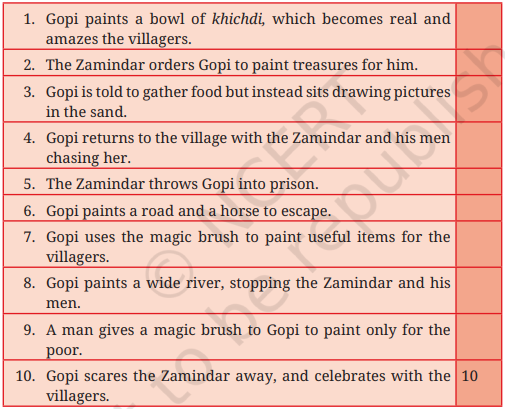
I Arrange the events in order of occurrence in the poem. The last one has been marked for you. Share your answers with your classmates and teacher.
Answer:
- Gopi is told to gather food but instead sits drawing pictures in the sand. (3)
- A man gives a magic brush to Gopi to paint only for the poor. (9)
- Gopi paints a bowl of khichdi, which becomes real and amazes the villagers. (1)
- Gopi uses the magic brush to paint useful items for the villagers. (7)
- The Zamindar orders Gopi to paint treasures for him. (2)
- The Zamindar throws Gopi into prison. (5)
- Gopi paints a road and a horse to escape. (6)
- Gopi returns to the village with the Zamindar and his men chasing her. (4)
- Gopi paints a wide river, stopping the Zamindar and his men. (8)
- Gopi scares the Zamindar away, and celebrates with the villagers. (10)
II Fill in the blanks by choosing the correct answer from the box given below.

The tone of the poem shifts throughout, reflecting the different moods of the story. Initially, the tone is 1. _________________ as Gopi uses her imagination to draw in the sand, and later when the Zamindar enters the story, the tone shifts to one of 2. _________________. In the final part of the poem, the tone becomes 3. _________________ as Gopi escapes, the Zamindar is defeated, and the villagers rejoice.
Answer: 1. playful and innocent
2. tension and suspense
3. triumphant and celebratory
III Fill in the blanks by choosing the correct option from within the brackets.
1. The poem mostly follows a simple rhyme scheme, _________________, which adds a rhythmic flow. (ABCB, ABBA, ABAB)
2. This poem belongs to the _________________ poetry genre, which tells a story through verse. (descriptive, narrative or ballad, free style)
Answer: 1. ABCB
2. Narrative or ballad
IV Give examples from the poem for the following explanations.
1. The poem is rich in imagery, creating clear pictures in the reader’s mind. For example, ___________________.
Answer: “That night the Zamindar lies in bed, dreaming of his gold, while Gopi paints a winding road, a horse both strong and bold.”
2. What is the effect of repetition in the line—‘On you, and you and you!’?
Answer: The repetition creates a sense of urgency and fear, making the threat sound stronger and more frightening to the Zamindar and his men.
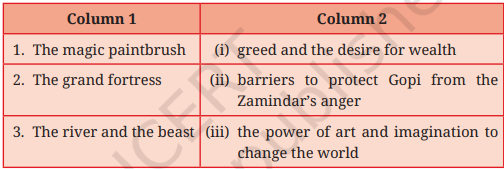
V Match the phrases from the poem in Column 1 with what they symbolise in Column 2.
Answer:
| Column 1 | Column 2 |
|---|---|
| 1. The magic paintbrush | (iii) the power of art and imagination to change the world |
| 2. The grand fortress | (i) greed and the desire for wealth |
| 3. The river and the beast | (ii) barriers to protect Gopi from the Zamindar’s anger |
VI Identify whether the following statement is true or false.
While Gopi uses the magic brush to help others, the Zamindar wants to use it for personal gain. This contrast drives the moral of the story.
Answer: True
Gopi uses the magic brush selflessly to help the poor, while the Zamindar wants it for greed and power. This contrast clearly shows the moral of the story.
Let us think and reflect (Page 128-130)
I Read the given extracts and answer the questions that follow.
1. But on a stone there sits a man,
A brush is in his hand.
He looks around. He calls to Gopi.
“Come here!” he whispers. “Hush!
We mustn’t let the village know
About this magic brush.”
He slips the brush into her hand
And tells her to be sure,
“Paint not for the wealthy ones,
But only for the poor.”

(i) Fill in the blank by selecting the correct option from those given in the brackets.
The man is whispering and telling Gopi to keep the brush a secret
reflects his _______________________ (careful and secretive/magical and delightful) nature.
Answer: The man is whispering and telling Gopi to keep the brush a secret reflects his careful and secretive nature.
(ii) What is the significance of the man slipping the brush into Gopi’s hand?
Answer: The man slipping the brush into Gopi’s hand shows that he is secretly giving her a special responsibility. It signifies that he trusts Gopi to use the magical brush wisely and only to help the poor.
(iii) Complete the following sentence with a suitable reason.
The most likely reason the man instructs Gopi to ‘Paint not for wealthy ones but only for the poor’ is because he _______________________.
Answer: The most likely reason the man instructs Gopi to ‘Paint not for wealthy ones but only for the poor’ is because he wants the magic to bring help and happiness to those who really need it, not to satisfy the greed of the rich.
(iv) Select the most appropriate title for the extract from the two given below.
A. The Magic Brush’s Secret
B. Gopi’s Special Gift
Answer: A. The Magic Brush’s Secret
2. And soon the news spreads far and wide,
Through forests, fields, and plains,
Until the Zamindar himself
Hears of these magic gains.
“I order you to paint for me,
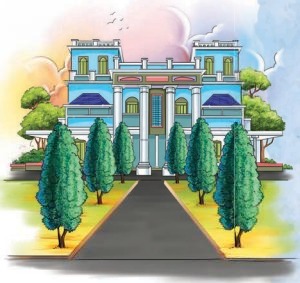
A fortress tall and grand.
Paint treasures, jewels, and riches rare,
Enough to rule this land.”
(i) Complete the following sentence with the correct reason.
The news of Gopi’s magic brush spreads ‘through forests, fields, and plains’ because of its _______________________.
Answer: The news of Gopi’s magic brush spreads ‘through forests, fields, and plains’ because of its ability to create real objects from paintings, which amazed and helped the villagers.
(ii) Why does the poet refer to things painted by Gopi’s paintbrush as ‘magic gains’?
Answer: The poet refers to things painted by Gopi’s paintbrush as ‘magic gains’ because whatever she painted turned real, bringing great benefit and happiness to the poor villagers.
(iii) Which of the following statements given below is false? Rectify the false statement.
A. Gopi’s magic brush draws the attention of the powerful Zamindar.
B. The Zamindar requests Gopi to paint a grand fortress and jewels.
Answer: False statement: B. The Zamindar requests Gopi to paint a grand fortress and jewels.
Correction: The Zamindar orders Gopi to paint a grand fortress and jewels.
(iv) What does the Zamindar’s demand for a grand fortress and jewels reveal about his character?
Answer: The Zamindar’s demand shows that he is greedy, selfish, and power-hungry, caring only about wealth and control rather than helping others.
II Answer the following questions.
1. Explain why Gopi made the right decision by refusing to paint for the Zamindar.
Answer: Gopi refused to paint for the Zamindar because the Zamindar was greedy and wanted to use the magic brush for selfish gains, like amassing wealth and power. Gopi understood that helping him would harm the villagers and misuse the magical gift. Her decision reflects her moral courage, sense of justice, and commitment to using the brush for good rather than greed.
2. Gopi threatens to draw a beast to scare away the Zamindar. Justify her action. How would you have dealt with the situation differently?
Answer: Gopi threatened to draw a beast to protect herself and the villagers from the Zamindar’s greed and potential cruelty. Her action was justified because it was defensive; she used her intelligence and the magical brush to maintain justice without causing real harm.
If I were in the same situation, I might have tried reasoning with the Zamindar first, appealing to his conscience, or seeking help from the villagers to collectively stand against his unfair demands.
3. What is the significance of Gopi celebrating with the villagers at the end of the poem?
Answer: The celebration shows that Gopi’s actions have restored peace, justice, and happiness in the village. It signifies the triumph of good over greed and reinforces the theme that honesty, courage, and community welfare are more valuable than wealth or power.
4. Compare Gopi’s use of the magic brush to how the Zamindar would have used it.
Answer: Gopi used the brush to help people, provide food, and create solutions that benefited the entire village. In contrast, the Zamindar would have used it selfishly, to accumulate personal wealth and power, ignoring the welfare of others. This contrast highlights the difference between selflessness and greed.
5. What can be inferred about Gopi’s character based on her refusal to follow the Zamindar’s orders?
Answer: Gopi’s refusal shows that she is brave, morally upright, and independent-minded. She values justice and the welfare of others above personal safety or obedience. Her character reflects intelligence, compassion, and ethical courage.
6. Justify the appropriateness of the title of the poem.
Answer: The title of the poem is appropriate because the magic paintbrush is central to the story—it drives the plot and symbolizes creativity, responsibility, and moral choices. The story revolves around how Gopi uses the brush wisely, highlighting the magic and its potential to change lives.
7. If you had the magic brush, how would you use it in today’s world?
Answer: If I had the magic brush today, I would use it to solve social problems and help people:
- Eradicate hunger by creating food for those in need.
- Provide shelter and clothing for the homeless.
- Promote education by creating schools and books.
- Protect the environment by restoring forests and cleaning polluted areas.
The brush would be used to bring positive change and make life better for everyone, not for personal gain.
Let us learn (Pages 130-132)
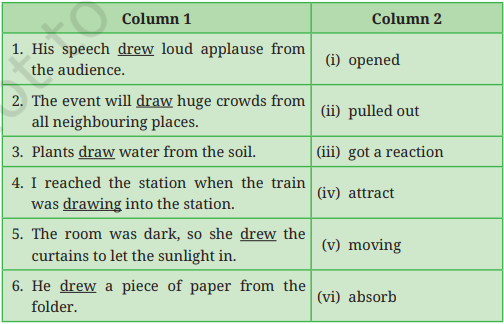
I The verb ‘draw’ has different meanings in different contexts. Match the sentences in Column 1 with their appropriate meanings in Column 2.
Answer:
| Column 1 | Column 2 |
|---|---|
| 1. His speech drew loud applause from the audience. | (iii) got a reaction |
| 2. The event will draw huge crowds from all neighbouring places. | (iv) attract |
| 3. Plants draw water from the soil. | (vi) absorb |
| 4. I reached the station when the train was drawing into the station. | (v) moving |
| 5. The room was dark, so she drew the curtains to let the sunlight in. | (i) opened |
| 6. He drew a piece of paper from the folder. | (ii) pulled out |
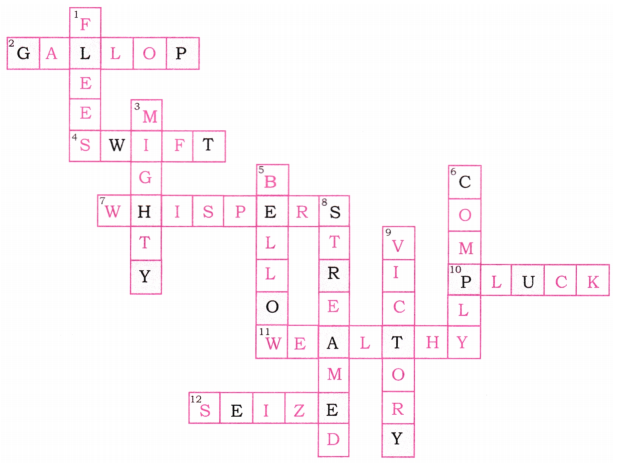
II Fill in the crossword. Clues have been given below. You will find the words in the poem.
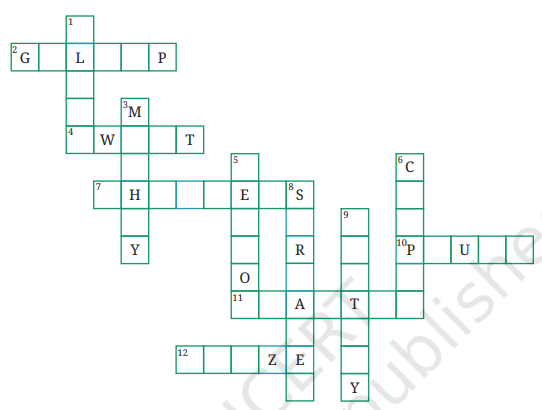
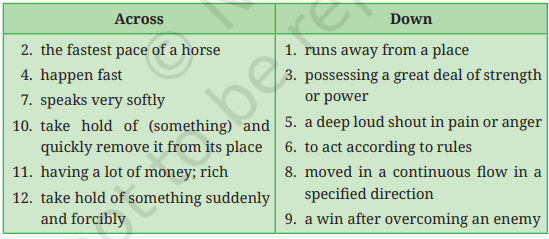
Answer:
III There are certain expressions that convey a sudden feeling or reaction.
They can be used to express a variety of emotions and thoughts.
Example: … he whispers. “Hush!”
(‘Hush’ denotes the act of silencing someone)
Now, match the expressions in Column 1 with what emotions or reactions they convey, in Column 2.
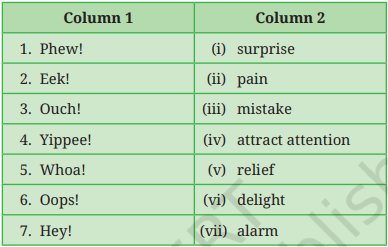
Now, create sentences using any five expressions from Column 1.
Answer:
| Column 1 | Column 2 |
|---|---|
| Phew! | relief |
| Eek! | alarm |
| Ouch! | pain |
| Yippee! | delight |
| Whoa! | surprise |
| Oops! | mistake |
| Hey! | attract attention |
- Phew! – Phew! I finally finished my exams on time.
- Eek! – Eek! There’s a huge spider on the wall!
- Ouch! – Ouch! I stubbed my toe on the table.
- Yippee! – Yippee! We won the football match!
- Oops! – Oops! I accidentally spilled the juice on the floor.
Let us listen (Pages 132-133)
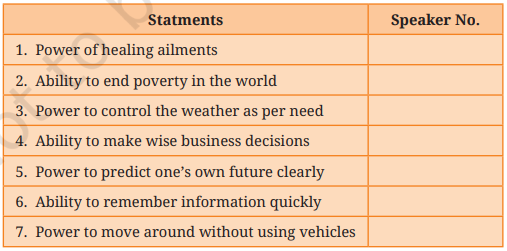
I You will listen to five speakers speak about a magical power they wish for. As you listen, match statements 1–7 with speakers (i)–(v). There are two statements you do not need. (Transcript for teacher on page 152 )
Speaker (i) : If I could have any magical power, I’d choose the ability to predict the future. Imagine being able to see profis and losses before time. I could make better savings and secure my business. Plus, I’d use it to help others make wise fiancial decisions as well.
Speaker (ii) : I think having the power to learn instantly would be amazing! Exams would be easy, and I’d have more time for activities I enjoy, like playing cricket. If I could remember everything,itwouldmakelifesomucheasier!
Speaker (iii) : I would want the power of fling. Imagine being able to see the world from up above clearly. I would be able to go from one place to another quickly without using any means of transport. It would be a dream come true.
Speaker (iv) : At my age, I’d love to have the power of healing. There are so many aches and pains that come with growing old, but it’s not just for me. If I could heal others too, I’d help my family stay healthy and happy.
Speaker (v) : If I had a magical power, I’d want control over the weather. We depend so much on the rains. With this power, I could ensure that crops always get the right amount of rain and sunshine.
Answer:
| Statements | Speaker No. |
|---|---|
| Power of healing ailments | (iv) |
| Ability to end poverty in the world | (i) |
| Power to control the weather as per need | (v) |
| Ability to make wise business decisions | (i) |
| Power to predict one’s own future clearly | (i) |
| Ability to remember information quickly | (ii) |
| Power to move around without using vehicles | (iii) |
Let us speak (Pages 133)
Intonation is the rise and fall of the pitch of tone while speaking.
The ‘falling’ tone is the fall in the pitch of the voice from a high level to a low level. It is marked  . The falling tone is generally used in imperative sentences. Such sentences are used in speech for different communicative purposes— to express a command or an instruction, to ask for a favour or to give a warning.
Read the following sentences from the text with the falling tone.
• Come here!
• Seize this magic brush…
• Paint my fortress tall!
• Go and fetch some rice.
Falling Intonation
Definition: The fall in the pitch of the voice from a high level to a low level while speaking.
Marked as: 
Use:
Falling tone is generally used in imperative sentences, which are sentences that:
- Give a command or instruction – e.g., Paint my fortress tall!
- Ask for a favour – e.g., Go and fetch some rice.
- Give a warning – e.g., Seize this magic brush…
Examples from the text (with falling tone):
- Come here! → Command
- Seize this magic brush… → Warning/command
- Paint my fortress tall! → Instruction
- Go and fetch some rice. → Favour/command
II Work in pairs. Take turns to make requests for the following formal and informal situations.
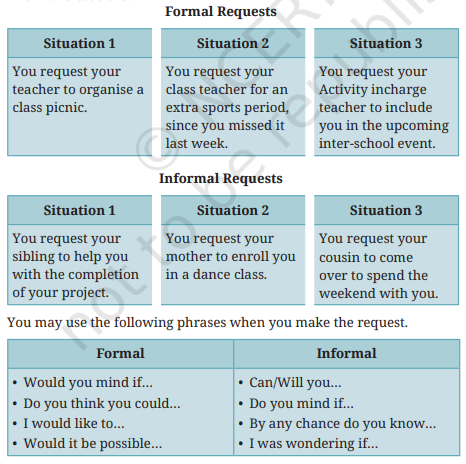
Answer: Students to do as directed.
Let us write (Pages 134-135)
I Imaginative essay is a type of creative writing where the writers use their imagination. An imaginative essay can be based on real-life events, observation, or experiences. It is usually a descriptive piece or a personal reflection.
Read the sample of an imaginative essay.
My Life as EcoFlash
Imagine an ordinary 13-year-old student who is also a secret superhero protecting the environment. That’s my life as EcoFlash! By day, I’m Meenu, an ordinary Grade 8 student. By evening, I use my powers to keep my neighbourhood green and clean.
As EcoFlash, I have the ability to grow plants, purify water, and clean polluted air with a wave of my hand. I wear a green suit with a glowing leaf symbol and carry a small seed pouch that holds magic seeds to restore damaged areas. My mission is to fight pollution, save trees, and educate people about taking care of our planet. My friends wonder why I’m always carrying a plant in my bag or why my shoes are muddy, but I can never tell them the truth.
Once, my little brother saw me turning a garbage dump into a beautiful garden and almost spilled my secret to our parents. I had to convince him it was a magic trick!
Being EcoFlash is not just about powers but also responsibility. Every time I see clean streets, blooming flowers, and children playing in green parks, I feel proud. I know that even small changes can make a big difference, and that’s what keeps me going.

II Complete the given checklist based on your observations and understanding of what an imaginative essay includes. Share the answers with your classmates and teacher.
1. Title — A relevant title
2. Introduction
• Captivating opening sentence to catch the reader’s attention
• Clear statement of the setting, situation, or main idea
• Establishes the tone (e.g., playful, serious, and adventurous)
• Introduces the narrator briefly (if applicable)
3. Setting and Context
• Description of the setting to create a mental picture
• Clear time frame (past, present, or future)
• Brief explanation of any unique or imaginative elements (e.g., powers, fantasy world)
4. Characters
• Main character introduced with unique traits
• Supporting characters briefly described (if relevant)
5. Central Idea
• Clear focus on a single powerful idea or narrative
• Logical flow of events, even if the story involves imagination or fantasy
6. Language and Style
• Use of sensory details (sight, sound, touch, smell, and taste) to enhance the narrative
• Creative metaphors or similes to enrich descriptions
7. Resolution
• Key turning point or moment of realisation
• Resolution of the main idea
• Clear takeaway message
8. Conclusion
• Ends on a reflective or thought-provoking note
• Summarises the main message or leaves the reader with a strong final impression
III Write an imaginative essay on any one of the following.
1. Imagine you were a scarf that flew away from a clothesline. Describe the places you travelled to and how you came back. Also write about what you thought was the most valuable experience.
Answer: Option 1: “The Adventures of a Flying Scarf”
Imagine I was a bright red scarf fluttering on a clothesline on a sunny morning. A sudden gust of wind lifted me into the sky, and I began my incredible journey. I soared over rooftops, danced above parks where children were playing, and glided past busy streets where cars honked below.
I flew across rivers, over mountains, and even through a market filled with colourful stalls. Everywhere I went, I felt the excitement of seeing the world from above, the thrill of freedom, and the joy of touching places I had never imagined.
After a long adventure, the wind gently carried me back to my home. I landed softly on the grass near the clothesline. My most valuable experience was understanding the beauty of exploration and appreciating the safety and warmth of home. Even the simplest places, like my owner’s garden, seemed magical after seeing the world from the skies.
2. Imagine you stumbled upon a magical book in the library. The book transported you to a different time period. Describe your experience and an important learning.
Answer: Option 2: “The Magical Book”
One quiet afternoon, I wandered into the school library and discovered a strange, glowing book tucked behind dusty shelves. Curious, I opened it, and in a blink, I was transported to medieval times! I found myself in a bustling marketplace with merchants selling spices, colorful fabrics, and handmade toys. Knights in shining armor rode past, and townsfolk bustled about their daily chores.
I spent the day learning about life in that era—how people lived, worked, and solved problems without modern technology. I even helped a young apprentice solve a tricky puzzle using logic and creativity. As the sun set, the book glowed again, and I was back in the library, holding the magical book in my hands.
The most important lesson I learned was that every era has its challenges and solutions, and creativity, courage, and kindness are timeless qualities that help people thrive anywhere and anytime.
Let us explore (Page 136)
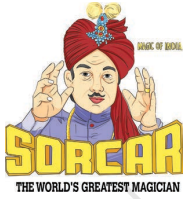
I Have you heard of India’s famous magician, P. C. Sorcar Sr.? He is known as one of the ‘World’s Greatest Magician’
and performed live magic shows in front of audiences and on television, internationally.
He was awarded Padma Shri on 26 January 1964 for his contribution to the world of magic.
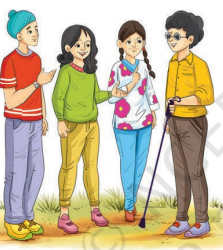
II Words can also play tricks. Read the riddles about things that seem to be unreal and find what they refer to.
1. I can fill a room, but I take up no space. I’m often heard, but never seen. What am I?
2. The more you take, the more you leave behind. What am I?
3. I have cities but no houses, I have forests but no trees. What am I?
4. I’m tall when I’m young and short when I’m old, in a dark room, my story is told.
Answer:
1. Air
2. Footsteps
3. Map
4. Candle
III You are asked to create a magical object. What object would you create? Make a drawing with all its details and mention its special quality on the same sheet. Put up the sheet on the display board.
Answer: I would create a Book of Infinite Knowledge. This ancient-looking book has a shimmering golden cover and pages that glow softly in the dark. Whenever you open it, the pages magically display answers to any question you have, from solving math problems to understanding life mysteries. The book can also teach new skills instantly, like painting, playing music, or learning a new language. To use it, simply place your hand on the cover, ask your question, and watch the glowing letters form on the pages. The book recharges its magic by being placed under sunlight every morning. While it cannot predict the future, it provides wisdom, guidance, and endless learning opportunities to anyone who uses it.

Leave a Reply