I Cannot Remember My Mother
Exercise Question
Questions within the Lesson
Exercise Question
Check Your Understanding
I. Fill in the blanks with appropriate words
Stanza 1
1. The poet remembers his mother while he is in the midst of his play.
2. The poet remembers the tune of some song but not the mother.
Setting: outdoor (outdoor/indoor)
Stanza 2
1. The poet remembers his mother in the early autumn season.
2. The poet remembers his mother by the smell of shiuli flowers / morning service in the temple.
Setting: outdoor (outdoor/indoor)
Stanza 3
1. The poet feels that his mother gazes at him from the sky.
Setting: indoor (outdoor/indoor)
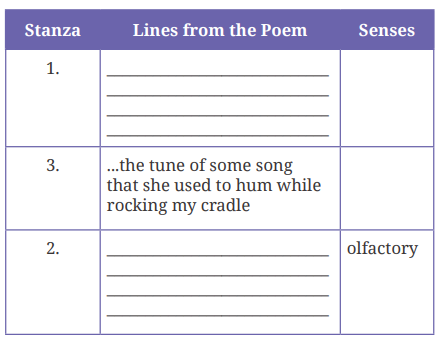
II. The senses of olfactory (smell), auditory (hearing), and visual (sight), are three of the five basic senses in humans. Give examples of references to senses from the poem. Complete the table given below.
Ans:-
| Stanza | Lines from the Poem | Senses |
|---|---|---|
| 1 | only sometimes in the midst of my play a tune seems to hover over my playthings the tune of some song that she used to hum while rocking my cradle | auditory |
| 3 | I feel that the stillness of my mother’s gaze on my face has spread all over the sky | visual |
| 2 | the smell of the shiuli flowers floats in the air the scent of the morning service in the temple | olfactory |
III. Read the poem silently once again and complete the following.
1. Two examples of alliteration from the poem are (i) my mother and (ii) some song
2. An example of onomatopoeia is hum
3. The poem uses imagery extensively. Explain.
Ans :- The poet creates clear images using senses like sound, smell, and sight.
He describes the tune of a song, the smell of shiuli flowers, and the blue sky with his mother’s gaze.
These images help the reader feel his memories of his mother.
4. Although the poem does not have a rhyme scheme, it is enjoyable because it has deep emotions, simple language, and beautiful images.
5. What is the tone of the poet? Why do you say so?
Ans :- The tone is nostalgic and emotional because the poet misses his mother and remembers her through feelings and memories.
6. What impact does the title of the poem have on the overall mood of the poem?
Ans :- The title creates a sad and emotional mood because it shows that the poet cannot clearly remember his mother.
7. The poet uses ‘I cannot remember my mother’ as a refrain because it shows his deep loss and reminds us again and again that his memories are unclear.
8. The poet uses symbolism to indicate the memory of his mother’s presence. Identify the symbols used in the poem.
Ans :-
tune of a song → memory of mother’s voice
shiuli flowers and their scent → mother’s presence
blue sky and gaze → mother’s love and care
Critical Reflection
1. Read the extract and answer the questions
1. I cannot remember my mother
only sometimes in the midst of my play
a tune seems to hover over my playthings,
(i) Complete the following sentence appropriately.
The poet is reminded of his mother during his playtime.
(ii) What is the primary emotion conveyed by the line ‘a tune seems to hover over my playthings’?
A. It enhances the joy of play.
B. It disrupts the playtime atmosphere.
C. It activates memories of the mother.
D. It symbolises the carefree nature of childhood.
Ans. C. It activates memories of the mother.
(iii) In the context of the poem, what role does the hovering tune play during the speaker’s playtime?
Ans. The hovering tune reminds the poet of his mother and brings back her memory while he is playing.
(iv) State whether the following sentence is true or false.
The poet experiences the tune lingering over playthings only occasionally during playtime.
Ans. True
(v) How could the poet feel his mother’s presence, even though she isn’t there?
Ans. The poet feels his mother’s presence through the tune of the song she used to hum.
2. Read the extract and answer the questions
I feel that the stillness of
my mother’s gaze on my face
has spread all over the sky.
(i) What does the poet suggest about the stillness of his mother’s gaze spreading over the sky?
A. The mother’s gaze is physically present in the sky.
B. The sky is a symbolic extension of the mother’s presence.
C. The sky mirrors the mother’s emotions.
D. The stillness is fleeting and unrelated to the mother.
Ans. B. The sky is a symbolic extension of the mother’s presence.
(ii) What emotion does the poet associate with the ‘stillness’ of his mother’s gaze?
A. a sense of grief
B. a sense of anticipation
C. a sense of nostalgia
D. a sense of serenity
Ans. D. a sense of serenity
(iii) State whether the following sentence is true or false.
The poet suggests that the mother’s gaze has a tangible and visual effect on the sky.
Ans. True
(iv) What is the purpose of likening the mother’s gaze to the sky?
Ans. The poet compares his mother’s gaze to the sky to show that her love and presence are wide, calm, and everywhere.
(v) Complete the sentence appropriately.
The tone of the poet in the given extract is calm and emotional because he feels his mother’s loving presence in the sky.
II. Answer the following questions
1. What is the emotional impact of the refrain, ‘I cannot remember my mother’?
Ans. It creates a feeling of sadness and loss and shows that the poet misses his mother deeply.
2. Interpret the connection between the poet’s mother and the following:
(i) shiuli flowers
Ans. The smell of shiuli flowers reminds the poet of his mother’s presence.
(ii) humming tune
Ans. The humming tune reminds the poet of his mother singing to him in childhood.
3. What role does nature play in the poet’s description of the memory of his mother?
Ans. Nature helps the poet remember his mother through flowers, scent, and the sky.
4. What can be inferred about the poet’s perception of the mother–child relationship?
Ans. The poet believes that a mother’s love is deep, caring, and always stays with the child even after she is gone.
Vocabulary in Context
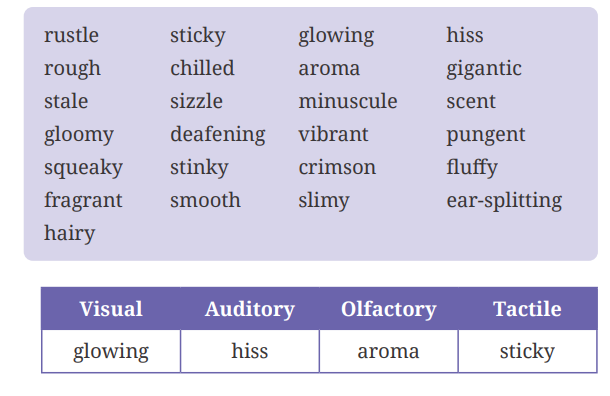
I. Work in pairs to classify the sensory words given in the box below. One example has been done for you.
Ans :-
| Visual (Sight) | Auditory (Hearing) | Olfactory (Smell) | Tactile (Touch) |
|---|---|---|---|
| glowing | hiss | aroma | sticky |
| gigantic | rustle | scent | rough |
| minuscule | sizzle | stale | chilled |
| vibrant | squeaky | pungent | smooth |
| crimson | deafening | stinky | slimy |
| gloomy | ear-splitting | fragrant | fluffy |
| shrill | hairy |
II. Fill in the blanks with sensory words in the box for the following passage written by Sarojini Naidu. There are two extra words.
Come and share my exquisite March morning with me:
this sumptuous blaze of gold and sapphire sky; these
1. scarlet lilies that adorn the sunshine; the voluptuous 2. perfumes of neem and champak and serisha that beat upon the languid air with their implacable 3. scents; the thousand little gold and blue and silver breasted birds bursting with the 4. shrill ecstasy of life in nesting time. And, do you know that the scarlet lilies are woven petal by petal from my heart’s blood, these little quivering birds are my soul made incarnate music, these heavy 5. perfumes are my emotions dissolved into aerial 6. scents, this
7. smooth blue and gold sky is the ‘very me’…
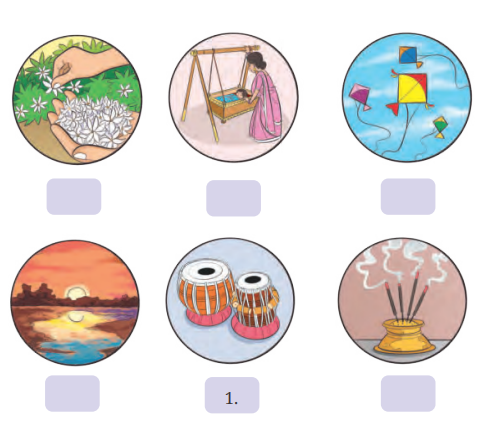
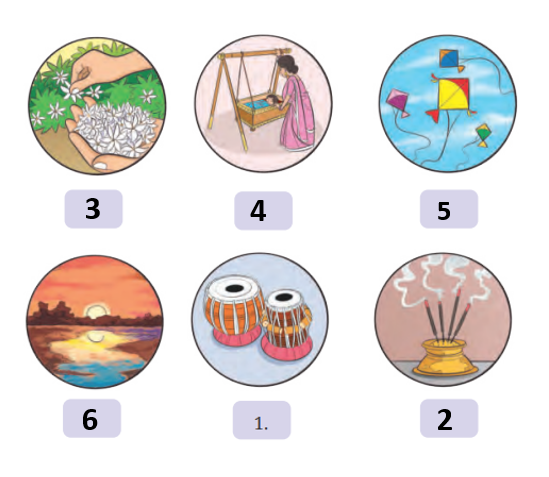
III. Write numbers against each picture with the phrases that describe them with their sensorial associations.
1. beats of music echo in air
2. melody of soothing scent, dancing in the air
3. fragrant breeze of blooming buds
4. gentle lullaby, a soft melody
5. colourful sky, painting a lively sight
6. attractive canvas painting the horizon
Ans :-
Writing Task
I. Imagine you had been on a school trip to a scenic place which appealed to all your senses. Write a diary entry describing the place and why it was a memorable experience.
Ans:-
Monday, 15 June 2026
Time: 8:30 p.m.
Today was one of the most beautiful and memorable days of my life. I went on a school trip to a scenic hill station, and it felt like a dream come true.
As soon as I reached, I saw the lush green mountains and a bright blue sky stretching far and wide. The view was so colourful and peaceful that I could not take my eyes off it. The cool breeze touched my face gently, making me feel fresh and calm. I could hear the soft rustling of leaves and the chirping of birds, which made the surroundings even more pleasant.
There was a garden full of blooming flowers. Their sweet fragrance filled the air, and I felt very happy walking through it. I also touched the soft petals, which felt smooth and delicate. Later, we sat near a small stream where the water made a soothing sound as it flowed over the rocks.
One of the most special moments was watching the sunset. The sky turned shades of orange, pink, and purple, and it looked like a beautiful painting. I felt a deep sense of joy and peace at that moment.
This trip appealed to all my senses and gave me unforgettable memories. I realised how beautiful nature is and how important it is to spend time in such peaceful places. I will always cherish this experience.
Questions within the Lesson
Reflect and Respond
I. Work in pairs. Discuss the memories from your childhood that you remember. List them and share with your classmates and teacher.
Ans :-
I remember playing outdoor games with my friends in the evening.
I remember listening to bedtime stories told by my mother.
I remember celebrating festivals with my family happily.
I remember going on school picnics and trips.
I remember learning to ride a bicycle for the first time.
II. Discuss how children’s relationship with their mother can influence their emotions and memories.
Ans :- A child’s relationship with the mother has a strong influence on emotions and memories. A loving and caring mother makes the child feel safe, happy, and confident. The child remembers her voice, love, and care throughout life. These memories bring comfort and emotional strength. A good relationship creates positive feelings, while a poor relationship may lead to sadness and insecurity.
III. Match the words given in Column 1 with their meanings in Column 2.
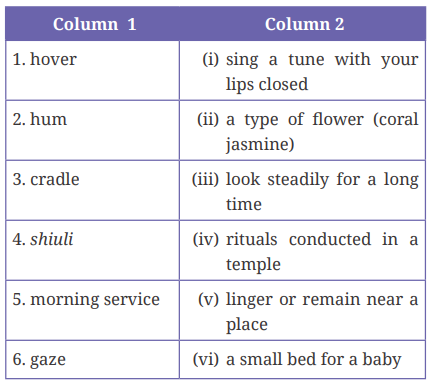
Ans :-
| Column 1 | Correct Match (Column 2) |
|---|---|
| 1. hover | (v) linger or remain near a place |
| 2. hum | (i) sing a tune with your lips closed |
| 3. cradle | (vi) a small bed for a baby |
| 4. shiuli | (ii) a type of flower (coral jasmine) |
| 5. morning service | (iv) rituals conducted in a temple |
| 6. gaze | (iii) look steadily for a long time |

Leave a Reply