Nine Gold Medals
Exercise Question
Questions within the Lesson
Exercise Question
Check Your Understanding
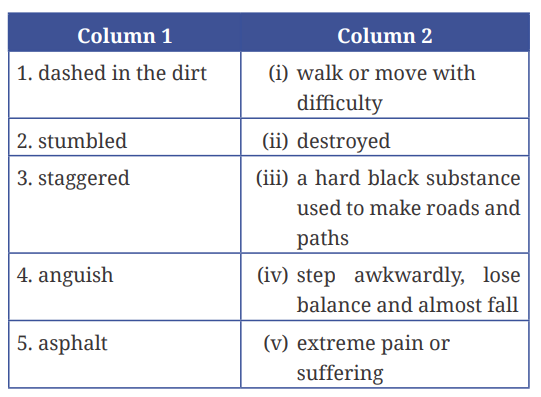
I. Work in pairs. Match the words and phrases in Column 1 with their meanings in Column 2. You may read the poem again and infer the contextual meaning. Check your answers with the teacher.
Ans:-
| Word | Meaning |
|---|---|
| 1. dashed in the dirt | (ii) destroyed |
| 2. stumbled | (iv) step awkwardly, lose balance and almost fall |
| 3. staggered | (i) walk or move with difficulty |
| 4. anguish | (v) extreme pain or suffering |
| 5. asphalt | (iii) a hard black substance used to make roads and paths |
II. Identify the gist of each stanza. Write the number of the stanza in the boxes given.
1. Spectators cheered participants of different events and waited enthusiastically for the final event to start.
Answer: Stanza 2
2. All runners dashed ahead as soon as they heard the gun shot; suddenly, one of the athletes tripped and fell on the ground.
Answer: Stanza 4
3. The race finished with nine athletes holding hands and winning the well-deserved gold medals; their smiles, and spectators standing up to applaud, conveyed everything.
Answer: Stanza 8
4. Participants got ready at the starting line and nine determined athletes waited for the sound of the gun.
Answer: Stanza 3
5. Athletes from various parts of the country had gone through months of training; had big dreams of winning a medal.
Answer: Stanza 1
6. The eight athletes stopped to help the young fallen athlete stand up, forgetting that they were competing.
Answer: Stanza 6
7. Nine athletes held the banner and walked hand in hand; this gesture represented the ethos of Special Olympics.
Answer: Stanza 7
8. The young athlete felt his dreams were shattered and cried in pain and disappointment, but something unique happened.
Answer: Stanza 5
III. Let us appreciate the poem.
1. Two examples of alliteration from the poem are
(i) standing still and (ii) beaming faces
2. Give three examples of visual imagery from the poem.
(i) The runners lined up at the starting line
(ii) The athlete falling on the asphalt
(iii) Nine runners holding hands and finishing together
3. Give an example of auditory imagery from the poem.
(i) The pistol exploded
4. How does the use of imagery make the poem more appealing?
Ans:- Imagery helps the reader to clearly imagine the scenes and feel the emotions, making the poem more interesting and lively.
5. How does the poet’s tone change from the beginning to the end of the poem?
Ans:- The tone changes from excitement and competition to compassion, unity, and joy.
6. What is the overall mood created by the poem?
Ans:- The overall mood is emotional, inspiring, and heartwarming.
7. What is the message being conveyed by the poem?
Ans:- The poem conveys that kindness, teamwork, and humanity are more important than winning.
Critical Reflection
I. Read the extracts given below and answer the questions that follow.
1. The eight other runners pulled up on their heels
The ones who had trained for so long to compete
One by one they all turned round and went back to help him
And brought the young boy to his feet.
(i) Select the correct option to complete the sentence.
The phrase ‘pulled up on their heels’ means that the runners _______.
A. moved aside
B. stopped running
C. tried to run faster
D. jumped ahead
Answer: B. stopped running
(ii) Mention one character trait common to all the eight other runners.
Answer: Kindness (compassion/helpfulness)
(iii) What is the tone of the poet in these lines?
Answer: Sympathetic and caring
(iv) How might the young athlete have felt on being helped by the others?
Answer: He might have felt grateful, encouraged, and supported.
(v) Would you consider this incident as a turning point in the poem? If yes, why? If no, why not?
Answer: Yes, because the race changes from competition to cooperation and shows true humanity.
2. That’s how the race ended, with nine gold medals
They came to the finish line holding hands still
And a standing ovation and nine beaming faces
Said more than these words ever will.
(i) How did the nine contestants feel when they reached the finishing line together?
Answer: They felt happy, proud, and united.
(ii) Why do you think all the nine contestants were given gold medals?
Answer: Because they showed teamwork, kindness, and true sportsmanship.
(iii) Complete the sentence appropriately.
The holding of hands signifies a feeling of _____________________.
Answer: unity (togetherness)
(iv) Choose the correct option to complete the sentence.
The spectators giving a ‘standing ovation’ indicates that they were ___________.
A. amazed
B. speechless
C. distracted
D. thoughtful
Answer: A. amazed
(v) Explain the last line of the extract.
Answer: The actions, smiles, and unity of the athletes expressed their feelings and message more powerfully than words could.
II Answer the following questions.
1. Describe how the setting established in the first two stanzas of the poem create a vivid atmosphere for the events that follow.
Answer: The first two stanzas describe a competitive sports event with excited spectators and well-prepared athletes, creating a lively and energetic atmosphere for the race.
2. How do you think the youngest athlete might have felt when he fell?
Answer: He might have felt sad, disappointed, and hurt as his dreams of winning were shattered.
3. Why were the athletes eager to begin the race?
Answer: The athletes were eager because they had trained for a long time and wanted to win medals and achieve their goals.
4. What does the transformation of the hundred-yard dash to a walk symbolise?
Answer: It symbolises unity, compassion, and the importance of helping others over winning.
5. How might the poem be different if the focus was solely on individual achievement rather than collective support?
Answer: The poem would focus only on competition and winning, and it would lose its message of kindness, teamwork, and humanity.
6. How does the poet’s use of language and tone enhance the reader’s engagement with the poem?
Answer: The poet uses simple and emotional language with a changing tone, which helps readers connect with the feelings and understand the message clearly.
7. What might be the poet’s purpose of writing this poem?
Answer: The poet’s purpose is to teach the value of empathy, teamwork, and kindness, showing that helping others is more important than winning.
Vocabulary in Context
I. The phrase ‘standing ovation’ is an example of an adjective–noun collocation. Identify two other similar examples from the poem.
Ans:-
final event
young boy
II. Complete the table given below by writing four nouns in Column 2 that collocate with the adjectives in Column 1. One example has been done for you. You may take the help of a dictionary.
| Column 1 | Column 2 |
|---|---|
| 1. big | disappointment, failure, surprise, decision |
| 2. heavy | |
| 3. strong | |
| 4. large | |
| 5. great |

Leave a Reply