Believe in Yourself
Exercise Question
Questions within the Lesson
Exercise Question
Check your Understanding
I. Based on your understanding of the poem, select the correct central idea for each stanza from the options given.
Stanza 1
(i) Facing challenges requires personal responsibility and a clear focus on one’s future.
(ii) Facing challenges is a journey best taken with support and guidance from others.
Answer: (i) Facing challenges requires personal responsibility and a clear focus on one’s future.
Stanza 2
(i) Fear and uncertainty make it difficult to make choices as the future approaches.
(ii) Facing the future with confidence makes choices easier and more straightforward.
Answer: (i) Fear and uncertainty make it difficult to make choices as the future approaches.
Stanza 3
(i) Personal growth involves finding balance between comfort and change.
(ii) Personal growth requires leaving behind comfort and embracing change.
Answer: (ii) Personal growth requires leaving behind comfort and embracing change.
Stanza 4
(i) The first step towards change may feel easy if you place your trust in others to guide you and provide support.
(ii) The first step towards change is difficult, but having self-belief and confidence helps you stay on track.
Answer: (ii) The first step towards change is difficult, but having self-belief and confidence helps you stay on track.
II. Rhyme Scheme
Fill in the blank to complete the following sentence.
The poem follows a simple, yet effective rhyme scheme _________ that flows steadily through each stanza.
Answer: ABAB
III. Tone
State whether the following statements are true or false.
1. The overall tone of the poem is motivational and encouraging.
Answer: True
2. The tone shifts from thoughtful in the beginning to one of determination by the end of the poem.
Answer: True
IV. Speaker
The speaker in this poem is not distant; rather, he/she comes across as a guide (stranger/guide) who understands the struggle and is encouraging the reader to take control of (interest in/control of) his/her own future.
The use of direct address ‘You’ creates a close connection, as though the speaker is talking directly to the reader (talking directly to the reader/addressing the reader from a distance).
V. Imagery
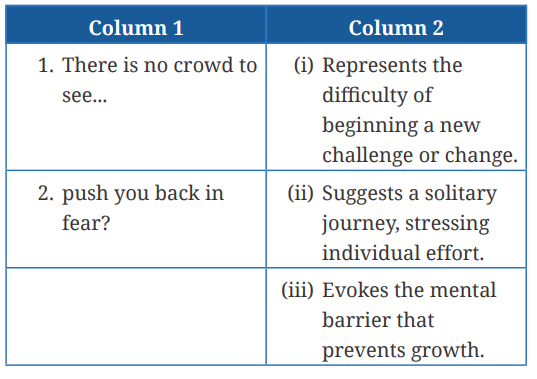
Match the phrases from the poem in Column 1 with the imagery they represent in Column 2. An extra
representation is given.
Ans:-
| Column 1 | Column 2 |
|---|---|
| 1. There is no crowd to see… | (ii) Suggests a solitary journey, stressing individual effort. |
| 2. push you back in fear? | (iii) Evokes the mental barrier that prevents growth. |
VI. Symbolism
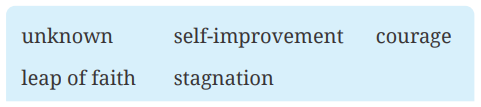
Select the words/phrases from the box below to complete the given sentences.
Ans:-
1. Comfort and the status quo represent stagnation and fear of change, symbolising the comfort zone that holds one back.
2. The future symbolises the unknown, the potential for change and success that requires courage to step into.
3. The first step symbolises the initial leap of faith required to begin the journey of self-improvement or personal development.
VII. Metaphor
Q1. The poet uses a metaphor in the line, ‘The first step is the hardest’. Explain why this is metaphorical.
Answer: The line ‘The first step is the hardest’ is metaphorical because it does not refer to a real physical step. It represents the beginning of any challenge or change in life. The “first step” stands for starting something new, and “hardest” shows the fear, doubt, and hesitation a person feels at the beginning. Thus, the poet uses this metaphor to show that starting a journey towards personal growth or success is the most difficult part.
VIII. Antithesis – Identify the lines from the poem that show antithesis and explain why.
Ans:
Example 1: “Will it pull you forward / Or push you back in fear?”
Two directly opposite actions—“pull you forward” and “push you back”—are placed in a parallel structure. “Forward” and “back” are opposites, showing the inner conflict between progress and fear, or courage and hesitation.
Example 2: “There is such ease in comfort / … But this isn’t what we are made for / This isn’t how we grow.”
“Ease in comfort” is contrasted with “how we grow.” Comfort suggests staying the same, while growth requires change and effort. This antithesis highlights that what feels easy is not what helps us improve, emphasizing the poem’s message about personal development.
Critical Reflection
I. Read the extract given below and answer the questions that follow.
1. Step up to the challenge
There is no crowd to see,
It’s just you and the future
And where you want to be.
(i) What does the line, ‘There is no crowd to see’ suggest about facing challenges?
Answer: The line suggests that facing challenges is a personal journey and one must deal with it alone without expecting support or attention from others.
(ii) Complete the following suitably.
The line ‘It’s just you and the future’ suggests that a person is responsible for shaping his or her own future through decisions and actions.
(iii) Fill in the blank with the appropriate word/phrase from the extract.
Latha will step up to the challenge her efforts to improve her vocal performance by practicing harder each day.
(iv) Select the most suitable title for the extract.
A. The Struggles of Change
B. Facing the Future Alone
C. A Journey of Growth
D. The Power of Fear
Answer: B. Facing the Future Alone
(v) Complete the analogy by using a word from the extract.
achieve : goal :: face : challenge
II. Answer the following questions.
1. What is the significance of the metaphor, ‘The first step is the hardest’ in the context of personal growth?
Answer: The metaphor signifies that starting something new or taking the first step towards personal growth is the most difficult part because it involves overcoming fear, doubt, and hesitation.
2. What message does the antithesis in the poem convey about the nature of personal development?
Answer: The antithesis conveys that personal development involves a struggle between opposite forces like fear and courage or comfort and change, and growth happens only when we choose to move forward despite fear.
3. Do you think the poet’s message is realistic in the context of real-world struggles? (Clue: Evaluate whether simply ‘believing in yourself’ is enough to overcome obstacles or other factors are also necessary.)
Answer: Yes, the poet’s message is realistic to some extent. Believing in oneself is important, but along with it, hard work, determination, support, and opportunities are also necessary to overcome real-world challenges.
4. Consider a situation where you or someone you know had to take a difficult first step towards a goal. How does the poem’s message about the importance of self-belief apply to this situation?
Answer: For example, a student who is afraid of public speaking may hesitate to participate. Taking the first step requires self-belief. Once the student gathers courage and performs, it becomes easier to improve. This shows that self-belief helps in overcoming fear and achieving success.
Vocabulary in Context
I. The phrase ‘status quo’ is a Latin expression that translates to ‘the state in which’ or ‘the existing state of affairs.’ Over time, it has become a popular term used in English to refer to the current situation or condition, especially when things remain unchanged.
There are other Latin terms commonly used in English. Read a few given below along with their meanings.
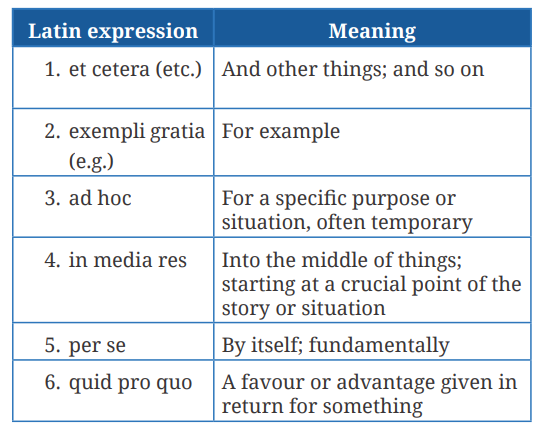
Now, fill in the blanks in the given sentences with the Latin expressions used in English from the table.
(i) I enjoy reading fantasy books, e.g. Harry Potter and Magical Paint Brush.
(ii) After helping Tanya with the homework, Ritu asked for a quid pro quo to borrow her notes next time.
(iii) I love all kinds of outdoor activities, such as trekking, hiking, biking, etc.
(iv) The park is not very special per se; it becomes more fun when you visit with friends.
(v) We created an ad hoc team to organise the school festival.
(vi) The movie started in media res, with the hero already fighting the villain in a huge battle.
II. The line , ‘Will it pull you forward/or push you back in fear?’ is a rhetorical question.

1. Read the following rhetorical questions and state what they intend to achieve.
1. (i) Isn’t it obvious that we must act now? Don’t we all have a responsibility to make a change?
Answer: These questions intend to urge people to take immediate action and realise their responsibility to bring about change.
(ii) Will we let fear control us, or will we rise above it?
Answer: This question intends to encourage people to overcome fear and choose courage and strength instead of being controlled by fear.
2. Match the situations in Column 1 to the rhetorical questions in Column 2.
| Column 1 | Column 2 |
|---|---|
| (i) Deciding whether to stand up for what is right | A. How can we ever grow if we never try anything new? |
| (ii) Owning up to a mistake made in a group project | B. Isn’t it better to admit our mistakes than to let them define us? |
| (iii) Deciding whether to try something challenging, like public speaking | C. If I don’t take responsibility now, when will I? |
| (iv) Choosing between two career paths | D. Can I really move forward without knowing which path to take? |
| (v) Deciding whether to apologise for a mistake | E. What’s the point of playing it safe if it means staying stuck? |
| (vi) Trying something new and stepping out of your comfort zone | F. How can we stay silent when we know what is right? |
Ans:-
| Column 1 (Situations) | Column 2 (Rhetorical Questions) |
|---|---|
| (i) Deciding whether to stand up for what is right | F. How can we stay silent when we know what is right? |
| (ii) Owning up to a mistake made in a group project | B. Isn’t it better to admit our mistakes than to let them define us? |
| (iii) Deciding whether to try something challenging, like public speaking | E. What’s the point of playing it safe if it means staying stuck? |
| (iv) Choosing between two career paths | D. Can I really move forward without knowing which path to take? |
| (v) Deciding whether to apologise for a mistake | C. If I don’t take responsibility now, when will I? |
| (vi) Trying something new and stepping out of your comfort zone | A. How can we ever grow if we never try anything new? |
Writing Task
Your class is conducting the morning assembly. You have been asked to deliver a speech on the topic, *‘Turning Challenges into Opportunities’*. Draft this speech by following the guidelines given below.
Answer:
Speech on “Turning Challenges into Opportunities”
Good morning respected Principal, teachers, and my dear friends. My name is ________, and today I am going to speak on the topic “Turning Challenges into Opportunities.” As it is rightly said, *“Difficulties in life are intended to make us better, not bitter.”* Have you ever thought why challenges come into our lives? Today, I will talk about how we can turn challenges into opportunities for growth and success.
Firstly, challenges help us learn new things and make us stronger. Whenever we face a difficult situation, we step out of our comfort zone and try something new. Many people feel scared or anxious when facing change because they fear failure. However, don’t you agree that without taking risks, we cannot grow? For example, if a student is afraid of speaking on stage, practicing and facing that fear helps them become confident over time.
Secondly, challenges open doors to new opportunities. When we face problems with a positive attitude, we develop confidence, determination, and courage. Isn’t it true that every failure teaches us an important lesson? For instance, if we fail in an exam, we learn to work harder and improve ourselves. By believing in ourselves and staying positive, we can turn every challenge into a stepping stone towards success.
In conclusion, challenges are not obstacles but opportunities in disguise. They help us grow and become better individuals. Let us face every challenge with courage and confidence. The next time you face a difficulty, remember—it is a chance to improve yourself. Thank you and have a nice day.
Questions within the Lesson
Reflect and Respond
I. Imagine that you are the person in the image
1. What emotions do you feel standing at the base of a difficult task?
Answer: I feel nervous, scared, and unsure, but also a little excited about the challenge.
2. What might make you take the first step?
Answer: Belief in myself, courage, and thinking about my future goals would make me take the first step.
II. Think about a time when you had to face a challenge
1. What was it, and how did you feel at the start of the journey?
Answer: It was a difficult task, and at the start I felt afraid, confused, and not confident.
2. How did you feel once you made the decision to move forward?
Answer: I felt more confident, strong, and determined to succeed.
III. What does the phrase ‘believe in yourself’ mean to you? Write some words or phrases you associate with believing in yourself.
Answer: It means having confidence in your abilities and trusting yourself.
Words/phrases: confidence, courage, self-trust, determination, positivity, strength.
IV. Select the correct meaning of ‘status quo’ based on the given sentence.
Even though some kids wanted to try new activities, most of them were happy with the status quo and didn’t want any changes.
A plan to make things more exciting.
A situation to keep things the same.
A decision where everything is completely different.
A choice to change things quickly without thinking.
Answer: 2. A situation to keep things the same.

Leave a Reply