How I Taught My Grandmother to Read
Exercise Question
Questions within the Lesson
Exercise Question
Check Your Understanding
I State whether the following sentences are true or false. Share your answers with your classmates and teacher
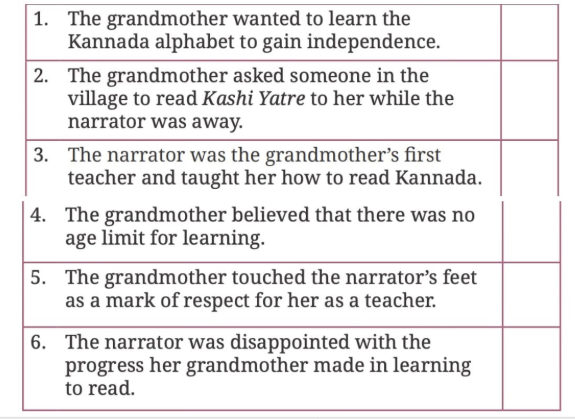
Answer:-
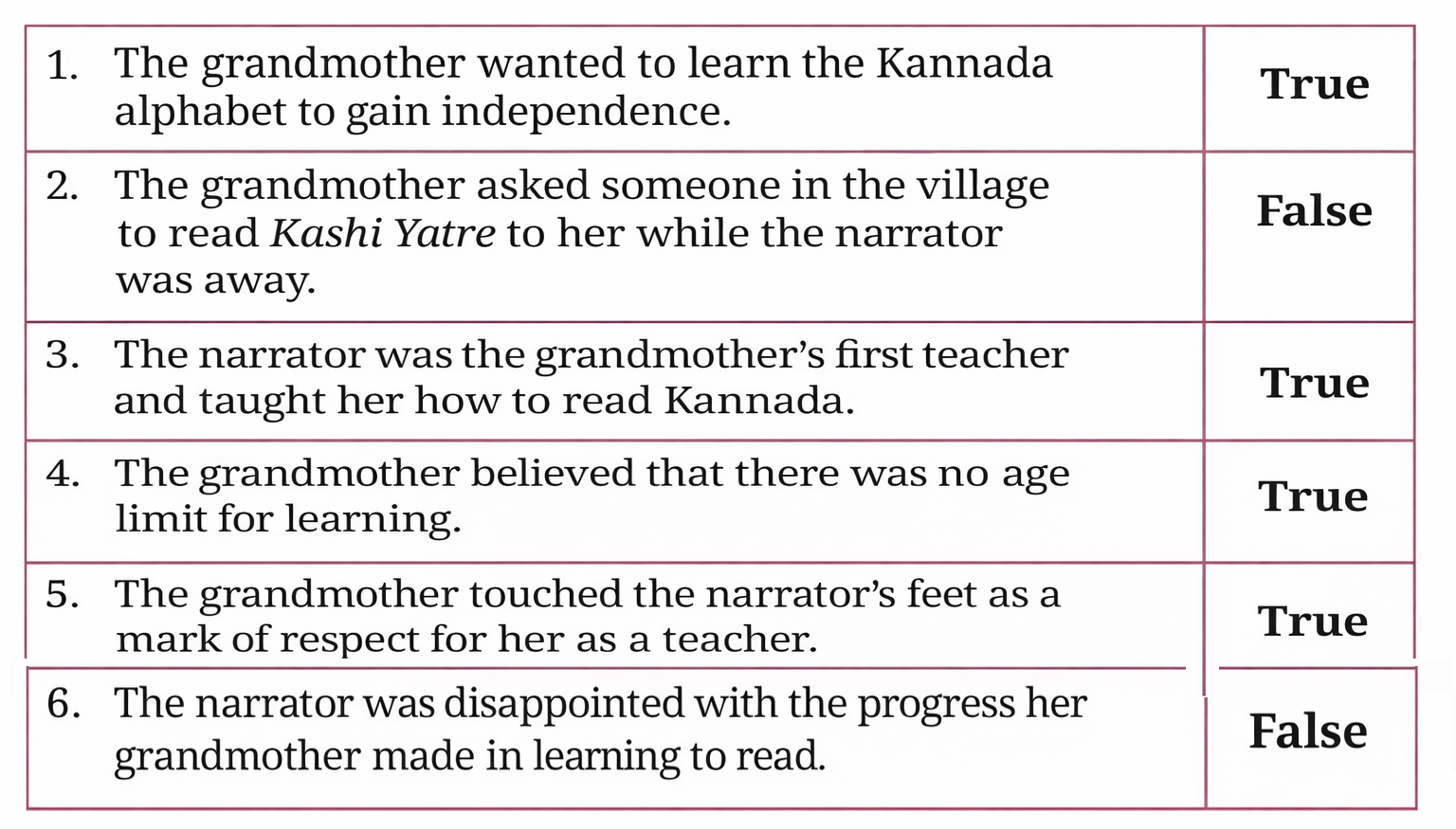
Critical Reflection
I Read the extracts given below and answer the questions
that follow.
1. When I came back to my village, I saw my grandmother in tears. I was surprised, for I had never seen her cry even in the most difficult situations.What had happened? I was worried.
‘Avva, is everything all right? Are you okay?’
I used to call her Avva, which means mother in the Kannada spoken in north Karnataka.
She nodded but did not reply. I did not understand and forgot about it. In the night, after dinner, we were sleeping in the open terrace of our house. It was a summer night and there was a full moon. Avva came and sat next to me. Her affectionate hands touched my forehead.
(i) Complete the following sentence with the appropriate option.
The phrase ‘never seen her cry in the most difficult situations’ tells us that the grandmother was ________________________.
A. strong-willed
B. understanding
C. considerate
D. bold
Answer: A. strong-willed
(ii) Complete the following with the correct option from those given in the brackets.
Grandmother did not reply when the narrator asked if she was alright because she might have been too ________________________ (emotional/tired) to respond.
Answer: emotional
(iii) Identify the clue from the extract that indicates a rural setting with traditional customs.
Answer: “sleeping in the open terrace of our house” and the use of the word “Avva” indicate a rural setting with traditional customs.
(iv) Which lines of the extract establish a tender atmosphere?
Answer: “Avva came and sat next to me. Her affectionate hands touched my forehead.”
(v) Which of the following aspect is NOT emphasised in the given extract?
A. the emotional turmoil of the grandmother
B. the affectionate bond between the narrator and her grandmother
C. the grandmother’s regret over her lack of education
D. the narrator’s concern for her grandmother
Answer: C. the grandmother’s regret over her lack of education
2. ‘I have decided I want to learn the Kannada alphabet from tomorrow onwards. I will work very hard. I will keep Saraswati Puja day during Dassara as the deadline. That day I should be able to read a novel on my own. I want to be independent.’
I saw the determination on her face. Yet I laughed at her
‘Avva, at this age of sixty-two you want to learn the alphabet? All your hair is grey, your hands are wrinkled, you wear spectacles and you work so much in the kitchen…’
Childishly I made fun of the old lady. But she just smiled
‘For a good cause if you are determined, you can overcome any obstacle. I will work harder than anybody but I will do it. For learning there is no age bar.’
(i) What does the grandmother’s statement, “I want to be independent,” reveal about her character?
A. She wanted to be literate.
B. She desires self-sufficiency.
C. She wants to prove her intelligence to others.
D. She feels pressured by society to learn.
Answer: B. She desires self-sufficiency.
(ii) Fill in the blank with the appropriate option from those given in brackets.
The grandmother’s determination shows that learning has no ___________________.
(age limit/gender bias/cultural barriers)
Answer: age limit
(iii) Complete the following with a suitable reason.
The narrator laughs at her grandmother’s decision to learn the alphabet at the age of sixty-two because she thinks that old people cannot learn new things easily.
(iv) List any two qualities displayed by the grandmother.
Answer: Determined and hardworking.
(v) How can we say that the narrator is making assumptions about her grandmother?
Answer: The narrator assumes that her grandmother is too old to learn because of her age, grey hair, and physical condition.
II. Answer the following questions
1. Why do you think the grandmother felt embarrassed to ask someone else to read to her while the narrator was away?
Answer: She felt embarrassed because she was uneducated and did not want others to know about her inability to read.
2. Why does the narrator initially laugh at her grandmother’s determination to learn at the age of sixty-two?
Answer: The narrator laughs because she believes that learning at such an old age is difficult and unusual.
3. What significance does the story of Kashi Yatre have in both the grandmother’s life and the story?
Answer: The story of Kashi Yatre inspires the grandmother and creates a strong desire in her to learn reading so that she can read it independently.
4. What does the grandmother’s desire to learn the Kannada alphabet reflect about her?
Answer: It reflects her determination, self-respect, and desire to become independent.
5. What lessons can we infer from the grandmother’s action of touching the narrator’s feet?
Answer: It teaches us to respect teachers regardless of their age and shows humility and gratitude.
6. What does the following line tell us about the broader theme of the story?
‘For a good cause if you are determined, you can overcome any obstacle.’
Answer: It shows that determination and strong willpower can help a person overcome any difficulty in life.
7. How effectively does the story highlight the value of education in supporting personal independence?
Answer: The story effectively shows that education helps a person become independent, confident, and self-reliant, as seen in the grandmother’s transformation.
Vocabulary and Structures in Context
I The expression ‘hide and seek’ is used in the text. This is called a binomial. Binomials are expressions consisting of two words, usually linked by a conjunction like ‘and’ or ‘or’, that are commonly used together in a fixed order. For example: odds and ends, right or wrong.
Match the binomials in Column 1 with their meanings in Column 2. You may refer to a dictionary.
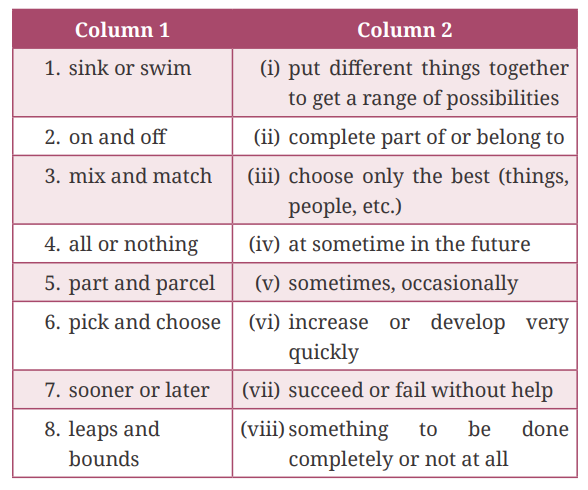
Answer :- 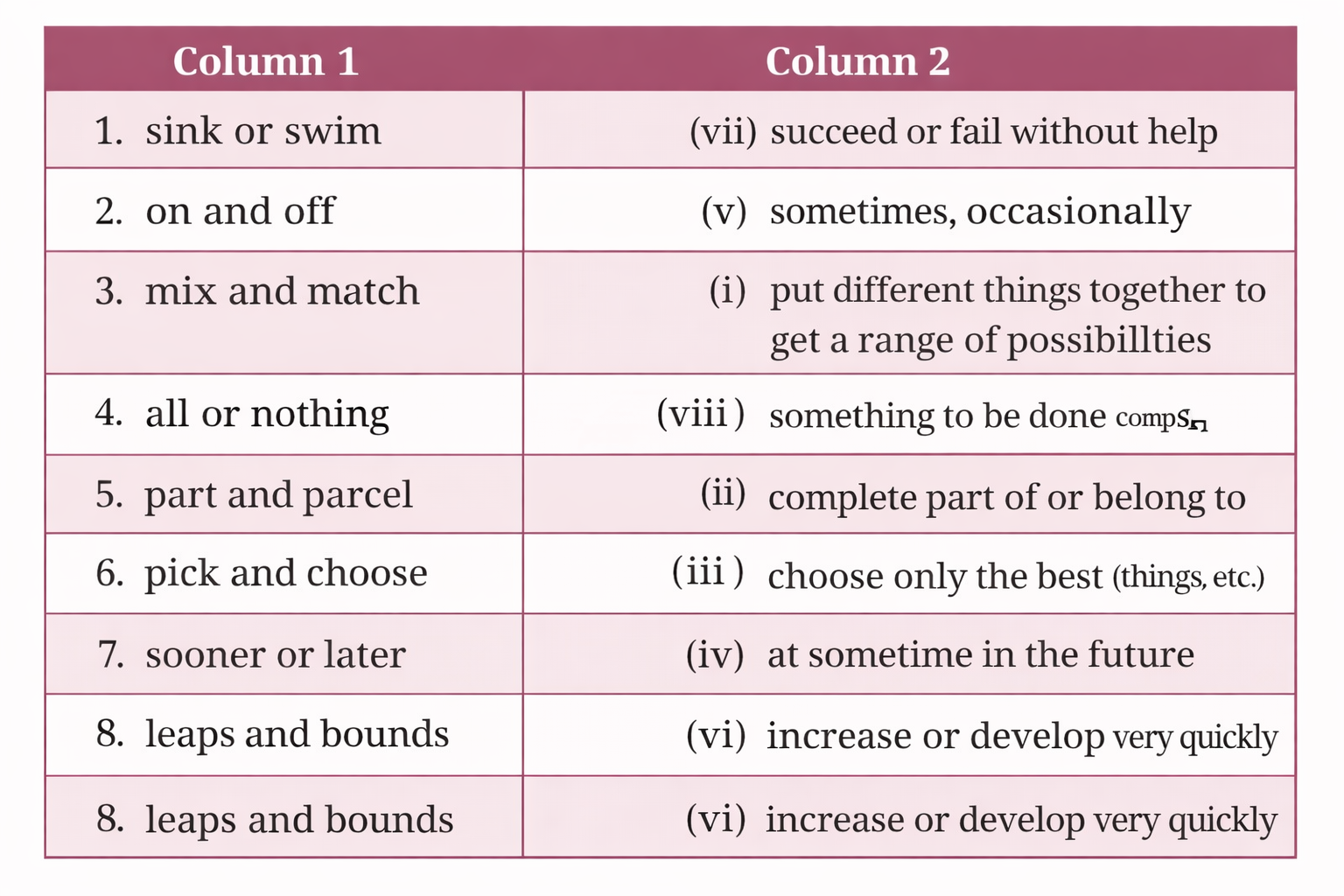
Now, use any five of the above binomials in sentences of your own.
Answer :-
1. You must learn to sink or swim when you face challenges alone.
2. The light kept going on and off during the storm.
3. You can mix and match clothes to create different styles.
4. She believes in giving her best; it’s always all or nothing for her.
5. Hard work is part and parcel of success.
II Read the following words from the text given in the box below.
unhappy , unusual , unfortunately ,irrespective , independent
These words are made by adding suitable prefixes (‘un’, ‘ir’, and ‘in’) to give an opposite or negative meaning to the words.
Now, make words by adding the suitable prefixes given in the box to the words from the text in Column 1. Write the prefixed words in Column 2. One example has been done for you
un ,im ,dis
in ,mis ,extra
| Column 1 | Column 2 |
|---|---|
| 1. popular | (i) unpopular |
| 2. belief | (ii) |
| 3. important | (iii) |
| 4. respect | (iv) |
| 5. correct | (v) |
| 6. continue | (vi) |
| 7. understand | (vii) |
| 8. ordinary | (viii) |
| 9. interesting | (ix) |
| 10. possible | (x) |
Answer :-
| Column 1 | Column 2 |
|---|---|
| 1. popular | (i) unpopular |
| 2. belief | (ii) disbelief |
| 3. important | (iii) unimportant |
| 4. respect | (iv) disrespect |
| 5. correct | (v) incorrect |
| 6. continue | (vi) discontinue |
| 7. understand | (vii) misunderstand |
| 8. ordinary | (viii) extraordinary |
| 9. interesting | (ix) uninteresting |
| 10. possible | (x) impossible |
III. Identify any five words with prefixes from the story and make sentences using each.
Answer:
1. Unhappy – The grandmother felt unhappy when she could not read the story.
2. Unusual – It was unusual for the grandmother to touch her granddaughter’s feet.
3. Unfortunately – Unfortunately, the writer died very young.
4. Irrespective – A teacher should be respected irrespective of age.
5. Independent – The grandmother wanted to become independent by learning to read.
IV. Match the idioms related to ‘learning’ given in Column 1 with their meanings in Column 2.
| Column 1 | Column 2 |
|---|---|
| 1. to hit the books | (iii) to study seriously |
| 2. to draw a blank | (v) to be unable to remember |
| 3. to learn the ropes | (vi) to understand how to do an activity |
| 4. to rack one’s brain | (ii) to think very hard |
| 5. to learn by heart | (i) to memorise something |
| 6. burn the midnight oil | (iv) to study or work late into the night |
Answer :-
| S.No. | Idiom | Meaning |
|---|---|---|
| 1 | to hit the books | (iii) to study seriously |
| 2 | to draw a blank | (v) to be unable to remember |
| 3 | to learn the ropes | (vi) to understand how to do an activity |
| 4 | to rack one’s brain | (ii) to think very hard |
| 5 | to learn by heart | (i) to memorise something |
| 6 | burn the midnight oil | (iv) to study or work late into the night |
Now, use these idioms in sentences of your own.
Ans –
I have to hit the books before my exams start.
I studied a lot, but I drew a blank in the test.
It took me some time to learn the ropes of using a computer.
I had to rack my brain to solve the difficult question.
I learnt the poem by heart for the competition.
She burnt the midnight oil to complete her project.
V. Read the following sentences from the text and underline the verbs. Also identify their tenses.
1. Secretly, I bought Kashi Yatre which had been published as a novel by that time.
2. I knew, then, that my student had passed with flying colours.
In sentence 1, verb ‘bought’ is in simple past tense.
In sentence 2, verb ‘had passed’ is in past perfect tense.
Answer:
1. Secretly, I bought Kashi Yatre which had been published as a novel by that time.
bought – Simple Past Tense
had been published – Past Perfect Tense (Passive)
2. I knew, then, that my student had passed with flying colours.
knew – Simple Past Tense
had passed – Past Perfect Tense
V (i). Fill in the blanks with simple past and past perfect tense form of the verbs given in brackets.
Answer:-
A. When the delegates arrived (arrive) at the conference, the keynote speaker had already begun (already begin) the session.
B. After the students had learned (learn) how to identify fake news online, they started (start) verifying information before sharing it.
C. Before Kiran started (start) using digital payment platforms, she had ensured (ensure) her understanding of online fraud prevention.
D. By the time Varun recognised (recognise) the importance of budgeting, he had exhausted (exhaust) most of his savings.
E. When Raghu logged (log in) in to the cybersecurity webinar, the instructor had already (already discuss) discussed the importance of strong passwords.
V (ii) .Fill in the blanks with the correct form of verbs given in brackets.
Last year, my parents and I A. ______ (take) a financial planning course. When we B. ______ (review) our expenses, we realised we C. ______ (spend) too much on unnecessary purchases. After my parents D. ______ (discuss) ways to save, I E. ______ (open) a savings account.
By the time we F. ______ (set) our budget, the course G. ______ (already introduce) investment strategies. We H. ______ (hurry) to take notes, but many participants I. ______ (complete) their financial plans. Despite that, we J. ______ (enjoy) learning how to manage money wisely.
Answer:-
Last year, my parents and I A. took (take) a financial planning course. When we B. reviewed (review) our expenses, we realised we C. had spent (spend) too much on unnecessary purchases. After my parents D. discussed (discuss) ways to save, I E. opened (open) a savings account.
By the time we F. set (set) our budget, the course G. had already introduced (already introduce) investment strategies. We H. hurried (hurry) to take notes, but many participants I. had completed (complete) their financial plans. Despite that, we J. enjoyed (enjoy) learning how to manage money wisely.
Writing Task
A letter to the editor is a formal letter in which the writer gives suggestions and creates awareness on an issue of public interest or an issue already raised in an article/write-up/published letter.
Answer:-
Dear Editor,
I am writing this letter to draw your attention towards the importance of student participation in adult literacy camps. Recently, various organisations have been working to promote adult education, but greater involvement from students can make these efforts more effective.
The issue of illiteracy still affects a large section of our society. Many adults are unable to read or write, which limits their independence and opportunities. It is imperative that we encourage young students to actively take part in literacy programmes. Such initiatives not only help adults become self-reliant but also nurture a sense of responsibility and empathy among students. By engaging in these programmes, students develop communication skills and gain real-life teaching experience.
A possible solution to this issue could be organising awareness campaigns in schools and communities. Authorities could consider implementing compulsory volunteer hours for students in literacy drives. Schools can also collaborate with organisations to conduct regular adult education camps. I trust this matter will be considered seriously for the benefit of society. I hope this letter gets published in the columns of your esteemed newspaper.
Yours truly,
A Concerned Citizen
Questions within the Lesson
NCERT Intext Questions for Class 9 English – (Page no – 1 & 2)
Reflect and Respond
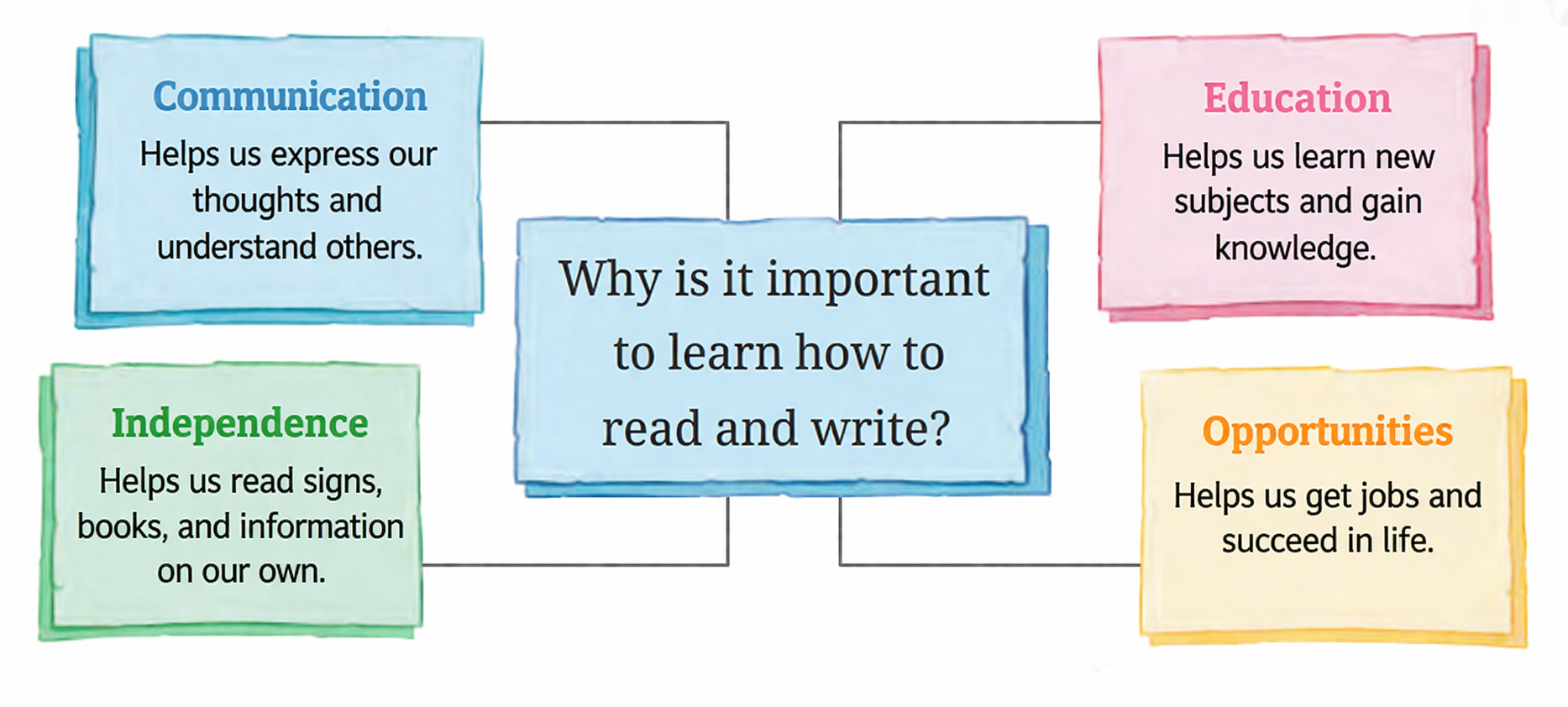
I Complete the given word web.
Answer:-
II Read the questions given below and share your answers with your classmates and teacher.
1. Which language(s) do your grandparents speak?
Answer:- My grandparents speak Hindi and our regional language.
2. How do they spend their time? How do you spend time with them?
Answer:- They spend their time praying, watching TV, and talking to family members. I spend time with them by listening to their stories, helping them, and sometimes watching TV together.
3. What is your favourite experience with them?
Answer:- My favourite experience is when they tell me stories from their childhood. It is fun and teaches me many life lessons.
4. What is something they cannot do easily but enjoy watching you do?
Answer:- They cannot use mobile phones or technology easily, but they enjoy watching me use them.
II Read the following passage. Match the highlighted words with their meanings given in the box below.
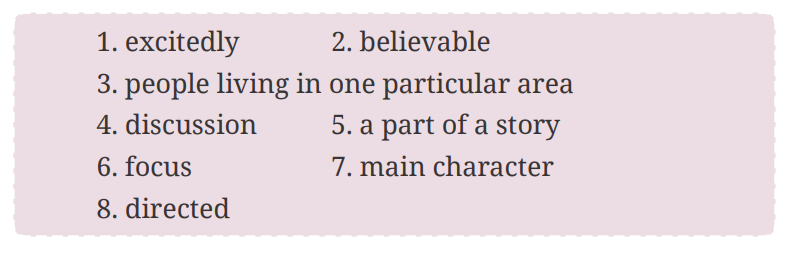
The casting for the (i) protagonist of our school’s annual play was done after a lot of (ii) debate as many good actors had auditioned for the role. We had decided to present an (iii) episode from an inspirational story. It was a life story of a group of children who worked with the (iv) community to spread literacy. Every day, we reached school early to practise with (v) concentration. We waited (vi) eagerly for the final presentation. All of us played our roles in a very (vii) convincing manner as our theatre teacher had (viii) guided us well.
Answer:-
(i) protagonist → main character (7)
(ii) debate → discussion (4)
(iii) episode → a part of a story (5)
(iv) community → people living in one particular area (3)
(v) concentration → focus (6)
(vi) eagerly → excitedly (1)
(vii) convincing → believable (2)
(viii) guided → directed (8)
NCERT Intext Questions for Class 9 English – ( Page no – 6 & 7 )
Check Your Understanding
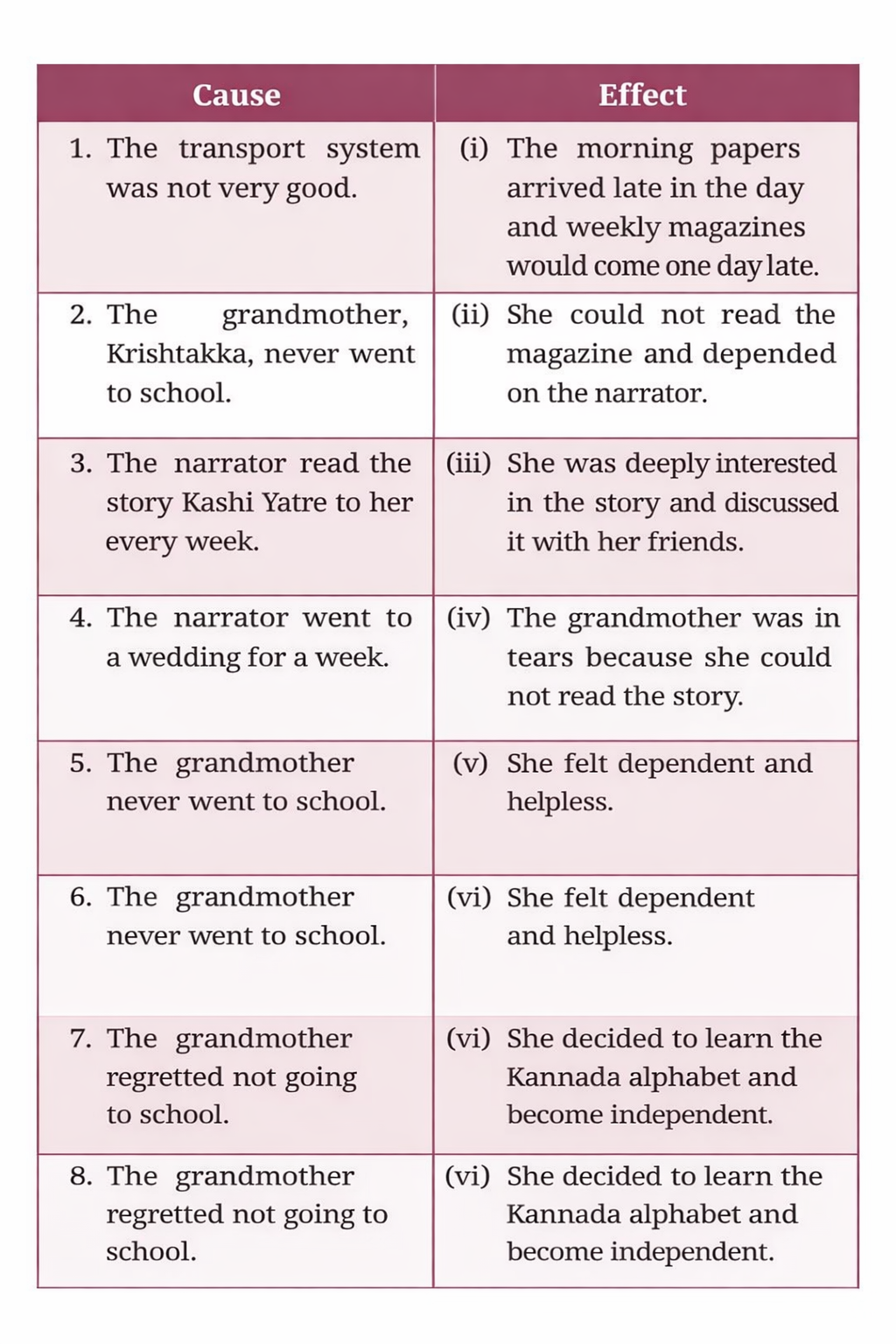
I Complete the cause and effect table given below based on Part I of the story. Share your answers with your classmates and teacher.
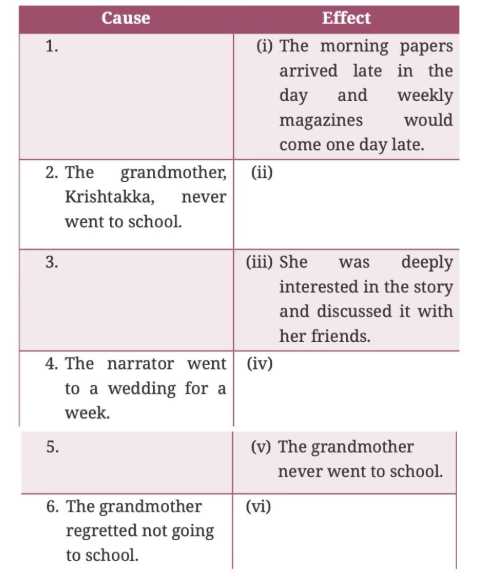
Answer:-
II. Do you think the narrator expected to see her grandmother in tears when she returned to the village? If yes, why? If no, why not?
Answer:- No, the narrator did not expect to see her grandmother in tears because she had never seen her cry even in the most difficult situations. She was surprised and worried to see her grandmother crying.
III. How might the narrator help her grandmother to fulfil her desire to learn to read and write?
Answer:- The narrator might help her grandmother by teaching her the Kannada alphabet and giving her regular practice so that she could learn to read and write independently.

Leave a Reply