Q1. What is a linear equation in two variables?
Answer:
A linear equation in two variables is an equation that can be expressed in the form ax + by + c = 0, where a, b, and c are real numbers, and a and b are not both zero.
Q2. What is the standard form of a linear equation in two variables?
Answer:
The standard form is:
ax + by + c = 0
Here, a and b are the coefficients of x and y, respectively, and c is the constant term.
Q3. What is a solution of a linear equation in two variables?
Answer:
A solution is a pair of values of x and y that satisfies the given equation when substituted into it.
For example,(2,3) is a solution of 3x + 2y = 12, because 3(2) + 2(3) = 12.
Q4. What is an ordered pair?
Answer:
An ordered pair is a pair of numbers written as (x,y). The first number represents the value of x, and the second represents the value of y. The order of the numbers matters.
Q5. How many solutions can a linear equation in two variables have?
Answer:
A linear equation in two variables has infinitely many solutions. For any suitable value assigned to one variable, a corresponding value of the other variable can be found.
Q6. What is the graph of a linear equation in two variables?
Answer:
The graph of a linear equation in two variables is a straight line. Every ordered pair that satisfies the equation represents a point on that line.
Q7. What is the slope of a line?
Answer:
The slope, or gradient, measures the steepness of a line. A positive slope means the line rises from left to right, while a negative slope means it falls from left to right.
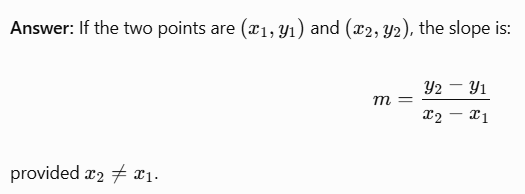
Q8. Write the formula for the slope of a line passing through two points.

Q9. What is the slope-intercept form of a linear equation?
Answer:
The slope-intercept form is:
y = mx + d
Here, m represents the slope, and d represents the y -intercept, where the line crosses the y -axis.
Q10. What are the four types of slope described in the chapter?
Answer:
1. Positive slope: the line rises from left to right.
2. Negative slope: the line falls from left to right.
3. Zero slope: the line is horizontal and parallel to the x -axis.
4. Undefined slope: the line is vertical and parallel to the y -axis.
Q11. What is a pair of linear equations in two variables?
Answer:
A pair of linear equations in two variables consists of two linear equations involving the same two variables, usually x and y. The equations can be written as:
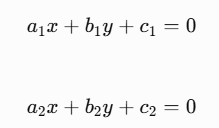
A solution of the pair is an ordered pair that satisfies both equations simultaneously.
Q12. Explain how a linear equation in two variables can be represented graphically.
Answer:
To draw the graph, first find at least two solutions of the equation by assigning values to one variable and calculating the other. Write the solutions as ordered pairs and plot them on the Cartesian plane. Join the plotted points with a straight line. Every point on this line represents a solution of the equation.
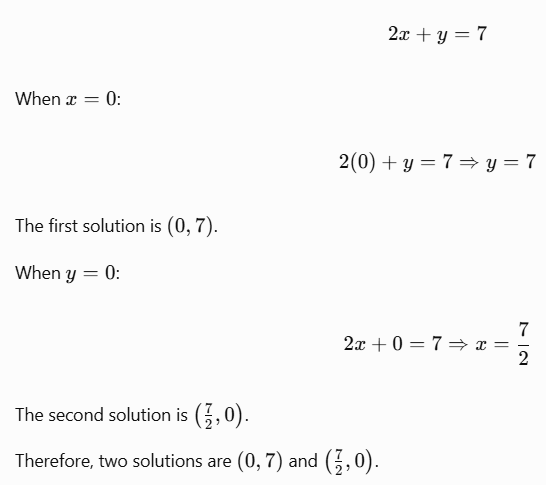
Q13. Find two solutions of the equation 2x + y = 7.
Answer:
The given equation is:
Q14. Explain the relationship between the slope and the slope-intercept form of a line.
Answer:
The slope-intercept form of a line is y = mx + d. In this form, m represents the slope, which measures the steepness of the line, while d represents the y-intercept. If m is positive, the line rises from left to right. If m is negative, the line falls from left to right. If m = 0, the line is horizontal.
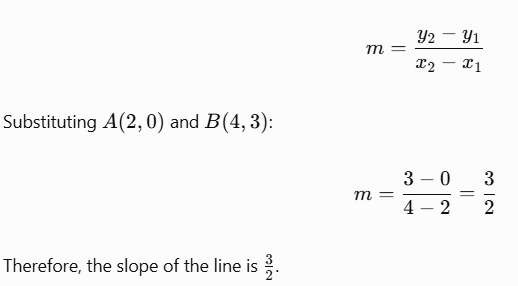
Q15. Find the slope of the line passing through A(2,0) and (B(4,3).
Answer:
Using the slope formula,
Q16. Explain the substitution method for solving a pair of linear equations.
Answer:
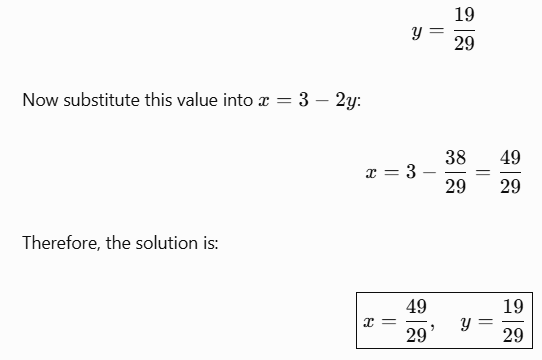
The substitution method involves expressing one variable in terms of the other variable using one equation. This expression is substituted into the second equation to obtain an equation in one variable. Solve that equation to find the value of the variable. Substitute the value obtained into either original equation to find the other variable.
Q17. Solve the following equations using the substitution method:
x + 2y = 3, 7x – 15y = 2
Answer:
From the first equation,
x = 3 – 2y
Substitute this value of x into the second equation:
7(3 – 2y) – 15y = 2
21 – 14y – 15y = 2
-29y = – 19
Q18. Explain the elimination method for solving a pair of linear equations.
Answer:
The elimination method is used to eliminate one variable from a pair of linear equations. First, multiply one or both equations by suitable numbers so that the coefficients of one variable become equal or opposite. Then add or subtract the equations to eliminate that variable. Solve the resulting equation and substitute the value obtained into an original equation to find the other variable.
Q19. Solve the equations x + y = 25 and x – y = 11 using the elimination method.
Answer:
The given equations are:
x + y = 25 (1)
x – y = 11 (2)
Adding equations (1) and (2):
2x = 36
x = 18
Substituting x = 18 into equation (1):
18 + y = 25
y = 7
Therefore, the two numbers are 18 and 7.
Q20. Explain the three possible types of solutions of a pair of linear equations.
Answer:
A pair of linear equations can have three types of solutions:
1. Unique solution: The equations have exactly one common solution.
2. Infinitely many solutions: Both equations represent the same line, so every point on that line satisfies both equations.
3. No solution: The lines are parallel and distinct, so they do not have any common point.
Q21. How can the graphical method be used to solve a pair of linear equations?
Answer:
To solve a pair of linear equations graphically, find at least two solutions for each equation and plot them on the Cartesian plane. Draw a straight line through the points for each equation. The point where the two lines intersect gives the common solution. If the lines are parallel, there is no solution; if they coincide, there are infinitely many solutions.
Q22. What is the relationship between the graphical method and the number of solutions?
Answer:
The number of solutions depends on the positions of the two lines.
- When the lines intersect at one point, the pair has a unique solution.
- When the lines are parallel, the pair has no solution.
- When the lines coincide, the pair has infinitely many solutions.
The common points of the two lines represent the solutions of both equations.
Q23. Under what conditions does a pair of linear equations have a unique solution, infinitely many solutions, or no solution?
Answer:
Consider the equations:
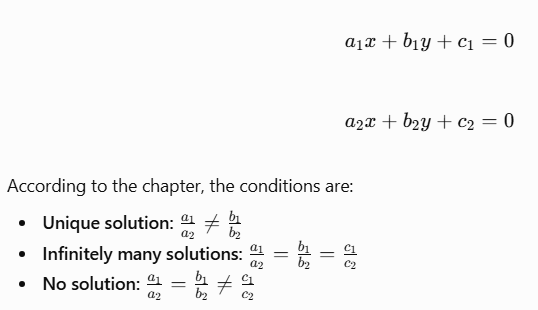
These ratio conditions apply when the relevant denominators are non-zero.
Q24. Explain how a real-life situation can be represented by a pair of linear equations.
Answer:
A real-life situation involving two unknown quantities can be represented using two variables. For example, suppose the cost of one adult ticket is ₹x and the cost of one child ticket is ₹y. If two adult tickets and three child tickets cost ₹600, the equation is 2x + 3y = 600. If three adult tickets and two child tickets cost ₹700, the second equation is 3x + 2y = 700. Solving both equations gives the individual ticket costs.
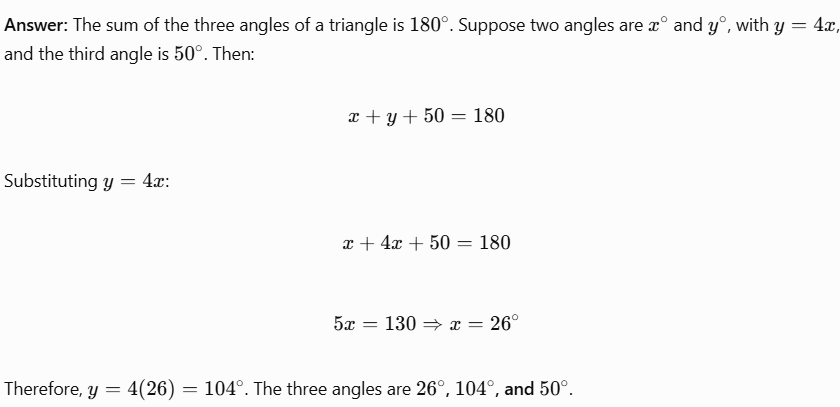
Q25. Explain how the sum of the angles of a triangle can be used to solve a pair of linear equations.

Leave a Reply