Q1. What is a cuboid?
Answer:
A cuboid is a three-dimensional solid having six faces, all of which are rectangles. It is characterised by three dimensions: length (l), width (w), and height (h).
Q2. What is the formula for the total surface area of a cuboid?
Answer:
The total surface area of a cuboid is the sum of the areas of its six rectangular faces.
TSA =2(lw + wh + hl)
Here, l is length, w is width, and h is height.
Q3. What is volume, and how is it measured?
Answer:
Volume measures the amount of three-dimensional space occupied by an object or container. It is measured in cubic units, such as cubic centimetres
\((cm^3)\) and cubic metres \((m^3)\)
Q4. Write the formulas for the total surface area and volume of a cube.
Answer:
A cube is a special type of cuboid in which length, width, and height are equal. If its side is a, then:
Total surface area: \(6a^2\)
Volume: \(a^3\)
Q5. Can two solids have the same volume but different surface areas? Explain with an example.
Answer:
Yes, two solids can have the same volume but different surface areas. For example, a cube of side 6 cm and a cuboid measuring 9 cm × 6 cm × 4 cm both have a volume of 216 \(cm^3\) However, their surface areas are 216 \(cm^2\) and 228 \(cm^2\) respectively. Thus, the cuboid has a greater surface area.
Q6. What is a right circular cylinder?
Answer:
A right circular cylinder is a solid whose cross-section parallel to its base is circular and whose axis is perpendicular to its circular base. Many pipes have this shape.
Q7. What is a cross-section of a three-dimensional object?
Answer:
A cross-section is the shape obtained when an extremely thin slice is taken through a three-dimensional object. For a cylinder, a slice parallel to its base gives a circular cross-section, while a slice parallel to its axis gives a rectangular cross-section.
Q8. How do we calculate the curved surface area of a cylinder?
Answer:
The curved surface of a cylinder can be opened to form a rectangle. The rectangle’s length is the circumference of the circular base, 2pir, and its width is the height, h.
CSA = 2pirh
Here, r is the radius and h is the height of the cylinder.
Q9. Write the formulas for the total surface area of a cylinder closed at both ends and at one end.
Answer:
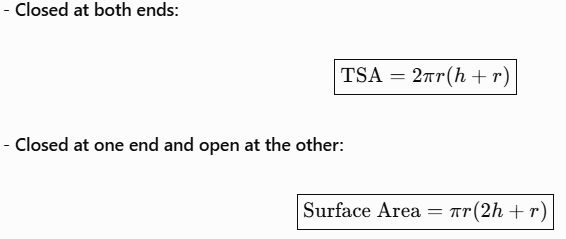
The formulas include the curved surface and the circular ends that are present.
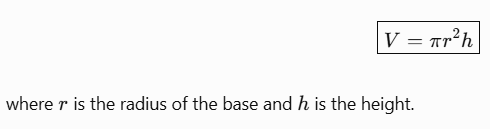
Q10. What is the formula for the volume of a cylinder?
Answer:
The volume of a cylinder is the area of its circular base multiplied by its height.
Q11. What is a right circular cone?
Answer:
A right circular cone is a solid formed when a right-angled triangle is rotated about one of its perpendicular sides. It has a circular base, a vertex, a height, and a slant height.
The relationship between its radius (r), height (h), and slant height (l) is:
\(l^2=h^2+r^2\)Q12. What is the curved surface area of a cone?
Answer:
The curved surface area of a cone is the area of its sloping surface, excluding the circular base.
CSA = pirl
Here, r is the radius of the base and l is the slant height.
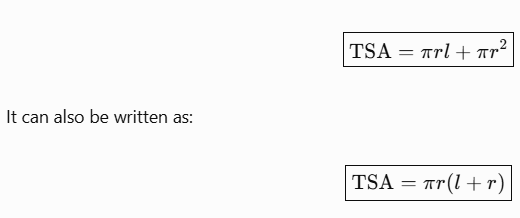
Q13. Write the formula for the total surface area of a cone.
Answer:
The total surface area of a cone is the sum of its curved surface area and the area of its circular base.
Q14. What is the formula for the volume of a cone?
Answer:
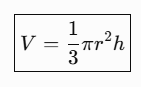
The volume of a cone is one-third of the product of the area of its circular base and its height.
Q15. What is the relationship between the volumes of a cone and a cylinder with the same base radius and height?
Answer:
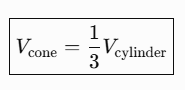
A cone has one-third the volume of a cylinder having the same base radius and height. Three cones filled with a suitable material can fill such a cylinder.
Q16. What is a pyramidal shape, and how is its volume calculated?
Answer:
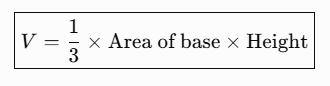
A pyramid is a solid whose base may be triangular, square, or another closed shape. All points on the base are connected to a single point called the apex, which lies in a different plane.
Its volume is calculated using the formula:
Q17. How is the surface area of a pyramid calculated?
Answer:
The surface area of a pyramid is calculated by adding the areas of all its polygonal faces. A separate general formula for the surface area is not required because the areas of the individual faces can be calculated and added together.
Q18. What is a sphere?
Answer:
A sphere is a three-dimensional shape consisting of all points in space that are at a fixed distance r from a fixed point O, called the centre. The fixed distance r is called the radius of the sphere. A ball is a familiar example of a spherical object.
Q19. Write the formula for the surface area of a sphere.
Answer:
The surface area of a sphere with radius r is four times the area of a circle with the same radius.
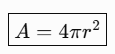
Archimedes showed that this surface area equals the curved surface area of a cylinder of radius r and height 2r that fits tightly around the sphere.
Q20. What is the formula for the volume of a sphere?
Answer:
The volume of a sphere is calculated using its radius.
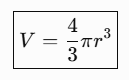
The volume can also be expressed as one-third of the product of the sphere’s surface area and its radius.
Q21. What is a hemisphere?
Answer:
A hemisphere is a three-dimensional solid formed when a sphere is cut into two equal halves by a plane passing through its centre. It has one curved surface and one flat circular base. Bowls, serving dishes, and dome-shaped covers are examples of objects resembling hemispheres.
Q22. Write the formulas for the curved surface area, total surface area, and volume of a hemisphere.
Answer:
If the radius of a hemisphere is r, its formulas are:
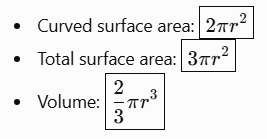
The total surface area includes both the curved surface and the flat circular base.

Leave a Reply