Q1. What is a proposition?
Answer:
A proposition is a statement that is either true or false. For example, “If it rains, then the road is wet” is a proposition.
Q2. What is the converse of a proposition?
Answer:
The converse of a proposition “If X, then Y” is “If Y, then X.” The conditions in the original statement are reversed.
Q3. How can we write “If X, then Y” in another form?
Answer:
The statement “If X, then Y” can also be written as “X implies Y.” It can also be expressed as “Y when X.”
Q4. Is the converse of every true proposition always true?
Answer:
No, the converse of a true proposition is not always true. For example, if it rains, the road becomes wet, but a wet road does not necessarily mean that it has rained.
Q5. What is a counterexample?
Answer:
A counterexample is an example that contradicts a given proposition. It helps demonstrate that a statement is false.
Q6. Why are counterexamples important in mathematics?
Answer:
Counterexamples are important because they help us show that a proposition is false in a short and convincing way.
Q7. State the proposition and its converse about multiples of 6 and 3.
Answer:
- Proposition: If a number is a multiple of 6, then it is a multiple of 3.
- Converse: If a number is a multiple of 3, then it is a multiple of 6.
Q8. What is a perfect square?
Answer:
A perfect square is a number that can be expressed as the product of a number multiplied by itself. For example, 25 = 5 × 5.
Q9. What is the relationship between perfect squares and the number of factors?
Answer:
A positive integer is a perfect square if and only if it has an odd number of factors. Thus, both the proposition and its converse are true.
Q10. State the Baudhāyana–Pythagoras theorem.
Answer:
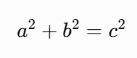
If a triangle is right-angled and its side lengths are a, b, and c, where c is the hypotenuse, then
Q11. What is the converse of the Baudhāyana–Pythagoras theorem? Is it true?
Answer:
The converse states that if the side lengths of a triangle satisfy
then the triangle is right-angled. This converse is true. A right triangle can be constructed with perpendicular sides a and b. By the Baudhāyana–Pythagoras theorem, its hypotenuse is c. Using the SSS criterion, the two triangles are congruent, so the original triangle is also right-angled.
Q12. Explain the difference between a proposition and its converse with an example.
Answer:
A proposition is a statement of the form “If X, then Y,” whereas its converse is “If Y, then X.” For example:
- Proposition: If it rains, then the road is wet.
- Converse: If the road is wet, then it has rained.
The proposition may be true, but its converse is not always true because the road could become wet due to water spilled by a tanker.
Q13. Explain why the proposition about multiples of 6 and 3 is true, but its converse is false.
Answer:
Every multiple of 6 is also a multiple of 3 because 6= 2 x 3. Therefore, every number divisible by 6 is divisible by 3. However, the converse is false because every multiple of 3 is not necessarily a multiple of 6. For example, 9 is divisible by 3 but not by 6.
Q14. Prove that a positive integer with an odd number of factors is a perfect square.
Answer:
The factors of a number can be arranged in pairs whose products give the number. If a number has an odd number of factors, at least one pair must contain the same factor twice, such as (f,f). Therefore, the number is \(f×f=f^2\) which is a perfect square.
Q15. Explain why every perfect square has an odd number of factors.
Answer:
The factors of a number can be arranged into factor-partner pairs. In a perfect square, one pair contains the same factor twice, such as (5,5) for 25. All other factors form pairs of different numbers. Since there is exactly one repeated-factor pair, the total number of factors is odd.
Q16. Are the proposition and converse about triangles with equal areas and congruence both true? Explain.
Answer:
The proposition “If two triangles have the same area, then they are congruent” is false. Two triangles can have the same area but different side lengths and shapes. The converse, “If two triangles are congruent, then they have the same area,” is true because congruent triangles have the same shape and size.
Q17. Explain the relationship between equal sides and equal opposite angles in a triangle.
Answer:
If two sides of a triangle are equal, then the angles opposite those sides are equal. The converse is also true: if two angles of a triangle are equal, then the sides opposite those angles have equal lengths. Therefore, both the proposition and its converse are true.
Q18. Write the proposition and converse related to equal angles in a triangle.
Answer:
Proposition: If two sides of a triangle are equal, then the angles opposite those sides are equal.
Converse: If two angles of a triangle are equal, then the sides opposite those angles are equal.
Both statements are true.
Q19. Explain the proposition and converse of the statement about squares and equal angles.
Answer:
The proposition is: “If a quadrilateral is a square, then all its angles are equal.” This is true because every angle of a square is a right angle. The converse is: “If all angles of a quadrilateral are equal, then it is a square.” This is false because a rectangle can have all angles equal without all four sides being equal.
Q20. Explain the proposition and converse of the statement about parallel lines and corresponding angles.
Answer:
The proposition states that if two lines are parallel, then the corresponding angles formed by a transversal are equal. This is true. The converse states that if the corresponding angles formed by a transversal are equal, then the two lines are parallel. This is also true.
Q21. If x=y, then a + x = a + y.Is the converse also true? Explain.
Answer:
The proposition is true because adding the same number a to both sides of x = y gives a + x = a + y.The converse is also true. Subtracting a from both sides of a + x = a + y gives x=y.
Q22. If a and b are perfect squares, then ab is a perfect square. Is its converse true?
Answer:
The proposition is true. Let a =
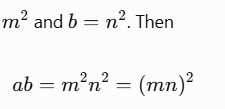
Thus, ab is a perfect square. However, the converse is false. For example, ab = 36 when a = 2 and b = 18, but neither 2 nor 18 is a perfect square.
Q23. If a number is divisible by 24, then it is divisible by both 4 and 6. Is the converse true?
Answer:
The proposition is true because 24 is divisible by both 4 and 6. Therefore, every multiple of 24 is divisible by both numbers. The converse is false. For example, 12 is divisible by both 4 and 6, but it is not divisible by 24.
Q24. If a positive integer is the square of a prime number, then it has exactly three factors. Explain whether the converse is also true.
Answer:
The proposition is true. If \(n=p^2\), where p is a prime number, its factors are 1, p, and \(p^2\).
Therefore, it has exactly three factors. The converse is also true: a positive integer with exactly three factors must be the square of a prime number.

Leave a Reply