Exploring Algebraic
Identities
Introduction & Number Patterns
Algebraic identities are special equations that are always true — no matter what values you put in for the variables. They make calculations faster and help us factor complex expressions.
Add the smallest and largest, then subtract twice the middle: the answer is always 2!
Try with 1, 4, 9 → (1+9) − 2×4 = 10−8 = 2
Try with 9, 16, 25 → (9+25) − 2×16 = 34−32 = 2
Try with 25, 36, 49 → (25+49) − 2×36 = 74−72 = 2
(n−1)² + (n+1)² − 2n² = (n²−2n+1) + (n²+2n+1) − 2n² = 2 ✓
Identity vs. Equation
An algebraic identity is an equation that is true for ALL values of the variables in it.
| Type | Example | True for… |
|---|---|---|
| Equation | x² − 1 = 24 | Only x = 5 or x = −5 |
| Identity | (x+y)² = x² + 2xy + y² | All values of x and y |
When a question says “prove that … is an identity”, you must show it holds for ALL values — usually by expanding one side using algebra to equal the other side.
Visualising Identities Geometrically
We can use squares and rectangles to visualise algebraic identities. Consider a square of side (a + b). When we divide it into smaller pieces, we “see” the identity in the areas.
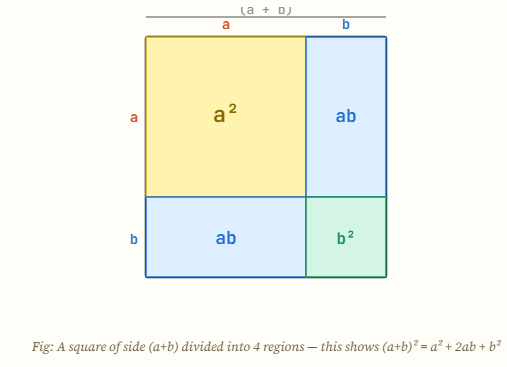
Reading the diagram:
This equals (a+b)² — the area of the whole square!
(a + b)² Identity
Works for all real numbers — positive, negative, fractions, irrational.
Proof using Algebra
= a(a + b) + b(a + b)
= a² + ab + ba + b²
= a² + 2ab + b² ✓
Verify for a = −2, b = −3
(a+b)² = (−5)² = 25
a² + 2ab + b² = 4 + 2(6) + 9 = 4 + 12 + 9 = 25 ✓
Expand (5x + 2y)²
(5x + 2y)² = (5x)² + 2(5x)(2y) + (2y)²
= 25x² + 20xy + 4y²
Find 43² without multiplying directly
= 40² + 2(40)(3) + 3²
= 1600 + 240 + 9
= 1849
- (a+b)² ≠ a² + b² — the middle term 2ab is often forgotten!
- When a and b are both positive, (a+b)² > a² + b²
- When ab = 0, (a+b)² = a² + b²
- When ab < 0, (a+b)² < a² + b²
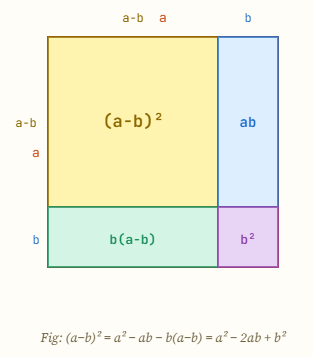
(a − b)² Identity
Replace b with −b in Identity 1 to get this identity.
Geometric Proof
Find 29² using the identity
= 30² − 2(30)(1) + 1²
= 900 − 60 + 1
= 841
Factor 36x² + 12x + 1
= (6x + 1)²
∴ Factor: (6x + 1)
- Can you spot (a−b)² inside 9x² − 24xy + 16y²? Hint: a=3x, b=4y
- What if both a and b are negative? Does the identity still hold?
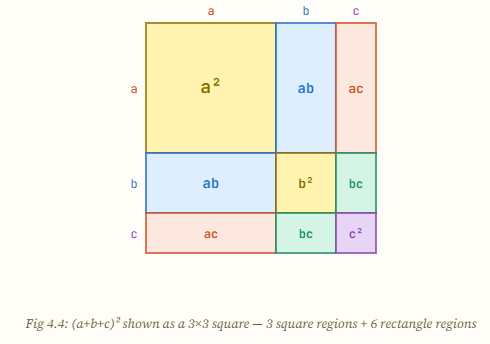
(a + b + c)² Identity
Derived by replacing b with (b+c) in Identity 1.
How to Derive It
(a + d)² = a² + 2ad + d²
Replace d → (b+c):
= a² + 2a(b+c) + (b+c)²
= a² + 2ab + 2ac + b² + 2bc + c²
= a² + b² + c² + 2ab + 2bc + 2ca ✓
Find 119²
119² = 100² + 10² + 9² + 2(100)(10) + 2(100)(9) + 2(10)(9)
= 10000 + 100 + 81 + 2000 + 1800 + 180
= 14161
Difference of Two Squares
Also written as: a² − b² = (a+b)(a−b)
55² = (55+5)(55−5) + 5² = 60×50 + 25 = 3025Find 23 × 17
= 20² − 3²
= 400 − 9 = 391
Since x² − y² = (x−y)(x+y), and x³ − y³ = (x−y)(x²+xy+y²),
can you show that (x−y) is also a factor of x⁴ − y⁴?
Hint: x⁴ − y⁴ = (x²)² − (y²)² = (x²−y²)(x²+y²)
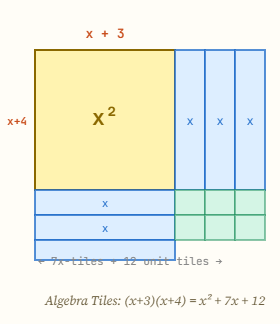
Factorisation — Algebra Tiles & Splitting the Middle Term
To factor a quadratic expression like x² + 7x + 12, we find two numbers a and b such that:
a × b = constant term = 12
→ a = 3, b = 4
∴ x² + 7x + 12 = (x + 3)(x + 4)
Step-by-Step: Splitting the Middle Term
Find a+b = 11, ab = 30
Factors of 30: (1,30), (2,15), (3,10), (5,6)
5 + 6 = 11 ✓ → split 11x as 5x + 6x
x² + 5x + 6x + 30 = x(x+5) + 6(x+5) = (x+5)(x+6)
Factor x² − 5x + 6
→ a = −2, b = −3 (since −2 + −3 = −5 and −2 × −3 = 6)
∴ x² − 5x + 6 = (x − 2)(x − 3)
- If constant is positive: both factors have same sign as middle term.
- If constant is negative: factors have opposite signs; larger magnitude gets middle term’s sign.
Cubic Identities
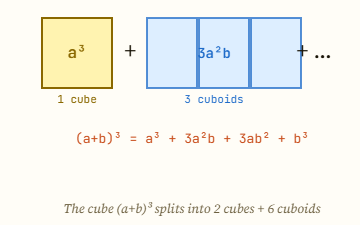
The cube (a+b)³ splits into 2 cubes + 6 cuboids
Volume = p³ + 6p²q + 12pq² + 8q³. Find the side.
Here: a = p, b = 2q
→ (p)³ + 3(p)²(2q) + 3(p)(2q)² + (2q)³
= (p + 2q)³
∴ Side = (p + 2q) units
x+y+z = 10, xyz = 25, x²+y²+z² = 38. Find x³+y³+z³.
100 = 38 + 2(xy+yz+zx) → xy+yz+zx = 31Step 2: Apply identity:
x³+y³+z³ − 3(25) = 10 × (38 − 31)
x³+y³+z³ = 70 + 75 = 145
Simplifying Rational Algebraic Expressions
A rational algebraic expression is a fraction where numerator and denominator are polynomials. We simplify by factoring both and cancelling common factors.
Simplify (x² − 7x + 12) / (5x² + 5x − 100)
Numerator: x² − 7x + 12 → need a+b = −7, ab = 12 → (x−3)(x−4)
Denominator: 5x² + 5x − 100 = 5(x² + x − 20) → need a+b=1, ab=−20 → 5(x+5)(x−4)
Cancel common factor (x−4):
───────────────── = ─────────
5(x+5)(x−4) 5(x + 5)
⚡ All 11 Identities — Quick Reference
Key Takeaways
- Identity = equation true for ALL values of variables
- Identities can be visualised using squares, rectangles, and algebra tiles
- Identities help expand complex expressions quickly
- Identities help factor expressions (reverse of expansion)
- Identities simplify numerical calculations (e.g. 43², 23×17)
- Rational expressions are simplified by factoring and cancelling common factors ≠ 0
- Always write working when using identities in exams — don’t skip steps.
- For factoring, check by multiplying back to verify your answer.
- When simplifying rational expressions, always state the condition (denominator ≠ 0).
- The consecutive-squares pattern (always gives 2) is a classic proof question — remember the algebraic proof using (n−1)², n², (n+1)².

Leave a Reply