Think It Over (Page No. 184)
1. Two astronauts are repairing the arm of a space station together during a spacewalk. Can they talk to each other and hear the sounds of metal clanking as they do on the Earth?
Answer: No, they cannot directly hear each other or the sounds of metal clanking during a spacewalk.
This is because sound is a mechanical wave that requires a material medium (solid, liquid, or gas) to travel. Outer space has a near vacuum, meaning there is almost no medium present. Without a medium, sound waves cannot propagate at all.
So instead of speaking directly, astronauts communicate through special communication devices fitted into their spacesuits that transmit sound as electrical signals.
2. How do most bats use sound to locate their prey in the dark at night?
Answer: Bats use a technique called echolocation to locate their prey.
Most bats emit short bursts of ultrasonic waves (frequency above 20 kHz) while flying. These waves travel outward and bounce back (reflect) when they strike nearby objects such as insects or obstacles. By sensing these returning echoes, bats can determine the position and distance of their prey, allowing them to hunt accurately even in complete darkness.
This is why bats are such effective nocturnal hunters — their natural sonar system works perfectly without any light. Animals like dolphins and whales also use echolocation similarly.
Pause and Ponder (Page No. 186)
1. Explore various ways of producing sound.
Answer: Sound is produced by vibrating objects. Here are the various ways of producing sound:
1. By Striking/Hitting:
- Striking a metal object like a bell or taal makes it vibrate and produce sound
- Hitting a drum makes its membrane vibrate
2. By Plucking:
- Plucking a stretched rubber band or string causes it to vibrate and produce sound
- Example: Guitar, sitar, veena
3. By Blowing:
- Blowing through a hollow pipe (like a bansuri/flute) causes the air column inside to vibrate and produce sound
4. By Rubbing/Scraping:
- Some animals like grasshoppers and crickets rub their wings or legs together to produce sound
5. By Vibration of Vocal Cords:
- In humans and some animals, sound is produced by the vibration of vocal cords located inside the voice box (larynx) in the throat
6. By Rapid Expansion of Gases:
- Sudden loud sounds like thunder or firecracker explosions are produced when air or gases are heated and expand rapidly, creating a sudden disturbance
2. Make a list of different types of musical instruments and identify their vibrating parts which produce sound.
Answer:
| Type | Instrument | Vibrating Part |
|---|---|---|
| String Instruments | Sitar | Strings |
| Guitar | Strings | |
| Sarangi | Strings | |
| Veena | Strings | |
| Tanpura | Strings | |
| Ektara | String | |
| Wind Instruments | Bansuri (Flute) | Air column inside the pipe |
| Harmonium | Air passing through reeds | |
| Trumpet | Air column + lips of player | |
| Percussion Instruments | Tabla | Membrane (drum head) |
| Mridangam | Membrane (drum head) | |
| Drum | Membrane | |
| Taal (Cymbals) | Metal plates | |
| Other | Tuning Fork | Metal prongs (tines) |
Pause and Ponder (Page No. 188)
3. Assertion (A): We cannot hear the sound of a bell ringing in a closed jar after most of the air is pumped out.
Reason (R): Sound requires a medium to travel.
Choose the correct statement:
(i) Both A and R are true, but R is not the correct explanation of A.
(ii) Both A and R are true, and R is the correct explanation of A.
(iii) A is true, but R is false.
(iv) A is false, but R is true.
Answer: The correct answer is:
(ii) Both A and R are true, and R is the correct explanation of A.
Explanation:
When most of the air is pumped out of the closed jar, very little medium is left inside it. Sound needs a material medium like air to travel. Therefore, the sound of the bell cannot be heard clearly in the jar after the air is removed.
Pause and Ponder (Page No. 191)
4. Assertion (A): Compressions and rarefactions move through the medium.
Reason (R): Individual particles of the medium continuously move forwardwith the wave.
Choose the correct statement:
(i) Both A and R are true, but R is not the correct explanation of A.
(ii) Both A and R are true, and R is the correct explanation of A.
(iii) A is true, but R is false.
(iv) A is false, but R is true.
Answer: The correct answer is:
(iii) A is true, but R is false.
Explanation:
Compressions and rarefactions do move through the medium as sound waves travel. However, the individual particles of the medium do not move continuously forward with the wave. They only vibrate back and forth about their mean positions.
Pause and Ponder (Page No. 192)
5. When sound travels from a tuning fork to your ear, which of the following actually reaches your ear?
(i) Air particles near the tuning fork
(ii) Energy carried by sound waves
(iii) The tuning fork material
(iv) A continuous stream of compressed air
Answer: The correct answer is:
(ii) Energy carried by sound waves
Explanation:
When sound travels from a tuning fork to our ear, it is the energy of the sound wave that reaches us. The air particles only vibrate back and forth about their mean positions and do not travel all the way from the tuning fork to the ear.
Pause and Ponder (Page No. 193)
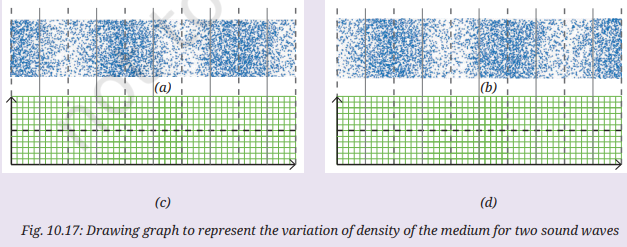
6. The variation of density of the medium for two sound waves is shown in Fig. 10.17 (a) and (b). Label compression and rarefaction by C and R on it. Inthe graph given in Fig. 10.17 (c) and (d), label the axes and draw the curves corresponding to Fig. 10.17 (a) and (b).
Answer:
Part 1 — Labelling C and R on Figures 10.17(a) and (b):
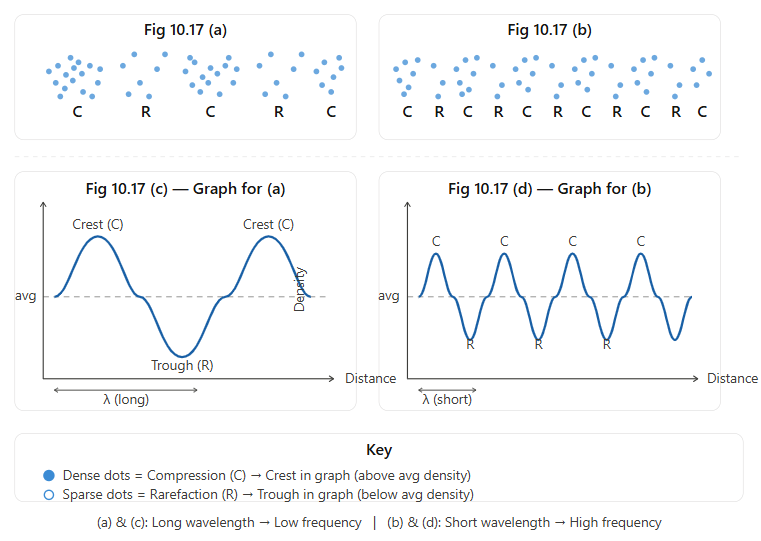
In Fig. 10.17(a), the medium shows regions that alternate between densely packed and sparsely packed particles. The dense regions are Compressions (C) and the sparse regions are Rarefactions (R), so the labels go: C, R, C from left to right.
In Fig. 10.17(b), the wave has a shorter wavelength (more cycles packed in the same distance), so the pattern repeats more quickly: C, R, C, R, C, R, C from left to right.
Part 2 — Graphs for Figures 10.17(c) and (d):
The x-axis is labelled Distance and the y-axis is labelled Density. A dashed horizontal line marks the average density (ρ₀).
For graph (c) (corresponding to wave (a)): Draw a sine wave with fewer cycles — a longer wavelength. Each crest (highest point) represents a compression (C) and each trough (lowest point) represents a rarefaction (R).
For graph (d) (corresponding to wave (b)): Draw a sine wave with more cycles — a shorter wavelength but same amplitude. More C and R pairs appear in the same distance.
The key rule to remember: Crest = Compression (C) and Trough = Rarefaction (R) on a density vs. distance graph.
Pause and Ponder (Page No. 195)
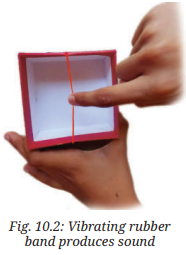
7. Conduct Activity 10.1 once again with a thick rubber band and then with a thin rubber band. Does the thin rubber band vibrate faster than the thick rubber band? If yes, how do the frequency and time period of the sound produced by the thin rubber band differ from that of the thick rubber band?
Answer: Yes, the thin rubber band vibrates faster than the thick rubber band.
The thin rubber band produces a sound with higher frequency because it vibrates more quickly.
Since time period and frequency are inversely related, the time period of the thin rubber band is smaller than that of the thick rubber band.
Therefore:
Thin rubber band → higher frequency and shorter time period
Thick rubber band → lower frequency and longer time period
8. If the frequency of a sound wave produced by an oscillating piston of a long tube filled with air is 20 Hz, then how many oscillations does the piston complete per minute?
Answer:
Given:
- Frequency of sound wave (ν) = 20 Hz
Solution:
Frequency means the number of oscillations completed per second.
So, oscillations per second = 20
To find oscillations per minute, multiply by 60:
Oscillations per minute = 20 × 60 = 1200 oscillations
The piston completes 1200 oscillations per minute.
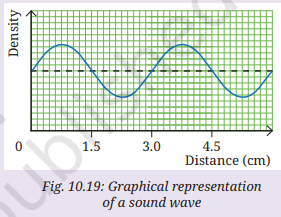
9. For the sound wave represented by the graph shown in Fig. 10.19, what is half of its wavelength?
Answer:
From Fig. 10.19, the distance between two consecutive crests is 3.0 cm, so the wavelength is 3.0 cm.
Therefore,
Half of the wavelength is 1.5 cm.
Pause and Ponder (Page No. 197 – 198)
10. Table 10.1 shows the speed of sound in a few media at atmospheric pressure.
Table 10.1: Speed of sound in different media at 15 °C
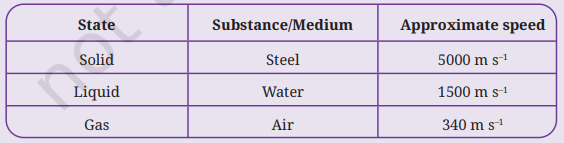
Compare the speeds in different media by finding the ratio of
(i) the speed of sound in water with respect to the speed in the air.
(ii) the speed of sound in steel with respect to the speed in the water.
Answer:
Given:
- Speed of sound in water = 1500 m s⁻¹
- Speed of sound in air = 340 m s⁻¹
- Speed of sound in steel = 5000 m s⁻¹
(i) Ratio of speed of sound in water to air
Therefore, the ratio is:

Leave a Reply