Think It Over (Page No. 208)
1. When does a farmer prefer asexual or sexual methods of reproduction for crops production?
Answer: Asexual Reproduction is preferred when:
- The farmer wants to produce genetically identical plants with the same desirable traits, such as taste, yield, or disease resistance.
- Rapid, large-scale propagation is needed using methods like cutting, grafting, layering, and tissue culture.
- Growing crops like sugarcane, potato, ginger, and banana where seeds are not required.
- Tissue culture helps produce virus-free, healthy plantlets ensuring high yields, as seen in banana farming.
Sexual Reproduction is preferred when:
- The farmer wants to develop new and improved varieties through cross-pollination or artificial hybridisation.
- Disease-resistant or high-yielding varieties need to be created through selective breeding or genetic engineering.
- Growing seed-based crops like wheat, maize, and rice.
2. Why do you think most complex animals and flowering plants use sexual reproduction, while many simple organisms, like yeast and hydra mainly reproduce asexually?
Answer: Simple organisms like yeast and hydra prefer asexual reproduction because their body structure is simple, allowing one parent to quickly produce identical offspring. It is fast, energy-efficient, and helps rapidly increase population under favourable conditions.
Complex animals and flowering plants prefer sexual reproduction because it involves two parents, producing offspring with a mix of genetic traits. This creates variation among individuals, which helps species adapt to changing environments and contributes to evolution. For example, some humans can tolerate low oxygen at high altitudes due to such variations accumulated over generations.
Additionally, sexual reproduction through meiosis maintains a constant chromosome number across generations while generating new genetic combinations, making species more resilient to diseases and environmental changes.
Pause and Ponder (Page No. 217)
1. In a china-rose (hibiscus or gudhal) plant, a pollen tube grows and continues through the style after pollen lands on the stigma. Which process is about to happen next?
Answer: The process about to happen next is Fertilisation.
After the pollen lands on the stigma of the china-rose (hibiscus) plant, a pollen tube grows down through the style and reaches the ovary. The male gamete travels through this pollen tube and arrives at the ovule, where it fuses with the egg cell (female gamete).
This fusion of the male gamete and the egg cell is called fertilisation, and it marks the beginning of new life. The fertilised egg is then called a zygote, which later develops into an embryo.
The complete sequence of events is:
- Pollen grain lands on the stigma — Pollination
- Pollen tube grows through the style — (currently happening)
- Male gamete reaches the ovule and fuses with the egg cell — Fertilisation (about to happen)
- Zygote is formed → develops into embryo
- Ovule develops into seed and ovary develops into fruit
2. Look at the pictures (Fig. 11.16) of calotropis (madar) seeds and dandelion seeds given below. Can you guess what kind of seed dispersal these seeds are adapted for?
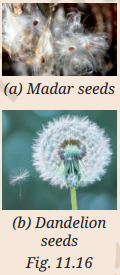
Answer: Calotropis (madar) seeds and dandelion seeds are adapted for dispersal by wind.
These seeds are very light and have hairy or feathery structures that help them to be carried away easily by the wind to far-off places.
3. A farmer plants two varieties of maize side by side, but notices that seeds form only when pollen from one variety reaches the stigma of the other. What type of pollination is this?
Answer: This is cross-pollination.
In this case, pollen from the anther of one maize variety reaches the stigma of another maize variety of the same type. According to the text, when pollen is transferred from a flower of one plant to the stigma of a flower of another plant of the same species, it is called cross-pollination.
Pause and Ponder (Page No. 218)
4. Why do animals with external fertilisation generally produce more eggs than animals with internal fertilisation?
Answer: In external fertilisation, eggs and sperms are released into the water. Many eggs get washed away by water currents, eaten by predators, or fail to get fertilised. To ensure that at least some young ones survive, animals with external fertilisation produce a large number of eggs.
5. In animals, which fertilisation method the gametes are more protected?
Answer: In internal fertilisation, the gametes are more protected because fertilisation takes place inside the body of the female, where the eggs and sperms are safe from external dangers.
Pause and Ponder (Page No. 222)
6. Ravi suddenly notices that he is growing taller rapidly, his shoulders are broadening, and his voice cracks. What stage of life is he entering?
Answer: Ravi is entering the stage of Puberty/Adolescence.
Explanation:
- The changes Ravi is experiencing — growing taller rapidly, shoulders broadening, and voice cracking — are all typical physical changes that occur in boys during puberty.
- As stated in the chapter, the testes produce hormones that control sperm production and cause these physical changes in boys during puberty. This is the stage where reproductive organs mature and begin producing gametes (sperm), making the body gradually capable of reproduction.
- Other common changes during puberty in boys include growth of facial hair, increase in muscle mass, and emotional changes.
7. Rina’s period occurs every 28 days. Her last period was on the 5th of March. On which day is she most likely to get her next period?
Answer: Rina’s next period is most likely to begin on 2nd April.
Calculation:
- Last period = 5th March
- Cycle length = 28 days
- Next period = 5th March + 28 days = 2nd April
As stated in the chapter, the menstrual cycle repeats every 21-35 days, commonly around 28 days, starting from puberty and continuing till menopause.
8. A human zygote has just formed. How many chromosomes does it have?
Answer: A human zygote has 46 chromosomes.
Explanation:
- The egg cell contains 23 chromosomes
- The sperm cell contains 23 chromosomes
- When they fuse during fertilisation:
- 23 + 23 = 46 chromosomes
As stated in the chapter, gametes are formed by meiosis, which reduces the chromosome number to half. When egg and sperm combine, the zygote regains the full number of 46 chromosomes arranged in 23 pairs, the same as the parent cells.
Pause and Ponder (Page No. 223)
9. What protective devices can be used during sexual activity to reduce the spread of STIs?
Answer: Condoms are the most effective protective devices to reduce the spread of STIs.
Explanation:
As stated in the chapter, Sexually Transmitted Infections (STIs) are infections that can be transmitted from an infected person to an uninfected person through close physical contact during sexual activity. These include:
- Gonorrhoea
- Herpes
- Syphilis
- Genital warts
- HIV (which can eventually lead to AIDS)
Protective Devices:
- Condoms — act as a physical barrier that prevents direct contact between partners, stopping the transmission of STIs. They also help prevent unwanted pregnancy.
- Vaginal covers — also act as barriers providing similar protection.
Important Points:
- Some STIs like HIV/AIDS are not curable yet, making prevention extremely important.
- Using condoms consistently and correctly is the best way to reduce the risk of STIs.
- Apart from protective devices, making responsible and thoughtful decisions about sexual activity is equally important.
10. If a couple uses oral contraceptive pills but not condoms, which risks remain and why?
Answer: The risk of contracting STIs remains even when using oral contraceptive pills.
Explanation:
What oral contraceptive pills do:
- They work by altering hormones to change the release of eggs (ovulation).
- They are effective in preventing unwanted pregnancy.
- However, they provide absolutely no protection against STIs.
What risks remain:
- Since no physical barrier is used, STIs can still be transmitted freely between partners during sexual activity.
- Dangerous infections like HIV, gonorrhoea, herpes, syphilis, and genital warts can still spread.
- Some of these STIs like HIV/AIDS have no cure yet, making this a serious health risk.
Why these risks remain:
- Oral pills only work internally by affecting hormones — they do not create any physical barrier between partners.
- STIs spread through direct physical contact, which oral pills cannot prevent in any way.
- Only condoms and vaginal covers act as physical barriers that can block the transmission of STIs.
Pause and Ponder (Page No. 224)
11. In many animals, the young ones can walk or find food soon after birth but human babies are completely dependent for a long time. What might be some advantages and disadvantages of this for humans as a species?
Answer: Human babies are completely dependent on their parents for a long time unlike many animals whose young ones can walk or find food soon after birth. This has both advantages and disadvantages for humans as a species.
Advantages:
1. Better Brain Development:
- The long period of dependence allows the human baby’s brain to grow and develop fully outside the womb.
- This leads to higher intelligence and complex thinking abilities that make humans unique.
2. Learning and Education:
- During this dependent period, human babies learn language, social skills, and behaviour from their parents and surroundings.
- This long learning period helps humans develop complex skills that no other animal possesses.
3. Parental Care and Protection:
- Parents provide food, warmth, protection and emotional support during this vulnerable period.
- As stated in the chapter, breastfeeding provides complete nutrition and protects the infant from many diseases.
4. Strong Family and Social Bonds:
- The extended period of care strengthens family bonds and builds a strong social structure in human society.
- This leads to the development of communities and civilisations.
Disadvantages:
1. High Parental Investment:
- Parents must invest a large amount of time, energy and resources in raising the child for many years.
- This limits the number of offspring humans can raise at one time.
2. Vulnerability:
- Human babies are completely helpless for a long period and cannot survive without adult care.
- If parents are absent or unable to provide care, the baby’s survival is seriously threatened.
3. Slower Population Growth:
- Because of the long dependence period and high investment in each child, humans reproduce less frequently compared to many other animals.
- This makes population recovery slower after major disasters or epidemics.
4. Burden on Mother:
- The mother requires proper nutrition, rest and support for a long time after birth.
- As mentioned in the chapter, some mothers even experience post-partum depression, which is a recognised condition needing treatment.

Leave a Reply