Think It Over (Page No. 8)
1. Where does a cell come from?
Answers: A cell comes from a pre-existing cell. According to cell theory, new cells are formed by the process of cell division from already existing cells.
2. How have technological interventions facilitated the creation of new knowledge in understanding the world beyond the naked eye?
Answers: Technological tools like microscopes have helped scientists study cells which are too small to be seen by the naked eye.
- Early scientists like Robert Hooke observed cells using a microscope.
- Modern light microscopes provide better magnification and clarity.
- Electron microscopes allow scientists to see very tiny structures at the nanometre level with great detail.
These advancements have greatly improved our understanding of cell structure and function.
3. How is the cell structural and functional unit of life?
Answers:
- All living organisms are made up of cells.
- Cells form tissues, tissues form organs, and organs form organ systems.
- Each cell performs essential functions like respiration, nutrition, excretion, and reproduction.
Therefore, a cell is called the structural unit (it builds the body) and functional unit (it performs life processes) of life.
4. How does a cell multiply?
Answers: A cell multiplies by the process of cell division.
- Mitosis: Produces two identical daughter cells for growth and repair.
- Meiosis: Produces four daughter cells with half the number of chromosomes, used in reproduction.
Cell division helps in:
- Growth of the body
- Repair of damaged tissues
- Reproduction in organisms
Pause and Ponder (Page No. 14)
1. What argument would you give for the necessity of a cell wall in plants usually fixed in one place versus in animals usually moving from one place to the other?
Answers: Plants are usually fixed in one place and cannot move. Therefore, they need a rigid cell wall to:
- Provide support and strength
- Protect them from environmental stresses like wind and rain
- Maintain their shape and upright position
In contrast, animals move from place to place, so their cells do not have a cell wall. This allows animal cells to be flexible, helping in movement and different body function
2. What consequences would you predict for a plant cell if its cell wall were to become as flexible as a cell membrane?
Answers: If the cell wall became flexible:
- The plant cell would lose its rigidity and fixed shape
- It would not be able to remain firm or upright
- The plant could become weak and droop or collapse easily
Thus, the rigid cell wall is essential to maintain the structure and support of plant cells.
3. Why is it important to cut the two potato pieces in roughly equal size and measure their initial weight before placing them in different liquids?
Answers: It is important because:
- Equal size ensures a fair comparison between the two pieces
- Measuring initial weight helps to accurately observe changes after the experiment
- Any increase or decrease in weight can then be correctly attributed to osmosis (movement of water)
This makes the experiment reliable and scientifically valid.
Pause and Ponder (Page No. 19)
4. Do white flowers contain any pigment? Give reasons.
Answers: Yes, white flowers may contain pigments, but they lack coloured pigments like those found in chromoplasts.
- In many cases, white flowers have no coloured pigments (like red, yellow, or orange).
- Sometimes, they may have colourless plastids (leucoplasts) instead of chromoplasts.
- Because of the absence of coloured pigments, the flowers appear white.
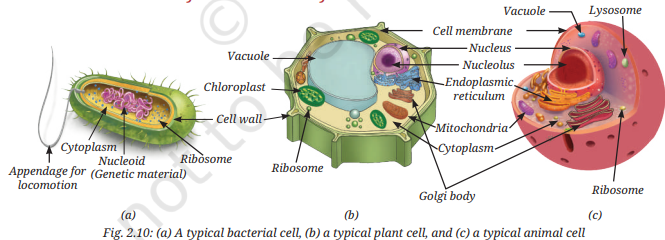
5. Draw a well-labelled schematic diagram of a plant or an animal cell using these clues—
(i) Nucleus appears as a dark and round body inside the cell.
(ii) ER spreads like a network of extended nuclear envelope.
(iii) Mitochondria and chloroplasts are rod shaped.
You may refer to Fig. 2.10.
Answers:
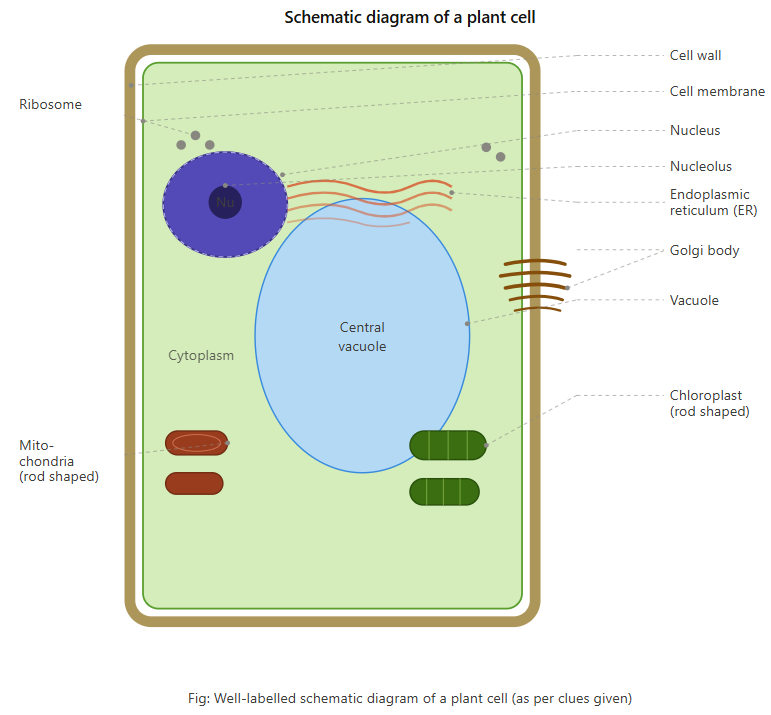
(i) The nucleus is shown as a dark, round body with an even darker nucleolus spot inside it, just as described.
(ii) The endoplasmic reticulum (ER) is drawn as a network of wavy, layered lines extending outward from the nuclear envelope, spreading like a mesh.
(iii) Both mitochondria (in red-brown) and chloroplasts (in dark green) are drawn in rod/elongated shapes, with internal lines suggesting cristae and thylakoids respectively.
All major plant cell organelles are labelled — cell wall, cell membrane, nucleus, nucleolus, ER, Golgi body, vacuole, chloroplast, mitochondria, ribosome, and cytoplasm.
Pause and Ponder (Page No. 22)
6. Instead of many small ones, why does a cell not have a single giant mitochondrion? How does this relate to the concept of surface area?
Answers: A cell has many small mitochondria because:
- Smaller mitochondria provide a larger total surface area compared to one big mitochondrion.
- More surface area allows more chemical reactions to occur for energy production.
- The inner membrane (cristae) increases surface area, helping in efficient release of energy (ATP).
If there were only one large mitochondrion, the surface area would be less, and energy production would be less efficient.
7. If the skin cells start dividing by meiosis instead of mitosis, what do you think will happen to a cut on the skin?
Answers: If skin cells divide by meiosis:
- The new cells will have half the number of chromosomes
- The cells will be genetically different and not identical
- Proper repair and healing of the cut will not occur
Therefore, the cut on the skin will not heal properly, because mitosis (which produces identical cells) is necessary for growth and repair.

Leave a Reply