Think It Over (Page No. 28)
1. How is the study of cells and tissues significant for understanding the life processes and human welfare?
Answer: The study of cells and tissues helps us understand how living organisms function and grow. Cells are the basic units of life, and similar cells form tissues that perform specific functions.
It explains how different parts of the body work together, such as muscles for movement and nerves for control. This knowledge is useful for human welfare, as it helps in medical treatment, disease control, and scientific research.
2. How are tissues in plants and animals different, and why?
Answer: Plant and animal tissues differ because their functions and lifestyles are different.
Plants are fixed in one place, so their tissues provide support and strength. Their cells have a rigid cell wall. Animals can move, so their tissues are flexible and do not have a cell wall.
Also, plants make their own food, so they have tissues for photosynthesis, while animals have tissues for digestion. These differences exist because plants and animals have different needs and ways of living.
3. How is the division of labour at various levels of organisation in multicellular organisms correlated with their structure and function?
Answer: In multicellular organisms, different cells and tissues perform different functions, which is called division of labour.
Cells form tissues, tissues form organs, and organs form organ systems. Each part has a structure suited to its function. For example, muscle tissue helps in movement, and nervous tissue helps in coordination.
This division of labour increases efficiency and helps organisms carry out complex life processes easily.
Think It Over (Page No. 33)
1. You may have noticed that fibres of coconut husk are hard and brittle, whereas the leaf stalks of coriander are soft and flexible. Find out the reason.
Answer: Coconut husk fibres are hard and brittle because they are made of sclerenchyma tissue, which has thick, lignified cell walls. These cells are mostly dead and provide great strength and rigidity.
On the other hand, the leaf stalks of coriander are soft and flexible because they contain collenchyma tissue, which has living cells with unevenly thickened walls. This tissue provides flexibility and allows bending without breaking.
Thus, the difference is due to the type of tissue present—sclerenchyma gives hardness, while collenchyma provides flexibility.
Think It Over (Page No. 34)
2. Why do you think that a thick cuticle on the outer wall of epidermis is advantageous for a plant living in the desert but disadvantageous for a plant living underwater?
Answer: A thick cuticle is useful for desert plants because it reduces water loss by preventing excessive transpiration in hot and dry conditions.
However, in underwater plants, a thick cuticle is disadvantageous because water is easily available, and such plants need to absorb gases and substances directly. A thick cuticle would slow down this exchange.
3. Once water is absorbed by plant roots, it has to travel against gravity through xylem. How do the ‘dead’ cells of the xylem work together with the living cells of leaves at the top to keep the water moving?
Answer: Water moves upward through xylem due to transpiration pull created by leaves. When water evaporates from the leaves, it creates a suction force that pulls water upward from the roots.
Even though xylem cells are dead, they form continuous tubes that allow water to flow. The living cells of leaves help by maintaining transpiration, which keeps the water moving against gravity.
4. What do you think will happen if there were no stomata in the epidermis of the stem or leaves?
Answer: If stomata were absent, plants would not be able to exchange gases (like carbon dioxide and oxygen) or carry out proper transpiration.
As a result:
- Photosynthesis would be affected due to lack of carbon dioxide
- Transpiration would stop, affecting water transport
- The plant may not survive
Think It Over (Page No. 40)
5. Look at the picture given below (Fig. 3.17). Carefully observe the various poses of classical and folk dances of India. Can you identify which joints are involved? Also, what type of movement each joint allows?
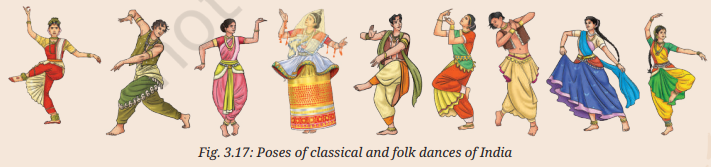
Answer: In the dance poses shown, different joints of the body are involved, each allowing specific types of movement:
- Shoulder joint (Ball and socket joint):
Allows movement in all directions (circular, forward, backward, sideways). It helps in raising and rotating arms. - Hip joint (Ball and socket joint):
Allows free movement of legs in different directions, helping in various dance steps. - Elbow joint (Hinge joint):
Allows bending and straightening of the arm. - Knee joint (Hinge joint):
Allows bending and straightening of the legs during dance movements. - Neck joint (Pivot joint):
Allows side-to-side movement of the head. - Wrist and ankle joints:
Allow flexible movements like turning, bending, and rotation.
Thus, different joints work together to provide flexibility, balance, and a wide range of movements required in dance.

Leave a Reply