Think It Over (Page No. 48)
1. How much distance should we maintain from the truck ahead to avoid a collision if it suddenly applies the brakes?
Answer: We should maintain a safe distance so that if the truck suddenly applies brakes, our vehicle has enough distance to stop and avoid collision.
This stopping distance depends on:
- the speed of our vehicle
- braking ability
- road conditions
- driver’s reaction time
So, there is no fixed number; the distance should be sufficient for safe stopping.
2 .Does this distance depend upon the speed with which we are moving?
Answer: Yes, this distance depends on speed.
- When speed is higher, the stopping distance is more
- When speed is lower, the stopping distance is less
The book explains that when brakes are applied, a vehicle travels some distance before stopping, and this distance increases with higher initial velocity.
Pause and Ponder (Page No. 51)
1. In the example of an athlete running back and forth on a straight track (Fig. 4.4), when will the displacement of the athlete be zero? What will be the total distance travelled in that case?
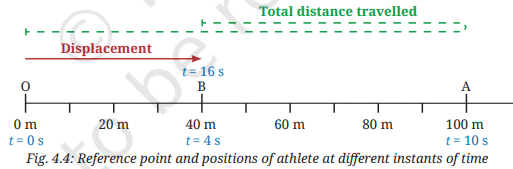
Answer: The displacement of the athlete will be zero when she returns to the starting point O.
This is because displacement is the net change in position, and if the initial and final positions are the same, displacement becomes zero.
Even though displacement is zero, the athlete has still covered some path.
From Fig. 4.4:
O → B = 40 m
B → A = 60 m
A → B = 60 m
B → O = 40 m
Total distance travelled = 40 + 60 + 60 + 40 = 200 m
2. Fuel used up in a vehicle depends on which of the following? Justify your answer.
(i) Total distance travelled
(ii) Displacement
Answer: Fuel used depends on: (i) Total distance travelled
Justification: Fuel consumption depends on the actual path covered by the vehicle, i.e., the total distance travelled.
- Distance is the total length of the path travelled.
- Displacement is only the shortest distance between initial and final positions.
A vehicle may have zero displacement (if it returns to the starting point), but it still consumes fuel because it has travelled some distance.
3. A ball rolls down an inclined track as shown in Fig. 4.6. Is its motion, a straight line motion? Assuming the starting point of the ball (O) to be the origin, can its motion from O to D be depicted using a horizontal line as shown in Fig. 4.3? Are the values of total distance travelled and magnitude of displacement from O equal or different at positions A, B, C and D?
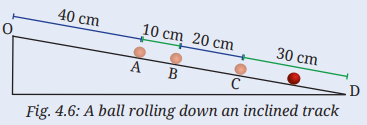
Answer: Yes, the ball is moving along a straight inclined track, so its motion is straight-line (linear) motion.
Yes. If we take point O as the origin, we can represent the motion on a horizontal straight line (like a number line) by marking distances from O. This is just a way to describe position, even though the actual path is inclined.
They are equal at all positions (A, B, C and D).
The ball moves only in one direction from O to D without turning back.
For motion in a straight line in one direction, total distance travelled = magnitude of displacement.
Therefore:
At A → distance = displacement
At B → distance = displacement
At C → distance = displacement
At D → distance = displacement
Conclusion:
- Motion is straight-line motion.
- It can be represented on a horizontal line.
- Distance and displacement are equal at all points because there is no change in direction.
Pause and Ponder (Page No. 53)
4. During a family road trip, you drive 200 km north in three hours. Afterwards, you drive 200 km south in two hours. Find the average speed and average velocity for your entire trip.
Answer: Average speed and average velocity
- Distance travelled = 200 km (north) + 200 km (south) = 400 km
- Total time = 3 h + 2 h = 5 h
Average speed
= Total distance ÷ Total time
= 400 ÷ 5 = 80 km/h
Displacement = 0 km (because you return to the starting point)
Average velocity
= Displacement ÷ Total time
= 0 ÷ 5 = 0 km/h
Final Answer:
Average speed = 80 km/h
Average velocity = 0 km/h
5. Under what condition(s) is the
(i) magnitude of average velocity of an object equal to its average speed?
Answer: When the object moves in a straight line in one direction without changing direction (no turning back).
(ii) magnitude of average velocity of an object zero while its average speed is not zero?
Answer: When the object returns to its starting point (displacement = 0), but it has travelled some distance.
Example: A round trip like going forward and coming back.

Leave a Reply