Think It Over (Page No. 94)
1. Why does a canoe move forward when the canoeist pushes water backwards with their paddle and why does it move faster when they push harder?
Answer: By Newton’s 3rd Law, when the paddle pushes water backward, water pushes the paddle forward with equal and opposite force, moving the canoe forward. Pushing harder increases this reaction force, so the canoe moves faster (Newton’s 2nd Law: F = ma).
2. Suppose the same canoeist uses the same paddle force in two different canoes, one empty and one carrying another passenger. In which case will the canoe move faster?
Answer: The empty canoe moves faster. Same force, but less mass = more acceleration (a = F/m). The canoe with a passenger has more mass, so acceleration is less.
Pause and Ponder (Page No. 97)
1. A weightlifter lifts a barbell (Fig. 6.8). List two forces that are acting on the barbell. Are these forces balanced if the weightlifter keeps the barbell steady?
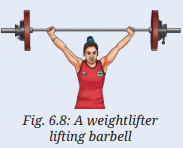
Answer: Two forces acting on the barbell:
- Gravitational force (weight) — acting downward, pulling the barbell toward Earth
- Muscular force applied by the weightlifter — acting upward
Are these forces balanced?
Yes, the forces are balanced when the barbell is held steady. Since the barbell is not moving (at rest), the net force on it is zero. This means the upward force applied by the weightlifter is equal in magnitude to the downward gravitational force — satisfying Newton’s First Law of Motion.
2. Two players R and S are participating in an arm-wrestling match (Fig. 6.9). At the instant, when the arms tilt to the front direction (out of the page towards you), are the forces exerted by the players balanced? If not, which player exerted the larger force?
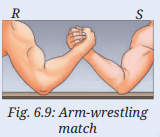
Answer: No, the forces are not balanced.
Player S exerted the larger force.
Reason: Since the arms are tilting towards S’s side (out of the page = forward direction, meaning S is winning/pushing R’s arm forward), there is a net force in S’s direction. This means the forces are unbalanced, and S is applying the greater force on R’s arm than R is applying back.
Pause and Ponder (Page No. 101)
3. An object is moving with a constant velocity. Is there a net force acting upon it?
Answer: No. By Newton’s First Law, an object moving with constant velocity has no change in speed or direction, meaning acceleration = 0. Since F = ma, if a = 0, then net force = 0.
4. Suppose, no net force is acting on an object. Which of the following situations are possible?
(i) Object remains at rest if at rest.
(ii) Object keeps moving with a constant velocity if already moving.
(iii) Object is moving with a constant acceleration.
Answer: When no net force acts on an object, the possible situations are:
- (i) Object remains at rest if at rest. ✔️
- (ii) Object keeps moving with constant velocity if already moving. ✔️
- (iii) Object is moving with constant acceleration. ✖️ Not possible without a net force.
Correct options: (i) and (ii)
5. In the real world, it is difficult to find a situation where no forces are acting on an object. But by applying additional forces, a condition can be achieved where the net force on the object is zero. Explain with the help of an example.
Answer: In real life, many forces act on an object, but we can apply an additional force to make the net force zero.
Example:
A box is pushed on the floor. The force of friction acts backward. If you push the box with a force equal to friction, both forces cancel out.
Net force = 0 → the box moves with constant velocity.
Pause and Ponder (Page No. 106)
6. A toy car of mass 100 g is moving with a constant velocity of 0.5 m s–1. What is the net force acting on the toy car?
Answer: Given: mass = 100g = 0.1 kg, velocity = constant = 0.5 m/s
Since velocity is constant, acceleration = 0
∴ Net force = ma = 0.1 × 0 = 0 N
7. Two children of different masses are sitting on identical swings. To impart identical initial acceleration, for which child would you require to apply a larger force? Explain why.
Answer: The heavier child requires a larger force.
By Newton’s 2nd Law: F = ma
Since acceleration (a) is the same for both, force is directly proportional to mass. The child with greater mass needs a greater force to achieve the same acceleration.
8. How are glass items packed for transportation using a bubble wrap or hay protected from damage?
Answer: By Newton’s 2nd Law (F = ma):
When a glass item falls or is jolted, it decelerates from high velocity to zero. Bubble wrap or hay acts as a cushion that:
- Increases the time over which the velocity changes to zero
- This reduces acceleration
- Which in turn reduces the force (F = ma) experienced by the glass
Since the force of impact is greatly reduced, the glass item is protected from breaking. This is the same principle used in airbags in vehicles.
Pause and Ponder (Page No. 110)
9. Why does a fireperson sometimes struggle when holding the pipe issuing water?
Answer: A fireperson struggles because water rushing out of the pipe pushes the pipe backward with a strong force (reaction force).
This is due to Newton’s third law of motion—the force of water moving forward causes an equal and opposite force on the fireperson.
10. Suppose a spacecraft is moving in a region of space where the gravitational force acting upon it is negligible. Suggest how can it change its velocity.
Answer: The spacecraft can change its velocity by firing its rocket engines.
The gases expelled backward exert an equal and opposite force on the spacecraft, making it speed up, slow down, or change direction—even in empty space.

Leave a Reply