Think It Over (Page No. 116)
1. What will be the magnitude of velocity of the child at the bottom of the blue slide?
Answer: Using conservation of mechanical energy (ignoring friction), the potential energy at the top converts entirely to kinetic energy at the bottom:
So if the blue slide has height h, the child’s speed at the bottom is √(2gh).
2. Will two children of different masses reach the bottom of the same slide with the same velocity?
Answer: Yes. Notice that mass m cancels out from both sides of the energy equation:
The final velocity depends only on the height h, not on the mass of the child. So both children reach the bottom with the same speed, regardless of their masses.
3. Which of the slides will result in the largest magnitude of velocity for the child at its bottom?
Answer: Again, since v = √(2gh), a greater height h means a greater velocity. So whichever slide has the greatest vertical height (not length — height) will give the child the largest speed at the bottom, regardless of the slide’s shape or steepness.
Looking at the chapter’s playground image, the tallest slide wins — its shape (curved, straight, or spiral) doesn’t matter, only how high it starts.
Pause and Ponder (Page No. 119)
1. In the previous chapter, a weightlifter is shown holding a barbell steady in her hands (Fig. 6.8). Is she doing any work on the barbell while holding it steady?
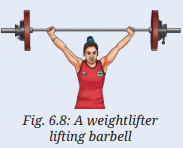
Answer: No, the weightlifter is not doing any work on the barbell while holding it steady.
According to the scientific definition, work done = force × displacement. Even though she is applying a large upward force on the barbell, the barbell has zero displacement since it is not moving. Therefore:
However, she still feels tired because her muscles repeatedly contract and expand internally, consuming the chemical energy of her body — even though no work is done on the barbell in the scientific sense.
2. Is the work done by friction on the stack of coins that travels on a rough surface (Fig. 6.13c) — positive, negative or zero?
Answer: The work done by friction on the stack of coins is negative.
Friction always acts in the direction opposite to the motion of an object. When the stack of coins slides along the rough surface, it moves in one direction, but the frictional force acts in the opposite direction to oppose the motion.
Since the displacement of the coins and the force of friction are in opposite directions:
This negative work done by friction reduces the kinetic energy of the coins, which is why the stack slows down and eventually comes to rest. The kinetic energy lost by the coins is converted into heat energy due to friction between the coins and the rough surface.
Pause and Ponder (Page No. 121)
3. When you pedal a bicycle on a flat road, your muscles supply energy. In what forms does this muscular energy appear as you ride?
Answer: When you pedal a bicycle on a flat road, the muscular (chemical) energy gets converted into several forms:
1. Kinetic Energy — The most direct conversion. Your muscles do work on the pedals, which drives the wheels, setting the bicycle and yourself into motion.
2. Heat Energy (Thermal Energy) — Friction between the tyres and the road, and within the moving parts of the bicycle (chain, gears, bearings), converts some energy into heat.
3. Sound Energy — Small amounts of energy are lost as sound produced by the moving parts of the bicycle, such as the chain and wheels.
4. Heat Energy in Muscles — Not all muscular energy is efficiently transferred to the bicycle. Some is lost as heat within your own muscles during the process of contraction and expansion.
Pause and Ponder (Page No. 123)
4. Two objects A and B of mass m and 4 m have the same kinetic energy. What is the ratio of the magnitude of velocities of A and B?
Answer:
Answer:
Given that objects A and B have masses m and 4m respectively, and both have the same kinetic energy.
Setting their kinetic energies equal:
Cancelling ½ and m from both sides:
Taking square root on both sides:
5. Does the kinetic energy of an object which moves with constant velocity change with its position?
Answer:
No, the kinetic energy of an object moving with constant velocity does not change with its position.
From the formula:
Kinetic energy depends only on the mass and velocity of the object. If an object moves with constant velocity, both mass and velocity remain unchanged regardless of where the object is. Therefore its kinetic energy remains constant at every position.
Also, from the work-energy theorem, if velocity is constant, no net work is being done on the object, meaning there is no change in its kinetic energy.
Pause and Ponder (Page No. 126)
6. Does the potential energy of an object near the surface of the Earth change if it moves with constant velocity in the horizontal direction? What if the object is gradually raised in the vertical direction?
Answer:
• When an object moves horizontally with constant velocity, its height does not change.
Since gravitational potential energy depends only on height (),
there is no change in potential energy.
• When the object is gradually raised in the vertical direction, its height increases.
As height increases, increases, so the gravitational potential energy also increases.
Pause and Ponder (Page No. 129)
7. For the situation depicted in Fig. 7.19, calculate the mechanical energy of the ball just before it hits the ground and show that even at this position, it is mgh.
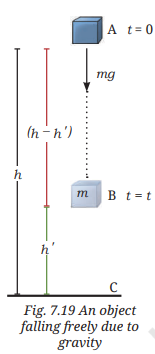
Answer: Just before the ball hits the ground (point C), height h’ = 0.
Finding velocity just before hitting ground:
Using kinematic equation, starting from rest (u = 0) at height h:
Calculating Kinetic Energy at point C:
Calculating Potential Energy at point C:
Since the ball is just at ground level, h’ = 0:
Calculating Mechanical Energy at point C:
This proves that even just before hitting the ground, the total mechanical energy of the ball is mgh, which is the same as its mechanical energy at point A (the starting position).
This demonstrates the conservation of mechanical energy — as the ball falls, its potential energy continuously decreases while its kinetic energy increases by the same amount, keeping the total mechanical energy constant throughout the motion.
8. You may have seen an exhibit like that in Fig. 7.22 in a science park, where a ball is released from the highest point. Describe how the kinetic energy and potential energy change at points A, B and C. Why do subsequent points, such as C, D and E, usually have lower heights compared to the previous ones? Could it have anything to do with the energy lost due to friction?
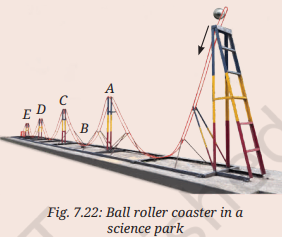
Answer:
Energy changes at points A, B and C:
At Point A (highest point):
- Potential energy is maximum
- Kinetic energy is minimum (nearly zero)
- The ball is momentarily at rest at the top
At Point B (lowest point):
- Potential energy is minimum
- Kinetic energy is maximum
- All potential energy has converted to kinetic energy, so the ball moves fastest here
At Point C (next high point):
- Potential energy increases again
- Kinetic energy decreases again
- Kinetic energy converts back into potential energy as the ball rises
Why do points C, D and E have lower heights?
Yes, it is absolutely due to energy lost because of friction.
In an ideal situation with no friction, the ball would reach the same height at every peak, since mechanical energy would be perfectly conserved. However, in reality:
- Friction acts between the ball and the track at every point
- This converts some mechanical energy into heat energy
- As a result, the total mechanical energy decreases gradually
- With less energy available, the ball cannot rise to the same height as before
Therefore, each successive peak (C, D, E) is lower than the previous one, and eventually the ball comes to rest due to continuous energy loss from friction.
Pause and Ponder (Page No. 132)
9. Explain why roads on hills are built to wind around in gentle slopes rather than going straight up (Fig. 4.26)?
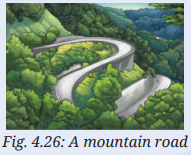
Answer: Roads on hills are built to wind around in gentle slopes because of the principle of the inclined plane — one of the simple machines discussed in this chapter.
Using the mechanical advantage formula:
Where L is the length of the slope and h is the vertical height.
For a gentle winding slope:
- The length L is very large
- Therefore mechanical advantage is greater than 1
- A much smaller force is needed to climb the hill
- Vehicles require less effort and fuel
For a straight steep road:
- The length L is very small
- Mechanical advantage is small
- A much larger force is needed to climb
- Vehicles would require much more engine power
10. To reach a higher floor, we find climbing an inclined ladder easier in comparison to climbing a vertical ladder (Fig. 7.30). Explain why.
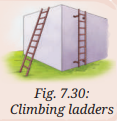
Answer: Climbing an inclined ladder is easier than a vertical ladder because of the principle of the inclined plane.
Using the mechanical advantage formula:
For an Inclined Ladder:
- The length L is greater than the vertical height h
- Therefore mechanical advantage is greater than 1
- The force required to climb is less than your own weight
- Effort is spread over a longer distance
For a Vertical Ladder:
- The length L is equal to the vertical height h
- Therefore mechanical advantage is equal to 1
- You must lift your full body weight at every step
- Much more effort is required
Important Note:
The total work done is the same in both cases since:
The height h reached is the same. However, by climbing at an angle (longer path), the force needed at each step is reduced, making it feel much easier — just like pushing a heavy object up a ramp requires less force than lifting it straight up.
This is why inclined ladders, ramps and winding staircases are preferred over vertical ones in everyday life.
Pause and Ponder (Page No. 135)
11. Why is it easier to open the lid of a can by using a spoon as shown in Fig. 7.35?
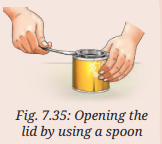
Answer: It is easier to open the lid of a can using a spoon because the spoon acts as a Class I Lever, where the fulcrum is in between the effort and the load.
Identifying the parts of the lever:
- Fulcrum — the edge of the can where the spoon rests
- Effort — the force applied by hand on the long end of the spoon
- Load — the resistance of the lid that needs to be overcome
Using the mechanical advantage formula:
In this case:
- The effort arm (distance from hand to fulcrum) is long
- The load arm (distance from fulcrum to lid) is short
- Therefore mechanical advantage is greater than 1
This means the force applied on the lid is much greater than the effort applied by the hand.
12. Why do you push an object closer to scissors (fulcrum) when you want to cut an object which is hard?
Answer: When cutting a hard object, we push it closer to the fulcrum (the pivot point of scissors) because of the principle of mechanical advantage of a lever.
Scissors work as a Class I Lever where:
- Fulcrum — the pivot point/screw of the scissors
- Effort — force applied by hand on the handles
- Load — the resistance of the object being cut
Using the lever formula:
When the object is placed closer to the fulcrum:
- The load arm decreases
- Therefore the load force increases
- A much larger cutting force is applied on the hard object
- The same effort by hand produces a greater force at the cutting point
This makes it much easier to cut hard objects by simply placing them near the fulcrum.
13. Throughout history, many designs of perpetual machines (using wheels, weights or magnets) have been proposed but none actually work. Why do all real machines eventually slow down and stop? Explain in terms of work and energy.
Answer: All real machines eventually slow down and stop because of friction and the law of conservation of energy.
In terms of Work and Energy:
- Every real machine has moving parts that experience friction
- Friction converts useful mechanical energy into heat energy and sometimes sound energy
- This energy lost as heat cannot be recovered and used again by the machine
- As a result, the machine keeps losing mechanical energy with every cycle
- Eventually, all mechanical energy is converted to heat, and the machine comes to a stop
Why perpetual machines are impossible:
A perpetual machine would require zero energy loss, meaning absolutely no friction — which is impossible in any real physical system. Even in the best designed machines, some energy is always lost to friction and heat.
Therefore, since machines do not create energy — they only transfer or transform it — and since some energy is always lost to friction, no machine can run forever without an external energy source. This is why all perpetual machine designs throughout history have ultimately failed.

Very helpful and easily understand able