Revise, Reflect, Refine
1. Which observation best supports the idea that sound is a mechanical wave?
(i) Sound shows reflection
(ii) Sound needs a medium to propagate
(iii) Sound has frequency
(iv) Sound carries energy
Answer: (ii) Sound needs a medium to propagate
Reason: A mechanical wave is defined as a wave that requires a material medium (solid, liquid, or gas) to propagate. Sound cannot travel through vacuum, which perfectly supports the idea that it is a mechanical wave.
2. For a sound wave propagating in a medium, increasing its frequency will increase its
(i) wavelength
(ii) speed
(iii) number of compressions per second
(iv) time period
Answer: (iii) number of compressions per second
Explanation:
Frequency means the number of oscillations or compressions passing a point in one second.
3. If 20 compressions pass a point in 4 seconds, the frequency is
(i) 80 Hz
(ii) 5 Hz
(iii) 10 Hz
(iv) 0.2 Hz
Answer:
Given:
- Number of compressions = 20
- Time = 4 s
4. In a room, the reflected sound reaches the ear 0.05 s after its production. Will it produce an echo or reverberation? Justify your answer.
Answer:
Given:
- Time for reflected sound to reach ear = 0.05 s
It will produce Reverberation, NOT an echo.
Justification:
| Condition | Time Gap |
|---|---|
| Echo | ≥ 0.1 s |
| Reverberation | < 0.1 s |
Since 0.05 s < 0.1 s, the reflected sound reaches the ear too quickly for the brain to distinguish it from the original sound. Instead of a separate echo, the sound persists and mixes with the original sound, producing reverberation.
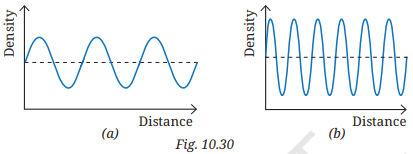
5. Graphs representing two sound waves are given in Fig. 10.30. If the scales on the X and Y axes of the two graphs are the same, which of the two sound waves has (i) greater wavelength, and (ii) smaller amplitude?
Answer:
(i) Greater wavelength:
Sound wave (a) has the greater wavelength.
Explanation:
The wavelength is the distance between two consecutive crests or troughs. In graph (a), the waves are spread farther apart compared to graph (b). Therefore, wave (a) has a greater wavelength.
(ii) Smaller amplitude:
Sound wave (a) has the smaller amplitude.
Explanation:
Amplitude is the maximum height of the wave from the mean position. The height of the wave in graph (a) is smaller than that in graph (b). Therefore, wave (a) has smaller amplitude.
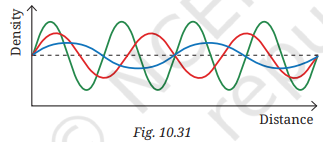
6. The sound waves emitted by three sources A, B and C are represented in Fig. 10.31. If the frequency of A is maximum and C is minimum, identify the corresponding curves, and mark A, B and C on them.
Answer:
Key Concept:
Higher frequency = More cycles (waves) in the same distance = Shorter wavelength
Lower frequency = Fewer cycles (waves) in the same distance = Longer wavelength
Observing the Graph (Fig. 10.31):
By counting the number of complete cycles in each curve:
| Curve Colour | Number of Cycles | Wavelength |
|---|---|---|
| Green | Most cycles | Shortest wavelength |
| Red | Medium cycles | Medium wavelength |
| Blue | Fewest cycles | Longest wavelength |
Identification:
| Source | Frequency | Curve |
|---|---|---|
| A | Maximum (highest frequency) | 🟢 Green curve |
| B | Medium frequency | 🔴 Red curve |
| C | Minimum (lowest frequency) | 🔵 Blue curve |
Conclusion:
- A → Green curve (most compressions, shortest wavelength, highest frequency)
- B → Red curve (medium compressions, medium wavelength)
- C → Blue curve (fewest compressions, longest wavelength, lowest frequency)
Remember: In the same medium, speed of sound remains constant, so:
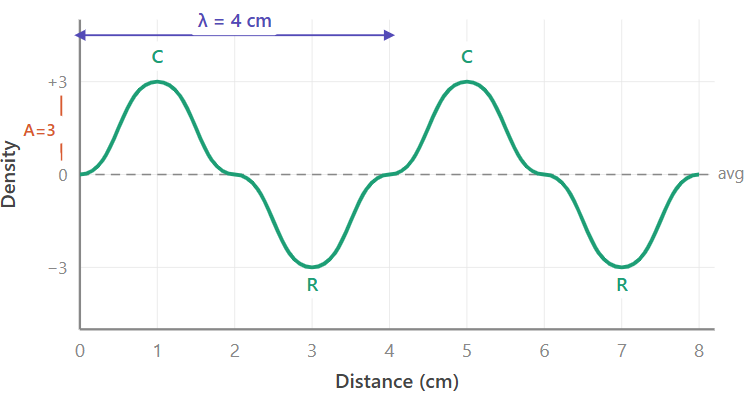
7. Draw a graph to represent a sound wave for which the density amplitude is 3 units and wavelength is 4 cm.
Answer:
- Y-axis → Density
- X-axis → Distance (cm)
- Average density = dashed line (middle)
- Amplitude = 3 units (crests are 3 units above, troughs 3 units below average)
- Wavelength = 4 cm (one complete cycle every 4 cm)
8. In a movie, while showing the explosion of a spacecraft in space, a flash of light is shown along with sound at the same time. What are the errors in this depiction?
Answer: There are two errors in this depiction:
- Error 1 — Sound in space: Space is a near vacuum, so sound cannot propagate there. The explosion would produce no sound at all, because sound needs a medium (solid, liquid, or gas) to travel.
- Error 2 — Light and sound simultaneously: Even if sound could travel, light travels at 300,000 km s⁻¹ while sound travels at only ~340 m s⁻¹ in air. The flash of light should be seen long before the sound is heard. Showing both at the same time is physically incorrect.
9. A source produces a sound wave of wavelength 3.44m. If the wave travels with a speed of 344m s⁻¹ find its time period.
Answer:
Given:
- Wavelength
- Speed
Using the formula:
Now, time period:
10. A ship searching for a sunken ship sent a sonar signal and detected an echo after 5s. If ultrasonic wave travels at 1525 m s⁻¹ in seawater, approximately how far down in the ocean is the wreckage of the sunken ship located?
Answer:
Given:
- Time taken for echo = 5 s
- Speed of ultrasonic wave in seawater = 1525 m s⁻¹
The sonar signal travels to the wreckage and comes back.
So, time taken to reach the wreckage:
Using:
11. A vehicle is fitted with an ultrasonic distance sensor as part of parking assistance system which provides echolocation, while the driver is reversing the vehicle. It emits ultrasonic wave (about 40 kHz) which is reflected by the obstacle. When the warning beep starts sounding at a distance of 1.2 m from the obstacle, how much time is taken by ultrasonic wave to travel to the obstacle and come back? Assume the speed of ultrasonic wave in air to be 345 m s⁻¹.
Answer:
Given:
- Distance from obstacle = 1.2 m
- Speed of ultrasonic wave = 345 m s⁻¹
The wave travels to the obstacle and comes back.
Total distance travelled:
Using:
12. The speed of sound in air is about 331 m s⁻¹ at 0 ºC and nearly 344 m s⁻¹ at 22 ºC. Roughly how much extra time will the sound of thunder take to travel a distance of 1720 m, if the air temperature changes from 22 ºC to 0 ºC? Assume that all other conditions remain unchanged.
Answer:
Given:
- Distance = 1720 m
- Speed of sound at 22 ºC = 344 m s⁻¹
- Speed of sound at 0 ºC = 331 m s⁻¹
Time taken at 22 ºC:
Time taken at 0 ºC: Extra time taken:
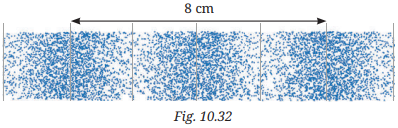
13. The variation of density of medium for a sound wave propagating with a speed of 340 m s⁻¹ is shown in Fig. 10.32. Calculate the wavelength and frequency of the sound wave.
Answer:
Given:
Speed of sound wave,
From Fig. 10.32, the distance of contains two complete wavelengths.
Therefore,
Converting into metre:
Now, using the formula:
- Wavelength or
- Frequency
14. The graphical representation of two sound waves A and B propagating at the same speed of 345 m s⁻¹ is shown in Fig. 10.33. What is the wavelength of each of them? Also, calculate their frequencies.
Answer:
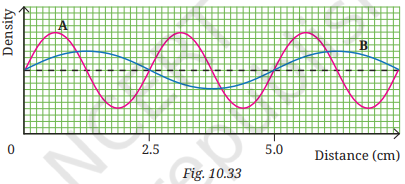
- Wave A completes one full wave in 2.5 cm
Therefore, wavelength of A,
- Wave B completes one full wave in 5 cm
Therefore, wavelength of B,
Given speed of sound,
Using the formula:
For wave A
For wave B
| Sound Wave | Wavelength | Frequency |
|---|---|---|
| A | or | |
| B | or |
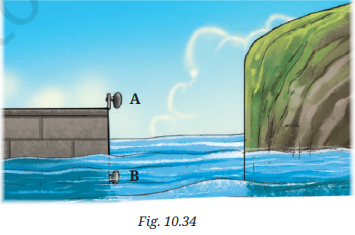
15. Two identical sound sources are placed at A and B — one in air and one submerged in water (Fig. 10.34). Both produce sounds at the same time, which travel horizontally to the vertical side of the cliff and come back. If the time taken by the sound to return to A is 4.5 times than that of B, what is the ratio between the speeds of sound in air and water?
Answer:

Leave a Reply