Revise, Reflect, Refine
1. A flower’s anthers are removed before it matures. Later, pollen from another plant of the same species is dusted onto its stigma and seeds are produced. Which process has been ensured here?
(i) Self-pollination (ii) Cross-pollination
(iii) Fertilisation (iv) Tissue culture
Answer: (ii) Cross-pollination
Explanation:
- The anthers were removed before the flower matured, which prevented any possibility of self-pollination.
- Later, pollen from another plant of the same species was dusted onto its stigma.
- Since pollen was transferred from one plant to another plant of the same species, this is clearly cross-pollination.
- This process is also used in artificial hybridisation in agriculture to develop better crop varieties.
2. Arrange the following stages of sexual reproduction in plants in the correct order:
(i) Pollen germination on stigma (ii) Fertilisation
(iii) Pollination (iv) Formation of zygote
Answer: Correct Order of Stages:
(iii) Pollination → (i) Pollen germination on stigma → (ii) Fertilisation → (iv) Formation of zygote
Explanation of each stage:
| Order | Stage | What happens |
|---|---|---|
| 1st | Pollination | Pollen grains are transferred from anther to stigma |
| 2nd | Pollen germination on stigma | Pollen grain germinates and produces a pollen tube that grows through the style into the ovary |
| 3rd | Fertilisation | Male gamete travels through pollen tube and fuses with the egg cell in the ovule |
| 4th | Formation of zygote | The fertilised egg is called a zygote, which later develops into an embryo |
3. Assertion (A): The zygote formed after fertilisation immediately attaches to the uterus wall.
Reason (R): The uterus wall is always prepared to receive the zygote.
(i) Both A and R are true, and R is the correct explanation of A.
(ii) Both A and R are true, but R is not the correct explanation of A.
(iii) A is true, but R is false.
(iv) A is false, but R is true.
Answer: (iv) A is false, but R is true.
Explanation:
Assertion (A) is FALSE because:
- The zygote does not immediately attach to the uterus wall after fertilisation.
- As stated in the chapter, after fertilisation the zygote first undergoes a series of mitotic divisions while travelling to the uterus.
- Only after this does it implant into the inner lining of the uterus.
- This implantation marks the beginning of pregnancy.
- So the process is not immediate — it takes some time.
Reason (R) is TRUE because:
- As stated in the chapter, before ovulation the uterus starts to prepare itself and the inner lining becomes thick and rich with blood vessels.
- This preparation is done to receive and nourish the developing zygote.
- So the uterus wall does prepare itself to receive the zygote.
- However, this is not the correct explanation of the assertion since the assertion itself is false.
4. Why does asexual reproduction produce offsprings that are genetically identical to the parent?
Answer: Because asexual reproduction involves only ONE parent and the process of MITOSIS.
Explanation:
- In asexual reproduction, a single parent produces offspring without the involvement of another individual.
- The central process behind asexual reproduction is mitosis — a type of cell division that produces two daughter cells, each having the same number of chromosomes identical to the parent cell.
- Since there is no mixing of genetic material from two parents, all offspring receive the exact same genetic information as the parent.
- These genetically identical individuals are called clones.
5. Explain why the menstrual cycle stops during pregnancy.
Answer: Because the uterus lining is needed to nourish the developing embryo.
Explanation:
- The menstrual cycle occurs when an egg is not fertilised — the thickened uterus lining sheds as it is no longer needed.
- However, during pregnancy, the egg has been successfully fertilised by a sperm, forming a zygote.
- The zygote implants into the thick inner lining of the uterus to receive nourishment for development.
- Since the uterus lining is now being used to support and nourish the developing embryo, it does not shed.
- Therefore the menstrual cycle stops completely during pregnancy.
6. Why are flowers that bloom at night white or light in colour as compared to flowers that bloom during the day?
Answer: Because white or light coloured flowers are more visible at night to attract pollinators.
Explanation:
- Flowers that bloom at night depend on nocturnal pollinators like moths and bats for pollination.
- In the darkness of night, colourful flowers cannot be seen easily.
- However, white or light coloured flowers reflect moonlight and starlight, making them clearly visible to nocturnal pollinators.
- In contrast, flowers that bloom during the day are pollinated by bees, butterflies and birds which can see bright colours in daylight.
- Night blooming flowers also tend to produce strong fragrance to further attract nocturnal pollinators.
7. Why do vegetatively propagated plants tend to be more vulnerable to diseases than sexually reproduced plants?
Answer: Because vegetatively propagated plants are genetically identical and lack variation.
Explanation:
- Vegetative propagation is a form of asexual reproduction that produces genetically identical plants (clones).
- Since all plants are genetically identical, they all share the same weaknesses and susceptibilities to diseases and pests.
- If one plant is affected by a disease, the same disease can easily spread to all other plants since none of them have any genetic resistance.
- In contrast, sexually reproduced plants have genetic variation, meaning some individuals may carry genes that make them resistant to certain diseases.
- This variation acts as a natural defence against the spread of diseases in a population.
8. If all flowers in a type of plant were only capable of self-pollination, how would it affect the genetic diversity over several generations? Explain.
Answer: It would greatly REDUCE genetic diversity over several generations.
Explanation:
- In self-pollination, pollen from the same plant fertilises its own eggs, meaning there is no mixing of genetic material from two different individuals.
- Over several generations, the offspring would become increasingly genetically uniform, as the same genetic combinations are repeated.
- This would lead to inbreeding, where similar genetic traits are repeatedly passed on.
- There would be very little variation among individuals of that plant species.
- With reduced genetic diversity, the species would become less adaptable to changing environments and more vulnerable to diseases and pests.
- Over time, this could even threaten the survival of the species if environmental conditions change drastically.
9. A farmer wants to produce a large number of genetically identical plants quickly. Suggest suitable reproduction methods and explain why they are effective.
Answer: The most suitable methods are Vegetative Propagation and Tissue Culture.
Method 1: Vegetative Propagation
Following methods can be used:
- Cutting — stem cuttings are planted in soil to grow new identical plants quickly.
- Grafting — a stem piece from the desired plant is joined to a rooted plant to grow faster.
- Layering — a branch is buried in soil until roots develop, then separated as a new plant.
Why effective:
- Involves only one parent plant
- Produces genetically identical offspring
- Much faster than growing from seeds
- Preserves all desirable traits of the parent plant
Method 2: Tissue Culture
- Small pieces of plant tissue (from shoot tip) are grown in artificial nutrient media in a laboratory.
- This produces a large number of identical plantlets in a very short time.
Why effective:
- Can produce thousands of identical plants from a single parent.
- Produces virus-free, disease-free healthy plants.
- Ensures high yield as seen in banana farming.
- Takes very less space and time compared to other methods.
10. Suresh prepares slides with pollen grains in different sugar concentrations (0%, 2.5%, 5%, 7.5%, 10%) to study the germination of pollen.
(i) What are the different hypotheses which can be tested using this set-up?
(ii) What parameters should be kept the same in this set-up?
Answer:
(i) Hypotheses that can be tested:
- Pollen grains require a sugar solution for germination.
- Different sugar concentrations affect the rate of pollen germination.
- There is an optimum sugar concentration at which maximum pollen germination occurs.
(ii) Parameters that should be kept the same:
- Type and quantity of pollen grains used on each slide
- Temperature and environmental conditions
- Amount of solution placed on each slide
- Time allowed for germination before observation
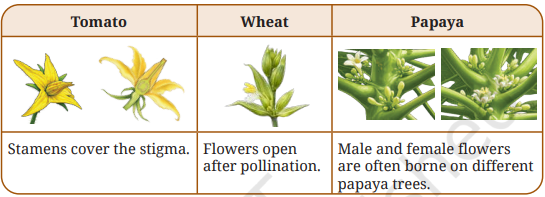
11. Look at the picture given below and think in line with the given prompts and find out which type(s) of pollination might have been followed in these flowers—
Answer:
Tomato: Self-pollination — the stamens cover the stigma, so pollen easily falls on the same flower’s stigma.
Wheat: Self-pollination — the flowers open only after pollination has already occurred.
Papaya: Cross-pollination — male and female flowers are often present on different papaya plants, so pollen must be transferred from one plant to another.
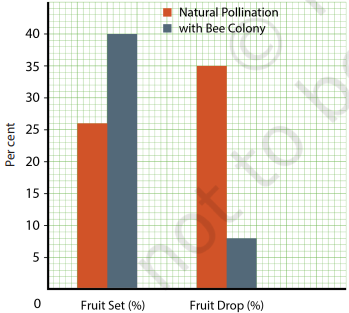
12. In the lower Himalayan region of northern India, apples are an important cash crop that contribute significantly to farmer’s livelihoods. The fruit yield in apple cultivation is declining continuously, associated with climate change and a significant decline in the population of natural pollinators. A researcher-farmer group set up two experimental apple orchards at two distinct locations: Places A and B. In apple orchards at Place A, they allowed natural pollinators to pollinate the flowers of the apple. In apple orchards at Place B, they applied mixed farming techniques of beekeeping. Along with honey, the farmer yielded apples. The yield of apples is depicted in Fig. 11.24, in terms of fruit setting (number of fruits/the total number of corresponding fruit-bearing branches) and fruit drop (premature falling of developing fruits) in the two types of experimental places of apple orchards.
(i) What are the hypotheses the researcherfarmers group has thought of for this investigation?
(ii) What are the different parameters in the experiment?
(iii) Compare and analyse the data of two experimental orchards Places A and B, in terms of high yields of apple fruits.
(iv) Based on your analysis, what do you infer from the data?
Answer:
(i) Hypotheses:
- The presence of bee colonies increases pollination in apple orchards.
- Better pollination leads to higher fruit set and lower fruit drop.
(ii) Parameters in the experiment:
- Type of pollination (natural pollinators at Place A, bee colony at Place B)
- Fruit set percentage
- Fruit drop percentage
(iii) Comparison and analysis:
- At Place A (natural pollination), fruit set is lower (about 25–30%) and fruit drop is higher (about 35%).
- At Place B (with bee colony), fruit set is much higher (about 40%) and fruit drop is very low (about 5–10%).
- This shows that orchards with bee colonies produce more fruits and lose fewer developing fruits.
(iv) Inference:
The use of bee colonies improves pollination efficiency, increases fruit yield and reduces fruit drop in apple orchards. Beekeeping along with farming is beneficial for better crop production.
13. A student claims, “In humans, ovulation always happens on day 14 of the menstrual cycle”. Critically examine this claim and state whether the claim is correct or not. Give at least two reasons for your answer.
Answer: The claim is not correct.
Reasons:
The menstrual cycle does not always last exactly 28 days. It can vary from 21 to 35 days in different women and even from month to month in the same woman.
Ovulation generally occurs around the middle of the cycle, so if the cycle length changes, the day of ovulation also changes. Therefore, it does not always happen on the 14th day.

Leave a Reply