Revise, Reflect, Refine
1. Meena and Hari observed an animal in their garden. Hari called it an insect while Meena said it was an earthworm. Choose the correct option which confirms that it is an insect.
(i) Bilateral symmetrical body
(ii) Body with jointed legs
(iii) Cylindrical body
(iv) Body with little segmentation
Answer: (ii) Body with jointed legs
Insects belong to phylum Arthropoda, whose defining characteristic is jointed appendages (legs). Earthworms are annelids — they have cylindrical, segmented bodies but no legs at all. So jointed legs confirm it is an insect, not an earthworm.
2. Sponges represent one of the simplest animal body plans. Their bodies lack true tissues and organs. Which feature of sponge cells supports its classification under the animal kingdom?
(i) Absence of mitochondria
(ii) Ability to photosynthesise
(iii) Presence of a cell membrane
(iv) Presence of a cell wall
Answer: (iii) Presence of a cell membrane
Sponges are animals, and like all animals, their cells have a cell membrane but no cell wall. Cell walls are found in plants, fungi, and bacteria — not animals. Sponge cells also have mitochondria (ruling out option i), cannot photosynthesize (ruling out option ii), and lack cell walls (ruling out option iv).
3. Observe two different animals in your immediate environment. What features help you distinguish between them? How do these features help place them into different groups?
Answer: Observation of Two Animals: House Lizard and Earthworm
Features That Help Distinguish Them:
| Feature | House Lizard | Earthworm |
|---|---|---|
| Body covering | Dry, scaly skin | Moist, smooth skin |
| Legs | Four legs present | No legs |
| Body symmetry | Bilateral | Bilateral |
| Segmentation | Absent | Present |
| Backbone | Present (vertebrate) | Absent (invertebrate) |
| Body shape | Flattened, elongated | Cylindrical |
| Breathing | Lungs | Skin |
How These Features Help in Classification:
Earthworm is placed in:
- Kingdom: Animalia
- Phylum: Annelida — because of segmented, cylindrical body and moist skin
House Lizard is placed in:
- Kingdom: Animalia
- Phylum: Chordata, Class: Reptilia — because of backbone, scaly skin and lungs
4. How would a scientist justify choosing cellular organisation as a more fundamental characteristic for the basis of classification rather than the presence of xylem and phloem?
Answer: Cellular organisation (whether the organism is unicellular or multicellular, and whether it has a true nucleus) is a basic and fundamental feature present in all living organisms. It shows the level of body design.
Xylem and phloem are found only in some plants and are not present in animals or simpler organisms. Therefore, cellular organisation is a more basic criterion for classification than the presence of xylem and phloem.
5. You find an unlabelled slide of a single-celled organism that has a well-defined nucleus and multiple cilia. Which group would it most likely belong to? Give reasons.
Answer: It would most likely belong to the group Protista.
This is because it is:
- Single-celled
- Has a well-defined nucleus (eukaryotic)
- Has cilia for movement
- These are key features of protists like Paramecium.
6. How does the diversity of organisms contribute to the balance and stability of an ecosystem?
Answer: Different organisms perform different roles such as producers, consumers, and decomposers. This maintains the food chain and nutrient cycle.
If biodiversity is high, the ecosystem becomes more stable, because if one species is affected, others can take over its role.
7. If all unicellular organisms were grouped into a single kingdom, what problems would arise?
Answer: Unicellular organisms are very diverse. Some have a true nucleus (eukaryotic) while others do not (prokaryotic). Some make their own food while others depend on other organisms. Grouping all of them into one kingdom would ignore these important differences and make classification inaccurate.
8. Viruses were studied in earlier classes. Why are they not placed in any of the five kingdoms? Give reasons.
Answer: Viruses are not placed in any kingdom because:
- They do not have a cellular structure.
- They can reproduce only inside a host cell.
- Outside a host, they behave like non-living particles.
Thus, they show both living and non-living characteristics.
9. If you were asked to revise the five kingdom classification, would you create a separate category for viruses or keep them outside the system? Justify your answer and explain what this indicates about the evolving nature of scientific classification.
Answer: Viruses should be kept outside the five-kingdom system because this system is based on cellular organisation, which viruses lack. This shows that scientific classification changes as new knowledge is gained.
10. Viruses contain genetic material like living organisms but lack cellular organisation. Which features prevent them from fitting into the five kingdom system? What does this tell us about the limitations of classification systems?
Answer: Viruses lack:
- Cell structure
- Independent metabolism
- Ability to reproduce on their own
This shows that classification systems have limitations and may need revision with new discoveries.
11. Both pteridophytes and bryophytes lack flowers and seeds, yet they are placed in different groups. Explain this classification using their key features.
Answer: Though both lack flowers and seeds:
- Bryophytes do not have vascular tissues (xylem and phloem) and have a simple body structure.
- Pteridophytes have vascular tissues and a more developed body structure with roots, stems, and leaves.
Hence, they are placed in different groups.
12. In the classification hierarchy, which group— class or genus— has fewer members but more features in common? Explain your answer.
Answer: Genus has fewer members but more features in common.
As we move from class to genus in the classification hierarchy, the number of organisms decreases and the similarity among them increases. Organisms in the same genus are very closely related.
13. A scientist discovers a new organism with the characteristic features of locomotion and autotrophic nutrition. Which character(s) would help the scientist identify the organism belonging to Protista according to the five kingdom classification?
Answer: The scientist should check:
- Whether it is unicellular
- Whether it has a well-defined nucleus (eukaryotic)
- Presence of structures like cilia/flagella for movement
- These features would help place it in Protista.
14. A researcher identified a unicellular eukaryotic organism as fungi. What identification key would you suggest according to the five kingdom classification to keep a unicellular organism in the Kingdom Fungi?
Answer: To place a unicellular organism in Kingdom Fungi, the key feature should be:
- Mode of nutrition — saprophytic (absorbing nutrients from dead matter)
- Presence of a cell wall
- Absence of chlorophyll
Even if unicellular (like yeast), these features justify placing it in the Fungi kingdom.
15. During a long-term ecological study, students examined organisms collected from three different environments— a freshwater pond, damp soil near decaying logs and the digestive tract of animals. Instead of naming organisms directly, scientists recorded only structural, cellular and nutritional features as given in the table below
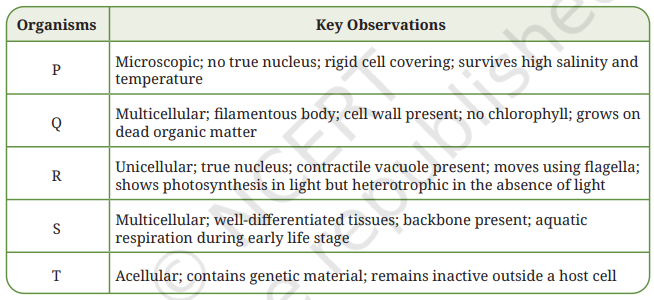
The students realised that some organisms fit neatly into Whittaker’s five kingdom classification, while others challenged the very basis of this classification.
Based on the case study, answer the following questions—
(i) Identify one organism that clearly belongs to the Kingdom Fungi. State one observation that supports your answer.
(ii) Which organism would be placed in the Kingdom Monera?
Mention one characteristic that justifies this placement.
(iii) Organisms R and Q are both eukaryotic, yet they are placed in different kingdoms. Analyse the criteria that separate them.
(iv) Explain why organism S cannot be classified using the mode of nutrition alone.
(v) Organism T does not fit into any of the five kingdoms. Which fundamental characteristic used in classification does it lack and what does this reveal about the limitations of classification systems?
(i) Kingdom Fungi — Organism Q
Answer: Organism Q is multicellular, has a cell wall, lacks chlorophyll, and grows on dead organic matter. The key supporting observation is that it grows on dead organic matter (saprophytic/decomposer mode of nutrition), which is a defining feature of Kingdom Fungi. Fungi obtain nutrients by absorbing them from dead and decaying matter.
(ii) Kingdom Monera — Organism P
Answer: Organism P has no true nucleus (prokaryotic), which is the defining characteristic that places it in Kingdom Monera. Bacteria and other monerans are the only organisms that lack a membrane-bound nucleus. Its ability to survive high salinity and temperature further suggests it could be an Archaebacterium.
(iii) Why R and Q are placed in different kingdoms despite both being eukaryotic
Answer:
| Feature | Organism R (Protista) | Organism Q (Fungi) |
|---|---|---|
| Organisation | Unicellular | Multicellular |
| Cell wall | May or may not have | Present (chitin) |
| Nutrition | Both autotrophic and heterotrophic | Heterotrophic (decomposer only) |
| Movement | Moves using flagella | Non-motile |
R is placed in Kingdom Protista because it is unicellular and shows dual nutrition (autotrophic in light, heterotrophic in darkness — resembling Euglena). Q is placed in Kingdom Fungi because it is multicellular, grows on dead matter, and has a filamentous body with a cell wall.
(iv) Why Organism S cannot be classified by mode of nutrition alone
Answer: Organism S is multicellular with well-differentiated tissues, a backbone, and undergoes aquatic respiration during early life stage — clearly indicating it is a vertebrate animal (like a frog or fish). However, its mode of nutrition is heterotrophic, just like Fungi and many Protists. Since multiple kingdoms share heterotrophic nutrition, using nutrition alone would not distinguish S from Fungi or Protista. Classification requires considering cell structure, body organisation, presence of backbone, and reproductive features together.
(v) Why Organism T does not fit into any of the five kingdoms
Answer: Organism T is acellular — it has no cellular structure at all. It merely contains genetic material and remains inactive outside a host cell. This clearly identifies it as a virus.
The fundamental characteristic it lacks is cellular organisation, which is the very basis of all five kingdoms. Every kingdom — Monera, Protista, Fungi, Plantae, and Animalia — is defined around organisms made of at least one cell.
This reveals an important limitation of classification systems: they are built around cellular life, and cannot accommodate entities like viruses that exist on the boundary between living and non-living. It shows that classification systems are not absolute — they evolve as science discovers new forms of life that challenge existing frameworks.

Leave a Reply