Revise, Reflect, Refine
1. Choose the most appropriate option to describe the role of biogeochemical cycles in an ecosystem.
(i) To provide food directly to all organisms.
(ii) To recycle essential nutrients between biotic and abiotic components.
(iii) To create new elements for use by living things.
(iv) To remove pollutants and toxins from the organism.
Answer: (ii) To recycle essential nutrients between biotic and abiotic components.
2. Which of the following is primarily responsible for warming of the Earth?
(i) Solar radiation is immediately absorbed by carbon dioxide, which then releases it as heat.
(ii) The atmosphere’s tiny particles absorb incoming solar radiation, which directly heats the Earth.
(iii) The Earth’s surface absorbs solar radiation, which is then re-radiated and trapped by greenhouse gases.
(iv) The Earth’s environment is heated only by the solar radiation reflected by the cloud
Answer: (iii) The Earth’s surface absorbs solar radiation, which is then re-radiated and trapped by greenhouse gases.
3. Explain how climate change affects the water cycle. Illustrate with examples.
Answer: The water cycle involves evaporation, transpiration, condensation, precipitation, infiltration and groundwater flow. It connects the cryosphere, hydrosphere, atmosphere, geosphere and biosphere together.
How Climate Change Affects the Water Cycle:
1. Increased Evaporation:
- Rising global temperatures cause more evaporation from oceans, rivers and lakes.
- A warmer atmosphere holds more moisture, leading to heavier and more intense rainfall in some areas.
- Example: Intensified southwest monsoons in India, bringing floods to some regions while leaving others in drought.
2. Melting of Glaciers:
- Higher temperatures accelerate the melting of Himalayan glaciers and polar ice.
- This adds more water to rivers, temporarily increasing their flow.
- In the long run, it raises sea levels, threatening coastal cities like Mumbai and Chennai.
3. More Runoff and Less Infiltration:
- Sudden bursts of intense rainfall cause more water to run off directly into rivers.
- Less water infiltrates into the ground, reducing groundwater recharge.
- This makes sustaining agriculture difficult, especially during dry months.
4. Soil Erosion:
- Excess runoff erodes soil, reducing its fertility and making it harder to grow crops.
5. Droughts in Some Areas:
- While some regions receive heavier rainfall, others experience prolonged droughts due to changed rainfall patterns.
Conclusion:
Climate change disrupts the water cycle by making rainfall patterns more extreme and unpredictable, threatening agriculture, water supply and coastal cities. It shows how a change in one sphere affects all others.
4. Describe how albedo affects the Earth’s surface temperature and its climate.
Answer: The fraction of solar radiation reflected by a surface is called its albedo. The word comes from Latin meaning “whiteness.”
How Albedo Affects Surface Temperature:
1. High Albedo Surfaces:
- Surfaces like snow and ice have very high albedo (0.80 – 0.90).
- They reflect a large proportion of incoming solar radiation back into space.
- As a result, they absorb very little heat and remain cool.
- This is why polar regions are extremely cold — the snow and ice keep reflecting sunlight rather than absorbing it.
2. Low Albedo Surfaces:
- Surfaces like black soil and ocean water have lower albedo.
- They absorb more solar radiation and heat up more quickly.
- This makes such regions relatively warmer.
How Albedo Affects Climate:
1. Polar Regions:
- High albedo of snow and ice keeps polar regions very cold, maintaining the cryosphere.
- If ice melts due to global warming, albedo decreases, causing more heat absorption — further accelerating warming. This is called the ice-albedo feedback loop.
2. Urban Areas:
- Cities have dark roads (asphalt) and concrete buildings with low albedo.
- They absorb more solar radiation and re-radiate heat, making cities warmer than surrounding rural areas.
- This is known as the Urban Heat Island Effect.
3. Forests vs Deserts:
- Dark green forests have lower albedo and absorb more heat.
- Light coloured deserts and sandy areas have higher albedo and reflect more sunlight.
Albedo Table from the Chapter:
| Surface | Albedo |
|---|---|
| Snow | 0.80 – 0.90 |
| Ice | 0.50 – 0.70 |
| Crushed Rock | 0.25 – 0.30 |
Conclusion:
Albedo plays a crucial role in determining how much solar energy a region absorbs or reflects. High albedo keeps regions cool while low albedo makes them warmer, directly influencing local and global climate patterns.
5. How are mountain and valley breezes formed? Suppose there are two mountains, one covered with grass and another covered with barren rocks; would the temperature of the two mountain breezes be different? If so, how?
Answer: Formation of Valley Breeze (Daytime):
- During the day, mountain slopes facing the Sun heat up more rapidly than the valley floor.
- The air over the slopes becomes warm and rises, creating a low pressure region on the slopes.
- Cooler air from the valley moves upward toward the slopes to replace the rising warm air.
- This upward flow of cool air from valley to slopes is called the valley breeze.
Formation of Mountain Breeze (Nighttime):
- After sunset, mountain slopes lose heat faster than the valley floor.
- The air over the slopes becomes cool, dense and heavy, and flows downward into the valley.
- The valley floor remains relatively warmer compared to the slopes.
- This downward flow of cool air from slopes to valley is called the mountain breeze.
Such breezes are commonly experienced in hilly regions like Shimla, Dehradun and other Himalayan valleys.
6. You have witnessed weather phenomena, such as winds, storms, rainfall, etc. Which atmospheric layer is mainly responsible for such phenomena and what is the primary reason for its occurrence?
Answer: Troposphere
The troposphere is the atmospheric layer mainly responsible for all weather phenomena like winds, storms and rainfall.
Key Features:
- Extends from Earth’s surface to about 12 km height.
- Temperature decreases with height at about 6.5°C per km.
- Contains most water vapour, dust and clouds.
Primary Reason:
The main reason is the uneven heating of Earth’s surface by solar radiation. This works as follows:
- Warm air near the surface rises upward, creating low pressure.
- Cool air rushes in to fill this gap, creating winds.
- Rising warm air cools and water vapour condenses to form clouds.
- This leads to precipitation as rain, hail or snow.
- These processes together produce weather phenomena like storms and rainfall.
Why not other layers:
- The stratosphere is calm due to temperature increasing with height.
- Other layers play only a minor role in surface climate.
Conclusion:
The troposphere is heated from the Earth’s surface and contains all moisture needed for weather formation. Uneven heating is the primary reason for all weather phenomena.
7. Explain the processes involved in the nitrogen cycle. How would life on Earth be affected if nitrogen were not cycled?
Answer: The movement of nitrogen between air, soil, water and organisms is called the nitrogen cycle. Nitrogen is essential for synthesis of proteins and nucleic acids.
Processes Involved:
1. Nitrogen Fixation:
- Bacteria like Rhizobium (in legume roots) and Azotobacter (in soil) convert atmospheric N₂ into ammonia (NH₃).
- Lightning also fixes small amounts of nitrogen.
2. Nitrification:
- Nitrosomonas converts ammonia into nitrite (NO₂⁻).
- Nitrobacter converts nitrite into nitrate (NO₃⁻) which plants can absorb.
3. Assimilation:
- Plants absorb nitrates and synthesize proteins and nucleic acids.
- Animals get nitrogen by eating plants or other animals.
4. Ammonification:
- When organisms die, decomposers like bacteria and fungi break down organic matter and return ammonia to the soil.
5. Denitrification:
- Pseudomonas bacteria convert nitrates back into N₂ gas, returning it to the atmosphere and completing the cycle.
If Nitrogen Were Not Cycled:
- Plants would not get nitrates from soil and could not make proteins — they would die.
- Animals depending on plants would have no food and would perish.
- Soil would lose all fertility, collapsing agriculture worldwide.
- Dead organic matter would accumulate as decomposition would stop.
- Ultimately all ecosystems would collapse.
Conclusion:
The nitrogen cycle is essential for soil fertility, plant growth and animal survival. Without it, life on Earth would cease to exist.
8. What are the impacts of deforestation on the Earth’s oxygen and carbon cycles? What are the other consequences of deforestation?
Answer: Impact on the Carbon Cycle:
- Trees are natural carbon sinks that absorb CO₂ through photosynthesis.
- Deforestation stops this absorption and releases stored carbon back as CO₂.
- This raises atmospheric CO₂ levels, intensifying the greenhouse effect and global warming.
- Natural carbon sinks get destroyed, disrupting the carbon cycle.
Impact on the Oxygen Cycle:
- Trees produce oxygen through photosynthesis.
- Clearing forests means less oxygen is produced and released into the atmosphere.
- The balance between oxygen production and consumption is disturbed.
- Less photosynthesis means more CO₂ remains unconverted, further reducing oxygen levels.
Other Consequences of Deforestation:
1. Reduced Rainfall:
- Trees release water through transpiration, contributing to local rainfall.
- Without trees, local rainfall declines making the area drier.
2. Soil Erosion:
- Tree roots bind soil together.
- Without roots, soil becomes loose and is easily washed away, causing loss of fertile topsoil.
3. Change in Albedo:
- Deforestation alters surface albedo, changing how much solar radiation is absorbed or reflected, affecting local climate.
4. Biodiversity Loss:
- Forests are home to millions of species.
- Clearing forests destroys habitats, leading to decline in biodiversity and possible extinction of species.
9. Explain with suitable diagram the path that carbon takes to go back to the atmosphere. You may start from plants using CO₂ from the atmosphere.
Answer: Path of Carbon — Step by Step:
Step 1 — Photosynthesis: Plants absorb CO₂ from the atmosphere and convert it into glucose using sunlight.
Step 2 — Respiration: Plants and animals release CO₂ back into the atmosphere through respiration.
Step 3 — Consumption: Animals eat plants, transferring carbon through the food chain.
Step 4 — Decomposition: When organisms die, decomposers break down organic matter and release CO₂ back into the atmosphere.
Step 5 — Fossil Fuel Formation: Over millions of years, buried dead organisms form fossil fuels like coal and oil.
Step 6 — Combustion: Burning fossil fuels rapidly releases stored carbon back as CO₂ into the atmosphere.
Step 7 — Ocean Exchange: Oceans absorb and release CO₂, with phytoplankton using dissolved CO₂ for photosynthesis.
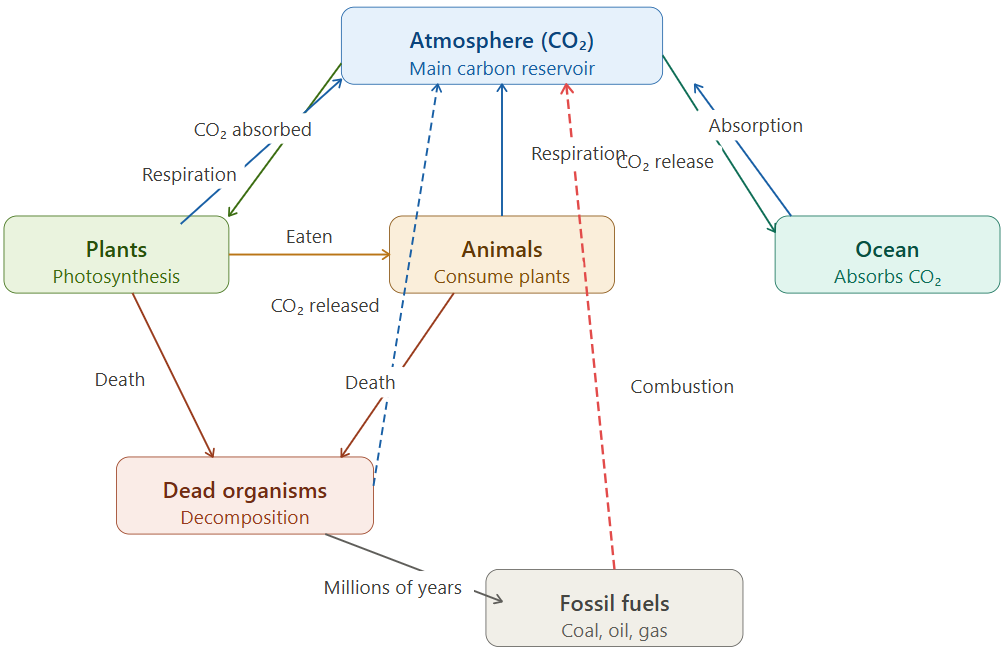
Conclusion:
Carbon moves between the atmosphere, plants, animals, oceans and fossil fuels through the carbon cycle. Human activities like burning fossil fuels have accelerated CO₂ release, disturbing this natural balance.
10. Why is an excess of CO₂ in the atmosphere considered undesirable even though it is required by plants?
Answer:
CO₂ is necessary because:
- Plants use CO₂ for photosynthesis to produce food and oxygen.
- A moderate amount of CO₂ acts as a greenhouse gas, keeping the Earth warm enough to support life.
But excess CO₂ is undesirable because:
1. Intensified Greenhouse Effect:
- Excess CO₂ traps more heat radiating from the Earth’s surface, causing global warming.
2. Melting of Glaciers:
- Rising temperatures melt Himalayan glaciers and polar ice, raising sea levels and threatening coastal cities like Mumbai and Chennai.
3. Extreme Weather:
- More CO₂ leads to intense monsoons, droughts and floods, disrupting agriculture and water supply.
4. Ocean Acidification:
- Excess CO₂ absorbed by oceans makes seawater more acidic, threatening coral reefs and marine life.
5. Habitat Loss:
- Global warming destroys ecosystems, causing biodiversity loss.
11. How is heat lost from the surface of the Earth? What is its significance?
Answer:
1. Re-radiation (Infrared Radiation):
- The Earth’s surface absorbs solar radiation and re-radiates it back into the atmosphere as infrared (heat) radiation.
- This is the primary way heat is lost from the surface.
2. Trapping by Greenhouse Gases:
- Greenhouse gases like CO₂, CH₄ and water vapour absorb some of this outgoing infrared radiation and prevent it from escaping into space.
- The remaining heat escapes into outer space.
3. Convection:
- Warm air near the Earth’s surface rises upward, carrying heat away from the surface into the atmosphere.
- This drives winds and weather patterns in the troposphere.
4. Evaporation:
- Water evaporates from oceans, rivers and lakes, absorbing heat from the surface and carrying it upward as water vapour.
Significance of Heat Loss:
- It maintains the energy balance of the Earth — energy received from the Sun equals energy lost.
- It drives winds, ocean currents and the water cycle.
- Greenhouse gases trapping some outgoing heat keeps Earth warm enough for life.
- Excess trapping due to increased CO₂ causes global warming, disrupting the climate.
12. If the Earth were a flat disc instead of a sphere, how would the patterns of solar radiation and temperature be different?
Answer:
On a Spherical Earth (Current Situation):
- Sun’s rays strike the equator directly (at 90°) and spread over a smaller area — so equatorial regions are warm.
- At the poles, rays strike at a low angle and spread over a larger area — so polar regions are cold.
- This uneven heating drives winds, ocean currents and seasons.
If Earth Were a Flat Disc:
1. Uniform Solar Radiation:
- Sun’s rays would strike the entire flat surface at the same angle.
- Solar radiation would be evenly distributed across the whole disc.
- There would be no difference between equatorial and polar regions in terms of sunlight received.
2. Uniform Temperature:
- Since all parts receive equal sunlight, the temperature would be the same everywhere on the disc.
- There would be no hot equatorial regions or cold polar regions.
3. No Seasons:
- Seasons occur due to the tilt of Earth’s spherical axis during revolution around the Sun.
- A flat disc would receive the same amount of sunlight throughout the year, so there would be no seasons.
4. No Winds or Ocean Currents:
- Winds and ocean currents are driven by uneven heating of the Earth’s surface.
- With uniform temperature everywhere, there would be no pressure differences, and therefore no winds or ocean currents.
5. No Weather Patterns:
- Without temperature differences and winds, there would be no weather phenomena like monsoons, storms or rainfall patterns as we know them.
6. Edge Effects:
- The edges of the disc would receive very little sunlight as rays would strike at extreme angles.
- These edge regions would be extremely cold.
13. Suppose there is a rise in atmospheric temperature on Earth. How would this affect the cryosphere, hydrosphere and biosphere?
Answer:
Effect on Cryosphere (Ice and Snow):
- Rising temperature would accelerate melting of Himalayan glaciers, polar ice caps and snow in regions like Ladakh.
- The cryosphere would shrink significantly over time.
- Permafrost (permanently frozen ground) would begin to thaw, releasing trapped methane — a powerful greenhouse gas.
Effect on Hydrosphere (Water Bodies):
- Melting glaciers would add more water to rivers, temporarily increasing their flow but eventually reducing it as glaciers disappear.
- Sea levels would rise, threatening low-lying coastal cities like Mumbai and Chennai with flooding.
- Warmer ocean water would increase evaporation, causing more intense rainfall in some areas and droughts in others.
- Ocean water would become more acidic as it absorbs excess CO₂, harming marine ecosystems.
Effect on Biosphere (Living Organisms):
- Rising temperatures would cause habitat loss for many species, leading to decline in biodiversity.
- Coral reefs would undergo bleaching and destruction due to warmer and more acidic oceans.
- Changes in rainfall patterns would threaten agriculture, affecting food security for millions.
- Many species unable to adapt to rapid temperature changes would face extinction.
- Coastal ecosystems like mangroves would be destroyed by rising sea levels.
14. Explain how the Earth’s atmosphere helps in maintaining a suitable temperature for life to survive on the Earth.
Answer: Two Key Roles of the Atmosphere:
1. Absorbing Harmful Radiation:
- The ozone layer in the stratosphere absorbs harmful UV rays from the Sun, protecting living organisms from skin cancer and eye damage.
- Clouds and gases absorb some sunlight before it reaches the surface, preventing overheating.
2. Trapping Outgoing Heat (Greenhouse Effect):
- The Earth’s surface absorbs solar radiation and re-radiates it as infrared heat back into the atmosphere.
- Greenhouse gases like CO₂, CH₄ and water vapour absorb this outgoing heat and prevent it from escaping into space.
- This keeps the Earth’s average temperature at about 15°C, warm enough to support life.
- Without this greenhouse effect, Earth would be too cold for life to survive.
Atmospheric Layers and Their Roles:
| Layer | Role in Temperature Regulation |
|---|---|
| Troposphere | Weather formation, heated from Earth’s surface |
| Stratosphere | Ozone layer absorbs harmful UV radiation |
Example from the Chapter:
- Venus has an uncontrolled greenhouse effect due to its thick CO₂ atmosphere, making it hotter than Mercury despite being farther from the Sun.
- Without any atmosphere, Earth would be like the Moon — extremely hot in sunlight and freezing cold in darkness.
15. Describe the interrelationship between different spheres of the Earth. Illustrate with example how these spheres function in a delicate balance.
Answer: The Five Spheres of Earth:
- Geosphere — solid rocks, soil and landforms
- Hydrosphere — oceans, rivers, lakes and groundwater
- Cryosphere — glaciers, ice caps and snow
- Atmosphere — the air surrounding Earth
- Biosphere — all living organisms and their habitats
How They Are Interrelated:
All five spheres constantly exchange energy and matter with each other. A change in one sphere triggers changes in others, showing they function as one interconnected Earth system.
Natural processes connecting the spheres:
- Solar radiation heats the atmosphere and surface (atmosphere ↔ geosphere).
- Water cycle connects hydrosphere, atmosphere, cryosphere and biosphere.
- Biogeochemical cycles (carbon, nitrogen, oxygen) link all spheres together.
- Winds and ocean currents transfer energy between atmosphere and hydrosphere.
Example — How Spheres Function in Delicate Balance:
Example 1: Monsoon System
- Warmer Arabian Sea water (hydrosphere) increases evaporation into the atmosphere.
- This drives the southwest monsoon, bringing rainfall to the geosphere (land and soil).
- Rainfall supports plant growth in the biosphere and recharges rivers and groundwater in the hydrosphere.
- A disturbance — like excess warming — brings floods to some regions and drought to others, disrupting all spheres.
Example 2: Deforestation
- Clearing forests (biosphere) reduces transpiration and photosynthesis.
- Less moisture enters the atmosphere, reducing local rainfall.
- Without tree roots, soil in the geosphere erodes more easily.
- More runoff reaches the hydrosphere, causing floods and reducing groundwater.
- Increased CO₂ (from less photosynthesis) warms the atmosphere, accelerating glacier melt in the cryosphere.
Example 3: Glacier Melting
- Rising atmospheric temperature (atmosphere) melts cryosphere glaciers.
- Meltwater raises sea levels in the hydrosphere.
- Coastal habitats in the biosphere are destroyed.
- Saltwater intrudes into coastal geosphere soils, making them infertile.
Interrelationship Diagram:
| Sphere | Connected To | Through |
|---|---|---|
| Atmosphere | Hydrosphere | Evaporation and rainfall |
| Cryosphere | Hydrosphere | Glacier meltwater |
| Geosphere | Biosphere | Soil nutrients |
| Biosphere | Atmosphere | Photosynthesis and respiration |
| Hydrosphere | Biosphere | Water for life |

Leave a Reply