Revise, Reflect, Refine
1. Differentiate between the following pairs of terms based on the clues given in parentheses:
(i) Cell membrane and cell wall (permeability)
(ii) RER and SER (structure)
(iii) Chloroplasts and chromoplasts (pigments)
Answer:
(i) Cell membrane and Cell wall (Permeability)
| Feature | Cell Membrane | Cell Wall |
|---|---|---|
| Permeability | Selectively permeable – allows some substances to pass and blocks others | Permeable – allows water and dissolved substances to pass freely |
| Nature | Thin and flexible | Rigid and strong |
| Function | Controls movement of materials in and out of the cell | Provides support and protection |
(ii) RER and SER (Structure)
| Feature | Rough Endoplasmic Reticulum (RER) | Smooth Endoplasmic Reticulum (SER) |
|---|---|---|
| Structure | Has ribosomes attached on its surface, so it looks rough | No ribosomes, so it looks smooth |
| Appearance | Rough and granular | Smooth and tubular |
(iii) Chloroplasts and Chromoplasts (Pigments)
| Feature | Chloroplasts | Chromoplasts |
|---|---|---|
| Pigment | Contain green pigment chlorophyll | Contain non-green pigments (yellow, orange, red) |
| Function | Help in photosynthesis | Give colour to fruits and flowers |
2. Two similar animal cells are placed in two different solutions:
Cell X is placed in pure water.
Cell Y is placed in a concentrated salt solution.
Cells are observed after some time. Cell X swells, and Cell Y shrinks. Which statement provides the correct explanation for the above observations?
(i) Salt molecules moved into Cell Y, causing it to shrink.
(ii) Water moved into Cell X and more water moved out of Cell Y than the salt solution entered in it.
(iii) Water moved into Cell X and moved out of Cell Y through the cell membrane.
(iv) Solute movement caused osmosis in both cells.
Answer: The correct statement is:
(iii) Water moved into Cell X and moved out of Cell Y through the cell membrane.
Explanation:
- In pure water (Cell X), the surrounding solution is hypotonic, so water enters the cell through osmosis, causing it to swell.
- In concentrated salt solution (Cell Y), the surrounding solution is hypertonic, so water moves out of the cell, causing it to shrink.
Osmosis is the movement of water across a selectively permeable membrane from a region of higher water concentration to lower water concentration.
3. Look at the diagram of a cell in Fig. 2.20. Identify the parts labelled from
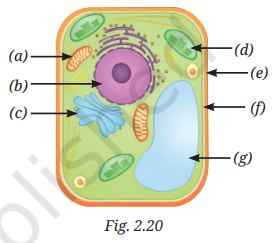
(a) to (g) and correctly match them with their functions given below:
(i) Controlling all the activities of a cell.
(ii) Site of cellular respiration.
(iii) Storage organelle that also provides rigidity to the cell.
(iv) Separates the cell contents from surroundings.
(v) Provides structural rigidity to the cell.
(vi) Packs and stores materials received from ER.
(vii) Helps in manufacturing food.
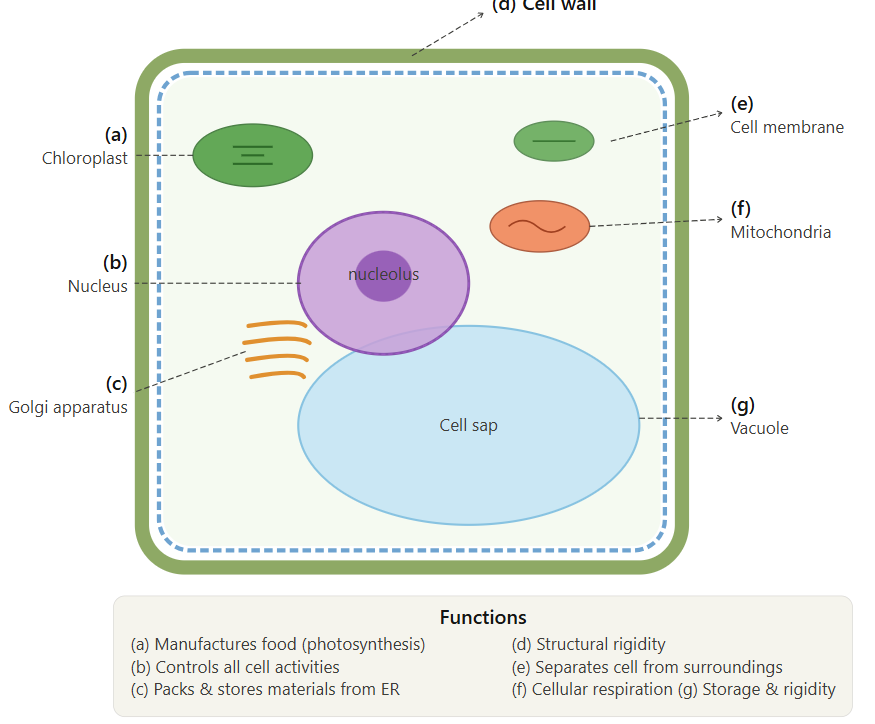
Answer: Identifying Parts (a) to (g) in Fig. 2.20
This is a plant cell diagram. Here is the identification and matching:
| Label | Organelle | Function |
|---|---|---|
| (a) | Chloroplast | (vii) Helps in manufacturing food (photosynthesis) |
| (b) | Nucleus | (i) Controlling all the activities of a cell |
| (c) | Golgi Apparatus | (vi) Packs and stores materials received from ER |
| (d) | Cell Wall | (v) Provides structural rigidity to the cell |
| (e) | Cell Membrane | (iv) Separates the cell contents from surroundings |
| (f) | Mitochondria | (ii) Site of cellular respiration |
| (g) | Vacuole | (iii) Storage organelle that also provides rigidity to the cell |
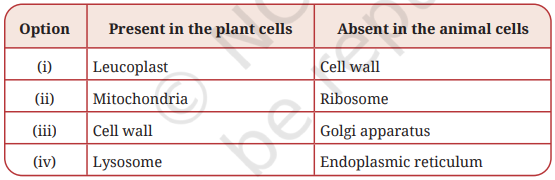
4. Which of the following option(s) of the pairs of cell organelles are correctly placed under the given categories?
Answer:
| Option | Present in Plant Cells | Absent in Animal Cells | Correct / Incorrect |
|---|---|---|---|
| (i) | Leucoplast | Cell wall | Correct |
| (ii) | Mitochondria | Ribosome | Incorrect |
| (iii) | Cell wall | Golgi apparatus | Incorrect |
| (iv) | Lysosome | Endoplasmic reticulum | Incorrect |
5. Two students, Renu and Rohit, were having a discussion on the plastids. Renu emphasised that all parts of the plants, even roots, contain plastids. However, Rohit did not agree with the statement and told her that plastids are absent in plant roots since the roots are underground and do not need to perform photosynthesis. Who is correct? Justify your answer.
Answer: Renu is correct.
Justification:
- Plastids are present in all plant cells, including roots.
- However, different types of plastids are found in different parts of the plant:
- Chloroplasts (green plastids) are present in leaves and perform photosynthesis.
- Leucoplasts (colourless plastids) are present in roots and help in storage of food like starch, oils, and proteins.
- Roots do not perform photosynthesis, so they do not contain chloroplasts, but they still contain plastids (leucoplasts).
Conclusion:
Renu is correct because plastids are present in roots, but in the form of leucoplasts, not chloroplasts.
6. Mitochondria and chloroplasts are two important organelles in a plant cell. Discuss how these two organelles are structurally and functionally similar to each other, and different from each other.
Answer:
Similarities between Mitochondria and Chloroplasts:
- Both are double membrane-bound organelles.
- Both have their own DNA and ribosomes, so they can make some of their own proteins.
- Both are involved in energy-related processes in the cell.
Differences between Mitochondria and Chloroplasts:
| Feature | Mitochondria | Chloroplasts |
|---|---|---|
| Function | Carry out cellular respiration and release energy (ATP) | Carry out photosynthesis and prepare food |
| Presence | Present in both plant and animal cells | Present only in plant cells |
| Pigment | Do not contain chlorophyll | Contain chlorophyll (green pigment) |
| Structure inside | Inner membrane forms cristae | Contains stroma and disc-shaped structures with chlorophyll |
Conclusion: Mitochondria and chloroplasts are similar in structure and energy-related roles, but differ in their functions—mitochondria release energy, while chloroplasts produce food using sunlight.
7. Which of the following pairs of cell organelles contains DNA?
(i) Chloroplasts, Ribosomes
(ii) Mitochondria, Nucleus
(iii) Golgi bodies, Ribosomes
(iv) Nucleus, Lysosomes
Answer: Correct option: (ii) Mitochondria, Nucleus
Explanation:
- The nucleus contains DNA in the form of chromosomes.
- Mitochondria also have their own DNA.
Why other options are incorrect:
(i) Ribosomes do not contain DNA
(iii) Golgi bodies and ribosomes do not contain DNA
(iv) Lysosomes do not contain DNA
8. A researcher carried out an experiment in which she took two carrots of similar size. She placed one carrot in plain water and the other carrot in concentrated salt solution (Fig. 2.21). After 24 hours she recorded her observations.
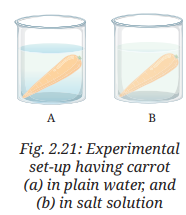
(i) What hypothesis does she want to test through this experiment?
Answer: The researcher wants to test that water moves in and out of cells through osmosis depending on the concentration of the surrounding solution.
(ii) What would you suggest for the improvement of this experiment?
Answer:
- Use carrots of equal size and weight for accurate comparison
- Measure and record the initial and final weight of carrots
- Keep all other conditions (time, temperature, amount of solution) constant
- Repeat the experiment to ensure reliable results
(iii) Why does the carrot in plain water stay stiff and crunchy, but the carrot in concentrated salt solution become rubbery and limp?
Answer:
- In plain water (hypotonic solution):
Water enters the carrot cells by osmosis, making the cells turgid (firm).
→ So, the carrot remains stiff and crunchy - In concentrated salt solution (hypertonic solution):
Water moves out of the carrot cells, causing them to lose water and shrink
→ So, the carrot becomes rubbery and limp
Conclusion: The experiment demonstrates osmosis, where water moves across a selectively permeable membrane based on concentration differences.
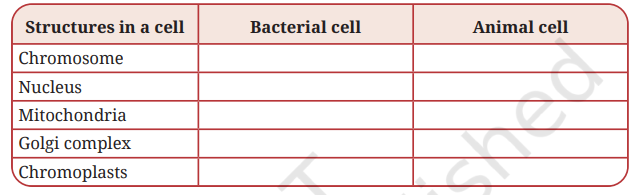
9. Indicate the presence or absence of following structures in bacterial and animal cells:
Answer:
| Structures in a cell | Bacterial cell | Animal cell |
|---|---|---|
| Chromosome | Present | Present |
| Nucleus | Absent | Present |
| Mitochondria | Absent | Present |
| Golgi complex | Absent | Present |
| Chromoplasts | Absent | Absent |
10. Carry out the following experiment:
Take four peeled potato halves and scoop each one out to make potato cups. One of these potato cups should be made from a boiled potato. Place each of the potato cups in a beaker containing water (Fig. 2.22). Now, set up the experiment as follows:
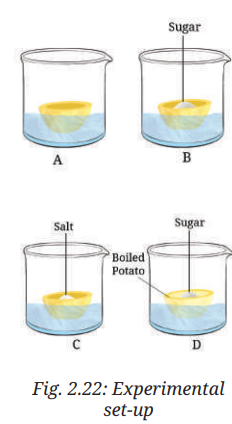
(a) Keep Cup A empty.
(b) Add one teaspoon sugar in Cup B.
(c) Add one teaspoon salt in Cup C.
(d) Add one teaspoon sugar in the boiled potato in Cup D.
Observe the four potato cups at least two hours and answer the following questions:
(i) Explain why water gathers in the hollowed portion of Cup B and Cup C.
Answer: Water gathers in Cup B (sugar) and Cup C (salt) due to osmosis.
- The solution inside the potato cup (sugar/salt) is more concentrated than the surrounding water.
- The potato tissue acts as a semi-permeable membrane.
- So, water moves from the outside (higher water concentration) to the inside (lower water concentration).
This movement of water causes water to collect in the hollow space.
(ii) Why is Cup A necessary for this experiment?
Answer: Cup A is the control setup.
- It contains no sugar or salt, so no concentration difference is created.
- It helps us compare and prove that water movement in other cups is due to osmosis.
Without Cup A, we cannot confirm the reason for water movement.
(iii) Explain why water does not gather in the hollowed portions of Cups A and D.
Answer:
- Cup A:
- No solute (sugar/salt), so no concentration difference → no osmosis → no water collection.
- Cup D (boiled potato):
- Boiling destroys the semi-permeable membrane of potato cells.
- Without this membrane, osmosis cannot occur.
Therefore, water does not collect in Cup D.
11. Identify the pair that incorrectly matches the cell organelle with its function.
(i) Ribosome — Protein synthesis
(ii) SER — Lipid and cellulose synthesis
(iii) Lysosome — Digestion of foreign agents
Answer:
(i) Ribosome — Protein synthesis (Correct)
Ribosomes are the sites of protein synthesis in the cell.
(ii) SER — Lipid and cellulose synthesis (Incorrect)
Smooth Endoplasmic Reticulum (SER) helps in lipid and hormone synthesis, not cellulose synthesis.
Cellulose is produced in plant cells, not by SER.
(iii) Lysosome — Digestion of foreign agents (Correct)
Lysosomes contain enzymes that digest waste materials and foreign substances.
12. What outcome do you expect, if all the mitochondria are removed from a eukaryotic cell?
Answer: Mitochondria are called the “powerhouses of the cell” because they produce energy (ATP) needed for all cellular activities.
If all mitochondria are removed:
- The cell will not be able to produce energy (ATP).
- All life processes like movement, growth, and repair will stop.
- Ultimately, the cell will die due to lack of energy.
13. Which phenomenon inhibits the formation of tumors in the human body? Can plants also develop tumors? Explain.
Answer:
(a) Phenomenon that inhibits tumors:
- The phenomenon is contact inhibition.
- In this process, cells stop dividing when they come in contact with neighboring cells, preventing uncontrolled growth.
(b) Can plants also develop tumors?
- Yes, plants can develop tumors, but they are different from animal tumors.
- Plant cells do not show contact inhibition due to their rigid cell wall.
- As a result, abnormal growth can occur, forming tumor-like structures (e.g., plant galls).
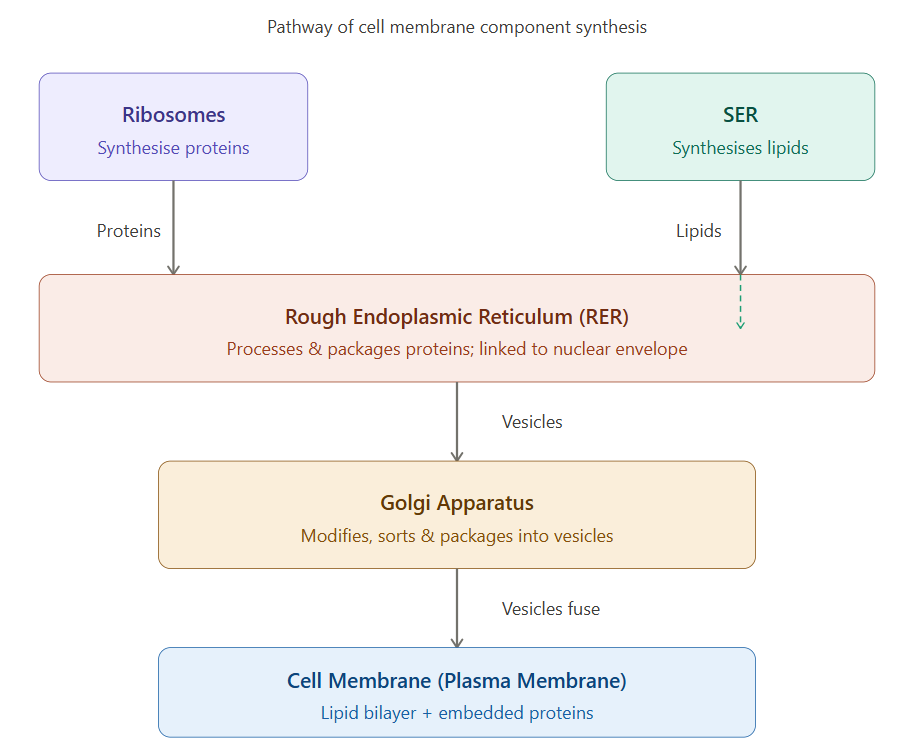
14. The cell membrane of a cell is made up of proteins and lipids. Which cell organelles help in the synthesis of cell membrane? Write the path of these compounds from their site of synthesis to the cell membrane and show this through a labelled diagram.
Answer:
1. Ribosomes — synthesise proteins (the membrane proteins)
2. Rough Endoplasmic Reticulum (RER) — has ribosomes on its surface; involved in protein synthesis and processing
3. Smooth Endoplasmic Reticulum (SER) — involved in the synthesis and storage of lipids (fats)
4. Golgi Apparatus — modifies, sorts, and packages both proteins and lipids into vesicles and sends them to the cell membrane
15. What would happen if gametes are formed by mitotic divisions?
Answer: If gametes are formed by mitosis, they will have the same number of chromosomes as body cells. After fertilisation, the chromosome number will double, leading to imbalance and abnormal development.
- Mitosis produces cells with the same number of chromosomes as the parent cell.
- Normally, gametes are formed by meiosis, which reduces the chromosome number to half.
16. A farmer, Deepa, was very happy with the harvest of amla (Indian Gooseberry) and lemons on her farm. However, she could sell only onefourth of the produce in the local market. Recognising that a significant amount of produce may be lost post-harvest, she employed a traditional yet scientifically sound method to extend the shelf life of amla and lemons. She turned perishable produce into profitable products, such as pickles and sharbat. She used the excess produce to prepare pickles, murabbas, and sharbat by adding appropriate amounts of salt, sugar, or jaggery to small pieces of fruit and their juices. These were then stored in small glass bottles for sale, helping her prevent the wastage of post-harvest produce. This shift from farming to agro-processing would strengthen food security and boost the local economy, creating a sustainable model that cuts waste while increasing her income. Based on the above passage answer the following questions:
(i) Which scientific concept has the farmer applied in the preservation of the farm produce?
Answer: Scientific concept applied: Deepa applied the concept of osmosis. By adding high concentrations of salt, sugar, or jaggery, she created a hypertonic solution around the microorganisms, causing them to lose water and die, thus preserving the food.
(ii) How does the addition of high concentrations of salt and sugar create an environment that prevents the growth of spoilage-causing bacteria and fungi?
Answer: When bacteria or fungi are placed in a high-concentration salt or sugar solution, the external solute concentration is much greater than inside their cells (hypertonic condition). Water moves out of the microbial cells through osmosis, causing them to shrink and die. Without water, microorganisms cannot grow or reproduce, preventing spoilage.
(iii) Suggest a healthy recipe of this kind for food preservation.
Answer:
- Wash and prick amla fruits with a fork
- Boil briefly, then soak in jaggery syrup for 2–3 days
- Store in clean glass jars
This preserves Vitamin C content of amla while extending shelf life naturally without artificial preservatives.
(iv) What are the scientific values addressed in this case?
- Observation and application — applying osmosis knowledge practically
- Sustainability — reducing food waste
- Innovation — converting perishables into value-added products
- Food security — making nutrition available beyond harvest season
- Economic thinking — boosting income through science-based solutions

Leave a Reply