Revise, Reflect, Refine
1. State whether True or False.
(i) Work is said to be done when a force is applied, even if the object does not move.
(ii) Lifting a bucket vertically upward results in positive work done on the bucket.
(iii) The SI unit for both work and energy is joule (J).
(iv) A motionless stretched rubber band has kinetic energy.
(v) Energy can change from one form to another.
Answer:
(i) False — Work is done only when a force is applied AND the object is displaced. If there is no displacement, no work is done.
(ii) True — When lifting a bucket upward, the force applied and displacement are in the same direction, so work done is positive.
(iii) True — The SI unit of both work and energy is joule (J).
(iv) False — A motionless stretched rubber band has potential energy (elastic potential energy), not kinetic energy. Kinetic energy requires motion.
(v) True — Energy can change from one form to another, for example electrical energy converts to light energy in a bulb.
2. Fill in the blanks.
(i) Work done = ______ × ______ (in the direction of force).
(ii) 1 joule of work is done when a force of ______ newton displaces an object by 1 metre in the direction of the force.
(iii) The expression for kinetic energy of a body of mass m and velocity v is ______.
(iv) The potential energy of an object of mass m at a small height h from the Earth’s surface is ______.
(v) Power is defined as the ______ at which work is done.
Answer:
(i) Force × Displacement
(ii) 1
(iii)
(iv) mgh
(v) rate
3. When a ball thrown upwards reaches its highest point, tick which of the following statement(s) are correct?
(i) The force acting on the ball is zero.
(ii) The acceleration of the ball is zero.
(iii) Its kinetic energy is zero.
(iv) Its potential energy is maximum.
Answer:
Correct statements:
- (iii) Its kinetic energy is zero.
- (iv) Its potential energy is maximum.
Incorrect statements:
- (i) The force acting on the ball is zero. (False — gravity still acts.)
- (ii) The acceleration of the ball is zero. (False — gravity gives constant acceleration downward.)
4. For each of the following situations, identify the energy transformation that takes place: (i) a truck moving uphill, (ii) unwinding of a watch spring, (iii) photosynthesis in green leaves, (iv) water flowing from a dam, (v) burning of a matchstick, (vi) explosion of a fire cracker, (vii) speaking into a microphone, (viii) a glowing electric bulb, and (ix) a solar panel.
Answer:
(i) Truck moving uphill:
(ii) Unwinding of a watch spring:
(iii) Photosynthesis in green leaves:
(iv) Water flowing from a dam:
(v) Burning of a matchstick:
(vi) Explosion of a fire cracker:
(vii) Speaking into a microphone:
(viii) A glowing electric bulb:
(ix) A solar panel:
5. A student is slowly lifted straight up in an elevator from the ground level to the top floor of a building. Later, the same student climbs the staircase, all the way to the top. Given that the height of the building is h = 72.5 m, acceleration due to gravity is, , and student’s mass is m = 50 kg.
(i) Find the gain in the potential energy if the student is lifted straight up to the top.
Answer:
(ii) Find the gain in the potential energy when the student climbs the stairs to the same top.
Answer: The final height is the same (72.5 m), so:
(iii) What do you conclude about the dependence of the potential energy on the path taken?
Answer: The gain in potential energy is exactly the same in both cases because:
Conclusion:
6. A crane lifts a mass m to the 10th floor of a building in a certain time. It then raises the same mass to the 20th floor of the same building in double the time. How much more energy and power are required? Assume that the height of all floors is equal.
Answer:
Let height of each floor = x metres
- Height of 10th floor = 10x
- Height of 20th floor = 20x
Energy Required:
Energy to 10th floor:
Energy to 20th floor:
The crane requires twice the energy to lift the mass to the 20th floor.
Power Required:
Let time to reach 10th floor = t, then time to reach 20th floor = 2t
The power required remains the same in both cases.
7. Which factors determine the energy required to raise a flag from the ground to the top of a tall flagpole using a pulley? Does raising the flag slowly or quickly change the amount of work done? If the speed at which the flag is raised is doubled, how does the power requirement change? Explain your answers.
Answer: Factors determining energy to raise a flag:
Using the formula:
The energy depends only on:
- Mass (m) of the flag
- Gravitational acceleration (g)
- Height (h) of the flagpole
Does speed affect work done?
No. Raising the flag slowly or quickly does not change the work done, since:
Work depends only on height, not on the speed or time taken.
Effect of doubling the speed on Power:
If speed is doubled, the same work is done in half the time. Since:
If time is halved, power is doubled.
So doubling the speed of raising the flag doubles the power requirement, even though the work done remains the same.
8. A man of mass 60 kg rides a scooter of mass 100 kg. He accelerates the scooter to a velocity v. The next day, his son with a mass of 40 kg joins him as a passenger. If the scooter reaches the same speed on both days in the same time interval, what is the ratio of the fuel of the tank used on the two days? Assume that the energy transfer to the scooter happens entirely due to fuel, and no other losses occur due to air resistance and friction.
Answer: Given:
- Mass of man = 60 kg
- Mass of scooter = 100 kg
- Mass of son = 40 kg
- Same velocity v reached on both days
- Same time interval on both days
Day 1 — Man alone on scooter:
Total mass = 60 + 100 = 160 kg
Kinetic energy (fuel used):
Day 2 — Man and son on scooter:
Total mass = 60 + 40 + 100 = 200 kg
Kinetic energy (fuel used):
Ratio of fuel used:
Conclusion: On the second day (with son as passenger), the scooter consumes more fuel because the total mass is greater, requiring more kinetic energy to reach the same velocity. The ratio of fuel used on Day 1 to Day 2 is 4:5.
9. On a seesaw with sliding seats, a child is sitting on one side and an adult on the other side. The adult weighs twice that of the child. The seesaw however is balanced. Draw a figure which depicts this situation showing the distances from the fulcrum where the child and the adult are seated.
Answer: Given:
- Let mass of child = m
- Mass of adult = 2m (twice the child)
- Seesaw is balanced
Using the lever balance condition:
This means the child must sit twice as far from the fulcrum as the adult.
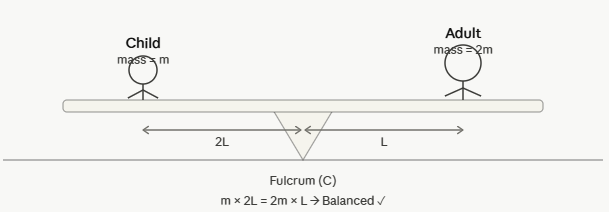
For example, if adult sits 1 m from fulcrum, child must sit 2 m from fulcrum on the other side.
Answer: Given:
- Mass of ball: m = 2 kg
- Initial velocity: u = 20 m s⁻¹
- Maximum height reached: h = 19.4 m
- g = 10 m s⁻²
(i) Sign of work done by gravity:
During Upward Motion:
The ball moves upward but gravity acts downward — opposite directions.
During Downward Motion:
The ball moves downward and gravity also acts downward — same direction.
(ii) Work done by air resistance:
Initial Kinetic Energy at ground:
Potential Energy gained at maximum height:
Final Kinetic Energy at maximum height:
Using Work-Energy Theorem:
Answer:
Given:
- Mass of block: m = 10.0 kg
- Initial Kinetic Energy at 0 m: K₁ = 180 J
- Friction: negligible
(i) Speed at 0 m:
Using kinetic energy formula:
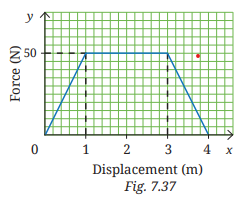
Finding Work Done by variable force (area under graph):
From Fig. 7.37, the force-displacement graph has three regions:
Region 1 (0 to 1 m): Triangle
Region 2 (1 to 3 m): Rectangle
Region 3 (3 to 4 m): Triangle (force decreases to zero)
Total Work Done:
(ii) Speed at 4 m:
Using Work-Energy Theorem:
Now finding speed:
12. The gravitational attraction on the surface of the Moon (lunar surface) is about 1/6 th of that on the surface of the Earth. An astronaut can throw a ball up to a height of 8 m from the surface of the Earth. How far up will the ball thrown with the same upward velocity travel from the surface of the Moon?
Answer: Given:
- Height reached on Earth: h_Earth = 8 m
- Gravitational acceleration on Moon: g_Moon = g/6
- Same initial velocity on both Earth and Moon
Key Concept:
Using conservation of energy, when a ball is thrown upward, all kinetic energy converts to potential energy at maximum height:
For Earth:
For Moon:
Dividing equation (2) by equation (1):
Answer: Given:
- Mass of car: m = 1000 kg
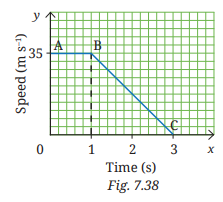
- From graph: Speed at A and B = 35 m s⁻¹
- Speed at C = 0 m s⁻¹
- A to B: t = 0 to 1 s (constant speed)
- B to C: t = 1 to 3 s (speed decreases to zero)
(i) How the car moves between A and B:
Between positions A and B (from t = 0 to t = 1 s), the speed remains constant at 35 m s⁻¹. This is the reaction time of the driver — the time between spotting the obstruction and actually applying the brakes. During this period:
- No brakes are applied
- Speed does not change
- The car moves with uniform velocity
- Acceleration = zero
(ii) Kinetic Energy of car at A:
At point A, speed v = 35 m s⁻¹
(iii) Work done by brakes between B and C:
At point B: Kinetic energy = 612500 J (same as A, since speed is still 35 m s⁻¹)
At point C: Kinetic energy = 0 J (car comes to rest)
Using Work-Energy Theorem:
The work done by brakes is negative because the braking force acts opposite to the direction of motion.
(iv) What does kinetic energy transform into?
When brakes are applied, the kinetic energy of the car is transformed into:
- Heat Energy — due to friction between the brake pads and wheels, both the brakes and tyres become hot
- Sound Energy — the screeching sound produced during braking
14. The potential energy-displacement graph of a 0.5 kg ball moving along a frictionless track is shown in Fig. 7.39. At O, the velocity of the ball is 0 m s–1 and potential energy is 30 J. Calculate the velocity of the ball at P, Q and R.
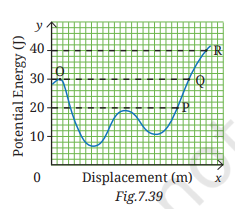
Answer: But can the ball reach R?
Total mechanical energy = 30 J.
At R, the potential energy shown is 40 J, which is greater than the total energy.
➡️ This means the ball cannot reach point R.
Its energy is not enough to climb that high.
So:
Step 2: Velocities at P and Q
At P:
At Q:
So:
(The ball momentarily comes to rest at Q.)
15. A coconut of mass 1.5 kg falls from the top of a coconut tree onto the wet sand on a beach. The height of the tree is 10 m. On impact, the coconut comes to rest by making a depression in the sand.
(i) Calculate the velocity of the coconut just before it hits the sand.
(ii) Assume that the average resistive force of sand is 3000 N and all of the coconut’s energy is used to create the depression in the sand. Calculate the depth of the depression the coconut makes in the sand. Assume g = 10 m s2.
Answer: Given:
- Mass of coconut,
- Height of tree,
- Resistive force of sand =
(i) Velocity of the coconut just before it hits the sand
Answer: When the coconut falls freely, gravitational potential energy converts into kinetic energy:
Cancel :
(ii) Depth of depression made in the sand
Answer: The coconut’s kinetic energy is used up in doing work against the sand.
Step 1: Kinetic energy just before impact
Step 2: Work done on sand
Work done to create depression:
All kinetic energy is spent in doing this work, so:

Leave a Reply