The Story of Indian Farming
Questions and activities
1. Why do farmers in Kerala grow rice while farmers in Punjab grow mostly wheat? What would happen if they swapped?
Answer: Kerala receives heavy rainfall from both the southwest and northeast monsoons and has tropical wet climate and suitable soil for rice. Rice needs a lot of water, so it grows well there. Punjab has fertile alluvial soil and a cooler winter season, which is ideal for wheat (a rabi crop).
If they swapped, the crops might not grow well because climate, soil, and water availability are different in both regions. Wheat may not grow properly in Kerala’s hot and wet conditions, and rice may not grow easily in Punjab without enough water.
2. Match the following:
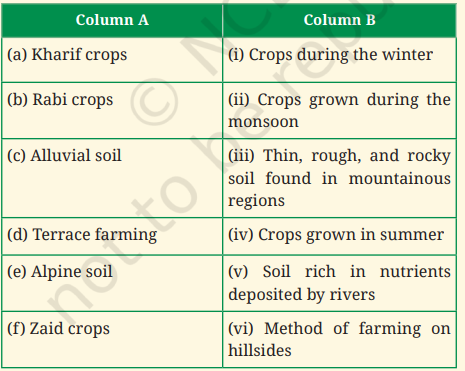
Answer:
| Column A | Column B |
| (a) Kharif crops | (ii) Crops grown during the monsoon |
| (b) Rabi crop | (i) Crops during the winter |
| (c) Alluvial soil | (v) Soil rich in nutrients deposited by rivers |
| (d) Terrace farming | (vi) Method of farming on hillsides |
| (e) Alpine soil | (iii) Thin, rough, and rocky soil found in mountainous regions |
| (f) Zaid crops | (iv) Crops grown in summer |
3. Why do certain crops thrive in specific regions?
Answer: Certain crops grow well in specific regions because of differences in climate, soil type, rainfall, temperature, and availability of water. For example, black soil is good for cotton, and alluvial soil is good for wheat and rice. Crops grow best where the natural conditions suit their needs.
4. How has modern technology helped farmers?
Answer: Modern technology has helped farmers by:
- Introducing high-yielding variety (HYV) seeds.
- Using tractors, harvesters, and threshing machines.
- Providing drip and sprinkler irrigation to save water.
- Offering weather forecasts and crop insurance schemes.
- Using greenhouses and even hydroponics.
These methods increase crop production and reduce hard labour.
5. Why is sustainable agriculture important? Write a short note on this.
Answer: Sustainable agriculture is important because it protects soil, water, and the environment while producing enough food. Modern farming methods increased production but also caused soil damage, water pollution, and health problems. Sustainable farming combines traditional wisdom with modern science. It uses organic manure, neem-based pesticides, and natural methods. This helps farmers grow crops without harming nature and ensures food for future generations.
6. Name some challenges that farmers face today. What might be their impact on people?
Answer:
Challenges faced by farmers:
- Small and decreasing landholdings.
- Climate change and unpredictable rainfall.
- High cost of machines and seeds.
- Soil degradation and falling groundwater levels.
Impact on people:
- Lower crop production.
- Increase in food prices.
- Financial problems for farmers.
- Possible food shortages.
7. Have a debate in class on the topic “Traditional irrigation methods are better than modern ones.”
Answer:
Points in favour of traditional methods:
- Use natural resources wisely.
- Cost less and are eco-friendly.
- Community-based systems like phad and bamboo drip irrigation.
Points in favour of modern methods:
- Drip and sprinkler irrigation save more water.
- Increase crop yield.
- Useful in areas with less rainfall.
Conclusion: Both methods have advantages. A balance between traditional and modern systems is best.
8. Write a short essay describing what farming might be like when you are 60 years old. You could also draw / paint a picture to illustrate what you envision.
Answer: When I am 60 years old, farming may be more advanced and eco-friendly. Farmers may use drones to check crops and soil moisture. Hydroponics and greenhouse farming may become common. Water-saving methods like drip irrigation will be widely used.
At the same time, people may return to organic farming to protect soil and health. Machines will be smaller and suitable for small farms. Climate-friendly crops may be grown. Farming will combine technology and traditional knowledge to protect nature and produce healthy food.
9. Form small groups and discuss the issues affecting the Ganga basin. Prepare a presentation proposing your solutions and their rationale (your reasons). Share and discuss in class. Your teacher will guide you in this exercise.
Answer:
Issues:
- Water pollution from chemicals and fertilisers.
- Soil erosion.
- Overuse of groundwater.
- Floods and droughts.
Solutions:
- Promote organic farming to reduce pollution.
- Use drip irrigation to save water.
- Plant more trees to prevent soil erosion.
- Treat industrial waste before releasing it into rivers.
Reason: These steps will protect water quality, improve soil health, and support farmers and people living in the region.
10. Looking at the crops listed in the section ‘Echoes from the Past’, which ones do you find in use in your home? What conclusion can you draw from your observations?
Answer: Crops mentioned include rice, wheat, barley, millets, sesame, pulses, cotton, fruits like mango and dates. Many of these such as rice, wheat, pulses, mustard, and mango are still used in our homes today.
Conclusion: Indian agriculture has a long history. Many crops grown in ancient times are still important today. This shows the continuity and strength of India’s farming traditions.

Shortest answer