India and Her Neighbours
Questions and activities
1. Explain who a maritime neighbour is with two examples with respect to India.
Answer: A maritime neighbour is a country that is connected to another country by a shared sea or ocean, even if they do not share a land border. The sea acts as a link for trade, culture and cooperation.
With respect to India, two maritime neighbours are:
- Sri Lanka – separated from India by the Palk Strait.
- Maldives – located close to Lakshadweep in the Indian Ocean.
2. How has Buddhism created links with India’s neighbours? Give examples to explain your answer.
Answer: Buddhism began in India and spread to many neighbouring countries through monks, traders and pilgrims.
- It spread to China, where Chinese monks like Faxian and Xuanzang came to India to study.
- It was taken to Sri Lanka in the 3rd century BCE by Mahendra and Sanghamitra.
- In Bhutan, Vajrayana Buddhism became important.
- In Myanmar and Thailand, Theravada Buddhism is widely practised.
Thus, Buddhism created strong spiritual and cultural bonds between India and her neighbours.
3. What does ‘open border’ policy mean? How does the India–Nepal ‘open border’ policy affect the lives of people living along the border?
Answer: An open border policy means people can cross the border without a passport or visa.
India and Nepal share an open border under the 1950 Treaty of Peace and Friendship.
This policy helps people by:
- Allowing free movement for work and education.
- Helping families stay connected.
- Encouraging trade in border towns.
- Making access to healthcare easier.
Daily life in border areas shows close cooperation and friendship.
4. The chapter says, “Being neighbours is not just about geography.” Explain this statement with an example.
Answer: Being neighbours is not only about sharing borders but also about sharing culture, history and cooperation.
For example, India and Bhutan share strong ties in hydropower projects, trade and Buddhism. Even when countries face challenges, they help each other.
Thus, neighbourhood also means friendship, trust and shared progress.
5. What are the different ways in which India has helped smaller countries in her neighbourhood? Explain with examples.
Answer: India has helped neighbouring countries in many ways:
- Built the Parliament building and Zaranj-Delaram highway in Afghanistan.
- Supported hydroelectric projects in Bhutan.
- Gave quick help to Maldives during the 2004 tsunami, 2014 water crisis and COVID-19.
- Helped restore temples like the Ananda Temple in Myanmar.
India also provides trade support, disaster relief and development assistance.
6. How do shared challenges become opportunities for cooperation? Were there examples in this chapter to illustrate this?
Answer: Shared challenges such as climate change, natural disasters and border security encourage countries to work together.
Examples:
- India and Bangladesh cooperate to protect the Sundarbans and manage rivers.
- India helped the Maldives during natural disasters.
- Regional groups like South Asian Association for Regional Cooperation (SAARC) promote cooperation in education, health and development.
Thus, problems can become opportunities for partnership.
7. If borders were drawn only by culture and connections, how would the map look different?
Answer: If borders were drawn by culture:
- India and Nepal might appear as one cultural region because of shared festivals and religion.
- Parts of Sri Lanka and Tamil Nadu might be closely linked due to Tamil culture.
- Countries like Thailand and Indonesia would show strong links with India because of shared Hindu and Buddhist traditions.
The map would show cultural zones instead of strict political borders.
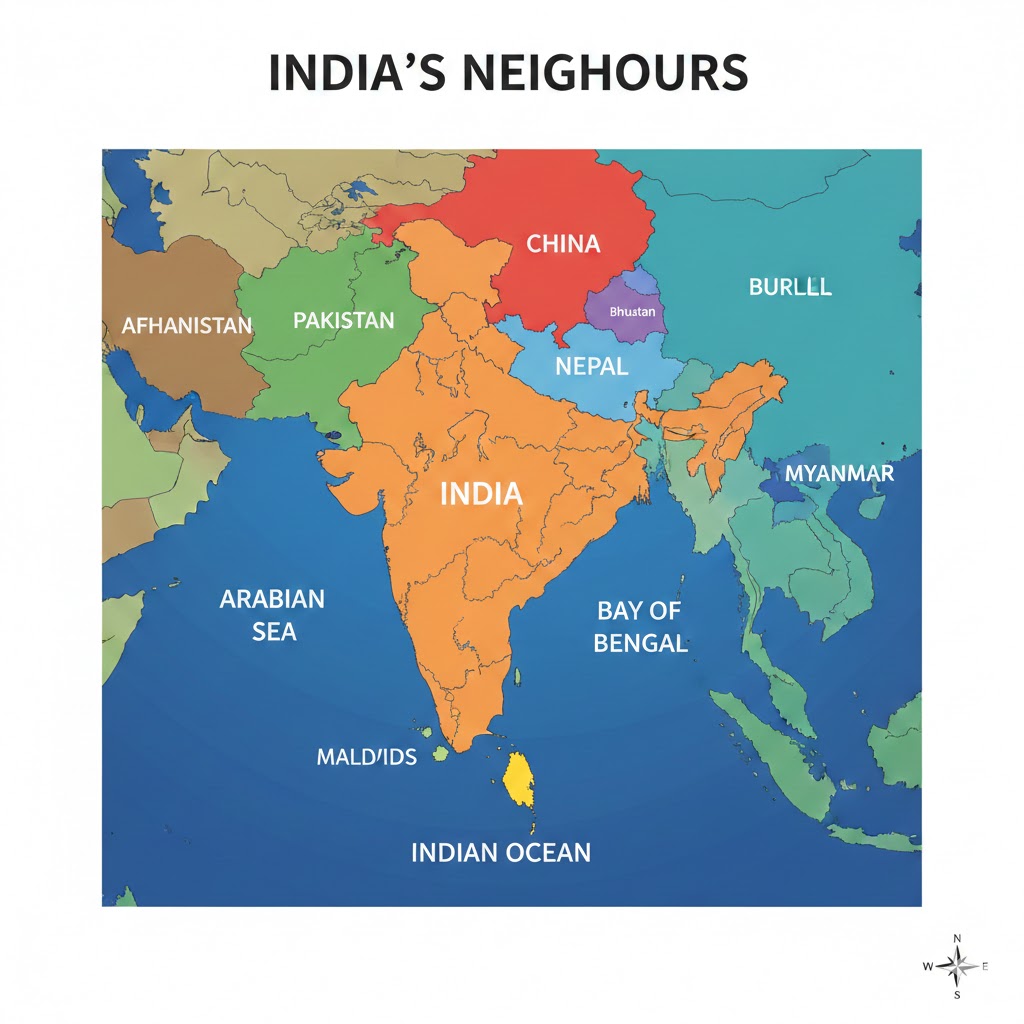
8. On blank maps:
(i) Label India’s neighbours.

Leave a Reply