Turning Tides: 11th and 12th Centuries
Questions and activities
1. Why is the period under consideration in this chapter regarded as a major transition in Indian history? Give two examples each of change and continuity from this period.
Answer: The 11th and 12th centuries are seen as a major transition because they marked the beginning of Turkic invasions and the establishment of foreign rule in parts of north India, which changed the political structure of the region.
Examples of Change:
- Establishment of foreign rule in north India after the victories of Muhammad Ghūrī, leading to the foundation of the Delhi Sultanate.
- Destruction of temples and centres of learning such as Nālandā Mahāvihāra by Bakhtiyār Khiljī, which affected Buddhist education.
Examples of Continuity:
- Flourishing of regional kingdoms like the Cholas and Hoysalas in south India.
- Continued growth of trade, art, literature and temple architecture, such as the construction of the Bṛihadīśhvara Temple.
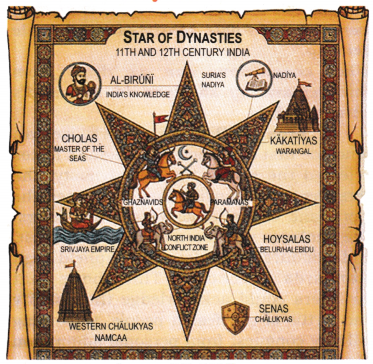
2. Observe Fig. 3.27 in the previous chapter and draw a similar ‘star of dynasties’ gathering all or most of the dynasties that appear in this chapter.
Answer:
3. Taking a map of the Subcontinent, draw a geographical tour that covers all or most dynasties in this chapter (you may draw inspiration from some of the ‘travels’ the chapter’s narration follows).
Answer: A possible tour on the map:
- Start from Afghanistan – Ghaznavids (Ghazni)
- Enter Punjab – Hindu Shāhis
- Move to Rajasthan – Chāhamānas (Ajmer, Delhi)
- Travel to Malwa – Paramāras (Dhar)
- Go east to Bengal – Senas
- Move to Odisha – Eastern Gangas
- Travel south to Telangana – Kākatīyas (Warangal)
- Move to Karnataka – Hoysalas (Belur, Halebidu)
- End in Tamil Nadu – Cholas (Thanjavur, Gangaikoṇḍacholapuram)
4. With the help of a map of India and Southeast Asia, can you calculate the approximate distance that Rājendra I’s fleet of ships had to navigate to reach their objective?
Answer: Rājendra Chola I sent his fleet from the Tamil coast to the Śhrīvijaya Empire (around present-day Malaysia/Indonesia).
Approximate distance from Tamil Nadu to the Strait of Malacca:
About 2,500–3,000 kilometres by sea.
5. Match these two pairs:
(a) Eastern Gangas (i) Belur
(b) Chandellas (ii) Bṛihadīśhvara temple
(c) Paramāras (iii) Konark Sun temple
(d) Hoysalas (iv) Kandāriyā Mahādeva temple
(e) Cholas (v) Bhojeshwar temple
Answer:
(a) Eastern Gangas → (iii) Konark Sun temple
(b) Chandellas → (iv) Kandāriyā Mahādeva temple
(c) Paramāras → (v) Bhojeshwar temple
(d) Hoysalas → (i) Belur
(e) Cholas → (ii) Bṛihadīśhvara temple
6. Working in groups, compare the dynasties in this chapter and in the preceding one; create a table to list the dynasties present in both, those that disappear from the preceding period, and those that appear in this chapter’s period.
Answer:
| Dynasties in Both Chapters | Disappear | Appear in This Chapter |
|---|---|---|
| Cholas | Gurjara-Pratīhāras | Ghaznavids |
| Western Chālukyas | Pālas (decline) | Ghūrids |
| Eastern Chālukyas | Rashtrakutas | Kākatīyas |
| Hoysalas | ||
| Senas |
7. Using the chapter and any additional reading, prepare a short note explaining (1) why centres of learning like Nālandā were important; (2) how their destruction may have affected education and culture in India.
Answer: Nālandā Mahāvihāra was one of the world’s earliest great universities. It:
- Attracted students from India, China, Tibet and Southeast Asia.
- Had vast libraries containing thousands of manuscripts.
- Was a centre for Buddhist philosophy, medicine, astronomy and grammar.
Its destruction by Bakhtiyār Khiljī led to:
- Loss of precious manuscripts.
- Decline of Buddhist education in India.
- Weakening of India’s international reputation as a centre of learning.
8. Why do you think Mahmūd of Ghazni carry out repeated raids from Afghanistan into India, while Muhammad Ghūrī sought territorial expansion into India and long-term control? Write a short note on how their motives shaped the outcomes of their campaigns.
Answer: Mahmūd of Ghazni carried out repeated raids into India mainly for plunder, wealth and religious prestige. Indian temples and cities were very rich, and the booty helped him strengthen his empire in Central Asia. He did not attempt to establish permanent rule in India. After each campaign, he returned to Ghazni with treasure, prisoners and war booty. As a result, his invasions caused destruction but did not lead to long-term political control over most of India.
On the other hand, Muhammad Ghūrī aimed at territorial expansion and permanent political control. After defeating Indian rulers such as Prithviraj Chauhan, he captured Delhi and left his generals to govern the conquered areas. Instead of merely looting and returning, he laid the foundation of foreign rule in north India. This ultimately led to the establishment of the Delhi Sultanate.
Conclusion: Mahmūd’s motive of plunder resulted in temporary raids and destruction, while Muhammad Ghūrī’s motive of expansion resulted in lasting political change and the beginning of a new phase in Indian history.

Leave a Reply