1. Introduction to India’s Urban Landscape
India has a rich urban heritage. Many cities developed in ancient times and continue to flourish today.
Examples of ancient and historical cities include:
- Harappan cities: Dholavira, Kalibangan and Rakhigarhi.
- Historical cities: Vijayanagara, Varanasi and Ujjain.
Meaning of a City
A city is a large human settlement where many people live and engage in different economic and social activities.
The main features of cities are:
- A high concentration of population.
- Different types of businesses and occupations.
- Government and administrative institutions.
- Developed transportation and communication systems.
- Infrastructure and public amenities.
- Elected local bodies responsible for local development.
Difference Between Urban and Rural Areas
| Urban Areas | Rural Areas |
|---|---|
| Include towns and cities. | Mainly consist of villages. |
| Generally have larger populations. | Generally have smaller populations. |
| Have diverse businesses and occupations. | Have more agriculture-based occupations. |
| Usually have developed transport and communication systems. | Generally have less developed transport and communication systems. |
| Have elected local bodies responsible for urban development. | Are governed by Gram Panchayats. |
The definition of an urban area differs from country to country. The chapter gives the following examples of population thresholds:
- Denmark: more than 220 people.
- Japan: 50,000 people.
- India: 5,000 people.
2. Population Density in Cities
Meaning of Population Density
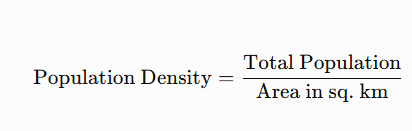
Population density refers to the number of people living in a particular unit of area. It helps us understand whether a place is densely or sparsely populated.
Population density is usually expressed as the number of people per square kilometre.
Formula:
Demographers
Demographers are experts who study the characteristics of populations, such as population size, age structure and geographical distribution.
Population Density in Rural and Urban Areas
- Rural areas generally have more open spaces and fewer densely built-up areas.
- Cities often have many buildings, roads, businesses and other structures concentrated in a smaller area.
- The satellite images of Asadpur Khera village and Gurugram city in Haryana illustrate the difference between rural and urban landscapes.
- Population density depends on the number of people living in an area and the size of that area.
Important Observation
A place with a large population is not necessarily more densely populated than another place. The area occupied by the population must also be considered.
3. How Do Cities Become Centres of Economic Activities?
Cities develop as centres of economic activities because they offer favourable conditions for trade, industries, employment and administration.
Factors Responsible for the Growth of Cities
1. Favourable geographical location
Places near rivers and coastlines often develop into important centres because these locations support transportation and trade.
2. Trade routes and markets
Places situated at the crossroads of trade routes attract traders and encourage markets to develop.
3. Availability of raw materials
Easy access to agricultural produce and raw materials supports manufacturing activities and artisan communities.
4. Industrial development
Factories and industries create employment opportunities and attract people from other places.
5. Transport and communication
Well-developed transport and communication systems make it easier for people and businesses to connect with different areas.
6. Government and administrative institutions
Cities that serve as centres of political and administrative power attract workers and support many economic activities.
7. Education and specialised skills
Educational institutions and specialised industries help cities develop skilled workers, encourage innovation and create new employment opportunities.
8. Tourism and cultural importance
Cities with famous monuments, religious places and cultural traditions attract visitors and support local businesses.
Growth of Urban Population
According to the estimates mentioned in the chapter:
- In 1951, around 17% of India’s population lived in urban areas.
- In 2025, around 40% of India’s population lived in urban areas.
- By 2050, an estimated 68% of the world’s population will live in cities, compared with 55% at the time discussed in the chapter.
These figures illustrate the growing importance of urban areas.
4. The Process of Urbanisation
Meaning of Urbanisation
Urbanisation is the process in which the population shifts from rural areas to urban areas, resulting in an increase in the proportion of people living in towns and cities and a decrease in the proportion living in rural areas.
Urbanisation is a gradual process through which villages may develop into small towns and trading centres, and towns may grow into large cities.
Stages of Urbanisation
Stage 1: Rural Origins
People mainly depend on agriculture and farm-related activities for their livelihoods.
Stage 2: Early Urbanisation
Small-scale industries, transport and services begin to develop. Small towns and trading centres emerge, attracting people from other areas.
Stage 3: Development of Infrastructure
Factories, hotels, government institutions, banks, entertainment facilities and sports facilities develop. Employment opportunities increase and the population grows.
Stage 4: Growth of Metropolitan Areas
Cities expand, their populations increase, high-rise buildings and shopping malls develop, and transport networks become busier.
Effects of Urbanisation
Urbanisation creates opportunities for economic and social development. However, as cities grow, they may also become crowded and expensive to live in.
5. Examples of Cities and Their Economic Activities
Different cities develop because of their geographical location, natural resources, industries, education, trade, tourism or administrative importance.
A. Jamshedpur: An Industrial City
- Sakchi was originally a small village on the Chota Nagpur Plateau.
- It was selected as the site for Asia’s first steel plant because of its proximity to rich iron ore deposits.
- The Tata family planned to develop the area into a township with modern facilities for factory workers.
- Sir Dorabji Tata built a hospital in the village before steel production began.
- Sakchi was renamed Jamshedpur in 1919.
- The city developed with wide, tree-lined streets, gardens, open spaces, houses and civic amenities.
- The growth of factories attracted people from within and outside Jharkhand for employment.
- Today, Jamshedpur is the largest industrial city in Jharkhand, as stated in the chapter.
Why is Jamshedpur an important example?
It shows how the availability of natural resources and industrial development can transform a small village into a major city.
B. Mumbai: A Financial and Commercial Centre
- Mumbai’s location along the Arabian Sea helped it develop as an important port city.
- Its port supported domestic and international trade.
- The establishment of the Bombay Stock Exchange (BSE) in 1875 strengthened Mumbai’s position as the financial capital of India.
- Trade and commerce expanded, attracting talent from different sections of society.
- The exchange of information and ideas encouraged innovation.
- The film industry began in the 1910s and was flourishing by the 1930s.
- Modern infrastructure supports a wide range of economic activities.
- Roads and bridges, including the Bandra–Worli Sea Link and Coastal Road, improve connectivity between different parts of the city.
- The Bandra Kurla Complex houses banks, corporate offices and financial institutions.
- Famous tourist attractions include the Taj Hotel and the Gateway of India.
Why is Mumbai important?
Mumbai is an example of how a favourable location, trade, financial institutions, industries and modern infrastructure can support urban growth.
C. Bengaluru: An Information Technology Hub
- Bengaluru is also known as the Silicon Valley of India.
- It developed into an IT hub because of the concentration of software firms, start-ups and higher education institutions.
- Specialised industries developed in clusters.
- These industries provide employment opportunities to skilled workers from different fields.
- Close connections between industries and educational institutions encourage innovation.
- New products and services are developed using advanced technologies such as Artificial Intelligence (AI).
D. Hyderabad: A Technology Centre
Hyderabad has developed into a major centre for technology-based enterprises.
E. Smaller Cities and Their Specialisations
Many smaller urban centres are known for particular industries and traditional products.
| City or Town | Famous For |
|---|---|
| Moradabad | Brass work |
| Ludhiana | Textile production |
| Tirupur | Textile production |
| Jaipur | Handicrafts and gem jewellery |
| Channapatna | Wooden toys |
| Kanchipuram | Silk sarees |
Cities such as Kochi, Indore, Lucknow, and Nagpur are also attractive to companies because their operating costs are lower than those in larger cities.
Companies establish offices and warehouses in these cities while serving customers across India and the world.
F. Cities Growing Through Tourism and Religious Activities
Some cities develop because of their historical monuments, cultural importance, and religious significance.
Agra: The Taj Mahal attracts approximately 70–80 lakh visitors every year, according to the chapter.
Amritsar and Varanasi: These cities attract pilgrims visiting sacred places.
Tourism and religious visits support economic activities in:
- Transportation
- Hospitality
- Local food vending
- Handicrafts
- Shops and markets
These activities provide livelihoods to local people.
G. Delhi: Growth Through Administration, Trade, and Services
Delhi has been an important centre of culture, trade, and administration since the Iron Age.
- Rajputs, Turks, and Mughals built forts, roads, and markets.
- The British developed a new capital for their Indian empire and introduced railways and electricity.
- After Independence, New Delhi became the capital of the Indian Republic.
- Ministries, industries, universities, and research centres attracted people from across the country.
- Population growth placed pressure on housing, water supply, and sewerage systems.
- The development of the National Capital Region (NCR), including NOIDA and Ghaziabad, helped ease some of this pressure.
- Better roads, highways, and metro rail supported regional expansion.
- Since the 1990s, Gurugram has become an important IT and Business Process Outsourcing (BPO) hub.
- Global companies have contributed to the development of housing and commercial spaces in Gurugram.
Business Process Outsourcing (BPO): A company hires another service provider to perform specific business functions or processes. This can reduce costs and provide access to expert professionals.
6. Cities as Cultural Hubs
Cities attract people from different regions. As a result, people share their languages, customs, traditions, food, festivals, and ideas.
Cities therefore act as cultural hubs where different communities interact and exchange cultural practices.
A. Mumbai and Vada Pav
Vada pav is a famous snack from Mumbai. It consists of a Maharashtrian-style potato dumpling placed inside pav or bread.
- It is easy to make.
- It is easy to carry and eat.
- It became popular among workers in Mumbai’s textile mills.
This example shows how the needs and lifestyles of urban workers can influence local food culture.
B. Kolkata and Durga Puja
Kolkata was once the capital of British-ruled India. It still has historical institutions such as the Indian Museum and Victoria Memorial.
Kolkata is also famous for its annual Durga Puja celebrations.
- Durga Puja is a five-day festival.
- It takes place every autumn.
- Kolkata’s Durga Puja was inscribed on UNESCO’s List of Intangible Cultural Heritage of Humanity in 2021.
C. Cultural Facilities in Cities
Cities provide facilities that encourage cultural learning, entertainment, and social interaction.
Examples include:
- Cultural centres
- Libraries
- Museums
- Sports stadiums
- Music festivals
- Public spaces
These facilities allow people to share knowledge and ideas, gain new experiences, build relationships, and form social networks.
The Pradhanmantri Sangrahalay in New Delhi presents the stories of India’s prime ministers and their contributions to national development.
7. Challenges Faced by Cities
The movement of large populations into cities increases the demand for essential resources and places pressure on existing infrastructure.
A. Pressure on Resources
As the population increases, the demand for food, water, energy, and housing also increases. Existing facilities may struggle to meet these needs.
B. Poor Infrastructure
Narrow and poorly maintained roads, along with unplanned residential areas, can make urban life difficult.
Some areas have inadequate access to:
- Water supply
- Sanitation
- Energy
- Waste-management facilities
C. Air Pollution
The increasing number of vehicles and rising pollution levels can affect the health and well-being of city residents.
Air Quality Index (AQI): A numerical scale used to report air quality. It combines information about pollutants such as particulate matter (PM2.5 and PM10), carbon monoxide, and sulphur dioxide into a single value.
A higher AQI indicates greater air pollution and a greater risk to public health.
The chapter states that the National Capital Region frequently records AQI levels above 400, compared with a safe limit of 50.
D. Water Scarcity
A growing population increases the demand for water. Poor urban planning, overuse of groundwater, and a lack of rainwater harvesting can worsen water shortages.
E. Traffic Congestion
An increasing number of vehicles can cause traffic jams, waste time, and make daily travel difficult.
F. Reduction in Green Spaces
Urban expansion reduces open areas and green spaces. This affects the environment and can contribute to higher temperatures.
G. Heat Islands
The creation of heat islands is one of the challenges faced by urban areas. It contributes to rising temperatures in cities.
H. Waste Generation
Growing populations produce increasing amounts of waste. Inadequate waste management creates environmental and public-health challenges.
I. Flooding During Monsoons
Poor urban planning and the encroachment of lake beds can contribute to flooding during the monsoon season.
J. Crime and Inequality
The chapter notes that urban areas often experience higher crime rates than rural regions because of factors such as higher population density and economic inequality. These issues affect residents’ safety and well-being and increase the need for policing and law enforcement.
K. Urban Slums
Slums are overcrowded city settlements with poor housing and limited access to water, sanitation, and other municipal services.
Important features of slums include:
- Overcrowded living conditions.
- Poor housing.
- Limited access to water and sanitation.
- Inadequate municipal services.
- Locations often near railway tracks, industrial areas, or the outskirts of cities.
Slums often develop because there is insufficient affordable housing for everyone migrating to cities.
People living in slums frequently support the urban economy through informal work such as vegetable vending, domestic help, laundry services, construction work, and plumbing.
Improving housing, healthcare, and education facilities for slum dwellers is an important urban challenge.
Pradhan Mantri Aawaas Yojana is mentioned in the chapter as a government scheme that provides affordable housing to economically weaker households.
8. Revival of Bengaluru Lakes Through Collective Action
Bengaluru faces water shortages during summer and flooding during the monsoon season.
Causes of the Problem
- Overuse of groundwater.
- Lack of rainwater harvesting.
- Encroachment on lake beds.
- Poor urban planning.
- Pollution of lakes by sewage and chemicals.
The chapter states that Bengaluru once had around 1,000 lakes, but rapid urbanisation reduced their number to about 200. Many remaining lakes became polluted, and some wells dried up.
Lakes such as Bellandur and Varthur became severely polluted. They developed foam, released toxic gases, and even caught fire.
Measures Taken to Revive Lakes
Non-profit organisations, Resident Welfare Associations (RWAs), and local communities have worked to revive lakes through the following activities:
- Desilting: Removing accumulated silt from lakes.
- Repairing bunds: Repairing lake embankments using natural materials.
- Clearing drainage channels: Improving the flow of water.
- Planting native plant species: Restoring natural vegetation around lakes.
- Restocking fish: Supporting aquatic life.
Benefits of Lake Revival
- Improves water availability.
- Helps maintain ecological balance.
- Improves the condition of surrounding areas.
- Contributes to residents’ quality of life.
Key point: The revival of Bengaluru’s lakes demonstrates the importance of collective action in addressing urban environmental problems.
9. Planning Our Cities
Cities need to be planned as dynamic systems because their needs change over time. Urban planning is important for addressing population growth, infrastructure requirements, and environmental challenges.
Meaning of Urban Planner
An urban planner is a person who plans and designs how land in cities and towns is used to improve infrastructure and the overall quality of life.
Important Factors in Urban Planning
1. Population
Planners must consider how many people live in a city and how its population may change.
2. Employment
They must consider the types of jobs people have and the location of businesses and workplaces.
3. Transportation
Transport systems should be interconnected to provide smoother travel and convenient access for everyone.
4. Housing and businesses
Planners must decide where homes, businesses, and other facilities should be located.
5. Public facilities
Cities need schools, hospitals, libraries, sports facilities, cultural centres, and community centres.
6. Public safety
Safe streets for pedestrians and cyclists are important. Fire stations and police stations should be located in places that are easy to reach.
7. Changing needs
Urban planning must respond to the changing needs of residents and address challenges, particularly those associated with climate change.
10. Jaipur: India’s Pink City
Jaipur, in Rajasthan, is an example of a planned city.
Planning and Design
- Maharaja Sawai Jai Singh II appointed Vidyadhar Bhattacharya as the chief architect and urban planner.
- Jaipur was designed in 1727.
- Vidyadhar Bhattacharya used principles of Indian architecture, including Vastu Shastra and Shilpa Shastra.
- The city was designed using a grid pattern.
- It was divided into rectangular blocks called chowkris.
- The plan considered the east-west and north-south cardinal directions.
Important Features of Jaipur
1. Wide streets: The city was planned with wide streets.
2. Open spaces and gardens: These provided open areas within the city.
3. Nine public squares: These served as centres of trade and interaction and contained important buildings and temples.
4. Security: A wall approximately 20 feet high enclosed the city and had seven gates.
5. Pink sandstone: Buildings along major streets were built using locally available pink sandstone, giving the city a uniform appearance and its name, the Pink City.
6. Sunlight and fresh air: The design allowed good sunlight and fresh air.
7. Water supply: Reservoirs and canals supported a steady water supply, taking the local dry climate into account.
8. Markets: Shaded porches were built in markets for the comfort of traders and travellers.
Jaipur continues to function largely according to its original design. It is an example of traditional planning, sustainability, and aesthetic appeal.
11. Dynamic Urban Planning of Singapore
Singapore is a small island nation with more than 8,000 people per square kilometre, according to the chapter. Despite its high population density, it has developed modern infrastructure while maintaining a high quality of life.
A. Long-Term Planning
Singapore has two important planning systems:
- Concept Plan: Looks up to 40 years ahead and guides how land should be used.
- Master Plan: A long-term planning document that provides a conceptual layout to guide future growth and development. Singapore updates it every five years.
Singapore transformed from an overcrowded port in the 1960s into a modern city-state with strong infrastructure for transport, electricity, water supply, and waste management.
B. Mixed-Use Spaces
Singapore promotes mixed-use spaces where homes, offices, parks, museums, and recreational facilities are located near one another.
For example, Marina Bay Sands is a leisure area with a museum, theatre, hotels, restaurants, and gardens. Raffles Place is a financial business district containing banks and offices.
C. Efficient Public Transport
Singapore has an extensive public transport system that connects different parts of the city.
It includes:
- Mass Rapid Transit (MRT) railways.
- Buses.
- Cycling paths.
- Green walking corridors for pedestrians.
- Park connectors linking multiple parks.
These facilities reduce reliance on cars, encourage walking, and create vibrant public spaces.
D. Green Buildings and Gardens
Singapore uses limited land efficiently through sustainable high-rise buildings, rooftop gardens, and vertical gardens.
Vertical gardens involve growing plants on vertical surfaces such as walls, fences, or structures instead of directly on the ground.
These green spaces improve the appearance of the city, reduce summer heat, and support biodiversity. Singapore has therefore earned the title of a Garden City.
E. Facilities for Different Age Groups
Singapore’s urban planning promotes:
- Walkability.
- Housing for senior citizens.
- Healthcare services.
- Childcare facilities.
- Diverse neighbourhoods.
- Green spaces.
Its community-centred design encourages social interaction and supports the needs of different age groups.
The chapter describes Singapore as one of the blue-zone cities associated with longer and healthier lives.
Key point: Singapore demonstrates how long-term planning, efficient public transport, green buildings, and accessible public facilities can support a high quality of life.
12. Urban Redevelopment Projects in India
Urban redevelopment projects aim to improve public spaces, infrastructure, and urban services.
They require the integration of technology, citizen participation, efficient infrastructure, and improved services such as waste management, water supply, public transport, energy efficiency, housing, and e-governance.
A. Sabarmati Riverfront, Ahmedabad
The Sabarmati Riverfront in Ahmedabad, Gujarat, is an example of urban redevelopment that combines ecological considerations with public use.
Its features include:
- Riverside promenades for walking.
- Parks.
- Markets.
- Boating facilities.
- The Atal Bridge, which allows pedestrians and cyclists to cross the river.
The project provides public spaces for recreation and movement along the river.
B. Mahatma Gandhi Road, Gangtok
Mahatma Gandhi Road in Gangtok, Sikkim, is a central shopping hub and pedestrian-only zone.
Its main features include:
- Shops.
- Restaurants.
- Hotels.
- Clean surroundings.
- A vibrant atmosphere.
It demonstrates how pedestrian-friendly spaces can improve the experience of people visiting and using city centres.
13. The Future of Cities: Growth and Sustainability
Cities are more than collections of buildings, roads, and markets. They are constantly changing places where people live, work, exchange ideas, and create new opportunities.
Cities are centres of both production and consumption, which are important aspects of economic growth. They also bring together people from different backgrounds, allowing traditions and modern ideas to interact.
Role of Technology in Improving Cities
The chapter highlights the use of Information and Communication Technology (ICT) to make urban life more convenient and sustainable.
Examples include:
- Intelligent traffic systems.
- Digital surveillance.
- Online grievance-redressal platforms.
- Solar-powered public spaces.
These technologies can help improve urban services and the management of city facilities.
Importance of Sustainable Cities
Rapid urbanisation brings challenges such as pollution, traffic congestion, inequality, and the loss of green spaces. These problems affect both urban residents and rural areas connected to cities.
A sustainable city should:
- Balance economic growth with care for people and nature.
- Provide opportunities without excluding vulnerable groups.
- Use resources responsibly.
- Address environmental challenges.
- Maintain a balance between development and sustainability.
- Improve infrastructure and the quality of life.
Sustainable urban development means developing cities in a way that supports people’s needs and economic growth while protecting nature and using resources responsibly.
The future of cities depends on balancing growth with sustainability.

Leave a Reply