Questions and activities
Q1. Why is it important for a country to study its population through demography?
Answer:
Demography helps a country understand the size, structure, and changes in its population. It helps the government plan schools, hospitals, roads, housing, and other public services. It also helps businesses understand people’s needs and use resources properly.
Q2. How can a low fertility rate affect a country’s future economy and workforce?
Answer:
A low fertility rate means that fewer children are born. Over time, this can reduce the number of working-age people in a country. There may be fewer workers to replace retired people, which can slow economic growth and increase the pressure on healthcare services and pension systems.
Q3. Do you think a high birth rate is always good for a country? Why or why not?
Answer:
No, a high birth rate is not always good for a country. A rapidly growing population increases the demand for food, education, healthcare, housing, and jobs. If these needs are not met, it can put pressure on the country’s resources and public services.
Q4. Do you think it’s better to have more people or fewer people in a country? What are the challenges countries face in the case of a fast-growing or shrinking population?
Answer:
Neither a large nor a small population is always better. A large working-age population can support economic growth if people have proper education, healthcare, and employment opportunities.
A fast-growing population can put pressure on food, housing, schools, hospitals, and jobs. A shrinking population can lead to a shortage of workers, slower economic growth, and greater pressure on pension and healthcare systems because of an increasing elderly population.
Q5. How does the age structure of a country affect the kind of jobs and services it needs? Explain with examples.
Answer:
The age structure determines the types of jobs and services a country needs. A country with many children needs more schools and childcare facilities. A country with a large working-age population needs more employment opportunities. A country with many elderly people needs better healthcare facilities and pension services. For example, India has a large working-age population, while Japan has an ageing population.
Q6. Why do you think families are generally getting smaller? Does having fewer children ensure better education and health for them? How does it affect families and society?
Answer:
Families are generally getting smaller because of better education, especially among girls, increased participation of women in formal jobs, later marriages, and the high cost of living in cities.
Having fewer children can help families provide better education, healthcare, and other facilities to each child. However, it does not automatically guarantee better education and health, as these also depend on the family’s resources and access to services.
Smaller families may be able to provide more attention and resources to each child. At the same time, declining birth rates can lead to an ageing population and a smaller workforce in the future.
Q7. Observe the graph below showing changes in life expectancy across gender in India and answer the questions given below:
a) Has the life expectancy in India increased? If yes, what could be the reasons?
b) What was the life expectancy of males and females in 2010?
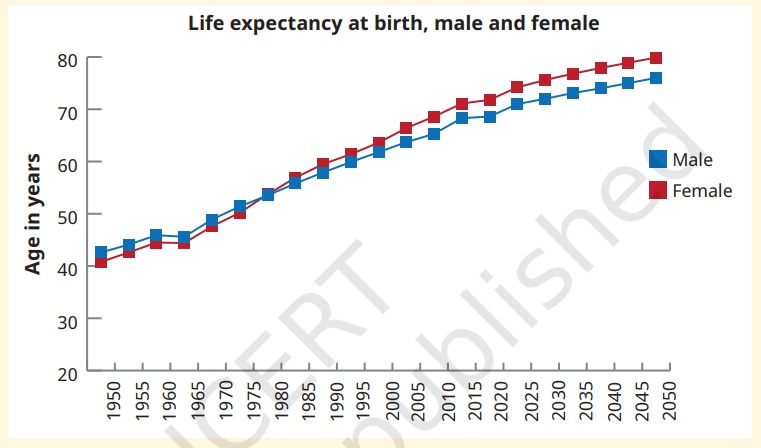
(a) Has the life expectancy in India increased? If yes, what could be the reasons?
Answer:
Yes, life expectancy in India has increased for both males and females. The main reasons are improvements in healthcare, better nutrition, improved sanitation, and better living conditions.
(b) What was the life expectancy of males and females in 2010?
Answer:
According to the graph, the life expectancy in 2010 was approximately 67 years for males and 70 years for females.
Q8. What is a demographic dividend, and how does it benefit a country? What do you think India needs to do today to make the most of its demographic dividend before 2050?
Answer:
A demographic dividend is the economic growth potential of a country resulting from a large and productive working-age population. It benefits a country because more people can work, earn money, pay taxes, and contribute to economic development.
To make the most of its demographic dividend before 2050, India needs to:
1. Provide quality education to young people.
2. Develop skills and provide better employment opportunities.
3. Improve healthcare facilities.
4. Encourage entrepreneurship and business development.
5. Provide opportunities for women to participate in the workforce.
Q9. Choose two countries (for example: India and Japan, or Nigeria and Italy). Find out their:
- Population size
- Fertility rate
- Life expectancy
- Age distribution
How are they different? What might be the reasons behind these differences? For instance, find out how countries with ageing populations are managing this.
Answer:
The chapter provides the following information about India and Japan:
| Indicator | India | Japan |
|---|---|---|
| Population | About 146 crore in 2025 | Exact figure not provided |
| Fertility rate | 1.9 in 2025 | Exact figure not provided |
| Life expectancy | 70 years in 2024 | Exact figure not provided |
| Age distribution | Large working-age population; nearly 65% are aged 15–59 | Ageing population |
| Median age | 28 years | 50 years |
India has a younger population and a large working-age group, while Japan has an older population. Better healthcare and longer life expectancy, along with low fertility rates, contribute to population ageing. The exact figures for Japan’s population size, fertility rate, and life expectancy are not provided in the chapter, so they cannot be filled in without using outside information.
Q10. Imagine you are a researcher who intends to study migration patterns in your locality. Make a questionnaire to collect data on the following questions.
- Name of the person
- Age of the person
- Occupation of the person
- Place of residence
- Number of years lived in the place
- List the factors contributing to migration, such as lack of facilities, poor infrastructure, limited job opportunities and so on.
Answer: Questionnaire on Migration Patterns
1. Name of the person: __________________
2. Age of the person: __________________
3. Occupation of the person: __________________
4. Place of residence: __________________
5. Number of years lived in this place: __________________
6. What are the main reasons for migration?
- Lack of basic facilities
- Poor infrastructure
- Limited job opportunities
- Better education
- Better employment opportunities
- Natural disasters
- Political instability
- Other reasons: __________________
Q11. Draw a population pyramid on graph paper for India using the data given in the following table.
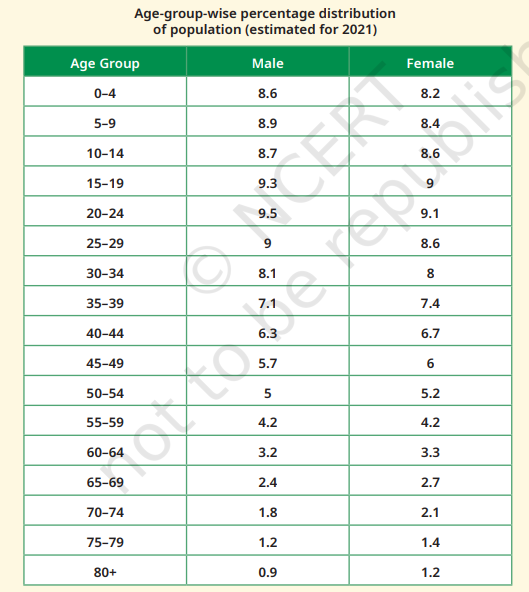
Answer: To draw the population pyramid for India using the estimated 2021 data given on page 189, follow these steps:
1. Draw a vertical axis in the centre to show the age groups, from 0–4 to 80+ years.
2. Draw a horizontal axis to show the population percentage.
3. Represent the male population on the left side using the male percentages in the table.
4. Represent the female population on the right side using the female percentages in the table.
5. Draw horizontal bars for each age group according to the given percentages.
6. Label the two sides as Male and Female, and give the graph the title Population Pyramid of India (2021).
The resulting graph will show the distribution of India’s population by age group and gender.
Q12. Observe the population pyramid for Japan in 2023 below. What can you infer from this? Write your observations and share in the class.
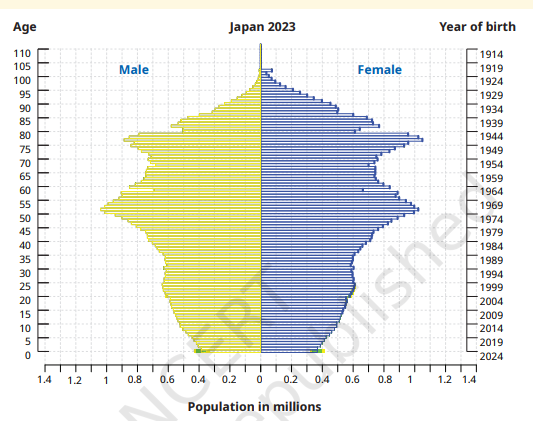
Answer: The population pyramid of Japan in 2023 shows the following:
1. Japan has an ageing population, with a considerable number of elderly people.
2. The middle and older age groups form a large part of the population.
3. The younger age groups form a relatively narrow base, indicating fewer children.
4. The population has a low birth rate and a low fertility rate.
5. People are living longer due to better healthcare and living conditions.
6. An ageing population can lead to a shortage of workers and increase the demand for healthcare facilities and pension services.
Therefore, Japan needs to prepare for the challenges of an ageing population by improving elderly care and using technology to address labour shortages.
The Big Questions? (Page No.167)
Q1. What is demography?
Answer:
Demography is the study of the human population, its size, structure, and composition, and how it changes over time due to births, deaths, and migration.
Q2. What are some important concepts of demography?
Answer:
Some important concepts of demography are population size, population structure and composition, birth rate, fertility rate, death rate, and migration. These concepts help us understand the characteristics and changes of a population.
Q3. How has the population of India and the world changed over time?
Answer:
The population of the world increased from 2.5 billion in 1950 to about 8.2 billion in 2025. India became the world’s most populous country in 2023 after surpassing China. India’s population is still growing, although its fertility rate has declined.
Q4. How do population trends shape societies and economies?
Answer:
Population trends affect the need for schools, hospitals, housing, roads, transportation, and jobs. A large working-age population can support economic growth, while an ageing population increases the need for healthcare and pensions. Governments use population information to plan resources and public services.

Leave a Reply