Questions and activities
Q1. What are some common features of cities?
Answer:
Cities have large populations, different kinds of businesses and occupations, government institutions, and well-developed transportation and communication systems. They also have markets, schools, hospitals, and other public facilities.
Q2. Can you think of a city or town near you that has grown in population? What could be the underlying reasons for the urban migration?
Answer:
Delhi is a city that has grown in population. People migrate to cities in search of better job opportunities, education, healthcare, and improved living conditions. The growth of industries, businesses, and transportation facilities also attracts people from rural areas.
Q3. With reference to the epigraph at the beginning of the chapter, who are the participants in the making of the city and what could be their contribution?
Answer:
All people living and working in a city are participants in its development. Workers build roads and buildings, teachers educate children, doctors provide healthcare, business owners create jobs, and government officials maintain public services. Residents also contribute by keeping their surroundings clean, following rules, and participating in community activities.
Q4. In what ways can urbanisation affect rural areas? Do cities also depend on rural areas? If yes, how? In what ways can rural and urban areas help each other develop?
Answer:
Urbanisation can provide rural people with better job opportunities and access to education and healthcare. However, it may also lead to the movement of people from villages to cities. Cities depend on rural areas for agricultural produce and raw materials. Rural and urban areas can help each other develop through trade, employment, improved transportation, and the exchange of goods and services.
Q5. What is urban planning? What are the risks of ignoring sustainable urban planning as cities expand into villages and forest areas?
Answer:
Urban planning is the process of organising how land in cities and towns is used to provide housing, transportation, businesses, parks, schools, hospitals, and other public facilities. Ignoring sustainable urban planning can cause traffic congestion, pollution, water scarcity, flooding, loss of green spaces, and pressure on natural resources. It can also negatively affect the lives of people and the environment.
Q6. Observe your own neighbourhood. What signs of good or poor planning do you notice? How do they affect daily life for you and others?
Answer:
Signs of good planning include well-maintained roads, proper drainage, parks, clean surroundings, and easily accessible schools and hospitals. Poor planning can be seen in traffic jams, overflowing waste, water shortages, and a lack of green spaces. Good planning makes daily life safer and more comfortable, while poor planning causes inconvenience and health problems.
Q7. Imagine you are an urban planner. What are the things you would consider to plan a city? Do groups like children, the elderly, and people with disabilities get easy access to parks, toilets, and public transport? What changes would you introduce to make it more inclusive?
Answer:
As an urban planner, I would consider the population, housing, transportation, water supply, sanitation, schools, hospitals, parks, and public safety. I would ensure that children, elderly people, and people with disabilities can easily access public facilities. I would provide ramps, lifts, accessible toilets, safe footpaths, pedestrian crossings, and convenient public transport. I would also include green spaces and community centres to make the city inclusive and comfortable for everyone.
Q8. Suppose your town, village or city has 100 people. Draw a rough map of the place on a graph paper. Imagine each square on the paper represents a specific area of the place, like residential neighbourhoods, parks, schools, factories, post offices and so on. Now, distribute the 100 people throughout the area. You can decide where the people will live, whether they all live in the residential areas, or some live in the commercial or industrial areas. Write this number in each of the boxes. In your depiction of the map, which areas are heavily populated and which are not? What were the reasons behind your choices of allocation of people?
Answer:
I would divide the area into residential, commercial, industrial, and public spaces and distribute the 100 people as follows:
| Area | Number of people |
|---|---|
| Residential neighbourhood | 50 |
| Commercial area | 15 |
| Industrial area | 10 |
| Area near schools and hospitals | 10 |
| Area near parks and open spaces | 5 |
| Other areas | 10 |
| Total | 100 |
The residential neighbourhood would be the most populated because most people need homes. Commercial and industrial areas would have fewer residents because they are mainly used for businesses and work. Parks and open spaces would have fewer people living in them because they are meant for recreation and environmental benefits.
Activity: Draw these areas as separate blocks on graph paper and mark the number of people in each block.
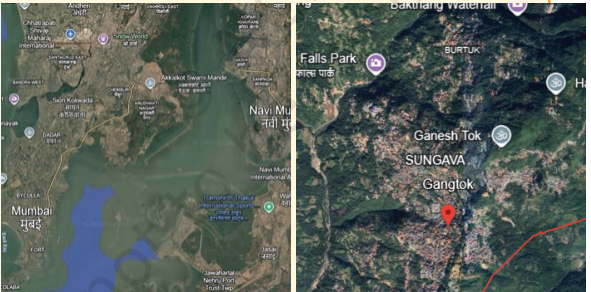
Q9. Observe the satellite view of Mumbai and Gangtok, respectively. Find out their population density and likely reasons for the difference.
Answer:
Population density refers to the number of people living per square kilometre. Mumbai has densely populated built-up areas because it is a major centre of trade, finance, industries, and employment. Gangtok has a different settlement pattern because it is located in a hilly region, where the availability of land for construction is limited by the terrain.
The exact population densities of Mumbai and Gangtok are not provided in the chapter, so they cannot be stated accurately using the chapter alone.
Q10. Find out how the city of Beijing, China, tackled the problem of air pollution. Prepare a report outlining measures that can be taken in India to mitigate air pollution in cities.
Answer: Report on Air Pollution in Cities
Air pollution is a major challenge faced by cities. It affects people’s health and reduces their quality of life. Cities need effective planning and proper management to control pollution.
Measures that can be taken to reduce air pollution in Indian cities include:
- Improving public transportation and encouraging people to use it.
- Reducing traffic congestion by promoting carpooling.
- Increasing green spaces and planting more trees.
- Managing waste properly and preventing open waste burning.
- Promoting cleaner technologies and energy-efficient infrastructure.
- Monitoring air quality and taking suitable steps to protect public health.
Note: The chapter does not describe the specific measures taken by Beijing. The points above are suggested measures for Indian cities, based on the urban challenges and planning principles discussed in the chapter.
Q11. Talk to a family or community member who has moved from a village to a city. Ask them the reason for the same and their experience, challenges and opportunities. How does city life compare to rural life?
Answer:
A person may move from a village to a city in search of better employment, education, healthcare, and living opportunities. City life offers diverse jobs, better access to many facilities, and improved transportation. However, people may face high living costs, crowded surroundings, traffic congestion, and housing difficulties.
In comparison, rural areas generally have smaller populations, close-knit communities, and more agriculture-based occupations. Cities offer more diverse economic opportunities, while rural areas often have a closer connection with agriculture and open spaces.
Q12. Learn about urban planning in other cities around the world. In what ways can some of those aspects be adapted for a city near you?
Answer:
Singapore is an example of effective urban planning. It has an integrated public transport system, green spaces, mixed-use areas, and sustainable high-rise buildings. These features can be adapted to a nearby city by improving public transport, developing parks, planting trees, planning residential and commercial areas properly, and providing safe walking and cycling paths. Such measures can improve the quality of life and make the city more sustainable.
Q13. Explore and suggest action points with respect to urban planning in cities to mitigate the challenges below and write a report. Two have been completed for you.
Waste Management: Conducting a ‘Segregate at Source’ awareness drive in residential areas with demos on dry/wet waste disposal and composting.
Traffic congestion: carpooling, high taxes on vehicle purchase, etc.
Inadequate safety of residents
Poor mobility within the city
Expansion of slums
Heat waves during summers
Answer:
(a) Inadequate safety of residents
- Improve street lighting and maintain safe public spaces.
- Place police stations and fire stations in easily accessible locations.
- Provide safe footpaths and pedestrian crossings.
- Strengthen law enforcement and community participation.
(b) Poor mobility within the city
- Improve public transportation, including buses and metro services.
- Develop safe cycling paths and walking corridors.
- Improve road maintenance and traffic management.
- Encourage carpooling to reduce traffic congestion.
(c) Expansion of slums
- Provide affordable housing for economically weaker households.
- Improve access to clean water, sanitation, and waste management.
- Develop housing and public facilities according to the needs of the population.
- Improve healthcare and educational facilities for slum residents.
(d) Heat waves during summers
- Increase parks and green spaces.
- Plant trees along roads and around buildings.
- Develop rooftop and vertical gardens.
- Protect existing green areas and plan sustainable buildings.
Q14. Find out about a slum rehabilitation programme where people moved from slums to proper housing in your city. What do you think its possible benefits could be for the communities there?
Answer:
A slum rehabilitation programme aims to provide people living in overcrowded settlements with proper housing and better living conditions. The chapter mentions the Pradhan Mantri Aawaas Yojana, which provides affordable housing to economically weaker households.
The possible benefits of such programmes include:
Access to safer and better-quality housing.
Improved sanitation, water supply, and other basic facilities.
Better health and hygiene.
Improved access to education and other public services.
Greater safety, dignity, and quality of life for families.
The success of such programmes depends on providing suitable housing and ensuring that essential services and livelihood opportunities remain accessible to the residents.
The Big Questions? (Page No.191)
Q1. How do cities become the centre of diverse economic activities?
Answer:
Cities become centres of diverse economic activities because of their favourable locations, transport facilities, trade routes, availability of raw materials, and development of industries and markets. They also provide jobs in businesses, education, administration, technology, and tourism. These opportunities attract people from different areas and help cities grow.
Q2. In what ways can urbanisation impact people’s lives?
Answer:
Urbanisation provides people with diverse job opportunities, better educational facilities, transportation, healthcare, and other services. It also brings people from different regions together, allowing them to share cultures, languages, traditions, and ideas. However, rapid urbanisation can cause overcrowding, pollution, traffic jams, water shortages, and a lack of affordable housing.
Q3. What kind of challenges do cities face in the 21st century?
Answer:
Cities face several challenges, such as overcrowding, air and water pollution, traffic congestion, water scarcity, and increasing waste generation. Rapid urbanisation also puts pressure on housing, roads, sanitation, and other infrastructure. The growth of slums, reduction in green spaces, rising temperatures, and safety concerns are other major challenges.
Q4. How can effective urban planning improve life in cities?
Answer:
Effective urban planning can improve life in cities by providing proper housing, well-maintained roads, efficient public transport, parks, schools, hospitals, and other public facilities. It can also improve water supply, sanitation, waste management, and public safety. Sustainable planning helps reduce pollution, protect green spaces, and make cities more convenient, inclusive, and comfortable for everyone.

Leave a Reply