Resistance and Resilience (1000–1700 CE)
Questions and activities
Q1. Choose the most appropriate answer.
Resistance and resilience are closely connected because:
a. Resistance always involves warfare.
b. Resilience enables communities to endure difficulties and sustain resistance.
c. Resistance is possible only when a kingdom has a large army.
d. Resilient societies avoid all forms of conflict.
Answer: (b) Resilience enables communities to endure difficulties and sustain resistance.
2. Why and how did groups such as the Sikhs, Marathas, and Rajputs assert their political power and identity during periods of changing political authority?
Answer:
The Sikhs, Marathas, and Rajputs asserted their political power and identity to protect their territories, traditions, and independence. The Rajputs resisted powerful rulers through military action and formed alliances when necessary. The Marathas, under Chhatrapati Shivaji, followed the idea of Swarajya, or self-rule, and used forts, guerrilla warfare, and strategic alliances. The Sikhs strengthened their community through collective organisation, the teachings of their Gurus, and armed resistance when required. These methods helped them preserve their political and cultural identities.
3. Why did some Rajput rulers decide to negotiate alliances with the Mughal power?
Answer:
Some Rajput rulers negotiated alliances with the Mughals for strategic and political reasons. These relationships allowed them to cooperate with the Mughal Empire and protect their interests. The Mughals also benefited from Rajput military strength, loyalty, and administrative abilities, which helped consolidate and stabilise their empire. However, some Rajput kingdoms, such as Mewar, continued to resist Mughal authority.
4. Imagine a market in a port town of India such as Surat, Masulipatnam, or Puducherry. You are a foreign trader from Italy or France and want to make a deal of cotton textiles. How would you secure the product in the local market? Whose help would you seek and what kind of challenges would you face in terms of language, quality of product, prices of commodities, etc.?
Answer:
As a foreign trader, I would seek the help of local merchants, brokers, interpreters, and bankers to purchase cotton textiles. The merchants would help me identify weavers, check the quality of the textiles, negotiate prices, and arrange the delivery of goods. I would also seek the help of shippers to transport the products safely.
The main challenges would be language differences, variations in the quality of textiles, changing prices, and competition from other traders. I would overcome these difficulties by using interpreters, inspecting the goods carefully, negotiating fair prices, and building trustworthy relationships with local merchants.
5. Watch any video at the given link and analyse the various functions of forts and fortresses. How did rulers perceive the importance of forts in terms of strategic concerns?
Answer:
Forts and fortresses served several important purposes:
- Defence: They protected kingdoms from enemy attacks and invasions.
- Military operations: They provided strategic bases for launching attacks and conducting guerrilla warfare.
- Safe retreats: They allowed rulers and soldiers to withdraw to safer locations during difficult situations.
- Protection during sieges: Strong defensive walls, water sources, and armouries helped forts withstand prolonged sieges.
- Administration: Forts also served as centres of administration and judicial authority.
Rulers considered forts essential for protecting their territories, maintaining political power, and resisting powerful enemies. Their strategic locations and strong defences helped kingdoms survive prolonged conflicts.
6. What architectural changes occurred in temple construction during the period under study? How do these changes reflect upon the resilient nature of Indian civilisation?
Answer:
From the 16th century onwards, changes occurred in the design and location of temples. Many temples were built in less visible places, along narrow lanes, with entrances that did not open onto main streets. Some resembled ordinary houses rather than conventional temples. Detailed exteriors became less common, and tall shikharas were frequently avoided. Some of these structures are described as haveli temples.
These changes show how communities adapted their religious architecture to avoid destruction. Despite difficult circumstances, people continued to preserve their religious traditions and rebuild temples. This reflects the resilience of Indian civilisation and its ability to adapt while maintaining cultural and spiritual continuity.
7. A kingdom has limited military resources but possesses fertile agricultural land, strong local support, and detailed knowledge of its terrain. Explain two ways in which these resources could contribute to the kingdom’s resilience when faced with a threat.
Answer:
1. Fertile agricultural land and local support: Fertile land would provide food and resources to sustain the population and soldiers during a conflict. Strong local support would help the rulers organise resistance and protect their territory.
2. Knowledge of local terrain: Detailed knowledge of hills, forests, rivers, and other geographical features would help the kingdom plan defensive strategies, launch surprise attacks, and avoid direct confrontation with a stronger enemy.
These resources would help the kingdom withstand threats even with limited military strength.
8. Consider the following statement: “A tradition becomes more resilient when people can carry it with them.” Do you agree? Explain using examples from the Bhakti tradition.
Answer:
Yes, I agree with this statement. A tradition becomes more resilient when people can practise it without depending entirely on specific places or buildings. The Bhakti tradition spread through devotional songs, hymns, local languages, and community gatherings.
For example, devotees practised nām kīrtan, or the recitation of the divine Name, even when temples were restricted or destroyed. Saints such as Chaitanya Mahaprabhu and Guru Nanak used community singing to bring people together. Sankardev composed the Kīrtana Ghosha, which became an important work in Vaishnava traditions.
These practices helped people preserve their beliefs, share their traditions, and maintain a sense of unity despite changing circumstances.
9. Voices from the Past: Choose any two of the following and write a short first-person account explaining what resilience means from that person’s perspective.
(a) A Bhakti Saint
I believe resilience means keeping my faith alive even when circumstances are difficult. Through devotional songs, hymns, and teachings in the local language, I share my devotion with people from different backgrounds. I encourage equality, simplicity, and community participation. Even when traditional places of worship face difficulties, people can continue their devotion through singing and prayer. This helps preserve our spiritual traditions and strengthens unity among people.
(b) A Rajput Soldier
For me, resilience means defending my kingdom and protecting its independence despite difficult challenges. I rely on courage, discipline, knowledge of the local terrain, and the support of my fellow soldiers. Our forts provide protection and help us withstand prolonged sieges. When necessary, we use strategic alliances and adapt our military methods to resist stronger enemies. Our determination helps us preserve our territory, traditions, and identity.
Q10. Design a Fort
You are a military architect advising a ruler.
Draw a simple, labelled plan of a fort that includes the following:
Residential complex
Defensive walls
Water source
Food storage
Escape route
Watchtower
Administrative area
Now, write a few sentences explaining how your design would help the kingdom withstand a long siege.
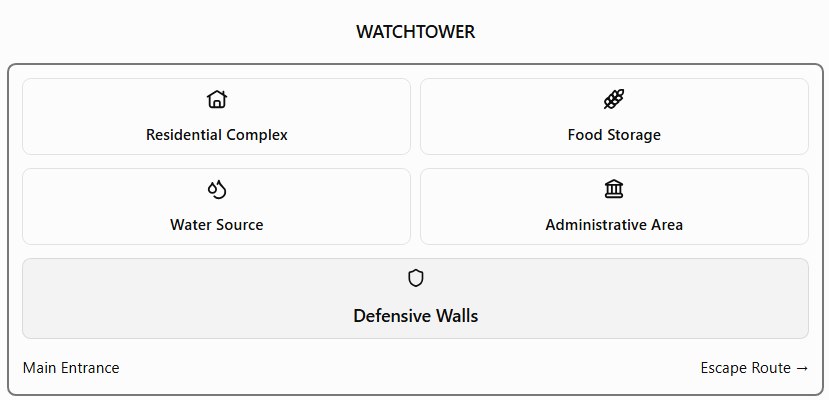
Explanation: This fort would help the kingdom withstand a long siege. The defensive walls and watchtower would help detect and prevent enemy attacks. The water source and food storage would provide essential supplies during a siege. The residential complex would provide shelter for the people, while the administrative area would help the ruler manage the kingdom. An escape route would provide an alternative way out during an emergency. Together, these features would improve the fort’s defence and self-sufficiency.
The Big Questions (Page no. 45)
Q1. How did Indian rulers use resistance and alliances to safeguard their lands?
Answer:
Indian rulers used military resistance, strategic alliances, diplomacy, and guerrilla warfare to protect their territories and maintain independence. The Rajputs resisted the Mughals, while some Rajput rulers formed cooperative relationships with them. Maharana Pratap used guerrilla warfare and the difficult terrain of the Aravalli Hills to fight the Mughal forces. The Ahoms used their knowledge of forests and rivers to defend their kingdom. Similarly, the Marathas built forts and formed strategic alliances to expand and protect their territories.
Q2. What factors contributed to the resilience of different kingdoms and communities during this period?
Answer:
Several factors contributed to the resilience of different kingdoms and communities during this period. These included strong leadership, military skills, strategic alliances, knowledge of local geography, and the use of guerrilla warfare. The Ahoms used their knowledge of Assam’s forests and river systems to resist invasions. The Marathas built strong forts for defence. Cultural and spiritual traditions, community support, and economic strength also helped people overcome difficulties and preserve their identities.
Q3. How did the Bhakti tradition foster a sense of solidarity?
Answer:
The Bhakti tradition fostered a sense of solidarity by emphasising devotion to God, social equality, inclusivity, and simplicity. Bhakti saints composed devotional hymns in local languages, making their teachings accessible to ordinary people. Saints such as Guru Nanak and Chaitanya Mahaprabhu used community singing to bring people together and bridge social divisions. The participation of people from diverse social backgrounds, including women, strengthened shared identities and promoted unity among communities.
Q4. How did the expansion of agriculture, trade, and commerce keep the economy sound?
Answer:
The expansion of agriculture, trade, and commerce helped maintain a dynamic and strong economy during this period. The use of irrigation technologies, such as the Persian wheel, improved agricultural production. The growth of markets, craft production, and urban centres encouraged economic activities. Traders connected inland regions with cities and distant markets, while maritime trade linked India with the Persian Gulf, the Arabian Sea, and other parts of the Indian Ocean. Merchant communities, money-changers, and financial instruments such as the hundi facilitated commercial transactions. These economic activities provided resources and stability that helped communities withstand political instability and external threats.

Leave a Reply