Atmosphere and Climate
Questions and activities
1. What is atmosphere? Explain its composition with the help of a pie diagram.
Answer: The atmosphere is a blanket of air surrounding the Earth. It is pulled down around the Earth by gravity, and is a mixture of gases in various proportions, vital for the survival of all living beings on the Earth. The Earth’s atmosphere is composed of a mixture of various gases. Nitrogen and oxygen are the two primary and most abundant gases, essential to life on the Earth. Carbon dioxide, argon, helium, neon, krypton, xenon, ozone, and hydrogen are some other gases present in the atmosphere, but are found in lesser quantities. The atmosphere also consists of water vapour and tiny dust particles.
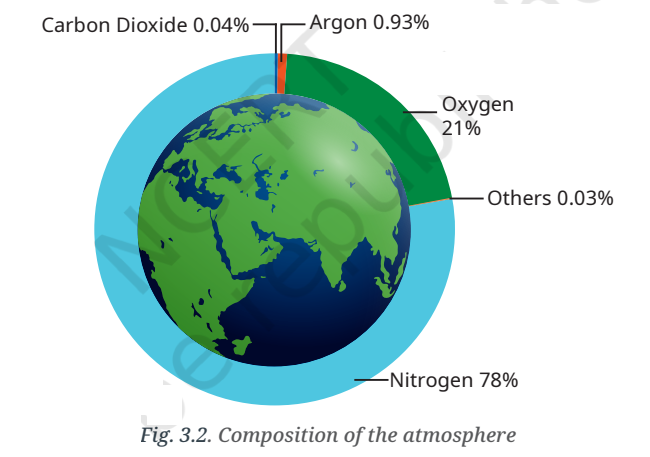
Nitrogen – 78%
Oxygen – 21%
Argon – 0.93%
Carbon Dioxide – 0.04%
Others – 0.03%
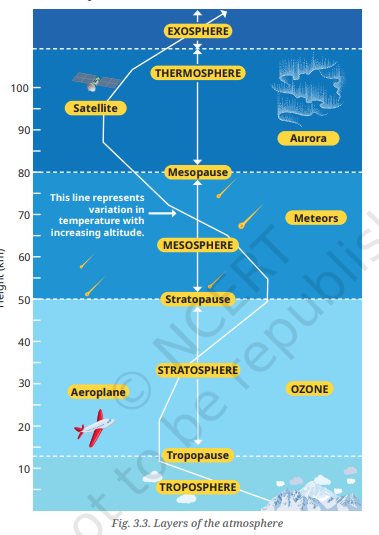
2. Draw a labelled diagram of the structure of atmosphere.
Answer:
3. Which are the four main seasons of India?
Answer: The Indian Meteorological Department (IMD) has recognised four distinct seasons in India:
(a) Winter – lasts from December to early April
(b) Summer or pre-monsoon – spans from April to June (or up to July in north-western India)
(c) Monsoon or rainy (Advancing monsoon) – spans from June to September
(d) Post-monsoon (Retreating monsoon) – lasts from October to December
4. Why do you not feel the pressure of the atmosphere?
Answer: The air above us exerts a significant force on our bodies, and yet we do not feel it. This is because air presses on us from all sides, and our bodies exert a counter-pressure in response. The pressure inside our bodies is also equal to the atmospheric pressure and cancels the pressure from outside.
5. In which layer of the atmosphere do aeroplanes fly and why?
Answer: Aeroplanes fly in the stratosphere. This layer is ideal for flying aeroplanes because it is free of clouds and other weather disturbances.
6. Distinguish between the following:
a. The troposphere and stratosphere
Answer:
| Troposphere | Stratosphere |
|---|---|
| The most important layer of the atmosphere, with an average height of about 12 kilometres. | Lies above the troposphere, extending up to 50 kilometres. |
| Temperature decreases with increasing altitude. | Contains a layer of ozone gas, which shields us by filtering the Sun’s harmful radiation, including ultraviolet radiation. |
| The air we breathe exists here, along with most of the water vapour and clouds. | It is free of clouds and other weather disturbances. |
| Nearly all weather phenomena, such as rainfall, fog, and hail, occur in this layer. | Ideal for flying aeroplanes. |
b. The south-west monsoon and north-east monsoon
| South-West Monsoon | North-East Monsoon |
|---|---|
| Also known as the summer monsoon. | Also known as the winter monsoon. |
| Characterised by winds blowing from sea to land across the Indian Ocean, the Arabian Sea, and the Bay of Bengal, between June and September. | Occurs in India from October to February. |
| Caused by the unequal heating of land and sea. During summer, the landmass heats up faster, creating a low-pressure area over India while the ocean remains cooler with high pressure. | During this season, the Indian landmass cools faster than the surrounding oceans, creating a high-pressure area over land and low pressure over the seas. |
| Moist winds blow from the ocean towards the land, bringing rainfall. It accounts for most of the rainfall in the country throughout the year. | Cold and dry winds blow from land to sea. These winds generally do not bring rainfall to most parts of India, except when they pass over the Bay of Bengal and cause rainfall in Tamil Nadu, Andhra Pradesh, and parts of Karnataka. |
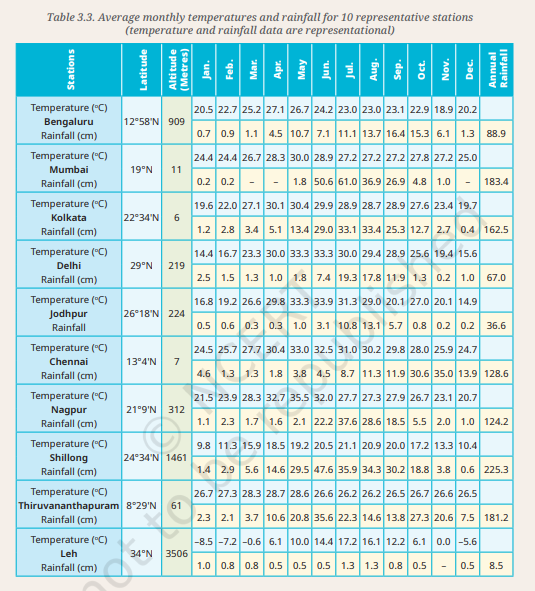
7.1. Now look at Table 3.3 again. Re-arrange the 10 stations according to their distance from the equator.
Answer:
| Rank | Station | Latitude |
|---|---|---|
| 1 (Closest to Equator) | Thiruvananthapuram | 8°29’N |
| 2 | Bengaluru | 12°58’N |
| 3 | Chennai | 13°4’N |
| 4 | Mumbai | 19°N |
| 5 | Nagpur | 21°9’N |
| 6 | Kolkata | 22°34’N |
| 7 | Shillong | 24°34’N |
| 8 | Jodhpur | 26°18’N |
| 9 | Delhi | 29°N |
| 10 (Farthest from Equator) | Leh | 34°N |
7.2. Find out:
(a) Two stations with the most extreme climate.
Answer:
- Delhi
- Leh
(b) Two stations influenced by retreating monsoons.
Answer:
- Chennai
- Thiruvananthapuram
(c) The two hottest stations in the months of:
(i) February
Answer:
- Thiruvananthapuram
- Chennai
(ii) June
Answer:
- Jodhpur
- Delhi
7.3. Now find out:
(a) Why does Shillong experience more rainfall than Kolkata?
Answer:
- Shillong is located in the Khasi Hills.
- Moist monsoon winds rise over the hills.
- As the winds rise, they cool and cause heavy rainfall.
- Therefore, Shillong receives more rainfall than Kolkata.
(b) Why does Delhi receive more rainfall than Jodhpur?
Answer:
- Delhi receives more rainfall from the South-West Monsoon.
- Jodhpur lies in a dry region and receives less monsoon rainfall.
- Therefore, Delhi receives more rainfall than Jodhpur.
7.4. Now think why
a. Thiruvananthapuram has an equable climate?
Answer: Thiruvananthapuram is located very close to the equator. Places near the equator get almost the same amount of sunlight all through the year, so the temperature does not change much between summer and winter. It is also a coastal city, and the sea helps keep the temperature steady. Looking at Table 3.3, its temperature stays between about 26°C and 29°C all year, which is why it has an equable (steady, mild) climate.
b. Chennai has more rainfall only after the fury of the monsoon is over in most parts of the country?
Answer: Chennai is on the south-eastern coast of India. In most of India, the south-west monsoon (June to September) brings most of the rain. But Chennai gets its heaviest rain later, in October–December. This is because of the north-east monsoon (winter monsoon), which blows after the south-west monsoon has already ended in most of the country. As these winds cross the Bay of Bengal, they pick up moisture and bring rain to Chennai’s coast. So Chennai’s main rainy season comes after the rest of the country’s monsoon is over.
c. Leh has moderate precipitation almost throughout the year?
Answer: Leh is located in a high mountain area beyond the Himalayas. The Himalayas act like a wall and block the moisture-carrying monsoon winds from reaching Leh. Because of this, Leh does not get heavy monsoon rain like the rest of India. Instead, it gets small amounts of rain (and snow) spread almost equally through all the months of the year, so its rainfall pattern looks moderate and steady rather than having one big rainy season.
7.5. Despite these differences across regions, can you observe any substantial evidence to conclude that the monsoons provide a very strong framework, lending overall climatic unity to the whole country?
Answer:
- Yes, the monsoons provide a strong framework of climatic unity to India.
- Most parts of the country receive rainfall during the South-West Monsoon.
- Some regions, like Chennai, receive rainfall during the North-East (Retreating) Monsoon.
- Monsoon rainfall supports agriculture and provides water for rivers, reservoirs, and wells.
- It influences farming, transport, festivals, and daily life across the country.
- Therefore, despite regional differences in climate, the monsoon gives India overall climatic unity.
The Big Questions (Page 39)
1. What is the composition of the atmosphere?
Answer:
- The atmosphere is made up of a mixture of gases.
- It contains 78% Nitrogen.
- It contains 21% Oxygen.
- It contains 0.93% Argon.
- It contains 0.04% Carbon dioxide.
- The remaining 0.03% consists of other gases.
- It also contains water vapour and dust particles.
2. How do the different layers of the atmosphere affect the planet Earth?
Answer:
- The Troposphere contains the air we breathe and is the layer where weather occurs.
- The Stratosphere contains the ozone layer, which protects the Earth from harmful ultraviolet rays.
- The Mesosphere burns up most meteoroids before they reach the Earth.
- The Thermosphere absorbs harmful solar radiation and helps in radio communication.
- The Exosphere is the outermost layer and merges gradually into space.
- Together, these layers make life on Earth possible.
3. What is the mechanism of monsoon?
Answer:
- The monsoon is caused by the unequal heating of land and sea.
- In summer, the land heats up faster than the sea.
- A low-pressure area develops over the land, while high pressure remains over the sea.
- Moist winds blow from the sea towards the land and bring rainfall.
- In winter, the land cools faster than the sea.
- High pressure develops over the land, and dry winds blow from the land towards the sea.
4. How can we reduce our carbon footprint?
Answer:
- Plant more trees.
- Use public transport, cycle, or walk whenever possible.
- Save electricity by switching off lights and electrical appliances when not in use.
- Use renewable sources of energy like solar and wind energy.
- Reduce, reuse, and recycle waste.
- Avoid burning waste and use fuel efficiently.

Leave a Reply