Questions and activities
1. “Good governance is the responsibility of the government alone.” Do you agree with this statement? Give reasons to support your answer.
Answer:
No, I do not agree with this statement. Good governance is not the responsibility of the government alone; it requires the combined efforts of different sections of society.
- The government makes policies, provides public services, and implements laws.
- Citizens elect their representatives, follow laws, participate in public affairs, and provide feedback.
- The media informs people about public issues and brings important matters to public attention.
- Civil society organisations raise awareness and work with communities.
- The private sector contributes through economic activities, innovation, and resources.
Therefore, cooperation among the government, citizens, and other organisations is essential for good governance.
2. Do you think students can contribute to good governance? Write a short note describing any five ways in which students can become more responsible and active citizens.
Answer:
Yes, students can contribute to good governance by becoming responsible and active citizens. They can help improve society in the following five ways:
1. Follow laws and rules: Students should obey rules and respect the laws of the country.
2. Keep their surroundings clean: They should avoid littering, reduce plastic waste, and encourage proper waste management.
3. Participate in community activities: Students can take part in cleanliness drives, awareness campaigns, and other activities for public welfare.
4. Raise public concerns: They can bring problems such as water wastage, poor sanitation, and unsafe roads to the attention of the concerned authorities.
5. Provide feedback and spread awareness: Students can share suggestions, inform others about public issues, and encourage people to participate in solving community problems.
In these ways, students can help strengthen democracy and promote good governance.
3. Choose any one public policy [for example, Right to Education (RTE), Swachh Bharat Mission, PM POSHAN, Ayushman Bharat, Digital India, or Jal Jeevan Missio and prepare a chart showing the following aspects:
The problem it addresses
The major stakeholders involved
How different actors coordinate
The role of citizens in its success
Present your findings to the class.
Answer:
| Aspect | Details |
|---|---|
| The problem it addresses | Poor sanitation, lack of cleanliness, and improper waste management in public places. |
| The major stakeholders involved | Central and state governments, local authorities, citizens, civil society organisations, and the private sector. |
| How different actors coordinate | Government authorities plan and implement cleanliness programmes. Local bodies manage sanitation and waste collection, while organisations and citizens support cleanliness activities. |
| The role of citizens in its success | Citizens should avoid littering, use public toilets responsibly, segregate waste, participate in cleanliness drives, and provide feedback to local authorities. |
4. Answer the following in one or two sentences.
a. What is governance?
Answer: Governance is the process of making, implementing, and monitoring decisions for the welfare of people. It involves the government, institutions, and citizens working together to address public problems.
b. How is governance different from government?
Answer: Government refers to the institutions that exercise political authority, including the Legislature, Executive, and Judiciary. Governance refers to the process through which decisions are made, implemented, and monitored in the public interest.
c. What is meant by public policy?
Answer: Public policy is a course of action adopted by the government to solve public problems, meet people’s needs, and promote the welfare of society.
d. Name any four principles of good governance.
Answer: Four principles of good governance are transparency, accountability, participation, and the rule of law.
5. Compare the following and present your answer in a tabular form.
a. Government and governance
b. Policy and public policy
a. Government and Governance
Answer:
| Government | Governance |
|---|---|
| It refers to institutions that exercise political authority. | It refers to the process of decision-making and implementation. |
| It includes the Legislature, Executive, and Judiciary. | It includes the government, citizens, media, civil society, and private organisations. |
| It focuses on who governs. | It focuses on how governing is carried out. |
| It formulates and implements policies and provides public services. | It ensures that decisions are implemented transparently, effectively, and accountably. |
b. Policy and Public Policy
Answer:
| Policy | Public Policy |
|---|---|
| A policy provides guidelines or a course of action for achieving a particular objective. | Public policy is a course of action adopted by the government to solve public problems and promote public welfare. |
| It may be made by schools, companies, hospitals, sports clubs, or other organisations. | It is formulated by the government to address issues affecting society. |
| It may apply only to a particular organisation or group. | It addresses public concerns such as education, healthcare, sanitation, and public safety. |
| Its scope may be limited to the organisation that makes it. | It is generally intended to benefit the public and may use public resources. |
6. Imagine you have been appointed to advise the district administration on improving governance. You have proposed
six points (given below), but the administration decides to prioritise only three areas for improvement. Which three would you recommend as priority areas, and which one out of the three do you feel is the most important?
a. Improve drinking water facilities in schools.
b. Improve sanitation and public toilets in schools and market areas.
c. Provide tricycles for orthopaedically challenged students.
d. Install open-area swings and open-air gym in public parks.
e. Ensure the vaccination of stray dogs to prevent rabies.
f. Ensure distribution of iron and folic acid tablets for female students in schools.
Answer:
I would recommend the following three areas as priorities for improving governance:
1. Improve drinking water facilities in schools (Option a): Clean drinking water is essential for students’ health and well-being.
2. Improve sanitation and public toilets in schools and market areas (Option b): Proper sanitation helps maintain cleanliness, protects public health, and provides better facilities for everyone.
3. Ensure the vaccination of stray dogs to prevent rabies (Option e): This measure can help protect people from diseases and improve public safety.
Most important priority: I consider improving drinking water facilities in schools the most important priority because safe drinking water is essential for students’ health and enables them to study in a healthy environment.
7. Match the policy action point to its corresponding stage in the policy cycle.
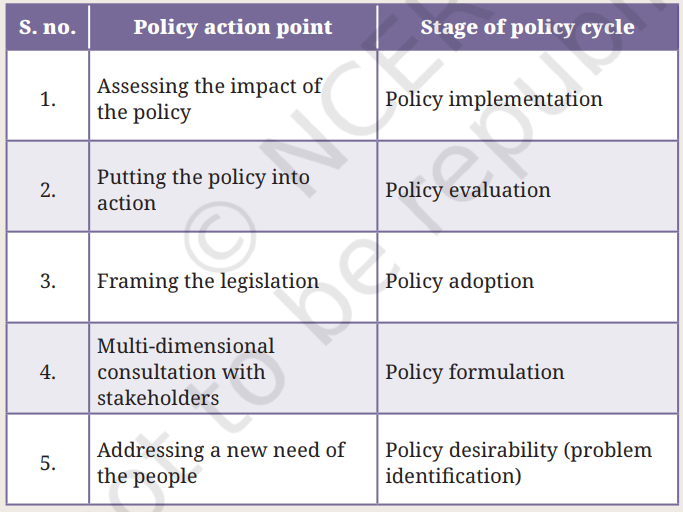
Answer:
| S. No. | Policy action point | Correct stage of policy cycle |
|---|---|---|
| 1. | Assessing the impact of the policy | Policy evaluation |
| 2. | Putting the policy into action | Policy implementation |
| 3. | Framing the legislation | Policy adoption |
| 4. | Multi-dimensional consultation with stakeholders | Policy formulation |
| 5. | Addressing a new need of the people | Policy desirability (problem identification) |
8. Read the following case and answer the given questions.
The government launches a programme to plant one lakh trees in a city. Funds are allocated, but only a few saplings survive because they are not watered or protected.
a. Which stage of the policy cycle appears to be weak?
Answer: The policy implementation stage appears to be weak because the saplings are not being watered or protected properly. Effective implementation is necessary to achieve the objectives of a programme.
b. Which organisations should coordinate to improve the programme?
Answer: The municipal corporation, forest department, local government authorities, and other concerned government departments should coordinate to improve the programme. Citizens, civil society organisations, and local community groups can also help water and protect the saplings.
c. Suggest two measures that could improve the outcome.
Answer:
1. Arrange regular watering and proper protection of saplings to ensure their survival.
2. Involve local residents, schools, and community organisations in tree-care activities and regularly monitor the growth of the planted trees.
9. Read each statement carefully. Do you agree or disagree? Give reasons for your answer.
a. A good public policy can fail if it is not implemented properly.
Answer:
I agree with this statement. Even a well-planned policy may fail to achieve its objectives if it is not implemented effectively. Proper coordination, monitoring, and accountability are necessary to ensure that the benefits of a policy reach the people.
b. Citizen participation sometimes makes decision-making slower, but it can improve governance.
Answer:
I agree with this statement. Consulting citizens and different stakeholders may take additional time because their views and suggestions must be considered. However, their participation helps the government understand public needs, make better decisions, and improve policies through feedback.
c. Technology alone cannot ensure good governance.
Answer:
I agree with this statement. Technology can make public services faster, more accessible, and more transparent, but good governance also requires accountability, citizen participation, effective institutions, and the rule of law. Digital services must also be accessible to people who have the necessary devices, internet access, and digital skills.
10. Design a public policy.
You are a member of your school’s student representative body. Identify one issue, for example, plastic waste, water wastage, road safety, energy conservation, or littering in public places. Prepare a simple policy proposal that includes the following
aspects of policymaking:
The reason for selecting the issue
Your proposed solution
Who should implement it?
How will students participate?
How will you know whether the policy has succeeded?
Answer:
Selected issue: Plastic Waste in School
Title: Plastic-Free School Policy
1. The reason for selecting the issue
Plastic waste makes the school campus dirty and contributes to environmental degradation. Reducing plastic waste will help maintain a clean and healthy school environment.
2. Your proposed solution
- Encourage students to bring reusable water bottles and lunch containers.
- Discourage the use of single-use plastic bags and bottles.
- Place dustbins around the school for proper waste segregation.
- Organise monthly awareness programmes about reducing plastic waste.
- Monitor the cleanliness of the school campus regularly.
3. Who should implement it?
The school principal, teachers, school management, and student representatives should implement the policy. Cleaning staff and other concerned school authorities should also support its implementation.
4. How will students participate?
- Bring reusable bottles and lunch containers to school.
- Avoid littering and dispose of waste properly.
- Participate in cleanliness drives and awareness campaigns.
- Encourage classmates to reduce plastic use.
- Report problems and provide suggestions to teachers and student representatives.
5. How will you know whether the policy has succeeded?
The policy will be considered successful if plastic waste on the campus decreases, students regularly use reusable items, waste is segregated properly, and the school remains clean. Regular monitoring and feedback from students and teachers will help measure progress and identify areas for improvement.
The Big Questions (Page no. 81)
1. What is governance, and how have its meaning and practice evolved over time?
Answer:
Governance is the process of making, implementing, and monitoring decisions for the welfare of people. In India, governance has evolved from traditional institutions such as Sabhā and Samiti and ideas like Rām Rājya and Rājadharma to a modern democratic system based on the Constitution, transparency, accountability, and citizen participation.
2. What is public policy? How does it affect our day-to-day lives, and what makes it ‘public’?
Answer:
Public policy is a course of action adopted by the government to solve public problems, meet people’s needs, and promote social welfare. It affects our daily lives through services such as roads, clean drinking water, electricity, education, healthcare, and sanitation. It is called ‘public’ because it addresses issues affecting society, promotes public welfare, and is formulated by the government.
3. What are the various stages of policy-making and policy implementation?
Answer:
The main stages of the policy process are:
1. Policy Desirability: Identifying the needs and problems of people.
2. Prioritising Policy: Deciding which issues need immediate attention.
3. Policy Formulation: Consulting stakeholders, preparing the policy, and assessing its financial feasibility.
4. Policy Adoption: Approving the policy and framing the necessary laws and regulations.
5. Policy Implementation: Putting the policy into action through government officials, local bodies, organisations, and citizens.
6. Policy Monitoring: Checking progress and identifying shortcomings.
7. Policy Evaluation: Assessing the results and impact of the policy and using feedback to improve it.
4. Who are the major contributors to policy-making and implementation?
Answer:
The major contributors are citizens, elected representatives, government officials, departments and ministries, civil society organisations, NGOs, experts, researchers, the media, private organisations, and international organisations. They help identify problems, suggest solutions, prepare and implement policies, provide resources, monitor progress, and give feedback.
5. What role do citizens play in shaping public policy and strengthening good governance?
Answer:
Citizens play an important role by voting, following laws, identifying public problems, raising concerns, participating in public discussions, giving suggestions, and providing feedback on government services. They can also participate in community activities and hold public authorities accountable. These actions help improve public policies, strengthen democracy, and promote good governance.

Leave a Reply