Questions and activities
Q1. Explain why a business can fail even with a great idea if one functional area [finance, human resources (HR), operations, or marketing] is weak. If you were running a bakery, which functional area would you prioritise first and why?
Answer:
A business can fail even with a great idea if one of its functional areas is weak. Poor financial management can lead to losses, untrained employees can affect product quality, inefficient operations can cause delays, and weak marketing can prevent customers from learning about the business. If I were running a bakery, I would prioritise management and operations first because they ensure efficient production, good quality, and timely delivery of fresh products.
Q2. Do you think innovation alone is enough to make a business successful? Why or why not?
Answer:
No, innovation alone is not enough to make a business successful. A business also requires proper planning, financial management, skilled employees, efficient operations, and effective marketing. Entrepreneurs must understand customer needs, manage risks, and maintain product quality. All these functional areas must work together to help the business grow and achieve success.
Q3. “A business plan is a dynamic roadmap for a startup.” Explain this statement with suitable examples. When should one change the business plan?
Answer:
A business plan is a roadmap that explains the goals of a business and the steps needed to achieve them. For example, a bakery owner must plan the location, products, prices, expenses, employees, and marketing strategies. It is called a dynamic roadmap because it can be changed according to business needs. The plan should be revised when customer preferences change, costs increase, competition grows, or the business faces unexpected challenges.
Q4. Do you think every entrepreneur should think about the impact of their goods or services on society and the environment? Explain using relevant examples.
Answer:
Yes, every entrepreneur should consider the impact of their goods and services on society and the environment. Businesses can improve people’s quality of life by providing useful products, creating employment, and supporting education and healthcare. For example, producing eco-friendly jute bags can help reduce the use of plastic. Entrepreneurs should adopt responsible practices that benefit society, protect the environment, and support sustainable development.
Q5. In 1931, two brothers, Digambar and Govind Dandekar, started a small business in South Mumbai selling ink powder. They began with limited resources, using recycled glass bottles to sell liquidink. At first, they faced financial problems and struggled to convince customers to trust their products. Instead of giving up, they focused on providing good-quality stationery at affordable prices. As the business grew, they noticed that artists in India did not have access to good art materials. Seeing this as an opportunity, they travelled to Glasgow to study colour chemistry and improve their products. After returning to India, they set up a laboratory to develop colours and art supplies suited to Indian needs. Over time, the company expanded into pencils, crayons, geometry boxes, and paints, eventually becoming a well-known brand.
(a) What entrepreneurial qualities did the Dandekar brothers display?
Answer:
The Dandekar brothers displayed hard work, determination, creativity, innovation, and perseverance. They continued working despite financial difficulties and problems in gaining customers’ trust. They recognised opportunities in the market and worked to improve the quality of their products.
(b) What opportunity did they identify in the market?
Answer:
They identified that artists in India did not have access to good-quality art materials. They recognised this gap in the market and decided to develop colours and art supplies suited to Indian needs.
(c) Was travelling to Glasgow a risky decision?
Answer:
Yes, travelling to Glasgow was a risky decision because it required money, time, and effort. However, the brothers took this risk to study colour chemistry and improve their products. Their decision helped them develop better colours and art supplies for Indian customers.
(d) Which functional area helped the company improve its products?
Answer:
Product development and innovation helped the company improve its products. The brothers studied colour chemistry in Glasgow and established a laboratory to develop better colours and art supplies suited to Indian needs.
(e) How did they serve society apart from earning profits?
Answer:
The brothers served society by providing good-quality stationery at affordable prices. They developed art materials suited to Indian needs, helping artists access better products. They also expanded their range to include pencils, crayons, geometry boxes, and paints.
Q6. How do you think entrepreneurship is important for India’s goal of becoming a developed nation by 2047?
Answer:
Entrepreneurship is important for India’s goal of becoming a developed nation by 2047 because it creates employment, encourages innovation, and promotes economic growth. Entrepreneurs develop solutions to real-world problems and help empower communities. Startups contribute to sustainability and self-reliance by developing local products and services. Entrepreneurship will therefore play an important role in achieving the vision of Viksit Bharat 2047.
Q7. Choose a product or service and develop a business plan for it using the following template:
- Business name
- Business idea
- Target customers
- Product/service and price
- Marketing idea
- Basic cost and expected profit
Answer: Business Plan for a Bakery
- Business name: Fresh Bakery
- Business idea: To prepare and sell fresh bread, cakes, pastries, and snacks.
- Target customers: Students, parents, families, and local residents.
- Product/service and price: Bread at ₹40 per loaf, pastries at ₹30 each, and cakes at ₹300 each.
- Marketing idea: Promote products through social media, posters, special offers, and online ordering.
- Basic cost and expected profit: The estimated monthly cost is ₹40,000, and the expected monthly revenue is ₹55,000. Therefore, the expected monthly profit is ₹15,000.
Q8. Find out about various government schemes to promote entrepreneurs in India. Learn about the eligibility requirements of these schemes. Prepare a write-up and discuss it in the class.
Answer:
The chapter mentions the Startup India scheme, which supports entrepreneurship and the vision of Atmanirbhar Bharat. It encourages innovation and local solutions to help make India self-reliant. Entrepreneurs should learn about the eligibility requirements of government schemes before applying for financial or other support. The chapter does not provide detailed eligibility criteria for these schemes.
Q9. Take any popular brand and identify:
- The problem it tackles
- Its initial target customers
- How it differentiated itself from other competitors or brands
- The resources it may have started with
Answer: Example – Lijjat Papad
(a) The problem it tackles: Lijjat Papad provides women with an opportunity to earn income, become financially independent, and support their families.
(b) Its initial target customers: Its target customers were people who bought papads for household consumption and food-related businesses.
(c) How it differentiated itself from competitors: Lijjat focused on consistent product quality, teamwork, and a cooperative system in which members were equal owners and profits were shared equally.
(d) The resources it may have started with: The founders started with ₹80, a recipe, borrowed equipment, raw materials, and their dedication and unity.
Q10. Over the next week, observe your daily routine at school and home. Identify 2–3 problems or inconveniences you or others face. For each problem, answer the following questions in a tabular format:
- Who faces this problem?
- How often does it occur?
- Why hasn’t it been solved yet?
- What business idea could solve it?
- Would people pay for your solution?
Answer: Sample Observation Table
| Problem | Who faces it? | How often does it occur? | Why hasn’t it been solved yet? | Business idea | Would people pay? |
|---|---|---|---|---|---|
| Difficulty getting healthy snacks at school | Students | Daily | Healthy snacks may not be readily available | A healthy snack stall | Yes, if prices are affordable |
| Wastage of paper | Students and teachers | Frequently | Paper is not always reused properly | A recycled-paper products business | Yes |
| Difficulty finding stationery nearby | Students | Frequently | A stationery shop may not be conveniently located | A stationery delivery service | Yes, for convenient delivery |
These are sample observations. Actual answers should be based on problems observed at your school and home.
11. Think of your startup idea and fill in the business plan template given below:
a. Business idea
Name of the company or shop:—————————-
Product/service:——————————————–
Tagline (optional):——————————————
b. Entrepreneur profile
Founder(s):————————————————-
Why did you choose this business idea?
What problem does your business solve?
Answer:
(a) Business idea
Name of the company or shop: Healthy Bites
Product/service: Healthy snacks, sandwiches, and fresh fruit bowls.
Tagline (optional): Healthy Food, Happy Life.
(b) Entrepreneur profile
Founder(s): A Class 9 student.
Why did you choose this business idea?
I chose this business idea because students need fresh, tasty, hygienic, and affordable snacks. This business can provide healthier food options to students and other customers.
What problem does your business solve?
The business solves the problem of limited access to fresh and healthy snacks. It provides convenient food options at reasonable prices.
c. Target customers
Who will buy your product or service?
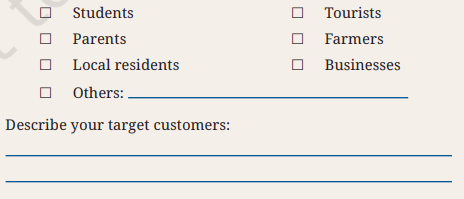
Answer:
Who will buy your product or service?
The target customers will include students, parents, local residents, and other people who prefer healthy snacks.
Describe your target customers:
My target customers are people who want fresh, hygienic, tasty, and affordable food products. They may include students looking for snacks during breaks and families looking for convenient food options.
d. Market research
Find answers to the following questions about potential customers.
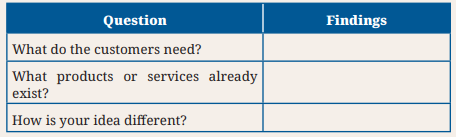
Answer:
| Question | Findings |
|---|---|
| What do the customers need? | Fresh, tasty, hygienic, and affordable snacks. |
| What products or services already exist? | Local snack shops, bakeries, and other food outlets. |
| How is your idea different? | The business focuses on healthier food options, freshness, and affordable prices. |
e. Product or service description
Describe your product or service. List its key features and benefits:
The business will sell fresh fruit bowls, sandwiches, and other healthy snacks. The products will be prepared hygienically, packed attractively, and sold at reasonable prices. The main benefits will be convenience, freshness, and a variety of food options.
f. Resources required
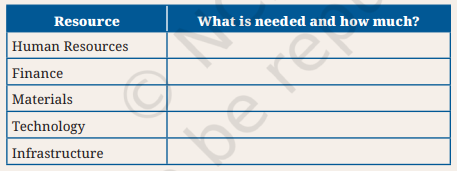
Answer:
| Resource | What is needed and how much? |
|---|---|
| Human Resources | Two workers to prepare and sell snacks. |
| Finance | ₹10,000 as initial investment. |
| Materials | Fruits, bread, vegetables, and packaging materials. |
| Technology | A mobile phone for taking orders and accepting digital payments. |
| Infrastructure | A small stall or counter and suitable storage facilities. |
g. Operations plan
How will the business work? Write the steps. You may depict this using a flow chart.
Answer:
- Purchase fresh ingredients from suppliers.
- Check the quality of the ingredients.
- Prepare snacks hygienically.
- Pack and display the products.
- Sell the products to customers.
- Record sales, expenses, and customer feedback.
h. Marketing plan
How will customers learn about your business?
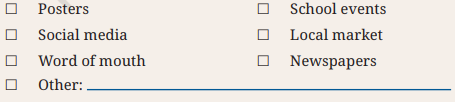
Answer: Customers will learn about the business through posters, social media, word of mouth, and school events. Special offers and attractive packaging will help attract customers. Good customer service and consistent quality will encourage repeat purchases.
i. Financial plan
Source(s) of finance:
Estimated monthly cost on various items:
| Item | Cost (₹) |
|---|---|
| Ingredients | 8,000 |
| Packaging | 2,000 |
| Rent and utilities | 3,000 |
| Other expenses | 2,000 |
| Total Cost | 15,000 |
Details of expected monthly revenue sources:
| Source of Income | Amount (₹) |
|---|---|
| Sale of fruit bowls | 10,000 |
| Sale of sandwiches | 12,000 |
| Sale of other snacks | 8,000 |
| Total Revenue | 30,000 |
Expected Profit: Revenue − Cost
₹30,000 − ₹15,000 = ₹15,000 per month
j. Risks and challenges
What challenges might your business face?
Answer: The business may face competition from other snack shops, rising ingredient costs, changing customer preferences, and food wastage. These problems can be managed through careful budgeting, proper inventory management, good-quality products, and customer feedback.
k. Social and environmental impact
How will your business help people or the environment?
Answer: The business will provide healthier food choices and create employment opportunities. It will try to reduce food wastage and use recyclable or environmentally friendly packaging materials. These practices can benefit customers and help protect the environment.
l. Conclusion
Why do you believe your business will succeed?
Answer: I believe this business will succeed because it offers fresh, healthy, and affordable snacks. Proper planning, good product quality, effective marketing, financial management, and customer satisfaction will help the business grow.
Q12. Visit a factory or a production unit.
Explore how a business operates by visiting a factory or production unit that manufactures a product. Prepare questions for the owner or manager, such as:
(a) What product does the factory produce?
Answer: The sample bakery production unit produces bread, cakes, pastries, and other bakery products.
(b) Who are its customers?
Answer: Its customers include local residents, families, students, shops, and other people who purchase bakery products.
(c) How did the business start?
Answer: A bakery business may start with a business idea, an initial investment, suitable equipment, raw materials, and a plan to produce and sell bakery products. The actual history should be recorded during the visit.
(d) What challenges did the business face in its early years?
Answer: Possible challenges include limited capital, difficulty attracting customers, competition, and the need to maintain consistent product quality. The actual challenges should be confirmed by speaking with the owner or manager.
(e) How does the business manage its finances?
Answer: The business can manage its finances by recording income and expenses, preparing a budget, controlling costs, tracking cash flow, and calculating profit or loss. These practices help the owner understand the financial performance of the business.
(f) How are employees recruited and trained?
Answer: Employees may be recruited according to the skills required for different jobs. They can be trained in production methods, hygiene, equipment use, quality standards, and customer service.
(g) How are products supplied to wholesalers, retailers, or consumers?
Answer: Products are prepared, checked for quality, packed, and then supplied to wholesalers, retailers, or consumers. Proper storage and timely delivery help maintain product quality.
During the visit, observe the production process carefully. Note the resources used, such as raw materials, machinery and technology, workers, and managers. Interact with the owner or manager and record key information. Take notes and photographs (if permitted).
(h) What resources are used in the production process?
Answer: The bakery uses raw materials such as flour, sugar, and other ingredients; machinery such as ovens and mixers; workers; managers; electricity; and suitable infrastructure. These resources help produce and deliver bakery products.
After the visit
(i) Understand the manufacturing process and create a process map showing the journey of the product from raw materials to the final customer.
Answer:
Raw material purchase → Inspection of materials → Preparation and mixing → Baking → Quality checking → Packaging → Storage → Distribution → Final customer
Identify barriers to growth, such as:
Answer:
1. Financial barriers: Lack of capital, difficulty obtaining loans, or insufficient funds for expansion.
2. Technical barriers: Outdated machinery or limited access to modern technology.
3. Human resource barriers: Shortage of skilled workers or difficulty hiring and retaining employees.
4. Market barriers: Strong competition or limited access to suppliers and customers.
5. Regulatory barriers: Complex procedures, licences, approvals, or paperwork.
Recommend some practical solutions through which the business could overcome these challenges. Share your findings by preparing a presentation and a report highlighting your observations, analysis, and recommendations. The format of the report may be as follows:
Recommend practical solutions through which the business could overcome these challenges.
Answer:
The business should prepare a proper financial plan, control unnecessary expenses, and explore suitable sources of funding. It should upgrade machinery when possible and train employees to improve productivity. Better marketing, online sales, and good customer service can help reach more customers. The business should also complete the required paperwork and follow applicable regulations.
After the factory visit, prepare a presentation and a report highlighting your observations, analysis, and recommendations. The format of the report may be as follows:
(a) Introduction
Answer: I visited a bakery production unit to understand how a business operates. The purpose of the visit was to learn about production, resources, financial management, employees, and the challenges faced by a business. The visit helped me understand the importance of planning and coordination.
(b) Production or service delivery process (with diagrams or flowcharts)
Answer: The bakery purchases raw materials, prepares the ingredients, bakes the products, checks their quality, packs them, and supplies them to customers.
Flowchart:
Raw materials → Preparation → Baking → Quality checking → Packaging → Distribution → Customers
(c) Resources required
Answer: The bakery requires raw materials, machinery, electricity, workers, managers, money, and suitable infrastructure. Equipment such as ovens and mixers helps in production. Skilled workers ensure proper hygiene, quality, and timely completion of work.
(d) Barriers identified (supported by observations or evidence)
Answer: Possible barriers include a shortage of funds, outdated machinery, a lack of skilled workers, competition, and difficulties in obtaining necessary approvals. These barriers may increase costs and affect business growth. Actual observations and statements from the owner should be included in the final report.
(e) Suggested solutions
Answer: The business should manage its finances carefully, invest in suitable technology, and train employees. It should improve marketing, maintain product quality, and develop better ways to reach customers. It should also follow the required rules and procedures to avoid regulatory difficulties.
(f) Reflection: Key lessons learned from the visit
Answer: The visit taught me that a successful business requires planning, teamwork, financial management, skilled employees, and effective marketing. Every functional area contributes to the smooth functioning of the business. I also learned that entrepreneurs must identify challenges, manage risks, and find practical solutions to achieve growth.
The Big Questions (Page no. 125)
1. How does entrepreneurship impact society and the economy?
Answer:
Entrepreneurship creates employment opportunities, encourages innovation, and promotes economic growth. It helps solve real-world problems by introducing useful products and services. It also empowers communities, supports sustainability, and encourages self-reliance. In this way, entrepreneurship contributes to the development of society and the economy.
2. What are some functional areas of a business?
Answer:
Some important functional areas of a business are finance and accounting, human resources, operations and production, marketing and sales, and research and product development. Finance manages money, while human resources looks after employees. Operations and production manage the making of goods or delivery of services. Marketing and sales promote and sell products, while research and product development help improve existing products and create new ones. All these areas work together for the success of a business.
3. How to develop a business plan?
Answer:
To develop a business plan, first identify the business idea and the target customers. Research the market and competitors, and describe the product or service you want to offer. Then identify the resources required and prepare plans for operations, marketing, and finance. Finally, consider possible risks and the social and environmental impact of the business. The business plan should be reviewed and updated when market conditions, customer preferences, costs, or other challenges change.

Leave a Reply