Elections
Questions and activities
Q 1. What reforms have been introduced by the ECI to make voting more inclusive for the following groups?
a. People with Disabilities
Answer:- The ECI introduced EVM with Braille and the Saksham App for easing voter identification and registration with customised services. Voting from home was extended for PwDs with a benchmark disability of 40%.
b. Service Voters
Answer:- The ECI introduced ETPBS (Electronically Transmitted Postal Ballot System) which enables service voters to cast their vote on an electronically received postal ballot from outside their originally assigned voting constituency.
c. Senior Citizens—60 years and above; and 80 years and above
Answer:- Voting from home was extended for senior citizens above 85 years of age. Initiatives focus on infrastructure accessibility and technology-assisted inclusion for senior citizens.
d. Prisoners
Answer:- No specific reform mentioned.
e. Persons in preventive detention
Answer:- No specific reform mentioned.
Q 2. What are the various functions of the Election Commission of India? Which of these functions is most important for the conduct of free and fair elections? Explain.
Answer:- The various functions of the Election Commission of India (ECI) are:
- Preparing and updating the electoral roll so that all eligible voters (above 18 years) can vote and ineligible names are removed.
- Deciding the dates and schedule for elections.
- Registering political parties and giving them election symbols.
- Supervising and controlling the entire election process.
- Making elections free and fair by using technology and special initiatives for inclusive voting.
The most important function for free and fair elections is ensuring free and fair elections. It is important because it builds trust in the system, stops unfair practices, makes sure everyone can vote easily, and keeps elections transparent and honest. Without this, elections would lose their real democratic value.
Q 3. Elections are the soul of a democracy. Do you agree? Why or why not?
Answer:- Yes, I agree that elections are the soul of a democracy.
Elections are essential because:
- They allow citizens to choose their representatives through periodic and regular elections.
- They make elected representatives accountable to the people.
- They ensure popular sovereignty and give power to the people.
- They provide legitimacy to the government.
- Without elections, there would be no real participation, representation, or accountability in a democracy.
Thus, elections are at the core of democratic functioning.
Q 4. Explain at least three differences between the national and state/regional political parties.
Answer:- Here are three main differences between national and state/regional political parties:
1. Geographical Spread: National parties operate across the country in several states, while state/regional parties are mainly active in one state or a few states.
2. Recognition Criteria: National parties must secure at least 6% of valid votes in Lok Sabha or Assembly elections in four or more states and win seats in multiple states. State parties need to meet similar vote percentage but only in their state and win a certain number of seats in that state.
3. Election Symbols: National parties get exclusive symbols that cannot be used by others anywhere in the country, while state parties get symbols that are reserved only in their state.
Q 5. Why should you vote? Arrange the following in the descending order of your choice. Discuss the reasons for your choice.
a. Opportunity to choose my representative
b. Makes me a responsible person
c. Opportunity to change the non-performing representative
d. Strengthens democracy
Answer:- My order (descending):
d. Strengthens democracy
a. Opportunity to choose my representative
c. Opportunity to change the non-performing representative
b. Makes me a responsible person
Reasons:
- Strengthens democracy is most important because voting is the foundation of democracy. It gives power to the people and keeps the system alive.
- Opportunity to choose my representative comes next as it allows us to select the best person to speak for us.
- Opportunity to change the non-performing representative is important because it makes leaders accountable.
- Makes me a responsible person is also valuable as it develops good citizenship, but it is a personal benefit.
Q 6. What is the Special Intensive Revision (SIR) initiative of the ECI? Explain the objectives and the necessity of conducting SIR.
Answer:- The Special Intensive Revision (SIR) is an initiative of the Election Commission of India (ECI) to update, verify, and correct the electoral rolls.
Objectives:
- To add names of all eligible voters, especially young voters who have turned 18.
- To delete names of ineligible persons (due to death, change of residence, duplicate enrollment, or being untraceable).
- To give time for claims and objections before finalising the electoral roll.
Necessity:
SIR is necessary to ensure that only eligible citizens are in the voters’ list and no one is left out. This makes elections fair, accurate, and inclusive. Without it, many people may not be able to vote or ineligible persons may vote, which weakens democracy.
Q 7. Match the political party name with its symbol.
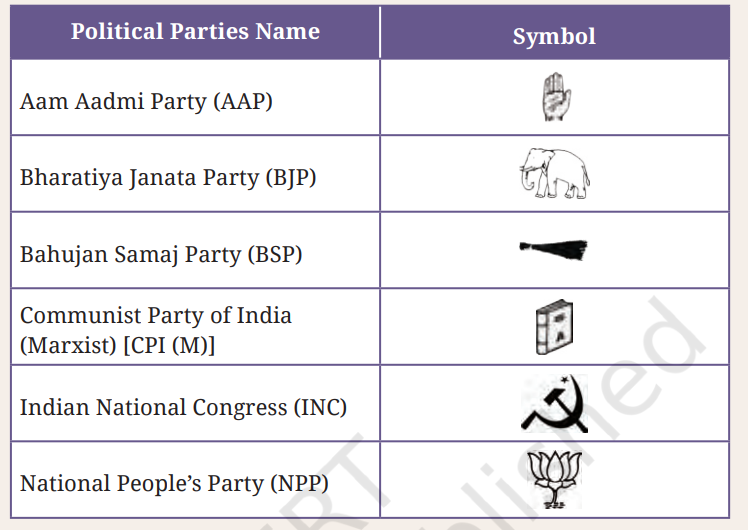
Answer:-
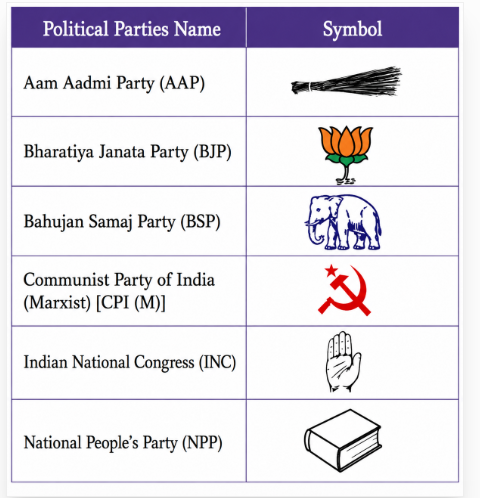
Q 8. Read the case study… and answer the following questions.
Ishani and her mother were in the local market, day before the state assembly elections. She noticed wall writing and campaign posters pasted everywhere. Large groups of campaigners were distributing pamphlets and raising slogans in support of the respective candidates. Ishani has turned 18 and will be voting for the first time. She had registered to vote through the ECI’s online portal. The next morning, she, along with her mother and her disabled elder brother, went to the polling station, which was well guarded by the police personnel. A wheelchair was made available to them, and volunteers guided them to the polling booth. Inside the polling booth, there were only three people who were performing all duties. Ishani had forgotten her voter ID card and Aadhaar card, but she was surprised as no one asked for them. After casting her vote, she was also able to see the VVPAT slip. While leaving, she wondered how the police personnel vote, as they must be on duty from early morning till late evening. When she went home, she narrated her entire experience to her 89-year-old grandmother, who cast her vote from home.
a. What initiatives were taken by the ECI to enable the voters to cast their vote?
Answer:-
- Wheelchair made available for the disabled brother.
- Volunteers guided them to the polling booth.
- Voting from home for senior citizens (grandmother, 89 years old).
- Use of VVPAT for verification.
b. If Ishani was allowed to vote even without carrying her Voter ID card or Aadhaar card, which other document might she be carrying that is valid for voting?
Answer:- She might have carried her Electoral Photo Identity Card (EPIC) or other documents approved by ECI such as Passport, Driving Licence, etc. (as per ECI rules).
c. Cite the examples of violations of the Model Code of Conduct.
Answer:-
- Wall writing and campaign posters pasted everywhere.
- Large groups of campaigners distributing pamphlets and raising slogans in the local market (close to polling day).
d. Give a suitable title to the passage.
Answer:- “My First Voting Experience” or “A Day at the Polling Booth – Inclusive Elections”.
e. Find out how the police and army personnel cast their votes.
Answer:- They can vote using the Electronically Transmitted Postal Ballot System (ETPBS) or postal ballots as service voters.
Q 9. A comparative chart of three countries is given below. Based on the information given in the chart, answer the questions.
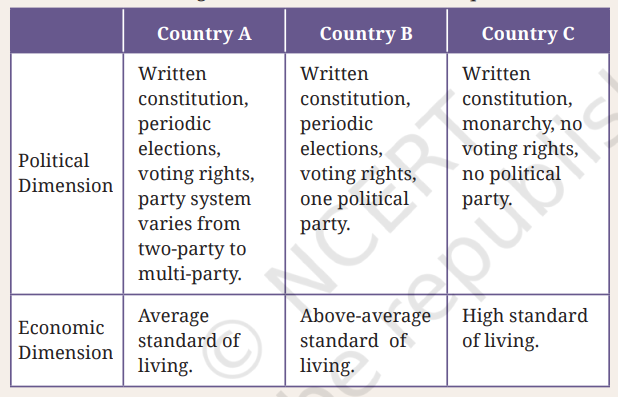
a. What is the difference between having a voting right in a country with a multi-party system and another with a single-party system?
Answer:- In a country with a multi-party system (Country A), people have a real choice. They can vote for different parties with different policies and ideas. This makes democracy meaningful and gives better representation.
In a country with a single-party system (Country B), even if voting rights exist, there is only one party. People do not have a real choice, and the same party always wins. Voting becomes less effective.
b. In which of the above countries would you like to stay and why?
Answer:– I would like to stay in Country A.
Why?
- It has a written constitution and periodic elections.
- It follows a multi-party system which offers real choice to voters.
- People have voting rights and an average standard of living. This makes it a proper democracy where citizens can participate freely and change the government if needed. Country C has no voting rights and Country B has only one party.
Q 10. What are the challenges to conducting free and fair elections?
Answer:– The main challenges to conducting free and fair elections are:
- Money and Muscle Power: Rich candidates and criminals use money and force to influence voters.
- Criminalisation of Politics: Candidates with criminal backgrounds contest elections.
- Misuse of Government Machinery: Ruling parties sometimes use official resources for campaigning.
- Fake News and Misinformation: Spread of false information through social media influences voters.
- Low Voter Turnout: Many eligible citizens do not vote due to lack of awareness or apathy.
- Influence of Caste, Religion, and Money: Voters are sometimes influenced by narrow identities instead of issues.
These challenges weaken democracy and reduce public trust in the electoral process. The ECI tries to control them through strict rules and monitoring.
Q 11. On the Stage.
Elections are to be held in your school for the posts of Head Girl, Head Boy, and Sports Captain. Assume the roles of an Election Commissioner, Returning Officer, Polling Agent, Candidate, Campaigner, Polling Officer, Police Personnel, and a Journalist, and perform their roles while ensuring free, fair, and transparent elections.
Answer:-
Title: Conducting School Elections – A Model of Free and Fair Process
As a student, I performed the following roles:
- Election Commissioner: I announced the election dates, rules, and Model Code of Conduct. I ensured no unfair campaigning.
- Returning Officer: I checked nomination forms and allotted symbols to candidates.
- Polling Officer: I verified student identity at the booth and helped maintain secrecy while voting.
- Polling Agent: I observed the voting process on behalf of my candidate.
- Candidate (Head Girl): I gave a speech about improving school facilities and discipline.
- Campaigner: I encouraged students to vote responsibly without forcing anyone.
- Police Personnel: I maintained order and prevented disturbance near the polling area.
- Journalist: I interviewed voters and wrote a fair report on how the elections were conducted.
Conclusion:- By playing these roles honestly, we learnt that free and fair elections need rules, transparency, and active participation from everyone. This strengthens democracy even at the school level.
13. Select one national or state political party. Using authentic and reliable sources such as the Election Commission of India (ECI) website, the official website of the selected political party, and newspapers. Prepare a comparative chart of the last two State Legislative Assembly elections. The chart should include the following details for the chosen party:
a. Some promises made in the Election manifesto
b. Percentage of votes polled
c. Number of seats won
d. Number of women who contested
e. Number of women candidates elected
Present the data for both elections in a clear and comparative format, citing all sources used.
Answer:- Chosen Party: Bharatiya Janata Party (BJP) – National Party
State: Uttar Pradesh (for example)
| Particulars | 2017 Assembly Election | 2022 Assembly Election |
|---|---|---|
| a. Some promises in Manifesto | Good governance, law and order, free ration, electricity for all | Women safety, investment, development for all sections |
| b. Percentage of votes polled | 39.7% | 41.3% |
| c. Number of seats won | 312 | 255 |
| d. Number of women who contested | 42 | 55 |
| e. Number of women candidates elected | 38 | 42 |
Sources:
- Election Commission of India (ECI) official website
- BJP official website and election manifestos
- Reports from The Hindu and Indian Express newspapers
This chart helps us compare the party’s performance in two elections. Students should select their own state and verify latest data from ECI website.
14. Do you think ‘One Nation, One Election’ can improve the efficiency of the electoral process? Divide the class and discuss into two groups—one to examine its potential advantages and the other to analyse its limitations.
Answer:- Yes, ‘One Nation, One Election’ can improve efficiency, but it also has limitations.
Advantages (Group 1):
- Saves huge money and resources spent on frequent elections.
- Reduces disruption to governance and development work.
- Allows governments to focus on long-term policies instead of constant campaigning.
- Increases voter turnout as people vote once for all levels.
Limitations (Group 2):
- It may reduce accountability as state and national issues get mixed.
- Regional parties may lose importance.
- If central government falls, all elections may need to be held again.
- Logistical challenges in a large country like India.
Conclusion: One Nation, One Election can make the process more efficient, but careful planning is needed to protect federalism and democratic values.
The Big Questions (Page 161)
1. Why are elections essential to a democratic system?
Answer:- Elections are essential because they are the core of democracy. They allow citizens to choose their representatives through periodic elections. Elected representatives are accountable to the people. Without elections, people cannot exercise their right to participate in decision-making or hold governments accountable. Regular elections ensure legitimacy, representation, and the right to change non-performing governments.
2. How do electoral systems and rules shape political representation and fairness?
Answer:- Electoral systems decide how votes are converted into seats. India uses the First-Past-The-Post (FPTP) system for Lok Sabha and Vidhan Sabha elections, where the candidate with the most votes wins. This gives clear winners but may not always reflect the exact proportion of votes. Proportional Representation (used for Rajya Sabha and President) gives seats in proportion to votes. Rules like universal adult franchise and reservation of symbols ensure fairness and representation of diverse voices.
3. What role do institutions and laws play in ensuring free and fair elections?
Answer:- Institutions like the Election Commission of India (ECI) supervise, direct, and control elections. Laws such as the Representation of the People Act, 1950 and 1951 govern electoral rolls, nominations, campaigns, and disputes. The Delimitation Commission ensures equal representation. Together, they maintain integrity, transparency, and accountability in the electoral process.
4. What challenges do elections face in practice, and how can these challenges affect democracy?
Answer:- Challenges include money and muscle power, criminalisation of politics, misuse of government machinery, fake news, and low voter awareness. These can lead to unfair elections, reduce public trust, weaken accountability, and harm the democratic spirit by favouring the powerful instead of the people’s will.

Leave a Reply