The Price Puzzle: What Drives the Market
Questions and activities
1. An increase in income always leads to a rise in demand for goods. Defend or refute, giving reasons for the same.
Answer:- We refute the statement.
When household income rises, consumers can afford to buy more goods or choose higher-quality products. A rise in income generally makes people feel more confident about spending, so the quantity demanded for many goods increases even if their prices stay the same.
However, an increase in income does not always lead to a rise in demand for all goods. Demand also depends on other factors like tastes and preferences of buyers, prices of related goods, seasonality, and future expectations. Therefore, the statement is not always true.
2. If petrol prices double, what happens to
a. Demand for diesel cars
b. Demand for electric cars
c. Demand for car accessories
d. Demand for public transport
Answer:-
a. Demand for diesel cars may increase because people may switch to diesel cars as they can be a relatively cheaper alternative in terms of running cost.
b. Demand for electric cars may increase as they become a good substitute for petrol cars to avoid high fuel expenses.
c. Demand for car accessories may decrease because higher petrol prices can reduce the overall use of private cars.
d. Demand for public transport may increase as people look for cheaper travel options instead of using petrol vehicles.
3. A farmer traditionally irrigates fields manually (labour-intensive). He installs drip irrigation (a technology upgrade) that reduces water use by 40 per cent and increases yield by 30 per cent. How does this affect
a. His cost of production
b. His willingness to supply at different prices
c. The overall market supply if many farmers adopt this technology
Answer:-
a. His cost of production decreases because the drip irrigation technology reduces water use and improves efficiency.
b. His willingness to supply at different prices increases. Lower cost of production improves his profitability, so he is willing to supply more at the same or even lower prices.
c. The overall market supply increases. If many farmers adopt this technology, total production of crops rises, leading to greater supply in the market.
4. During online festival sales, the prices of many products are very low. Use the concept of demand and supply to explain why the sellers sell at such a low price. What happens to the equilibrium when the price is lowered? Does this benefit only consumers or sellers as well? Explain.
Answer:- Sellers reduce prices during online festival sales to attract more buyers and increase the quantity demanded. According to the Law of Demand, when the price of a product falls, the quantity demanded rises.
When the price is lowered, the market moves towards a new equilibrium with a higher quantity sold. This helps sellers clear their stock faster.
This benefits both consumers and sellers. Consumers get products at lower prices, while sellers benefit from higher sales volume and increased total revenue even at lower prices per unit.
5. Suppose the government sets a maximum sale price for an essential vaccine below the market-driven price. What is likely to happen? Choose from the options below and elucidate your point.
a. Surplus b. Shortage
c. No effect d. Fall in demand
Answer:- b. Shortage
When the government sets a maximum sale price (price ceiling) below the market equilibrium price, the quantity demanded becomes greater than the quantity supplied. This creates a shortage of the essential vaccine in the market. Producers may supply less because the price is too low, while more consumers want to buy it at the cheaper controlled price.
6. The government levies higher taxes on products such as tobacco and alcohol to promote healthier choices among citizens. Can you find out other goods where price controls have been set in place? What are the reasons for the same?
Answer:- The government sets price controls on essential goods like medicines. It imposes a maximum price (price ceiling) on medicines to prevent overcharging.
Reasons:
- To protect consumers from exploitation.
- To ensure essential goods remain affordable for all, especially vulnerable and low-income groups.
- To promote fairness and equity in the market.
- To safeguard public welfare when markets fail to provide fair outcomes.
7. Can excessive government regulation hurt markets? Explain with suitable examples.
Answer:- Yes, excessive government regulation can hurt markets.
Explanation with examples:
- Price distortions and reduced producer incentives: If the government fixes prices below the market level (e.g., setting a low maximum price for wheat), farmers may lose motivation to produce more. This can lead to reduced production and shortages.
- Compliance burdens: Too many rules, licenses, and permits make it difficult for small businesses to operate. For example, a small restaurant may need multiple permissions for food safety, fire safety, and pollution control, increasing costs and time. This hampers the ease of doing business.
- Discourages innovation and entrepreneurship: Heavy regulation reduces the incentive for producers to invest in new technology or better methods. Farmers may not adopt improved seeds or irrigation if they cannot earn adequate returns.
Thus, while some regulation is necessary, excessive intervention can harm market efficiency and growth.
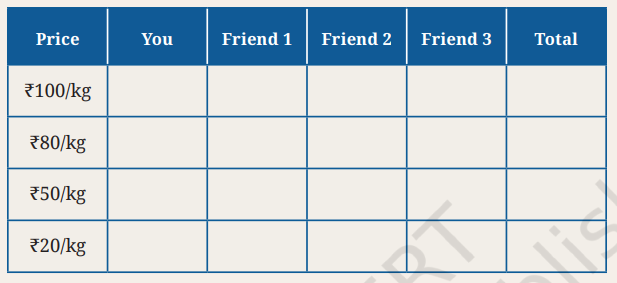
8. In the table below, different prices of guava are given.
a. Think and write how much guava you will buy at each price.
b. Ask the same question to three of your friends and fill in the table.
c. Also make a graph for each one of you and one final graph for the total quantity.
Answer:-
| Price | You | Friend 1 | Friend 2 | Friend 3 | Total |
|---|---|---|---|---|---|
| ₹100/kg | 1 kg | 0 kg | 1 kg | 2 kg | 4 kg |
| ₹80/kg | 2 kg | 1 kg | 2 kg | 3 kg | 8 kg |
| ₹50/kg | 3 kg | 2 kg | 3 kg | 4 kg | 12 kg |
| ₹20/kg | 5 kg | 4 kg | 5 kg | 6 kg | 20 kg |
9. Visit the nearby vegetable market and try to find answers to the following questions.
a. Who decides the prices of different vegetables in the vegetable market?
b. Sometimes the prices of a few vegetables is too high, and sometimes too low. Why is this?
c. The price of tomatoes is high in the morning and eventually gets lower by the evening. Have you ever noticed this? Comment.
Answers:-
a. The prices of different vegetables in the vegetable market are decided by the interaction of demand and supply forces among buyers and sellers.
b. Sometimes the prices of a few vegetables are too high and sometimes too low because prices react to changes in demand and supply. Factors such as seasons, availability of supply, festivals, trends, weather, time of day, and consumer preferences influence demand and supply, causing price fluctuations.
c. Yes, this is commonly noticed. The price of tomatoes is high in the morning due to higher demand (fresh supply and more buyers early in the day). By evening, demand decreases or leftover supply increases, leading to lower prices. This shows how demand and supply determine prices in real markets.
10. Categorise the following combination of goods into substitute goods and complementary goods.
a. Movie ticket in the cinema hall and popcorn
b. Eraser and pencil
c. Laptop and computer
d. Air Conditioner and cooler
e. Notebook and pen
f. Apple and banana
g. Mobile and earphones
Answer:-
Substitute Goods (These goods can replace each other):
c. Laptop and computer
d. Air Conditioner and cooler
f. Apple and banana
Complementary Goods (These goods are used together):
a. Movie ticket in the cinema hall and popcorn
b. Eraser and pencil
e. Notebook and pen
g. Mobile and earphones
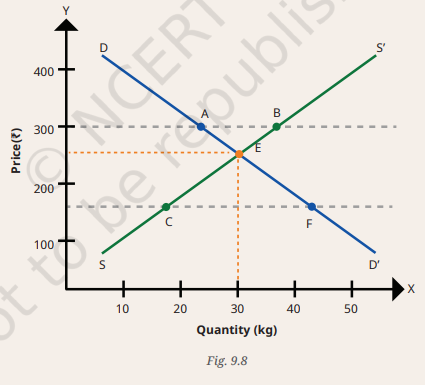
11. Fig. 9.8 shows the demand curve DD’ and Supply curve SS’.Based on the figure, answer the following questions:
a. What does point E represent in this market?
b. What is the equilibrium price and equilibrium quantity at point E?
c. Point A lies on DD’. Point B lies on SS’. What do the points A and B indicate about demand and supply? What does the gap between A and B (both on the upper dashed price line) represent?
d. Point F lies on DD’. Point C lies on SS’. What do the points F and C indicate about demand and supply? What does the
gap between C and F (both on the lower dashed price line) represent?
e. If the price stays at the lower dashed line, what could happen next in a free market?
Answers:-
a. Point E represents the market equilibrium point in this market.
b. At point E, the equilibrium price is ₹300 and the equilibrium quantity is 30 kg.
c. Point A (on DD’) indicates the quantity demanded at the higher price. Point B (on SS’) indicates the quantity supplied at the higher price.
The gap between A and B represents excess supply (surplus) at the price of ₹300 (above equilibrium).
d. Point F (on DD’) indicates the quantity demanded at the lower price. Point C (on SS’) indicates the quantity supplied at the lower price.
The gap between C and F represents excess demand (shortage) at the price of ₹200 (below equilibrium).
e. If the price stays at the lower dashed line (₹200), there will be excess demand (shortage). In a free market, the price will rise due to competition among buyers until it reaches the equilibrium price at point E.
The Big Questions (Page 195)
1. What are the factors that influence the demand for and supply of goods and services in a market?
Answer:- The demand for goods and services is influenced by price, prices of related goods (substitutes and complementary goods), income of consumers, tastes and preferences, population, seasonality, and future price expectations. The supply of goods and services is influenced by price, prices of related goods, number of sellers, technology, and future expectations of producers.
2. How are prices of goods and services determined through demand and supply interactions?
Answer:- Prices are determined by the interaction of demand and supply. When demand is greater than supply, prices rise. When supply is greater than demand, prices fall. When the quantity demanded equals the quantity supplied, the market reaches equilibrium, and the price becomes stable.
3. What is market equilibrium, and does it exist in the real world?
Answer:- Market equilibrium is the point where the quantity demanded equals the quantity supplied, so there is neither a shortage nor a surplus. In the real world, equilibrium is not permanent because changes in technology, income, weather, trends, interest rates, political events, pandemics, and other factors continuously change demand and supply, causing the market to adjust to a new equilibrium.
4. How and why does the government intervene in the market?
Answer:- The government intervenes in the market to protect consumers, workers, and producers from unfair practices, regulate monopolies, ensure fair prices through price ceilings and price floors, and provide public goods and services such as roads, parks, sanitation, and national defence. Government intervention helps promote fairness, social welfare, and equal access to essential goods and services, although excessive regulation may also create problems

Leave a Reply