The world is rapidly evolving, and businesses need to adapt more rapidly than ever.
As consumers demand more sustainable, tech driven solutions, businesses need leaders who are responsive, adaptable and, above all, confident in their management.
We’re helping to build the next generation of business leaders who understand how to lead, collaborate and connect both within their organisations and with stakeholders.
When you study a Bachelor of Business, major in Management at MIT, you’ll learn what it means to be innovative and creative in a business environment, with the marketing, finance and tech skills to back up your plans.
LEARN TO LEAD HIGH PERFORMING BUSINESSES
Get the edge in today’s challenging and competitive business environment. Learn the art and science behind what it takes to succeed in leadership, project management, strategic decision-making and human relations.
The field of business management exposes you to new challenges and develops the skills you need to become a future-driven leader.
MIT School of Business gives you the skills and accreditations future employers are looking for. The key areas of study include management theory and practice, human resource management, budgeting and planning, organisational behaviour, change management, leadership skills, strategic management, knowledge management and international business.
THIS COURSE INCLUDES:
PRACTICAL EXPERIENCE
We put theory into action at every stage. This keeps things exciting and prepares you for the workplace.
SKILLS FOR TOMORROW
Get ready to lead in the rapidly changing world of business with the skills to adapt and respond quickly.
PROBLEM SOLVING
Analyse, predict and respond to challenges with innovation and insight.
DESIGN YOUR LEARNING
Choose electives from marketing, accounting, or entrepreneurship to create your dream career path.
READY TO LEAD
Graduate with the analytical skills and knowledge to build processes that drive change in business.
GLOBAL KNOWLEDGE
Be prepared for the challenges of working in an increasingly connected and global economy.
CAREER PATHS
Graduates of the Bachelor of Business, major in Management can go on to get employment in leading organisations and growing industries. If you have an entrepreneurial spirit, the course will equip you with skills to start your own business. Or you might find employment in entry-level positions within a wide range of public and private enterprises.
Career roles include:
Office Administrator
General Manager
Operations Manager
Human Resource Manager
Remuneration and Benefits Manager
Employee and Industry Relations Officer
Business Process Improvement Manager
Organisational Development Consultant
Corporate Planning Manager
Project Manager
Quality Assurance Manager
Risk Manager
Organisational Change Consultant
Business Analyst
Management Consultant
And more
COURSE LEARNING OUTCOMES
The Bachelor of Business, major in Business Analytics aims to provide graduates who will:
Be able to demonstrate a broad and coherent knowledge and skills in the principle and practice of management;
Have a strong understanding of the importance of leadership skill and negotiation skills and organisational dynamics;
Be able to work effectively in a team environment and communicate knowledge, skills and ideas to others in different contexts: organisational, industry and globally;
Be able to apply knowledge and skills to demonstrate autonomy, well-developed judgement and responsibility;
Be able to adapt successfully in a rapidly changing business environment;
Be able to analyse and evaluate and implement policies and strategies to achieve organisational short-term and long term goals and objectives;
Credit transfer provides students with credit for learning already achieved. Applicants are assessed on a case-by-case basis. Learn more about credit transfer.
Applications for credit transfer must be made before or during orientation and enrolment week.
Recognition of Prior Learning
Recognition of prior learning (RPL) allows students to gain credit towards their course based on their prior learning (including formal, informal and non‐formal learning). Applicants are assessed on a case-by-case basis. Learn more about credit transfer.
Applications for Recognition of Prior Learning must be made before or during orientation and enrolment week.
COURSE STRUCTURE
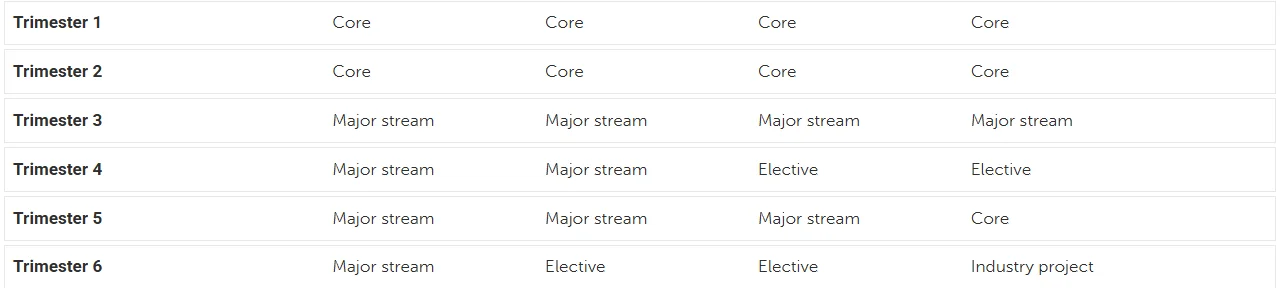
The Bachelor of Business, major in Management course comprises common core units, a major stream of management and elective units. To graduate from the degree students must complete 360 credit points overall. Each unit is worth 15 credit points, and full-time students undertake four units per trimester.
All students complete general business education in their first year before choosing a specialism.
As you progress through your course, your knowledge will become more focussed on your chosen major field. This is put into action in your final year industry-based project.
A typical course outline might look like:
Four units per trimester is a full time load. All units are the same weight.
Please note, the Industry Project is mandatory. During the project, a personal development session will be offered to help you source and execute the project.
If a third party is required to find a project, you will incur a fee. An indicative fee is $350 plus GST.
All Courses
About us
MIT is registered by Tertiary Education Quality and Standards Agency (TEQSA) as an Institute of higher education (TEQSA Provider Identification Number: 12138) and our courses are accredited by TEQSA. TEQSA is Australia’s independent national regulator of the higher education sector including public universities in Australia. TEQSA ensures that all public and private higher education providers meet the Higher Education Standards Framework or the Threshold Standards in order to be accredited to deliver tertiary level programs within Australia’s higher education system. MIT is also registered on the Commonwealth Register of Institutions and Courses for Overseas Students (CRICOS Provider No: 01545C, 03245K (NSW)) to provide courses for overseas students.
As a proprietary limited company, MIT is registered with the Australian Securities and Investments Commission (ASIC) and is established under a Constitution. A copy of the MIT Constitution is available upon request.
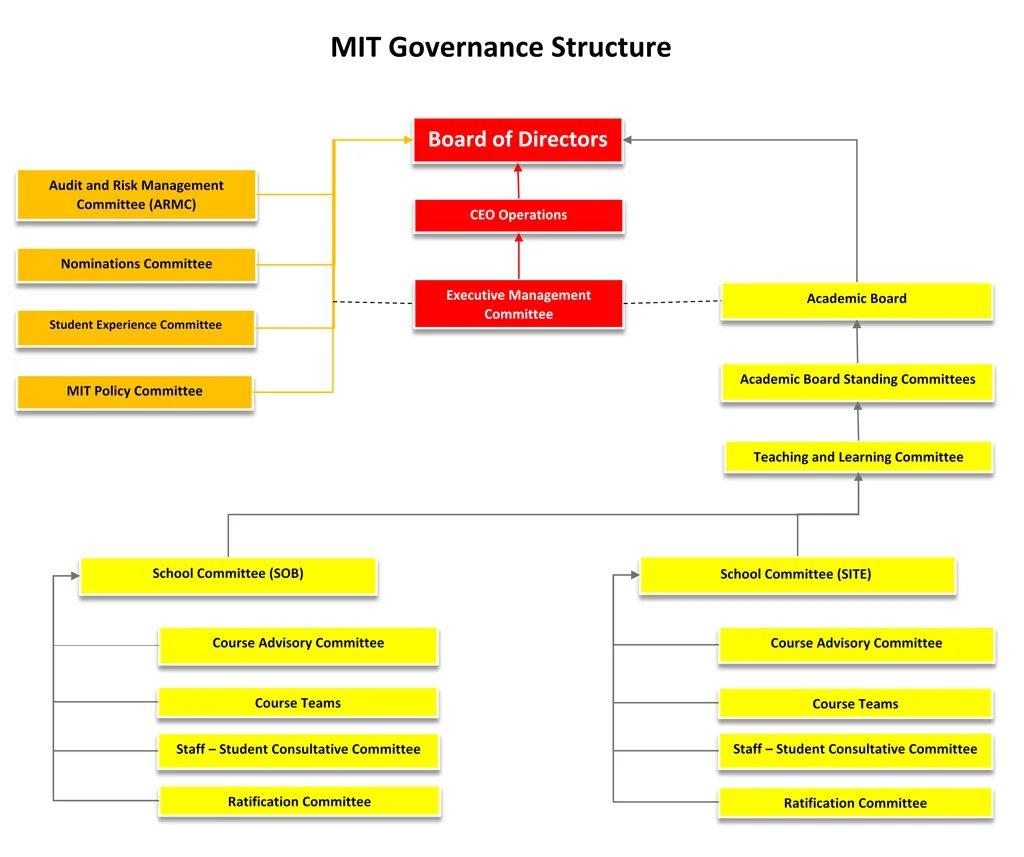
Our corporate and academic governance structures ensure that MIT is operating effectively and sustainably and that we maintain the highest standards in the quality of our teaching and learning. A high-level organisational chart of MIT can be found here.
MIT provides a suite of undergraduate and postgraduate coursework programs to domestic and international students in Business, Accounting, Information Technology, Computer Networking and Engineering (Telecommunications). In addition, the institute also offers NEAS endorsed English language programs through its English Language Centre.
MIT has two campuses, located in the heart of two of the most liveable cities of the world, Melbourne and Sydney. Aptly located in the heart of the CBDs, both the campuses are easily accessible by Public transport.
MIT believes that everyone deserves access to a tertiary education. When people make the choice to pursue a higher education, they are truly seeking to improve their situation. MIT proudly provides students with an opportunity to learn and better their job prospects and future career progression. Students are given access to a rigorous academic curriculum which is delivered by qualified academic and professional staff on a one-on-one basis. Additionally, a wide-range of personalised support services enhances student engagement and enables students to reach their full potential.
If you are thinking about quality education and personalised learning experience, we look forward to meeting with you.
MIT wishes you every success in the pursuit of your chosen career.
Welcome to MIT where both continuing and new students join in the search for academic success and enter into a life changing educational experience. MIT fully supports every student’s endeavour and assists in achieving their goals.
Improving our student experience and graduate outcomes remain a top priority at MIT. We have recently upgraded our support services including our industry internships, study skills programs, Buddy Programs and Mentoring Programs. I truly believe our success lies with the students’ success. When you become a MIT student you will be able to sign up for these services at no cost to enhance your learning and help achieve excellent grades.
MIT programs are continually being enhanced and updated to reflect changes in industry and to keep the programs up to date, motivational and interactive.
I look forward to seeing you on campus and am truly excited to see what we can accomplish together.
Dr. Shesh Ghale (h.c) Chief Executive Officer
Melbourne campus
Located in the centre of Melbourne Central Business District (CBD), the MIT Melbourne campus is the larger of the two campuses.
Situated among shops, restaurants, banks, post offices and entertainment outlets, close to parks and gardens, hospitals, the State Library of Victoria and the Queen Victoria Market, and with easy access to public transport, the MIT Melbourne campus offers the perfect balance between study, work and play.
Campus facilities and services include excellent teaching and learning facilities, modern computer labs, networking studio labs, wireless internet, a comprehensive library with the latest electronic information services, computer shop, student lounge, prayer room, campus security, first-aid facilities, career advisory, study support and counselling.
Programs offered at this campus include: Business, Accounting, Information Technology, Networking, Engineering and English Language.
Indicative Total Student Enrolments
As at the beginning of 2019, MIT had approximately 1,400 plus student enrolments at its Melbourne Campus.
Travelling to Melbourne campus & Map
MIT Melbourne campus is easily accessible by bus, train, tram or car. For Melbourne public transport information, please visit ptv.vic.gov.au/.
Sydney campus
The MIT Sydney campus is located in Sydney’s Central Business District (CBD) next to Darling Harbour, one of the city’s largest shopping, food and entertainment precincts. Located right in the heart of the City on Sussex Street, easily accessible by train- we are a few minutes’ walk from Wynyard and Town Hall stations.
MIT Sydney offers excellent teaching and learning facilities, that are modern, inviting, built for purpose and designed to be social. Students are exposed to all the benefits of the city, as the campus is surrounded by cafes, restaurants and shops.
Campus amenities and services include:
Modern computer labs
Wireless internet
Expansive modern library with the latest electronic information services
Quiet study areas
Student Lounges with built in charging ports
Centre of Learning
Counselling and Advocacy Services
Campus security and first aid room
Prayer room
Outdoor Courtyard with a recreational area.
Governance
The Board of Directors is the governing authority of MIT and is responsible for overseeing the higher education operations and the general direction and superintendence of the Institute. The board includes a majority of independent members along with representatives of the owners of the company and the executive management. External and internal members play a significant role in the Board with the external members bringing expertise and experience not represented in MIT. This is balanced by the presence of internal members who are the key internal stakeholders and these individuals where responsible for bringing MIT to the position it is today. In total, the Board ensures that MIT fulfills its responsibilities as detailed in its Vision and Goals statements, in addition to ensuring that MIT continues to meet its obligations and responsibilities as an Institute of higher education.
Standing committees of the Board have been established to provide the Board with advice and recommendations or to exercise specific powers delegated to them by the board.
The academic achievement scholarship is merit-based and is not available to new students. This scholarship will cover 30 per cent of program tuition fees.
MIT Undergraduate Second and Third-year Scholarship
This scholarship makes it easier to continue your studies at MIT and plan for your future. You’ll receive a one-unit fee waiver each trimester, equivalent to a 25% reduction in tuition fees.
Management is the process of planning, organising, directing, and monitoring the available company resources such as, human, financial, and technological resources, to accomplish company goals and objectives, efficiently and effectively.
What do Managers do?
Modern managers are leaders and also great team players. Managers are typically involved with forming visions, setting goals and objectives, formulating and executing strategies. They are involved in all aspects of business, from setting long-term strategic direction to day-to-day running of the organisation. They know what makes organisations successful and how to get the best out of people and other resources to improve performance and to achieve organisational goals.
What will I study?
The Management major prepares you for real-world business, whether you wish to start your own business or work for one. BBus (Management) focuses on critical challenges facing today’s managers, such as changing technology, increased globalisation, evolving regulatory environments, heightened competition, industry convergence, customer empowerment, cultural diversity and relationships between people and organisations.
The final year capstone industry-based projects will be on a real application in industry or an organisation. This project will allow you to bring together and strengthen the knowledge and skills you have gained during the course.
What jobs can I get with a Bachelor of Business, major in Management
Which major is the best for a Bachelor of Business?
All students complete a broad business units in the first year of study before confirming which major they want to select. This allows students to choose from a well-informed position.
Studying in Australia: Your Guide to Universities, Programs, and Student Visas
Australia is a popular destination for international students, offering quality education, diverse campuses, and vibrant cities. From affordable universities to top-ranked institutions, Australia has something for everyone. Here’s everything you need to know about studying in Australia.
Top Universities in Australia
Australia’s Top Universities
Australia is home to some world-renowned universities, consistently ranking among the best globally. Australian National University (ANU), University of Melbourne, University of Sydney, and University of Queensland are a few examples of prestigious institutions that attract international students.
QLD Universities
Queensland offers a range of universities, including Griffith University, James Cook University in Brisbane, and Central Queensland University. These institutions provide various programs suited to different interests and career paths.
Universities in Perth, Australia
Perth is a vibrant city with reputable universities such as Edith Cowan University (ECU), Murdoch University, and University of Western Australia. Known for their high quality of education, these universities offer excellent options for both local and international students.
University in Melbourne List
Melbourne is a hub for quality education with universities like Deakin University, University of Melbourne, and RMIT University, each offering diverse programs and a dynamic student life.
University in Brisbane, Australia
Brisbane hosts renowned institutions like Griffith University and James Cook University, providing a range of study options with excellent facilities and support for international students.
Universities in Sydney, Australia
Sydney is home to leading universities, including the University of Sydney, University of New South Wales (UNSW), and Macquarie University.
Affordable and Cheapest Universities in Australia
Cheapest University in Australia
For those on a budget, Australia offers affordable education options without compromising quality. Central Queensland University and Edith Cowan University are known for providing affordable programs.
Low-Cost Universities in Australia
Universities like Western Sydney University and Victoria University offer lower tuition fees, making education accessible for international students.
Affordable Universities in Australia
Many Australian universities provide scholarships and affordable courses. University of Sunshine Coast and Charles Darwin University are among those that offer value without high costs.
Popular Programs and Courses in Australia
Masters Degrees and Programs in Australia
Australia offers a wide range of master’s programs in fields like IT, business, engineering, and more. Universities such as University of Queensland and Monash University offer specialized programs designed to boost your career prospects.
MBA in Australia Cost
The cost of pursuing an MBA in Australia varies by institution, with top programs available at University of Melbourne and Australian Graduate School of Management (AGSM). While MBA programs can be expensive, many universities offer financial aid and scholarships.
Best IT University in Australia
Australia’s top IT programs can be found at institutions like University of Technology Sydney (UTS) and RMIT University, providing cutting-edge knowledge and skills for a career in tech.
MBBS Cost in Australia
Medical education in Australia is rigorous and offers high-quality training. The cost of an MBBS in Australia is typically high but provides excellent career opportunities globally.
Scholarships and Financial Aid
Scholarships in Australia for Indian Students
Many Australian universities offer scholarships specifically for Indian students. Scholarships can help reduce tuition costs, making education more accessible for international students.
Student Visas and Living Costs
Student Visas Australia
To study in Australia, you’ll need a student visa. The visa application process is straightforward, but it’s essential to meet the requirements for acceptance. Ensure you apply early to secure your visa on time.
Living Cost in Australia for International Students
Living expenses vary depending on the city. Major cities like Sydney and Melbourne are more expensive, while places like Brisbane and Perth offer more affordable options. On average, international students should budget for accommodation, food, and other personal expenses.
Universities by Location and Specialty
Griffith University (Queensland)
Known for its research and industry connections, Griffith offers a variety of programs in fields like health, business, and environmental studies.
Deakin University (Melbourne)
Deakin is popular among international students for its flexible learning options and strong support services.
James Cook University (Brisbane)
Located in Queensland, James Cook is recognized for its programs in tropical health, marine science, and environmental studies.
Edith Cowan University (ECU) (Perth)
ECU provides a range of programs and is known for its focus on teaching quality and graduate outcomes.
Murdoch University (Perth)
Murdoch offers a student-centered approach and is known for courses in law, psychology, and veterinary science.
List of Australian one of the Best Universities
For a complete list of universities, Australia has a diverse range of institutions across various cities. Here are some popular ones:
Central Queensland University: Known for affordability and strong industry ties.
University of Western Australia: Highly regarded for research and academic excellence.
CQ University: Offers practical, career-focused courses in multiple disciplines