Address: Gardens Point campus - 2 George St, Brisbane, QLD 4000Kelvin Grove campus - Level 4, X Block, Kelvin Grove Campus, Victoria Park Rd, Kelvin Grove, QLD 4059Postal address - GPO Box 2434, Brisbane, QLD 4001
Ideal for practising engineers who want management qualifications with advanced engineering skills and knowledge.
Develop the analytical tools and methods to improve efficiency within manufacturing and service organisations.
Study quality control, organisational infrastructure management, and development of decision support systems.
Learn about innovation, integration, continuous improvement of your organisation and how to improve competitive advantages.
International students can choose this course as part of our combined masters packages, which allow you to complete two master degrees in two years.
Why choose this course?
QUT’s Master of Engineering Management will deliver real world skills and knowledge for professional advancement.
You will gain technical skills in quality control and improvement, organisational infrastructure management (transportation, water, energy, buildings and telecommunications), and the development of decision support systems.
You will learn an integrated computer-based approach to monitor and manage internal and external resources of an organisation, including tangible assets, financial resources, materials and human resources. This approach facilitates the flow of information between all business functions inside the organisation and manages connections to outside stakeholders.
You will acquire knowledge in a range of strategies and practices used in an organisation to identify, create, represent, distribute and enable adoption of insights and experiences. These practices focus on organisational objectives such as competitive advantages, innovation, the sharing of lessons learned, integration and continuous improvement of the organisation.
What to expect
This course is designed for practising engineers to gain the specialist skills and advanced engineering knowledge required for leadership and management postitions in a diverse range of engineering roles. It will provide the analytical tools and methods required to improve operational efficiencies, typically within manufacturing and service organisations.
Careers and outcomes
The Master of Engineering Management allows graduates to become specialist engineering managers within their chosen professional field, particularly to become leaders and managers of engineering processes. Graduates can also use the skills and knowledge gained to diversify their capabilities across a broader spectrum of engineering disciplines.
Graduates will be capable of undertaking management-level roles in operations management, quality control management, logistics, supply chain management and other specialised engineering fields.
Possible careers
Infrastructure management
Logistics analyst
Manufacturing management
Operations manager
Course Structure
To graduate with a Master of Engineering Management you are required to complete 96 credit points (8 units) consisting of:
60 credit points of core engineering management postgraduate units, including advanced research skills and research based project units, a professional practice unit and an advanced discipline unit. Plus 36 credit points of advanced discipline and management units to be selected from a list of options.
All Courses
Entry requirement
You must have a recognised four-year full time (or equivalent) bachelor or bachelor honours degree in engineering with a minimum grade point average (GPA) of 4.00 (on QUT’s 7-point scale).
All Courses
Our university
Preparing you for tomorrow
We’re an ambitious and collaborative institution that seeks to equip our students and graduates with the skills they’ll need in an increasingly disrupted and challenged world.
Our university
Queensland University of Technology (QUT) is a major Australian university with a truly global outlook. Home to over 50,000 students, we’re providing real-world infrastructure, learning and teaching, and graduate skills to the next generation of change-makers.
Queensland University of Technology (QUT) is an ambitious institution, with a growing research output focused on technology and innovation. QUT ranks in the world’s top 200 universities.
Our strategic plan establishes QUT as ‘the university for the real world’ and charts our provision of transformative education and research that is relevant to our communities.
With more than 50,000 students across two inner-city campuses in Brisbane, QUT offers academic programs in fields spanning business, creative industries, education, engineering, health, law, science, and social justice.
Real-world university
We are transforming the learning experience, embedding work integrated learning, and focusing on developing entrepreneurial skills. We offer executive education and professional development through QUTeX, flexible learning through QUT Online, and pathways into our undergraduate programs through QUT College.
QUT is well-known for our strong links to industry and government, and our inter-disciplinary teams create high-impact research in areas as diverse as climate change mitigation, digital media, materials science, and biomedical innovation.
QUT is committed to embedding Indigenous Australian cultures, knowledges, and perspectives across everything we do, and through our Campus to Country strategy we are in the process of transforming our campuses to reflect the past and present culture of Indigenous Australians.
Faculties and schools
Explore our faculties and schools and the real-world learning experiences and research they are engaged in.
Connections
With a commitment to enhancing the staff and student experience and doubling Indigenous enrolments over the next five years, Connections – the QUT Strategy 2023 to 2027 – is a bold plan to transform the learning experience.
The strategy connects aspiration to opportunity for our students and staff, it expands pathways for our Indigenous Australian students, and it builds supportive research environments. The strategy outlines our ambition to enrol up to 60,000 students a year across our urban campuses in the next five years which will include rebuilding our international student base.
QUT will also develop a curriculum transformation approach that responds to demand from students to support their journey from high school to graduation and beyond and reinforces the value of professional connections within the curriculum.
Our strategic evolution
Connections – the QUT Strategy 2023 to 2027 – articulates our shared vision for the future of QUT – the university for the real world. Connections informs our renewed purpose – to provide transformative education, student experiences and research relevant to our communities.
Connections strengthens the commitment to Indigenous Australian Excellence as outlined in our most recent Blueprint 6 strategy.
The Blueprint had a strong focus on ensuring Aboriginal and Torres Strait Islander voices are heard, through increasing the Indigenous Australian staff and research focus and further developing Indigenous Australian researchers. It is also committed to increasing our Indigenous Australian student intake and providing dedicated support to Indigenous students.
The Indigenous artwork which features in Blueprint 6 is by Aboriginal graphic designer and artist Keisha Thomason. She is a proud Waanyi and Kalkadoon (Mount Isa, Queensland) and Chinese woman. Her artwork style is contemporary, influenced by her culture, identity and the modern world. We have continued that through Connections.
Our history
Although the name Queensland University of Technology has only been used since 1989, the institutions that came before have made us the university we are today.
The Brisbane campuses of QUT are situated on the land of the Turrbal and Yugara people. We acknowledge that these sites have historically been a place of teaching and learning.
We aspire to be the university of choice for Indigenous Australians, and we’re embedding Indigenous Australian culture into everything we do.
With more than 50,000 students and offering more than 200 courses and research programs, Queensland University of Technology (QUT) is a modern university for the real world.
We began operating as QUT in January 1989, following approval of our status as a university.
But our history truly begins in colonial times…
Brisbane School of Arts 1849
The Brisbane School of the Arts began as a place of recreation, with a library, public debates and lectures.
Eventually, the school developed a stronger educational focus, offering two drawing classes in 1881.
In 1882, the Brisbane School of the Arts became the Brisbane Technical College.
Brisbane Technical College 1882
Initially, only 80 students attended the Brisbane Technical College. After the economic depression of the early 1890s, enrolments rose to more than 1,000 students in 1897.
Brisbane Technical College was the largest institution in Queensland in the 19th century.
In 1908, the Queensland Parliament passed the Technical Instruction Act, and Brisbane Technical College became the Central Technical College.
Central Technical College 1908
Central Technical College became a key institution for apprenticeship and vocational training for both men and women, with courses such as mathematics, literature, healthcare, and industrial electronics.
After World War II, the college expanded to a site in South Brisbane. By the early 1960s, Central Technical College had more than 13,000 students and had further expanded its courses.
Eventually, the professional and technical courses offered at Central Technical College moved to the Queensland Institute of Technology.
Brisbane Kindergarten Training College 1911
Established in 1911 with an initial enrolment of five students, by 1929 the Brisbane Kindergarten Training College offered two separate courses.
By the end of the 1930s, student numbers had increased to 25, and in 1946 the college introduced a three-year course and the number of students steadily increased.
Brisbane Kindergarten Training College was renamed the Brisbane Kindergarten Teachers College in 1965.
Campuses and facilities
Gardens Point campus
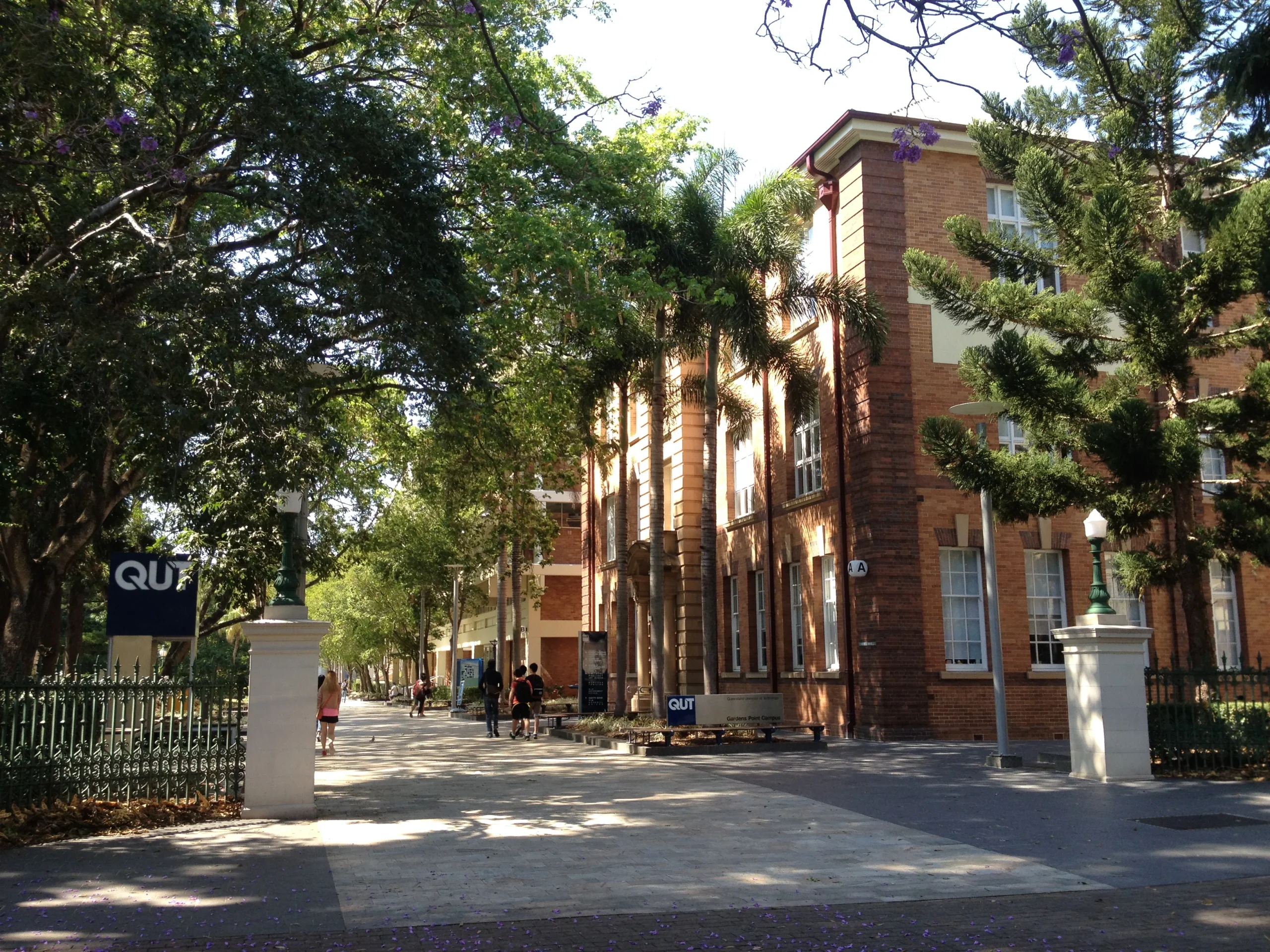
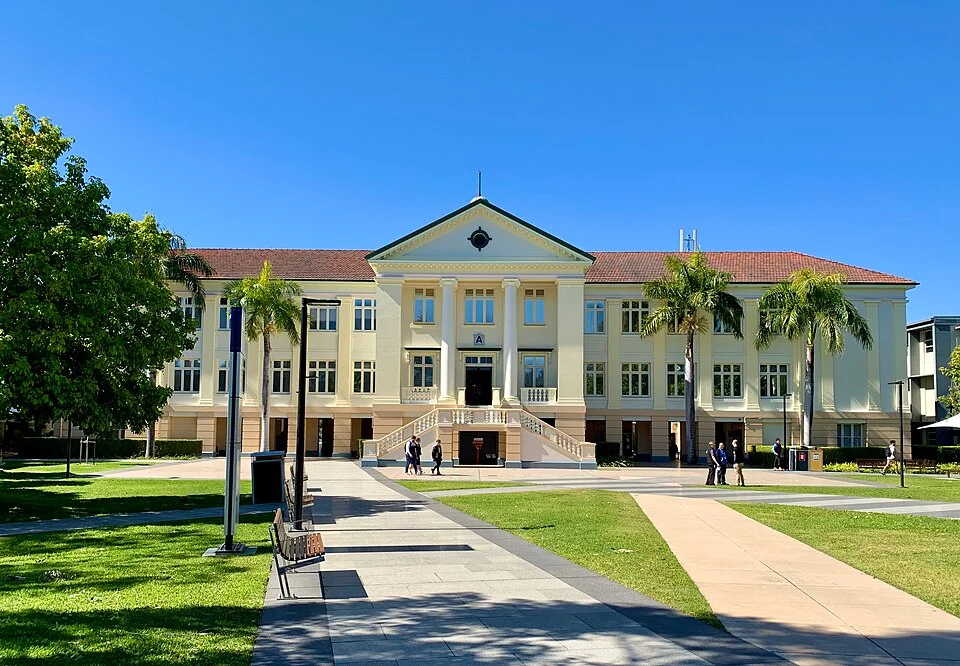
Our architecture and built environment, business, engineering, information technology, law, mathematics and science students are based at Gardens Point, right in the centre of Brisbane.
The main campus of our communication, creative industries, design, education, health and justice students, Kelvin Grove is located in the thriving Kelvin Grove Village.
You may be able to apply for scholarships that cover tuition fees for all or part of your course. If you receive a QUT-funded scholarship you won’t need to pay tuition fees for your research degree, if you complete your degree within:
a maximum of 4 years full-time (or equivalent) for doctoral students (PhD and professional doctorate)
a maximum 2 years full-time (or equivalent) for research masters students.
If you don’t receive a scholarship that covers your tuition fees, you must pay your fees directly to QUT before the start of each semester.
In 2025, the fee range for international full-fee paying students is $35,000-$43,000 annually (AUD) for research degrees and will increase to $37,600-$45,600 in 2026. To find more details check the costs in the course information.
We review fees annually.
Other study-related costs and living expenses
Your research degree may take a number of years to complete, so you need to consider your living expenses while you’re studying.
When you’re close to finishing your research, you may also need to pay for thesis proofreading and editing.
Centrelink payments
If you’re an Australian citizen or permanent visa holder and intend to apply for Centrelink payments while you study, it is important to check your eligibility first, as this will depend on your individual circumstances.
You must declare any scholarship income you receive to Centrelink as it may affect your payments.
We want to help our international students find appropriate financial aid, loans, grants, and other types of financial assistance available through government and private programs in Australia and their home countries.
Australia Awards
Australia Awards are a series of scholarships, fellowships, and grants aiming to promote knowledge, education links, and enduring ties between Australia and its neighbours.
Endeavour Awards and Fellowships are competitive, merit-based scholarships and fellowships providing opportunities for Australians to undertake study, research or professional development overseas, and for overseas citizens to do the same in Australia.
Research Training Program (RPT) grants support postgraduate research training in the higher education sector, and provide financial support to postgraduate students of exceptional research promise who undertake their higher degree by research (HDR) at an eligible Australian higher education provider (HEP).
You can indicate whether you would like QUT to consider pathway programs (Diploma, Foundation or English language) on the application form. You can select one of the searchable course packages. You can also request specific packaged offer by leaving a comment when submitting the student’s application. You will find this comment section at the end of the application form.
Application fee payment is done through the portal just as you are about to submit the application. You will be redirected to the payment page. Once the payment is done, you will be returned to the student application to submit. For more information about making payment through the agent portal, you can view the understanding payments through the QUT Application Portal video.
The application status will be ‘Submitted’ as soon as QUT receives the application. A good way to track the application is to monitor the application status change from ‘Submitted’ to ‘Under assessment’.
The best way to contact admissions is by using the ‘Message’ function in the portal. You can also contact us by ‘replying’ to QUT’s Studylink email (eg app-xxxxxxxx@mail.qut.studylink.com where xxxxxxxx is the students Studylink application number).
No. You can request for a revised offer by sending us a message in the portal by ‘replying’ to QUT’s Studylink email (eg app-xxxxxxxx@mail.qut.studylink.com where xxxxxxxx is the student’s Studylink application number).
Yes. After we have checked the uploaded documents to meet the conditions and confirmed that the student have met all the conditions, we will reissue an unconditional offer which can be accepted in the portal.
After you accept the student’s offer letter in the portal, you will be redirected to the payment page. For more information about making payment through the agent portal, you can view the understanding payments through the QUT Application Portal video.
Payment can be made through credit card or telegraphic transfer.
Payments with credit cards will be processed immediately and will update the application status in StudyLink which will alert us that payment is finalised.
For payments by funds transfer, you will be directed to Flywire to create an order. Please upload the proof of payment so that we can track arrival of funds. Please note that fund transfer payments will take longer to appear on the applicant’s record.
Applicants must have found a QUT supervisor prior to submitting an EOI as they will be asked to provide their supervisor’s written support as part of the EOI process.
Please refer to our how to apply guide for details on finding a supervisor and research topic and supporting documents which must be submitted with the EOI.
Studying in Australia: Your Guide to Universities, Programs, and Student Visas
Australia is a popular destination for international students, offering quality education, diverse campuses, and vibrant cities. From affordable universities to top-ranked institutions, Australia has something for everyone. Here’s everything you need to know about studying in Australia.
Top Universities in Australia
Australia’s Top Universities
Australia is home to some world-renowned universities, consistently ranking among the best globally. Australian National University (ANU), University of Melbourne, University of Sydney, and University of Queensland are a few examples of prestigious institutions that attract international students.
QLD Universities
Queensland offers a range of universities, including Griffith University, James Cook University in Brisbane, and Central Queensland University. These institutions provide various programs suited to different interests and career paths.
Universities in Perth, Australia
Perth is a vibrant city with reputable universities such as Edith Cowan University (ECU), Murdoch University, and University of Western Australia. Known for their high quality of education, these universities offer excellent options for both local and international students.
University in Melbourne List
Melbourne is a hub for quality education with universities like Deakin University, University of Melbourne, and RMIT University, each offering diverse programs and a dynamic student life.
University in Brisbane, Australia
Brisbane hosts renowned institutions like Griffith University and James Cook University, providing a range of study options with excellent facilities and support for international students.
Universities in Sydney, Australia
Sydney is home to leading universities, including the University of Sydney, University of New South Wales (UNSW), and Macquarie University.
Affordable and Cheapest Universities in Australia
Cheapest University in Australia
For those on a budget, Australia offers affordable education options without compromising quality. Central Queensland University and Edith Cowan University are known for providing affordable programs.
Low-Cost Universities in Australia
Universities like Western Sydney University and Victoria University offer lower tuition fees, making education accessible for international students.
Affordable Universities in Australia
Many Australian universities provide scholarships and affordable courses. University of Sunshine Coast and Charles Darwin University are among those that offer value without high costs.
Popular Programs and Courses in Australia
Masters Degrees and Programs in Australia
Australia offers a wide range of master’s programs in fields like IT, business, engineering, and more. Universities such as University of Queensland and Monash University offer specialized programs designed to boost your career prospects.
MBA in Australia Cost
The cost of pursuing an MBA in Australia varies by institution, with top programs available at University of Melbourne and Australian Graduate School of Management (AGSM). While MBA programs can be expensive, many universities offer financial aid and scholarships.
Best IT University in Australia
Australia’s top IT programs can be found at institutions like University of Technology Sydney (UTS) and RMIT University, providing cutting-edge knowledge and skills for a career in tech.
MBBS Cost in Australia
Medical education in Australia is rigorous and offers high-quality training. The cost of an MBBS in Australia is typically high but provides excellent career opportunities globally.
Scholarships and Financial Aid
Scholarships in Australia for Indian Students
Many Australian universities offer scholarships specifically for Indian students. Scholarships can help reduce tuition costs, making education more accessible for international students.
Student Visas and Living Costs
Student Visas Australia
To study in Australia, you’ll need a student visa. The visa application process is straightforward, but it’s essential to meet the requirements for acceptance. Ensure you apply early to secure your visa on time.
Living Cost in Australia for International Students
Living expenses vary depending on the city. Major cities like Sydney and Melbourne are more expensive, while places like Brisbane and Perth offer more affordable options. On average, international students should budget for accommodation, food, and other personal expenses.
Universities by Location and Specialty
Griffith University (Queensland)
Known for its research and industry connections, Griffith offers a variety of programs in fields like health, business, and environmental studies.
Deakin University (Melbourne)
Deakin is popular among international students for its flexible learning options and strong support services.
James Cook University (Brisbane)
Located in Queensland, James Cook is recognized for its programs in tropical health, marine science, and environmental studies.
Edith Cowan University (ECU) (Perth)
ECU provides a range of programs and is known for its focus on teaching quality and graduate outcomes.
Murdoch University (Perth)
Murdoch offers a student-centered approach and is known for courses in law, psychology, and veterinary science.
List of Australian one of the Best Universities
For a complete list of universities, Australia has a diverse range of institutions across various cities. Here are some popular ones:
Central Queensland University: Known for affordability and strong industry ties.
University of Western Australia: Highly regarded for research and academic excellence.
CQ University: Offers practical, career-focused courses in multiple disciplines