Address: Gardens Point campus - 2 George St, Brisbane, QLD 4000Kelvin Grove campus - Level 4, X Block, Kelvin Grove Campus, Victoria Park Rd, Kelvin Grove, QLD 4059Postal address - GPO Box 2434, Brisbane, QLD 4001
Our QUT MBA students and alumni lead on a transformative scale, driving positive change across a multitude of industries worldwide. Explore our Insights blog, and discover how their studies have empowered them to unlock their full potential and make a meaningful impact in their organisation and community. Hear their inspiring stories and gain insights from their time at QUT.
Study at a leading business school. We’re Australia’s first business school to earn the triple crown accreditation. Less than 1% of all business schools globally have achieved triple accreditation, and we’re proud to be part of this distinguished group.
Explore our range of new scholarships, designed to support future leaders from diverse backgrounds in gaining their MBA.
Take part in our global study tours to MIT Sloan School of Management in Boston and WHU Otto Beisheim School of Management. You can also gain insights from local business leaders on our Queensland study tour.
Engage in flexible study designed to accommodate your professional commitments, with classes conveniently scheduled on weeknights across a 7-week teaching period. Complete your MBA with a hands-on workplace project, where you’ll plan a new venture or consult for an organisation.
Applications for our in-person MBA are currently paused. Please contact us to register your interest for future intakes.
What to expect
QUT’s MBA will teach you to challenge conventions and go beyond established pathways, equipping you to lead and manage decisively in a complex business world. As a QUT MBA student you will critically analyse business situations and develop innovative solutions to real-world cases.
Tailored with your professional commitments in mind, our classes are conveniently scheduled weekly on weeknights outside of working hours. Through our flexible and innovative units, you will develop the skills essential to becoming a global business professional. The practical nature of this MBA course enables you to apply concepts and management techniques learned in class directly to your workplace.
Our MBA program is designed to transform your thinking, expand your skills and open the way to confident leadership to make an impact in an ever-changing world.
Study at a globally-ranked business school
Taking your next career step can be both exhilarating and daunting. The QUT MBA gives you the confidence to elevate your career by transforming your thinking and broadening your capability set.
Tailor your MBA to your career aspirations and engage in flexible study with short teaching periods (6 weeks), weeknight classes (scheduled outside of working hours) and part-time learning options.
Join a university in the top 1% of business schools worldwide. QUT was the first and is one of only three Australian business schools to be awarded triple international accreditation. This means that our courses are recognised globally, allowing your career to advance wherever life takes you.
Develop your real-world skills
With practical coursework and our immersive, real-world delivery style, our MBA is designed to grow your confidence and broaden your capability. The MBA program draws together all disciplines and arms you with the ability to analyse quickly and act decisively.
In the final stages of the program these skills are applied in a real venture or for a project with an organisation.
Build your network by studying with like-minded peers who will challenge you with unique perspectives from a range of industries and backgrounds. Throughout your MBA degree you will be taught by industry-proven business professionals who are leaders in their fields. They will inspire you to consider new ways of thinking and responding to complex problems.
Our MBA cohort is made up of ambitious professionals from a diverse range of industries including:
business
healthcare
sports
not-for-profit
technology.
Whether you aim to accelerate your career and move into senior management or executive positions, transition to a new industry, or launch your own venture, the QUT MBA equips you with the strategic mindset, leadership skills, and industry insights to make it happen.
Meet our MBA alumni
Discover how our graduates have transformed their careers and lives through their MBA studies. Read their stories.
What can you do with an MBA?
QUT’s MBA postgraduate degree will empower you with the skills, knowledge, expertise and industry connectivity to achieve your career goals. Throughout the MBA program you will:
develop skills in strategic thinking, decision-making, team management and change management
establish proficiency in financial analysis, economics, budgeting, investment and risk management
build competence in market research, brand management, supply chain management and process improvement
expand skills in business planning and innovative thinking
grow strong communication skills in presenting, negotiating, interpersonal communication and networking.
Details and units
1. Building Foundations
Strategic Management
Communicating to Influence
Economics in Business
Problem Framing for Creative Action
Accounting for Decision Making
Marketing Strategically
Personal Leadership and Change
Data Analysis and Decision Making
2. Multi-Disciplinary Decision Making
Understanding and Leading Others
Business Law
Entrepreneurship
Financial Management
Contemporary Human Resources Management Issues
Managing Technological Innovation
Understanding Leadership and Complexity
Corporate Governance and Accountability
3. Concentrations
Students can then add greater depth in an area of interest by choosing a concentration in Leadership and Strategy or a specific discipline pathway from within the QUT Business School’s postgraduate offerings or from other schools and faculties at QUT.
Leadership and Strategy
You will be able to select 36 credit points from the following list of units:
Systems Thinking for Managers
Investment Strategies for Technology
Negotiation Skills and Strategies
Crisis Communication
Business Process Design
Advanced Strategy for Global Business
Smart Decision Making: Beyond Digital and Big Data
If you complete the Leadership and Strategy concentration the title will appear on your academic transcript.
4. Integrated Workplace Project
The final component of the MBA program is made up of one capstone unit which provides you with the opportunity to apply what you have learned in the program to real opportunities in a new venture or within an organisation.
Integrated Workplace Project
All Courses
Entry requirements
You must either have a:
recognised bachelor degree in any field with a minimum grade point average (GPA) of 4.50 (on QUT’s 7-point scale) and a minimum three years full-time post degree work experience with minimum of two years relevant professional work experience and one year minimum supervisory/management experience; or
recognised postgraduate degree in any field with a minimum grade point average (GPA) of 5.50 (on QUT’s 7-point scale) and a minimum three years full-time post degree work experience with minimum of two years relevant professional work experience and one year minimum supervisory/management experience.
Work experience
Relevant work experience indicates an applicants capacity to contribute to workshop discussions and the wider student body. To enable us to assess your work experience, a current curriculum vitae providing details of your roles, responsibilities and achievements is required.
Additional entry requirements
You must submit responses to following mandatory reflective questions:
Motivation to complete the QUT MBA
Intended contribution to the cohort
Work/life/study balance strategy
Current leadership philosophy
You may also be required to:
attend an interview with the MBA Director or nominee.
Pathway
You may be admitted to the Graduate Certificate in Business Administration with a minimum of seven years work experience including six years minimum relevant professional work experience and one year minimum supervisory/management experience). Upon completion of the Graduate Certificate in Business Administration with a GPA 4.50 (or higher) students can articulate into the Master of Business Administration.
All Courses
Our university
Preparing you for tomorrow
We’re an ambitious and collaborative institution that seeks to equip our students and graduates with the skills they’ll need in an increasingly disrupted and challenged world.
Our university
Queensland University of Technology (QUT) is a major Australian university with a truly global outlook. Home to over 50,000 students, we’re providing real-world infrastructure, learning and teaching, and graduate skills to the next generation of change-makers.
Queensland University of Technology (QUT) is an ambitious institution, with a growing research output focused on technology and innovation. QUT ranks in the world’s top 200 universities.
Our strategic plan establishes QUT as ‘the university for the real world’ and charts our provision of transformative education and research that is relevant to our communities.
With more than 50,000 students across two inner-city campuses in Brisbane, QUT offers academic programs in fields spanning business, creative industries, education, engineering, health, law, science, and social justice.
Real-world university
We are transforming the learning experience, embedding work integrated learning, and focusing on developing entrepreneurial skills. We offer executive education and professional development through QUTeX, flexible learning through QUT Online, and pathways into our undergraduate programs through QUT College.
QUT is well-known for our strong links to industry and government, and our inter-disciplinary teams create high-impact research in areas as diverse as climate change mitigation, digital media, materials science, and biomedical innovation.
QUT is committed to embedding Indigenous Australian cultures, knowledges, and perspectives across everything we do, and through our Campus to Country strategy we are in the process of transforming our campuses to reflect the past and present culture of Indigenous Australians.
Faculties and schools
Explore our faculties and schools and the real-world learning experiences and research they are engaged in.
Connections
With a commitment to enhancing the staff and student experience and doubling Indigenous enrolments over the next five years, Connections – the QUT Strategy 2023 to 2027 – is a bold plan to transform the learning experience.
The strategy connects aspiration to opportunity for our students and staff, it expands pathways for our Indigenous Australian students, and it builds supportive research environments. The strategy outlines our ambition to enrol up to 60,000 students a year across our urban campuses in the next five years which will include rebuilding our international student base.
QUT will also develop a curriculum transformation approach that responds to demand from students to support their journey from high school to graduation and beyond and reinforces the value of professional connections within the curriculum.
Our strategic evolution
Connections – the QUT Strategy 2023 to 2027 – articulates our shared vision for the future of QUT – the university for the real world. Connections informs our renewed purpose – to provide transformative education, student experiences and research relevant to our communities.
Connections strengthens the commitment to Indigenous Australian Excellence as outlined in our most recent Blueprint 6 strategy.
The Blueprint had a strong focus on ensuring Aboriginal and Torres Strait Islander voices are heard, through increasing the Indigenous Australian staff and research focus and further developing Indigenous Australian researchers. It is also committed to increasing our Indigenous Australian student intake and providing dedicated support to Indigenous students.
The Indigenous artwork which features in Blueprint 6 is by Aboriginal graphic designer and artist Keisha Thomason. She is a proud Waanyi and Kalkadoon (Mount Isa, Queensland) and Chinese woman. Her artwork style is contemporary, influenced by her culture, identity and the modern world. We have continued that through Connections.
Our history
Although the name Queensland University of Technology has only been used since 1989, the institutions that came before have made us the university we are today.
The Brisbane campuses of QUT are situated on the land of the Turrbal and Yugara people. We acknowledge that these sites have historically been a place of teaching and learning.
We aspire to be the university of choice for Indigenous Australians, and we’re embedding Indigenous Australian culture into everything we do.
With more than 50,000 students and offering more than 200 courses and research programs, Queensland University of Technology (QUT) is a modern university for the real world.
We began operating as QUT in January 1989, following approval of our status as a university.
But our history truly begins in colonial times…
Brisbane School of Arts 1849
The Brisbane School of the Arts began as a place of recreation, with a library, public debates and lectures.
Eventually, the school developed a stronger educational focus, offering two drawing classes in 1881.
In 1882, the Brisbane School of the Arts became the Brisbane Technical College.
Brisbane Technical College 1882
Initially, only 80 students attended the Brisbane Technical College. After the economic depression of the early 1890s, enrolments rose to more than 1,000 students in 1897.
Brisbane Technical College was the largest institution in Queensland in the 19th century.
In 1908, the Queensland Parliament passed the Technical Instruction Act, and Brisbane Technical College became the Central Technical College.
Central Technical College 1908
Central Technical College became a key institution for apprenticeship and vocational training for both men and women, with courses such as mathematics, literature, healthcare, and industrial electronics.
After World War II, the college expanded to a site in South Brisbane. By the early 1960s, Central Technical College had more than 13,000 students and had further expanded its courses.
Eventually, the professional and technical courses offered at Central Technical College moved to the Queensland Institute of Technology.
Brisbane Kindergarten Training College 1911
Established in 1911 with an initial enrolment of five students, by 1929 the Brisbane Kindergarten Training College offered two separate courses.
By the end of the 1930s, student numbers had increased to 25, and in 1946 the college introduced a three-year course and the number of students steadily increased.
Brisbane Kindergarten Training College was renamed the Brisbane Kindergarten Teachers College in 1965.
Campuses and facilities
Gardens Point campus
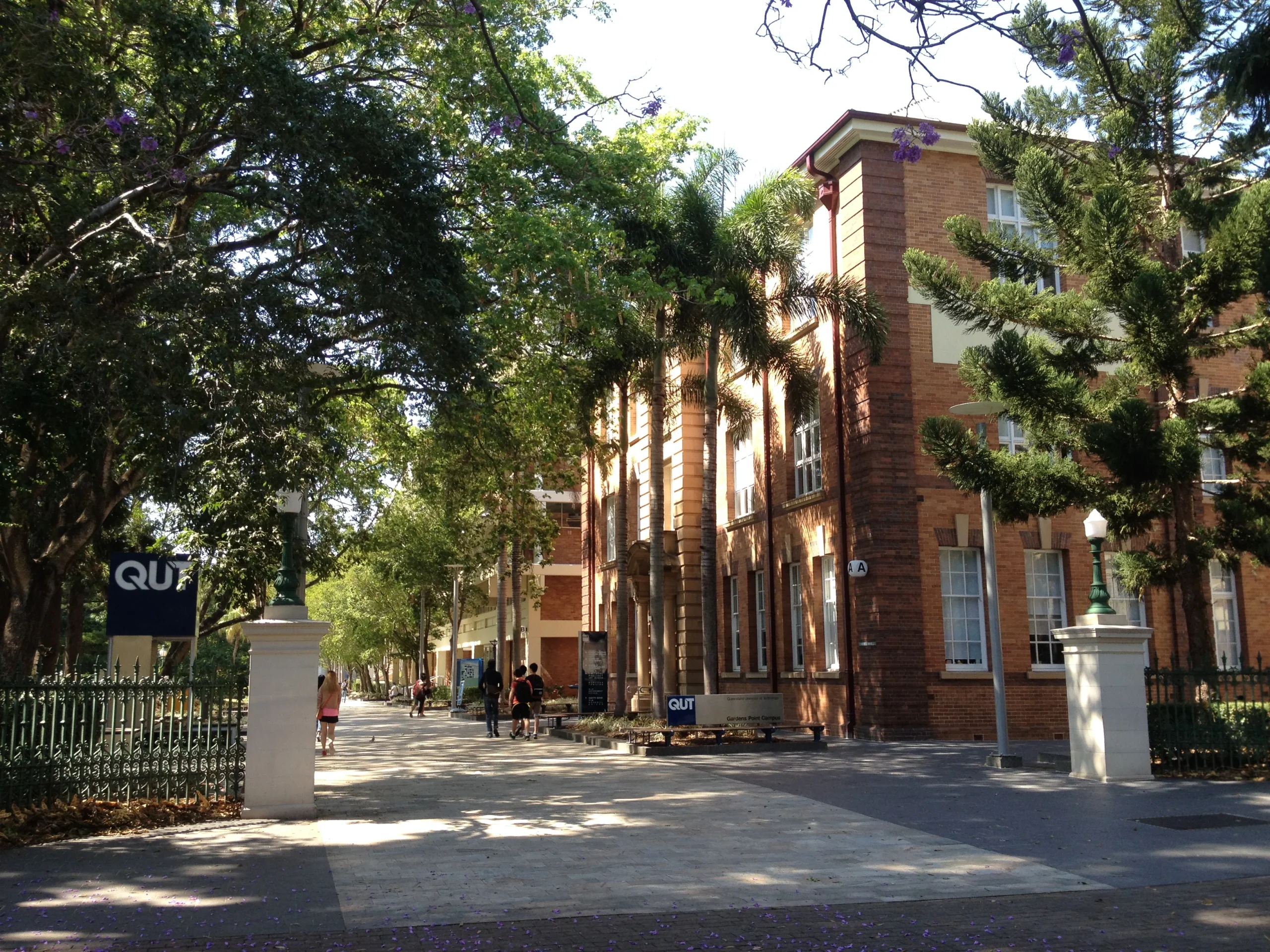
Our architecture and built environment, business, engineering, information technology, law, mathematics and science students are based at Gardens Point, right in the centre of Brisbane.
The main campus of our communication, creative industries, design, education, health and justice students, Kelvin Grove is located in the thriving Kelvin Grove Village.
You may be able to apply for scholarships that cover tuition fees for all or part of your course. If you receive a QUT-funded scholarship you won’t need to pay tuition fees for your research degree, if you complete your degree within:
a maximum of 4 years full-time (or equivalent) for doctoral students (PhD and professional doctorate)
a maximum 2 years full-time (or equivalent) for research masters students.
If you don’t receive a scholarship that covers your tuition fees, you must pay your fees directly to QUT before the start of each semester.
In 2025, the fee range for international full-fee paying students is $35,000-$43,000 annually (AUD) for research degrees and will increase to $37,600-$45,600 in 2026. To find more details check the costs in the course information.
We review fees annually.
Other study-related costs and living expenses
Your research degree may take a number of years to complete, so you need to consider your living expenses while you’re studying.
When you’re close to finishing your research, you may also need to pay for thesis proofreading and editing.
Centrelink payments
If you’re an Australian citizen or permanent visa holder and intend to apply for Centrelink payments while you study, it is important to check your eligibility first, as this will depend on your individual circumstances.
You must declare any scholarship income you receive to Centrelink as it may affect your payments.
We want to help our international students find appropriate financial aid, loans, grants, and other types of financial assistance available through government and private programs in Australia and their home countries.
Australia Awards
Australia Awards are a series of scholarships, fellowships, and grants aiming to promote knowledge, education links, and enduring ties between Australia and its neighbours.
Endeavour Awards and Fellowships are competitive, merit-based scholarships and fellowships providing opportunities for Australians to undertake study, research or professional development overseas, and for overseas citizens to do the same in Australia.
Research Training Program (RPT) grants support postgraduate research training in the higher education sector, and provide financial support to postgraduate students of exceptional research promise who undertake their higher degree by research (HDR) at an eligible Australian higher education provider (HEP).
An MBA, or Master of Business Administration is a postgraduate degree for working professionals to elevate their expertise, leadership skills and real-world experience. It is a popular course for professionals who aspire to work in senior management and leaderships roles. This is due to the qualification’s global recognition across finance, marketing, media and management industries and beyond.
The abbreviation ‘MBA’ stands for Master of Business Administration. It is a postgraduate degree for working professionals and leaders who aspire to reach senior management positions or to qualify for a promotion in their current role. It is also for those wanting to elevate their leadership capabilities, strategic thinking and business acumen.
Our MBA is a flexible course. How long it takes to complete our MBA course is entirely up to you. If you choose to study full-time, an MBA takes 1.5 years to complete. With part-time study, you can expect to complete your MBA in 3 years.
However, course duration will vary person-to-person based on whether you choose to study full-time or part-time. You can choose how many course units you feel comfortable with each teaching period. This means you can study anywhere between 0-4 units each teaching period.
An MBA is a well-respected qualification both domestically and internationally. This is why many invest in an MBA course for the opportunities it opens in their career.
Completing an MBA can lead to increases in salary, promotions, expanded professional networks, ongoing industry mentorship and elevated leadership skills.
What do you learn in an MBA?
Throughout an MBA course at QUT, you will expand your knowledge on core areas including but not limited to:
Studying in Australia: Your Guide to Universities, Programs, and Student Visas
Australia is a popular destination for international students, offering quality education, diverse campuses, and vibrant cities. From affordable universities to top-ranked institutions, Australia has something for everyone. Here’s everything you need to know about studying in Australia.
Top Universities in Australia
Australia’s Top Universities
Australia is home to some world-renowned universities, consistently ranking among the best globally. Australian National University (ANU), University of Melbourne, University of Sydney, and University of Queensland are a few examples of prestigious institutions that attract international students.
QLD Universities
Queensland offers a range of universities, including Griffith University, James Cook University in Brisbane, and Central Queensland University. These institutions provide various programs suited to different interests and career paths.
Universities in Perth, Australia
Perth is a vibrant city with reputable universities such as Edith Cowan University (ECU), Murdoch University, and University of Western Australia. Known for their high quality of education, these universities offer excellent options for both local and international students.
University in Melbourne List
Melbourne is a hub for quality education with universities like Deakin University, University of Melbourne, and RMIT University, each offering diverse programs and a dynamic student life.
University in Brisbane, Australia
Brisbane hosts renowned institutions like Griffith University and James Cook University, providing a range of study options with excellent facilities and support for international students.
Universities in Sydney, Australia
Sydney is home to leading universities, including the University of Sydney, University of New South Wales (UNSW), and Macquarie University.
Affordable and Cheapest Universities in Australia
Cheapest University in Australia
For those on a budget, Australia offers affordable education options without compromising quality. Central Queensland University and Edith Cowan University are known for providing affordable programs.
Low-Cost Universities in Australia
Universities like Western Sydney University and Victoria University offer lower tuition fees, making education accessible for international students.
Affordable Universities in Australia
Many Australian universities provide scholarships and affordable courses. University of Sunshine Coast and Charles Darwin University are among those that offer value without high costs.
Popular Programs and Courses in Australia
Masters Degrees and Programs in Australia
Australia offers a wide range of master’s programs in fields like IT, business, engineering, and more. Universities such as University of Queensland and Monash University offer specialized programs designed to boost your career prospects.
MBA in Australia Cost
The cost of pursuing an MBA in Australia varies by institution, with top programs available at University of Melbourne and Australian Graduate School of Management (AGSM). While MBA programs can be expensive, many universities offer financial aid and scholarships.
Best IT University in Australia
Australia’s top IT programs can be found at institutions like University of Technology Sydney (UTS) and RMIT University, providing cutting-edge knowledge and skills for a career in tech.
MBBS Cost in Australia
Medical education in Australia is rigorous and offers high-quality training. The cost of an MBBS in Australia is typically high but provides excellent career opportunities globally.
Scholarships and Financial Aid
Scholarships in Australia for Indian Students
Many Australian universities offer scholarships specifically for Indian students. Scholarships can help reduce tuition costs, making education more accessible for international students.
Student Visas and Living Costs
Student Visas Australia
To study in Australia, you’ll need a student visa. The visa application process is straightforward, but it’s essential to meet the requirements for acceptance. Ensure you apply early to secure your visa on time.
Living Cost in Australia for International Students
Living expenses vary depending on the city. Major cities like Sydney and Melbourne are more expensive, while places like Brisbane and Perth offer more affordable options. On average, international students should budget for accommodation, food, and other personal expenses.
Universities by Location and Specialty
Griffith University (Queensland)
Known for its research and industry connections, Griffith offers a variety of programs in fields like health, business, and environmental studies.
Deakin University (Melbourne)
Deakin is popular among international students for its flexible learning options and strong support services.
James Cook University (Brisbane)
Located in Queensland, James Cook is recognized for its programs in tropical health, marine science, and environmental studies.
Edith Cowan University (ECU) (Perth)
ECU provides a range of programs and is known for its focus on teaching quality and graduate outcomes.
Murdoch University (Perth)
Murdoch offers a student-centered approach and is known for courses in law, psychology, and veterinary science.
List of Australian one of the Best Universities
For a complete list of universities, Australia has a diverse range of institutions across various cities. Here are some popular ones:
Central Queensland University: Known for affordability and strong industry ties.
University of Western Australia: Highly regarded for research and academic excellence.
CQ University: Offers practical, career-focused courses in multiple disciplines