Used in everything from games and movies to autonomous driving, computer graphics, vision and imaging is a stimulating and relevant niche of computer science.
Designed to create talented, knowledgeable and creative practitioners, the MSc in Computer Graphics, Vision and Imaging will allow you to pursue a range of related careers and become career-ready for the world of computer graphics, special effects and many other areas.
This MSc is led by experts renowned in computer graphics, geometry processing, computer vision, and virtual environments. You will receive a solid foundation in machine vision, image processing, computer graphics, and machine learning, with optional modules to specialise in areas like robot vision, virtual environments, or biomedical imaging.
The programme includes an individual project, allowing you to apply your skills to a focused area of interest. Access to unique facilities, including 3D scanners and prototypes, 5G motion capture, and virtual reality tools, further enhances your learning experience, preparing you for a range of careers in imagery, graphics, and vision.
Who this course is for
This programme is ideal for you if you wish to develop the skills necessary for a career in computer graphics, 3D acquisition and fabrication, medical imaging, robotics, special effects in games and film, computer vision, image and video generation and representation, or related applications.
All Courses
Entry requirements
A minimum of an upper second-class UK Bachelor’s degree (or international qualification of an equivalent standard) in a relevant subject such as computer science, mathematics, electrical engineering, or physical sciences. Additionally, applicants must have suitable mathematics and computer programming skills. Relevant work experience may also be considered.
English language requirements
The English language level for this programme is: Level 2
International applicants can find out the equivalent qualification for their country by selecting from the list below. Please note that the equivalency will correspond to the broad UK degree classification stated on this page (e.g. upper second-class). Where a specific overall percentage is required in the UK qualification, the international equivalency will be higher than that stated below. Please contact Graduate Admissions should you require further advice.
Equivalent qualifications for India
The award of any of the following from a recognised institution:
A Bachelor’s degree with a minimum overall CGPA of 7.5/10, 6.0/8.0, 5.5/7.0, 4.0/6.0, 3.0/4.0 or 60% where a GPA scale is not used. The overall mark required is dependent on the ranking of the institution at which the degree has been taken. For further information on institution ranking please refer to section on graduate programmes on the prospective students India page.
Alternative qualifications
Master’s
Medical
Dental degree
MPhil/PhD
All Courses
About UCL
Founded in 1826 in the heart of London, UCL is London’s leading multidisciplinary university, with more than 16,000 staff and 50,000 students from over 150 different countries.
We are a diverse community with the freedom and courage to challenge, to question and to think differently.
Through a progressive approach to teaching and research, our world leading academics, curious students and outstanding staff continually pursue excellence, break boundaries and make an impact on real world problems.
Since 1826, we have championed independent thought by attracting and nurturing the world’s best minds.
UCL is a diverse global community of world-class academics, students, industry links, external partners, and alumni. Our powerful collective of individuals and institutions work together to explore new possibilities.
Academic excellence
2nd in UK for research power (REF 2021)
11 academic faculties
32 Nobel laureates (including 2 new laureates in 2024)
150+ nationalities represented by student body
400+ undergraduate programmes
700+ postgraduate programmes
16,000 staff (in 2023)
51,000 students (in 2023)
Across the globe
Our network of connections span across the globe:
440,000+ alumni in 190 countries
50% international students
34% international staff
Partnerships with institutions worldwide
What UCL does
UCL is taking on some of the biggest challenges of our time, and making vital contributions to the public good. Discover more about our strategic goals, key statistics and history.
Academic leadership grounded in intellectual excellence
A global leader in the integration of research and education, underpinning an inspirational student experience
Addressing global challenges through our disciplinary excellence and distinctive cross-disciplinary approach
An accessible, publicly engaged organisation that fosters a lifelong community
London’s Global University: in London, of London and for London
Delivering global impact through a network of innovative international activities, collaborations and partnerships.
In addition to UCL 2034, UCL Strategic Plan 2022-27 sets out our whole-university priorities for the next 5 years, focusing effort and investment on a small number of shared priorities. The plan aims to build on the trajectory established by UCL 2034 and our ambition to be London’s global university.
We are continually making an impact on the world we live in.
The UCL History department, which dates back to 1830, is one of the best in the world for history research and teaching. Our rewarding programmes make this an exciting place to study over 5,000 years of history across every continent, from the ancient Middle East to the twenty-first century. We nurture talent irrespective of students’ background and maintain a learning environment in which students are both supported and challenged to achieve their full potential. All of our permanent academic staff engage in their own research while teaching, ensuring that we offer a modern and research-led curriculum.
UCL sits at the heart of one of the most dynamic cities in the world and is committed to being a global leader in knowledge exchange, enterprise and open innovation.
UCL Bloomsbury and UCL East
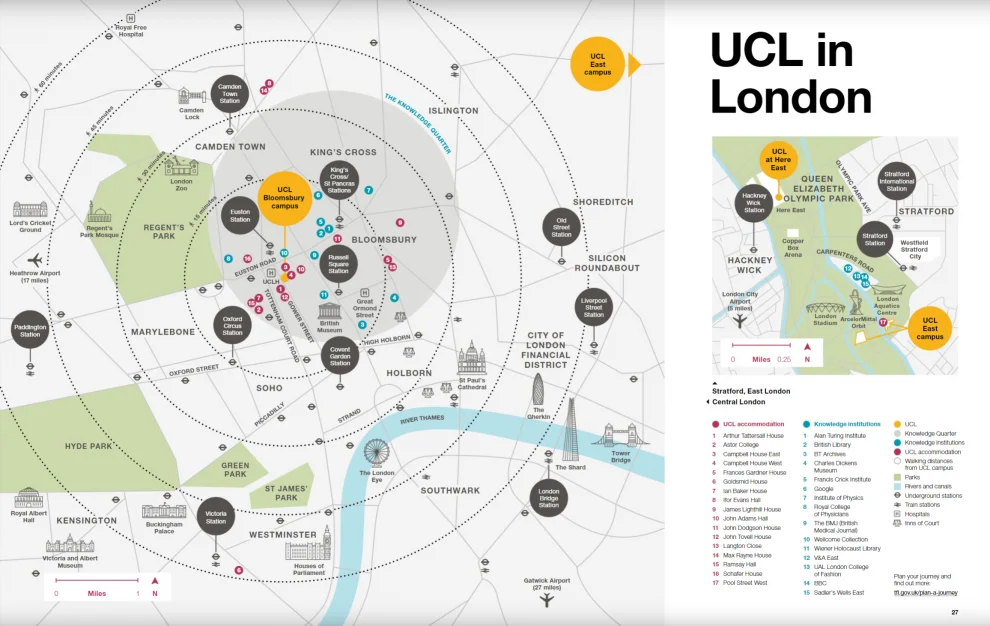
UCL’s historic campus is in Bloomsbury, central London, with the main Quad on Gower Street. We are continually creating new world-class facilities in our Bloomsbury campus – both through new developments and refurbishing some of our buildings that are rich in heritage.
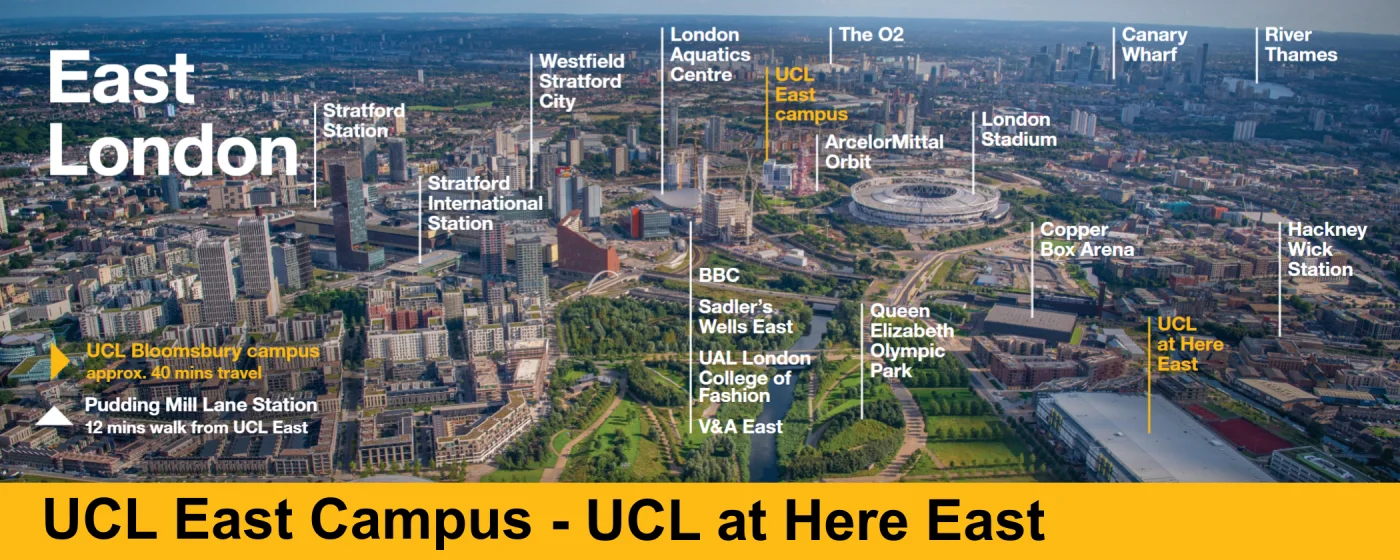
In addition, in the largest single expansion since UCL was founded nearly 200 years ago, UCL East (at Queen Elizabeth Olympic Park, Stratford) has now joined our Bloomsbury campus in discovering, co-creating and sharing new knowledge for the benefit of all. The new campus opened in autumn 2022.
We know that money can be a worrying topic for most students. We aim to help by setting out clearly and simply what you need to pay for and what support is available to you.
Tuition fees
The level of fee will depend upon whether you’re classed as a UK, Overseas or Islands student – this will be confirmed if you are offered a place at UCL.
UCL’s annual tuition fee covers all elements of your tuition (except any field courses you might have to take), registration and examinations.
However, optional courses taken elsewhere in the University of London may attract an additional fee.
Fees for accommodation are charged separately.
Dual degree programmes
We offer several ‘Dual Degree’ programmes where students spend half of their degree studying at UCL and the other half at a university overseas (these are distinct from Year Abroad or International programmes).
In these cases, fees are payable to UCL for the time spent studying at UCL, and to the other host university for the time spent there.
UK student fees
UCL’s undergraduate fees are currently set at £9,250 for UK students for the first year of study. Fees for UK undergraduates have been frozen at £9,250 for 2024-25, but may be subject to increase for the year commencing 2025 and for each year of study thereafter.
UCL reserves the right to increase its fees in line with government policy (including on an annual basis for each year of study during a programme).
Tuition fees for overseas (international) students
For Overseas undergraduate students only, UCL implemented fixed fees from the academic year 2018 onwards.
The overseas fee values published below, unless otherwise indicated in the programme Notes, are the fees that will be charged to 2024-25 entrants for each year of study on the programme.
For example, if you’re starting the BSc Physics in 2024-25, you’ll pay £37,500 in 2024-25, and £37,500 in 2025-26 and £37,500 in 2026-27.
Entrants in 2025-26 or later (including deferred students) will pay higher fees, which will be published in August 2024.
Students on certain degree programmes will incur some additional costs not covered by their tuition fee; for example, for specialist equipment, artists’ materials, books or costs related to carrying out fieldwork.
Students on Architecture or Fine Art programmes will need to purchase different materials depending on the nature of their work; students on Earth Sciences or Archaeology programmes will need to buy some specialist tools and may need weather-proof gear.
For students on programmes with an element of fieldwork, there may also be extra costs for travel or a contribution to the department to cover costs.
If possible additional costs concern you, please do not hesitate to contact the department in which you are interested for more details.
There are a number of scholarships available to undergraduate students.
You can use the scholarships finder to search for awards that you might be eligible for. Your academic department may also be able to provide you with more information about funding.
Our UCL Global Scholarships programme provides financial support for international students to attend UCL – London’s Global University.
The UCL Global Scholarships programme supports international students who are from lower income backgrounds. Our goal is to promote access to study at UCL so that our student body remains diverse. These scholarships provide support for living costs and/or tuition fees for the duration of a degree programme. There are separate schemes available for undergraduate and masters study.
The UCL Global Undergraduate Scholarship is open to all undergraduate programmes and aims to enable and encourage international students from low income backgrounds to pursue their degree at UCL.
The UCL Global Masters Scholarship is open to all taught masters programmes and aims to enable and encourage international students from lower income backgrounds to pursue their degree at UCL.
All Courses
FAQs
The International Office can provide advice for students from overseas and information on a range of issues including fees, English Language requirements, sources of funding and finding accommodation.
All undergraduate students in the UK and Overseas have to apply for an undergraduate programme via the Universities and Colleges Admissions Service, or UCAS. You will find all the information about applying as an international student and how to track your application the UCAS website.
How do I check you have my undergraduate application?
You can track the progress of your application at the UCAS website. If you have a specific enquiry about your application then you can contact the degree programme’s faculty office. Faculty office contacts
If you would like to submit additional information in support of your application or check the status of your application you can e-mail UCL Admissions: admissions@ucl.ac.uk or write to:
Admissions
UCL Registry
University College London
Gower Street
London
WC1E 6BT
United Kingdom
How do I apply for an Erasmus or Affiliate programme?
Affiliate applications: Enquiries concerning Affiliate applications should be sent to affiliatestudents@ucl.ac.uk
Erasmus applications: UCL’s Erasmus+ Institutional Coordinator is Lucy Gaunt (l.gaunt@ucl.ac.uk).
Entry Requirements
Lorem ipsum dolor sit amet, consectetur adipiscing elit, sed do eiusmod tempor incididunt ut labore et dolore magna aliqua. Ut enim ad minim veniam, quis nostrud exercitation ullamco laboris nisi ut aliquip ex ea commodo consequat.
Study in the UK: Top Universities, Programs, and Scholarships
The United Kingdom is a world-renowned destination for higher education, offering a diverse selection of prestigious universities, affordable options, and a wide array of programs. Here’s a guide to some of the key aspects to consider when planning to study in the UK.
1. Top UK Universities
The UK is home to many highly ranked universities known for their academic excellence and research facilities:
Oxford University (Oxford, UK): One of the oldest and most prestigious universities globally, renowned for its rigorous programs.
University of Sheffield (UK): Known for its research and innovation, Sheffield offers a broad spectrum of disciplines.
Swansea University (UK): Located in Wales, Swansea offers a variety of courses and a beautiful coastal setting.
Sheffield Hallam University (UK): With strong industry connections, Sheffield Hallam is a popular choice for practical and applied programs.
Heriot-Watt University (Scotland): Recognized for engineering, business, and science, Heriot-Watt has campuses around the world.
University of Glasgow (Scotland): A leading research university with a global reputation, especially in the arts, sciences, and medicine.
Loughborough University (UK): Known for its excellent sports facilities and engineering programs.
Nottingham Trent University (UK): Known for its creative arts, Nottingham Trent provides industry-relevant courses.
University of Liverpool John Moores (UK): Offers a wide range of programs and strong research opportunities.
For those interested in studying in London, consider renowned institutions such as University College London (UCL) and London School of Economics (LSE), as well as universities across the Greater London area, which offer diverse programs in nearly every field.
2. Popular Programs
The UK offers a variety of degree programs across disciplines:
Masters in Management (UK): UK universities provide management degrees, including MBA and MSc in Management, which are recognized globally.
LLM in the UK: Ideal for those pursuing a career in law, with universities offering specializations like international and corporate law.
Physiotherapy Masters in the UK: Programs such as MSc in Physiotherapy are offered in leading institutions, providing a path to careers in healthcare.
PhD Programs: Research-oriented students can explore a PhD in various fields, with excellent resources and guidance.
MBA Programs: Some of the best MBA programs can be found at institutions like Oxford University and University of Manchester, with options tailored for both recent graduates and professionals.
3. Scholarships and Financial Aid
The UK offers numerous scholarships for international students, including options specifically for Indian students:
UK Scholarships for Indian Students: Various UK universities provide scholarships to assist with tuition fees and living costs.
British Scholarships: The UK government and other organizations offer scholarships such as the Chevening Scholarship and Commonwealth Scholarships.
United Kingdom Scholarships: Some scholarships are specific to certain regions, universities, or programs, supporting students with exceptional academic achievements.
4. Affordable Education Options
For students seeking affordable education, here are some options:
Cheapest Universities in the UK: Many universities offer competitive tuition rates, including University of the Highlands and Islands and University of Cumbria.
Cost of MBA Programs in the UK: While MBA programs are generally an investment, several universities offer reasonably priced MBAs with flexible formats.
5. Student Visas and Requirements
To study in the UK, international students typically need a Tier 4 (General) Student Visa. Visa requirements include proof of acceptance from a recognized university, financial resources, and English language proficiency.
6. Living and Studying in the UK
Studying in the UK offers students an opportunity to live in vibrant cities like London, Manchester, and Edinburgh, or in quieter university towns. Most universities provide accommodation options and student support services to help international students adjust to life in the UK.
7. Top Subjects and Specializations
Whether pursuing MS degrees in sciences, LLM in law, or MA in the arts, UK universities cater to diverse academic interests, with programs designed to provide both theoretical knowledge and practical skills.
8. Healthcare and MBBS
For those interested in healthcare, the MBBS program in the UK is well-regarded, though the cost can be significant. The UK’s universities offer state-of-the-art facilities and strong clinical training.