MIT Sloan is about invention. It’s about making ideas matter. At the MIT Sloan School of Management, leaders are equipped to unlock tomorrow’s most complex challenges. Through intellectual rigor and experiential learning, our full-time, two-year MBA program develops leaders ready to make a difference in the world. Explore our admissions process and start your application to join the next generation of innovators.
All Courses
Application Requirements:
Cover letter
Resume
Respond to Video Question 1 and 2
One letter of recommendation
Additional references
Organizational Chart
Academic Transcripts
GMAT (Focus Edition and 10th Edition) or GRE test scores
Relevant coursework & professional certifications
Short answer questions
Online application fee
Graduate Record Examination (GRE)
GRE or GMAT (Focus Edition and 10th Edition) scores are required.
To share your GRE score, please enter Institute Code 3791.
Graduate Management Admissions Test (GMAT)
GMAT (Focus Edition and 10th Edition) or GRE scores are required.
To share your GMAT (Focus Edition and 10th Edition) score, please enter Massachusetts Institute of Technology (MIT) – MIT Sloan School of Management
English Language Ability tests, like the TOEFL and IELTS are not required. English abilities are evaluated during our interview process.
A complete application entry requires:
Cover Letter
MIT Sloan seeks students whose personal characteristics demonstrate that they will make the most of the incredible opportunities at MIT, both academic and non-academic. We are on a quest to find those whose presence will enhance the experience of other students. We seek thoughtful leaders with exceptional intellectual abilities and the drive and determination to put their stamp on the world. We welcome people who are independent, authentic, and fearlessly creative – true doers. We want people who can redefine solutions to conventional problems, and strive to preempt unconventional dilemmas with cutting-edge ideas. We demand integrity and respect passion.
Taking the above into consideration, please submit a cover letter seeking a place in the MIT Sloan MBA program. Your letter should conform to a standard business correspondence, include one or more professional examples that illustrate why you meet the desired criteria above, and be addressed to the Admissions Committee (300 words or fewer, excluding address and salutation).
Resume
Please submit a one-page resume. This will help us easily track your academic and career path. Try to focus on your work results, not just your title or job description. Here are some pointers on formatting:
One page limit
Times New Roman font
Size 10 font
Word or PDF formats only
Provide the following information in reverse chronological order:
Education: Please include relevant awards, scholarships and professional societies
Work Experience: Please include company name, title, results-oriented bullets that demonstrate your skill set, and dates
Additional information: Please include extracurricular activities/community service, technical skills/certifications, and special skills/interests, and languages spoken (if applicable).
Video Question 1
Introduce yourself to your future classmates. Here’s your chance to put a face with a name, let your personality shine through, be conversational, be yourself. We can’t wait to meet you! Videos should adhere to the following guidelines:
No more than 1 minute (60 second) in length
Single take (no editing)
Speaking directly to the camera
Do not include background music or subtitles
Note: While we ask you to introduce yourself to your future classmates in this video, the video will not be shared beyond the admissions committee and is for use in the application process only.
Video Question 2
All MBA applicants will be prompted to respond to a randomly generated, open-ended question. The question is designed to help us get to know you better; to see how you express yourself and to assess fit with the MIT Sloan culture. It does not require prior preparation.
Video Essay 2 is part of your required application materials and will appear as a page within the application, once the other parts of your application are completed. Applicants are given 10 seconds to prepare for a 60-second response.
The following are examples of questions that may be asked in the Video Question 2:
What achievement are you most proud of and why?
Tell us about a time a classmate or colleague wasn’t contributing to a group project. What did you do?
One Letter of Recommendation
A detailed recommendation can tell us a lot about you. Make sure you select an individual qualified to speak about your results as a professional and your potential as a leader. Some important details:
MBA applicants must submit one letter of recommendation.
A recommendation from a professional contact is preferred, ideally a manager or supervisor.
We do not accept recommendations from family members.
Your letter of recommendation must be received by the deadline date for the round you are applying (see above for our deadlines.) It is your responsibility to remind your recommender to make sure it is submitted on time.
You will be instructed to add your recommender’s contact information and they will be sent instructions on how to submit their letter. You should choose a recommender who can answer the following questions:
How long and in what capacity have you known the applicant?
How does the applicant stand out from others in a similar capacity?
Please give an example of the applicant’s impact on a person, group, or organization.
Please give a representative example of how the applicant interacts with other people.
Please tell us anything else you think we should know about this applicant.
Describe the most important piece of constructive feedback you have given the applicant. Please detail the circumstances and the applicant’s response.
Additional References
We want to make sure we give you the best chance to show us your strengths, so please provide us with contact information for two additional professional references. If we still have questions after reading your application, we might reach out to one or both of these references. Similar to your recommender, these additional references should be able to speak to your professional and/or academic background. These two individuals should be different from your recommender.
Organizational Chart
To help us better understand your current role and the impact that you have on your team and department, please submit an organizational chart. We should be able to clearly understand the internal structure of your organization, where you sit in your organization, and your line of reporting.
Organizational charts should not be more than two pages and keep the following in mind:
Give us as much detail as possible (names, titles, etc.) but it’s ok to redact names if you need to.
Please circle your role in red so that your position is easily identifiable.
Make sure we can easily identify where you are, to whom you report, and if applicable, who reports to you.
If your recommender or references are on your organizational chart (they may not be, and that’s ok!), please highlight them for us.
If you are a consultant, entrepreneur, or affiliated with the military review our FAQs for suggestions on how to approach the organizational chart.
Please scan and upload your transcript(s) from all colleges and universities you attended or are currently attending. If you are currently earning a degree, please upload your most up-to-date transcript. We review transcripts carefully, please double check that what you have uploaded is legible; if you can’t read it, neither can we! Some important details:
All applicants to the program must hold a four-year undergraduate degree or three-year equivalent undergraduate degree from outside of the U.S, by time of matriculation.
Do not mail any hard copies of official academic records or transcripts.
If you received an undergraduate degree as part of a Master’s program, please include an undergraduate entry in addition to your Master’s degree.
If your transcripts are not in English, please scan and upload both the original and the certified translation.
We cannot accept “digitally signed” or encrypted transcripts. If you’re having difficulty uploading your document, this may be the reason. Print out your transcript, scan it, and upload the PDF.
We do not accept transfer credits. Any MIT classes taken pre-matriculation cannot be counted toward your degree at MIT Sloan
Once admitted to the program you will be required to provide an official signed and sealed transcript from all schools attended. Any discrepancies between the scanned transcripts and official transcripts may result in a candidate’s rejection or a withdrawal of our offer of admission.
Test Scores
Standardized tests, specifically the GMAT (Focus Edition and 10th Edition) and GRE are a critical component of the application process and play an important role in our holistic evaluation process. The MIT Sloan Admissions Committee expects that you will submit a GMAT (Focus Edition and 10th Edition) or GRE score to be reviewed as part of your application. Both the remote and in-person versions of these exams are accepted with no preference. If your current situation prevents you from being able to submit a test score, you may request a test waiver explaining the situation; the Admissions Committee will take your request under advisement and let you know if the waiver has been approved. If the waiver is approved, and you are later admitted, the Admissions Committee reserves the right to offer conditional admission such as, but not limited to, receiving a certain score on the GMAT or GRE or taking a supplemental class.The test waiver request form is not intended to be a Statement of Academic Readiness and should focus only on the circumstances surrounding your inability to take a GMAT or GRE. To request a test waiver, please start your application and navigate to the Test Scores section; you can submit your request there. Once submitted, you will receive a response by email as soon as possible.
The Admissions Committee is also interested in assessing the writing abilities of anyone who is admitted to MIT Sloan’s MBA program. For anyone who submits a GMAT (Focus Edition) or is granted a test waiver, the Admissions Committee may require that you take the GMAC Business Writing Assessment. If you took the GMAT (10th Edition) or the GRE and have a valid AWA score, that will satisfy this requirement. If the Admissions Committee requires you to take the GMAT Business Writing Assessment, we will contact you after interview invitations are sent.
We will accept self-reported test scores by the application deadline, and welcome either the traditional or online version of exams. Test scores must be valid by the application deadline. Official scores should also be sent using the following school codes:
To share your GMAT (Focus Edition and 10th Edition) score, please enter Massachusetts Institute of Technology (MIT) – MIT Sloan School of Management
GRE School Code: 3791
For the 2024-25 admission cycle, we will accept all versions of the GMAT (Focus Edition and 10th Edition) or GRE, including remote or in-person.
Relevant Coursework & Professional Certifications
We welcome applicants from many types of academic backgrounds and do not have any academic prerequisites. That being said, we want to understand what relevant coursework you have already completed in order to assess how prepared you are for our core MBA courses.
In the application, we ask you to tell us which courses (if any) in the following subject areas you have taken. We’ll also ask what grade you received in each course.
Calculus
Communications
Linear Algebra
Microeconomics
Organizational Behavior
Probability
Statistics
Additionally, if you earned special certifications or took professional development courses in your spare time, please tell us about them! Feel free to submit academic evidence not already on your transcripts, such as: professional certifications CFA, CPA, ACCA, among others; non-degree coursework such as MITx MicroMasters, CORe, edX, MBA Math, or any other non-degree coursework you completed.
Short Answer Question
The Admissions Committee is excited to learn more about you and your background. In 250 words, please respond to the following short answer question:
How has the world you come from shaped who you are today? For example, your family, culture, community, all help to shape aspects of your life experiences and perspective. Please use this opportunity to share more about your background.
Application Fee
The non-refundable application fee of $250.00 USD must be paid online prior to submitting your application.
In addition to the list below, attendees of some recruitment events and conferences where MIT Sloan is present may qualify for an application fee waiver. If you are in attendance at one of these events, you will be notified at the conclusion of the event and the payment section of your application will reflect the waiver automatically.
Please note that we cannot grant retroactive fee waivers if the application fee has already been paid online. If you are submitting a request, please wait to hear back from us.
You may be eligible for a fee waiver if any of the following apply:
Current Peace Corps Members
Current Teach for America Members or Alumni
Forte MBA Launch Participants
Veteran or Active Duty U.S. Military Personnel
Paying the application fee will result in insurmountable financial hardship
Participants from the following list of programs, conferences, and fellowships are also eligible for an application fee waiver:
MIT Sponsored Programs
MIT Summer Research Program (MSRP General)
MIT Summer Research Program (MSRP Biology/BCS/CBMM)
On-Campus MIT ACCESS Program
MIT Media Lab Open House Travel Grant Recipients
MIT OME Laureates and Leaders
MIT OME The Standard
MIT Emergent Behaviors of Integrated Cellular Systems (EBICS)
Harvard-MIT Health Sciences and Technology (HST) Summer Institute
Fellowship Programs
APSA Diversity Fellowship Program (APSA DFP)
Emergent Behaviors of Integrated Cellular Systems Research Experience for Undergraduates (EBICS REU)
Gates Millenium Scholars Program
Leadership Alliance Summer Research Early Identification Program (SR-EIP)
Louis Stokes Alliance for Minority Participation (LSAMP)
Maximizing Access to Research Careers (MARC)
McNair Scholars Program
Mellon Mays Minority Undergraduate Fellowship Program (MMUF)
Morehouse College Dr. John H. Hopps Jr. Defense Research Scholars Program Hopps (HOPPS)
National Association of African American Honors Programs (NAAAHP)
Questbridge
Ralph Bunche Summer Institute (RBSI)
Research Initiative for Scientific Enhancement Program (RISE)
The National Consortium for Graduate Degrees for Minorities in Engineering and Science (GEM)
University of Baltimore Maryland County Meyerhoff Scholars Program
Woods Hole Partnership Education Program
Events and Conferences
ACM Richard Tapia Celebration of Diversity in Computing
American Indian Science and Engineering Society (AISES)
Annual Biomedical Research Conference for Minority Students (ABRCMS)
California Forum for Diversity in Graduate Education
Emerging Researchers National Conference in STEM (ERN)
National Association of African American Honors Programs (NAAAHP)
National Organization for the Professional Advancement of Black Chemists and Chemical Engineers (NOBCChE)
National Organization of Minority Architects
National Society of Black Engineers (NSBE)
National Society of Black Physicists (NSBP)
Society for the Advancement of Chicanos and Native Americans in Science (SACNAS)
Society of Hispanic Professional Engineers (SHPE)
Society of Women Engineers (SWE)
Spelman College Research Day
The National GEM Consortium
All Courses
About
The MIT community is driven by a shared purpose: to make a better world through education, research, and innovation. We are fun and quirky, elite but not elitist, inventive and artistic, obsessed with numbers, and welcoming to talented people regardless of where they come from.
Founded to accelerate the nation’s industrial revolution, MIT is profoundly American. With ingenuity and drive, our graduates have invented fundamental technologies, launched new industries, and created millions of American jobs. At the same time, and without the slightest sense of contradiction, MIT is profoundly global. Our community gains tremendous strength as a magnet for talent from around the world. Through teaching, research, and innovation, MIT’s exceptional community pursues its mission of service to the nation and the world.
Mission Statement
The mission of MIT is to advance knowledge and educate students in science, technology, and other areas of scholarship that will best serve the nation and the world in the 21st century.
The Institute is committed to generating, disseminating, and preserving knowledge, and to working with others to bring this knowledge to bear on the world’s great challenges. MIT is dedicated to providing its students with an education that combines rigorous academic study and the excitement of discovery with the support and intellectual stimulation of a diverse campus community. We seek to develop in each member of the MIT community the ability and passion to work wisely, creatively, and effectively for the betterment of humankind.
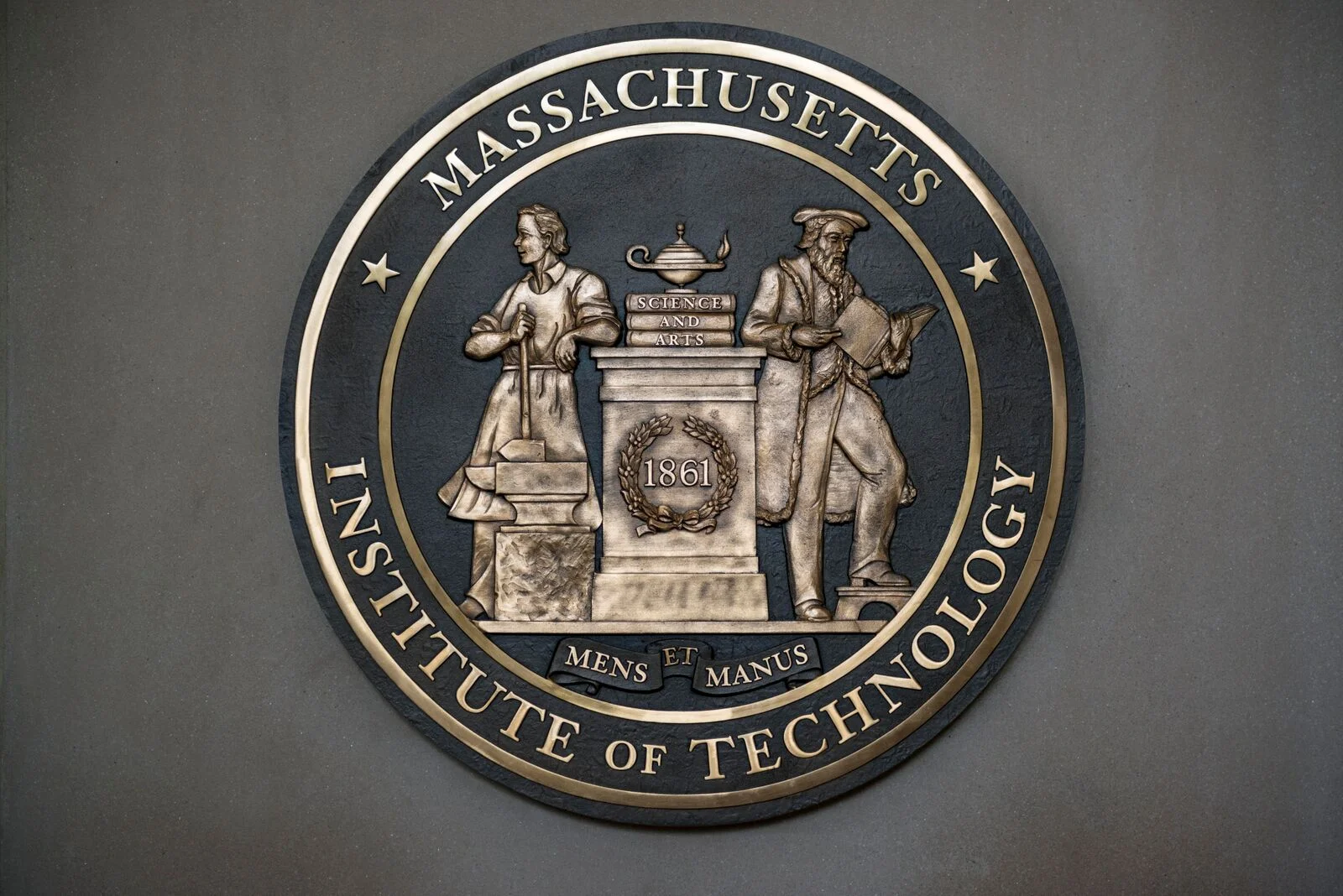
MIT’s motto is “mens et manus,” or “mind and hand,” signifying the fusion of academic knowledge with practical purpose.
Responding to calls from the community that MIT would benefit from having a statement of shared values, in December 2020 the Institute charged the MIT Values Statement Committee to develop one through broad consultation across the MIT community. On April 12, 2022, then-President Rafael Reif, Provost Cynthia Barnhart and Chancellor Melissa Nobles shared the values statement with the community, with their strong endorsement.
Values Statement
Excellence and Curiosity
We strive for the highest standards of integrity, and intellectual and creative excellence. We seek new knowledge and practical impact, in service to the nation and the world.
We prize originality, ingenuity, honesty, and boldness. We love discovery and exploration, invention and making. We delight in the full spectrum of human wisdom.
Drawing strength from MIT’s distinctive roots, we believe in learning by doing, and we blur the boundaries between disciplines as we seek to solve hard problems. Embracing the unconventional, we welcome quirkiness, nerdiness, creative irreverence, and play.
We accept the risk of failing as a rung on the ladder of growth. With fearless curiosity, we question our assumptions, look outward, and learn from others.
Openness and Respect
We champion the open sharing of information and ideas.
Because learning is nourished by a diversity of views, we cherish free expression, debate, and dialogue in pursuit of truth – and we commit to using these tools with respect for each other and our community.
We strive to be transparent and worthy of each other’s trust – and we challenge ourselves to face difficult facts, speak plainly about failings in our systems, and work to overcome them.
We take special care not to overlook bad behavior or disrespect on the grounds of great accomplishment, talent, or power.
Belonging and Community
We strive to make our community a humane and welcoming place where people from a diverse range of backgrounds can grow and thrive – and where we all feel that we belong.
We know that attending to our own and each other’s wellbeing in mind, body, and spirit is essential. We believe that decency, kindness, respect, and compassion for each other as human beings are signs of strength.
Valuing potential over pedigree, we know that talent and good ideas can come from anywhere – and we value one another’s contributions in every role.
Together we possess uncommon strengths, and we shoulder the responsibility to use them with wisdom and care for humanity and the natural world.
MIT’s MindHandHeart office has been charged with implementing the statement’s intent and language across the Institute. Resources for the MIT community can be found at Supporting MIT Values.
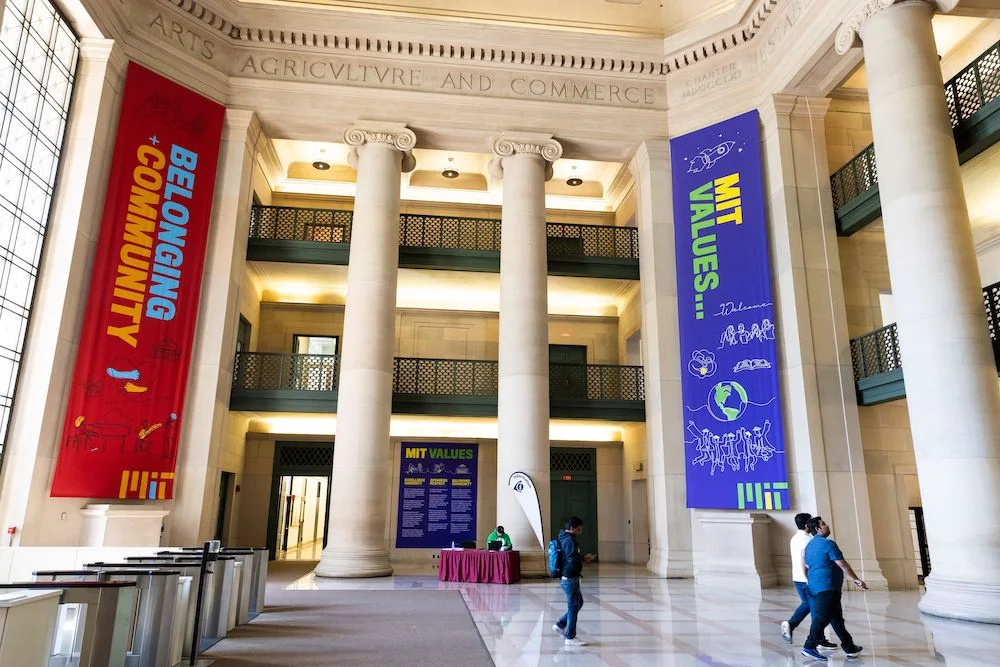
In September 2022, the Institute installed five billboard-scale banners in Lobby 7. Drawing on the words of the MIT Values Statement and illuminating them with line-art illustrations and a vivid color scheme, this installation is intended to promote the values to MIT’s on-campus community, as well as visitors to the Institute’s front door.
Key Facts
History
Incorporated – 1861
Motto – “Mens et manus” (“mind and hand”)
Campus
Location – Cambridge, MA USA
Size – 168 acres (0.68 km2)
Student residences – 19
Playing fields – 26 acres (0.11 km2)
Gardens + green spaces – 40+
Publicly sited works of art – 60+
Admissions (Class of 2027)
Applicants – 26,914
Admits – 1,291
Selected Honors
Nobel laureates – 101
National Medal of Science winners – 61
National Medal of Technology and Innovation winners – 33
MIT Facts provides an annual overview of the breadth of the Institute’s academics, activities, and culture.
A brief history of MIT
In 1865, the founding of MIT established a new kind of independent educational institution relevant to an increasingly industrialized America. Since then, MIT has built a robust tradition of solving problems in the public interest at the intersection of technology and humanity.
A private university in the public interest
The story of MIT begins with a heartfelt belief: that the American educational system of the 19th century was fundamentally broken. Instead of treating a scientific education and a practical education as fundamentally incompatible, its founders envisioned a new education to unify mens et manus, mind and hand, theory and practice, into a coherent program of study within a single institution.
In 1860, MIT’s founding President William Barton Rogers and his allies applied to the Massachusetts legislature for “an Act of Incorporation of the Massachusetts Institute of Technology,” which was to include a museum, a society of the arts, and a school of industrial science. The state agreed, and allocated land in Boston’s Back Bay, on the condition that the institution remain open to members of the public. The charter was granted on April 10, 1861, on the eve of the Civil War, which delayed classes until 1865.
In 1863, in the midst of the war, Congress passed the Morrill Land Grant Act, which allowed states to sell up to 30,000 acres of public land-for each congressman and senator in a state’s congressional delegation-to fund colleges and universities, open in their admission to ordinary people, that would educate students in the mechanical and agricultural arts, as well as military training. In Massachusetts, the grant was split, with some funds sent west to create the Massachusetts Agricultural College,01 while the rest was allocated to the newly-minted MIT. The proceeds from the grant endowed MIT with the resources to construct its earliest academic buildings, and also (re)committed it02 to acting in the public interest in perpetuity.
A new approach to education
There have been found many American parents willing to try new experiments even in the irrevocable matter of their children’s education…It requires courage to quit the beaten paths in which the great majority [have walked].
From its inception, the new institution, offering a new education, attracted a new kind of student. Ellen Swallow Richards, the first woman in the United States to earn a degree in STEM,03 graduated from MIT in 1870. She soon became its first female faculty member, helped establish the field of public sanitation04 and founded many programs to promote science education for women. Robert Robinson Taylor, the son of a freed slave, integrated MIT in 1888; he later became America’s first accredited black architect, and helped build schools,05 libraries, and other buildings across the American south.
MIT also became a beacon for students from around the world: the first international student was admitted to MIT in 1866, and many more were admitted in the decades after, despite a contemporaneous wave of anti-immigrant nativist political sentiment.06 As our blogger Yuliya wrote in her early history of international students at MIT:
In 1909, [Scotland native] President Maclaurin began his tenure at MIT with a vision to build a more diverse and inclusive Institute and “build a better understanding between countries.” [Under Maclaurin], 1 in 15 students at MIT came from a foreign country, possibly the highest proportion of international students in a U.S. institution…To achieve this ideal, MIT provided admissions pamphlets in Spanish and Chinese, and President Maclaurin traveled the world to recruit foreign students.
Today, international outreach, education, and institution-building remain core aspects of MIT’s global strategy.
Our current campus
By the early 1900s, MIT had run out of room in its original Back Bay campus, and in 1916 moved to the left bank of the Charles River into its current campus, which was designed and constructed by alumni.
As America entered World War I, MIT became a military training ground,07 hosting the first Army-ROTC program as well as the first ground school for Navy pilots.
But it was World War II, and the Cold War that followed it, that transformed MIT, and it grew rapidly with an influx of federal funding devoted to basic scientific research. Meanwhile, the horrors of the war led to the creation of a committee, led by Professor Warren K. Lewis, on the foundations of the MIT education. Haunted by his wartime work on the bomb, and fearful of the consequences of a technical education untethered to human concerns, Lewis’ report recommended the establishment of a new school of humanistic and social sciences at MIT and to nurture dynamic thinkers who would cut against the grain of conventional thought.08
The mission of MIT is to advance knowledge and educate students in science, technology, and other areas of scholarship that will best serve the nation and the world in the 21st century.
The Institute is committed to generating, disseminating, and preserving knowledge, and to working with others to bring this knowledge to bear on the world’s great challenges. MIT is dedicated to providing its students with an education that combines rigorous academic study and the excitement of discovery with the support and intellectual stimulation of a diverse campus community. We seek to develop in each member of the MIT community the ability and passion to work wisely, creatively, and effectively for the betterment of humankind.
Community (as of 10/30/23)
Employees (including faculty) – 17,180
Professors (all ranks) – 1,089
Other teaching staff – 1,020
Undergraduate student-to-faculty and instructional staff ratio – 3:1
Students – 11,920
Undergraduates – 4,576
Women – 2,231 (49%)
US minority groups – 2,650 (58%)
Graduate students – 7,344
Women – 2,969 (40%)
US minority groups – 1,617 (22%)
Faculty
For MIT’s faculty – just over 1,000 in number – cutting-edge research and education are inseparable. Each feeds the other. When they’re not busy pioneering the frontiers of their fields, MIT faculty members play a vital role in shaping the Institute’s vibrant campus community – as advisors, coaches, heads of houses, mentors, committee members, and much more.
Campus Life
MIT’s collaborative, hands-on, curiosity-driven ethos extends across our campus – and beyond. On the stage or field, in makerspaces and living communities, MIT is where brilliant, committed, creative people come together to learn, work, live, and play. All the elements are here to cultivate students’ personal and intellectual growth, fostering the whole student.
Diverse in every sense of the word, our community is a playground for opportunity in the heart of a global innovation hub. Just 364.4 smoots (plus or minus one ear) across the Charles River from Boston – one of the best cities in the world for students – our 168-acre riverside campus brims with daring artists, talented athletes, and a club for just about anything.
Student Life
With 500+ student organizations (chocolate science, anyone?), nearly 40 Greek-letter and independent living groups, chaplains for more than 20 faith traditions, and a commitment to diversity and inclusion, student life at MIT offers a welcoming place for everyone. To complement their academics and research, students choose their own extracurricular adventures, from a spectacular array of ways to participate in music, dance, and sports to dozens of groups that savor and celebrate cultures from around the world. To help students navigate challenges, MIT offers a strong support network (bolstered by occasional visits from puppies, pigs, and pygmy goats).
Our residence halls are part entertainment center, part brain trust, part support system, and wholly central to students’ MIT experience. Campus residences have distinct personalities and traditions (like a cross-campus water fight or the Baker House piano drop), which contribute as much to our students’ growth as their academic experiences do. Dining at MIT is about choice and flexibility, with six dining halls, nearly a dozen retail eateries, vending hubs, and a variety of meal plan options.
MIT’s Department of Athletics, Physical Education, and Recreation offers sports instruction and participation at all levels. With 33 varsity sports – 16 for men, 15 for women, two co-ed – the Engineers boast 419 Academic All-America citations (the most in the country) and over 1,500 athletic All-America honors. We also work to foster community, inspire leadership, and promote wellness through physical education, recreation programs, club sports, intramurals – and, for the swashbuckling, the pirate arts.
The arts thrive naturally in MIT’s creative culture of experimentation and innovation that crosses every discipline. On a campus that features more than 3,500 noted works of contemporary art and landmark buildings by legendary architects like Frank Gehry and I.M. Pei, more than half of all undergraduates enroll in arts classes each year.
At MIT, we welcome and support a diverse community of remarkable talent. But we know that to make a better world, we must work to continually make a better MIT. With that inspiration, we strive to remove barriers to talent wherever we find them, to build mutual understanding across our campus, to celebrate our wonderful range of cultures and backgrounds – and to help everyone in our community feel at home at MIT.
Succeeding at MIT means staying healthy – mind and hand, body and soul. Everyone needs a checkup or a check-in sometime. The Institute’s network of physical and mental support resources aims to keep our community happy, healthy, and active. And, through initiatives like MindHandHeart and DoingWell, we are always looking for ways to engage students, faculty, and staff to make MIT stronger and more welcoming. In that spirit, we have created a new Wellbeing Lab in the Student Center, which offers workshops, demonstrations, classes, and other programs focused on self-care-as well as a space to simply relax and recharge.
We understand that pursuing an MBA is a significant financial investment. Our Admissions Committee automatically considers all admits for merit-based fellowships. There is no additional application process required, and admits will be notified of any merit-based fellowship at the time of admission.
Additionally, the majority of MBA students use loans to finance their education. These come from two government programs, from MIT directly, or through an alternative lending source. Some students receive funding through on-campus teaching and research assistantships. You may apply for these after the completion of your first semester. Please see the MBA program website for more information.
Outside scholarships and financial aid
How an outside scholarship works with your MIT Scholarship
Many MIT students receive outside scholarships. They come from a variety of sources: grants from your home state, a local business, non-profit organizations, employer tuition remissions/benefits, VA Benefits, the ROTC program, a National Merit Scholarship, or even a Pell Grant (which does not have its own application process). Any aid from a source other than MIT is considered an outside scholarship. The intent of these additional funds is that they be applied to your MIT education.
All of MIT’s financial aid is need based. This means that we offer aid entirely based on your family’s demonstrated financial need. In order to be equitable, we need to be consistent in what we ask all families to pay. An outside scholarship adds to what a family has available to pay, which affects a family’s calculated need. We do not offer families more financial aid than their calculated need.
With all that in mind, MIT first uses your outside scholarship to reduce or cover your student contribution (up to $5,400). Any additional money from your outside scholarship, beyond the amount of your student contribution, will reduce your MIT Scholarship. An outside scholarship cannot be used to reduce or cover the parent contribution.
Why an outside scholarship doesn’t reduce the parent contribution
All families are in different situations: some have many resources while others may have very little. Some families obtain resources through employment, while others obtain them through investment earnings, access to assets, or external scholarship funds.
MIT’s policy to cap financial aid at a student’s calculated need while allowing outside aid to also reduce the student contribution is embedded in our strong belief that need-based, rather than merit-based aid, is a more equitable way to distribute financial aid dollars. This allows MIT to maximize available funds for the families that need it most.
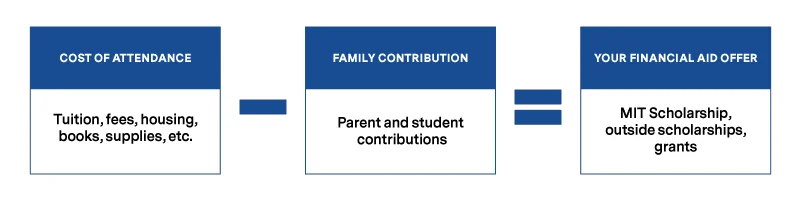
Once we calculate how much a family can afford to pay for college expenses-by taking account of their available resources-we take the difference between the family contribution and the total cost of attendance and cover the difference with financial aid. This is called meeting full need. By only offering need-based aid, we can use our resources in the most efficient way possible to support the financial need of all our students. Therefore, your outside scholarship, after reducing or covering the amount of your student contribution, must reduce your MIT Scholarship so that your total aid is not greater than your total demonstrated need or the total cost of attendance.
Please note: Families whose total income is less than $75,000, with typical assets, are not expected to contribute toward their student’s MIT education.
What you can do if your outside scholarship is more than your student contribution
If your outside aid, which includes the Pell Grant, is greater than your student contribution, we encourage you to contact your financial aid counselor. You may be able to use a portion of your outside scholarships toward the one-time purchase of a computer or to pay for the MIT Student Health Insurance Plan before reducing your MIT Scholarship. You may also want to contact your scholarship organization to see if they can postpone sending the funds for a future academic year that may be more advantageous.
All VA education benefits are treated like outside scholarships, including any housing and book stipends. Any additional money from your VA education benefits, beyond the amount of your student contribution, will reduce your MIT Scholarship.
All Courses
International students
International students are considered for aid using the same process that we use for all applicants. We are committed to meeting 100% of demonstrated financial need for international students just as we are for domestic students.
Our commitment to affordability
We want to make sure that MIT is an affordable option for all of our admitted students. Our financial aid team works closely with you and your family to develop a plan tailored to your financial circumstances, so that you can attend MIT and cover your expenses while you’re here.
How to apply
Applying for financial aid can be complicated, so we have broken it down to make it a bit easier. Before we can decide what your financial aid looks like, we need to know what your financial situation is. To do this, we use two documents that paint us a detailed picture of what kind of aid you’ll need to be able to attend MIT affordably.
Two steps to apply for aid.
CSS Profile: a tool provided by the College Board that we use to determine if you qualify for a need-based MIT Scholarship
Parental tax returns or income documentation: your parents’ tax returns or income documentation must be submitted through the College Board’s secure IDOC platform. If your parents live outside the U.S., please provide the tax return from that country, along with a translation to English if applicable.
After submitting the CSS Profile, you will need to submit your parents’ tax returns or income documentation to the College Board’s secure Institutional Documentation Service (IDOC) for processing.
If your parents live outside the U.S., please provide the tax return from that country, along with a translation to English if applicable. Professional translation is not required, documents may be translated by you, your family, or someone you know.
If your parents are separated or divorced, you will need both parents’ income documentation.
You must submit all documents directly to IDOC. We are not able to accept anything sent directly to MIT.
We know applying for aid can sometimes be overwhelming, so we are here to answer any questions that you may have. Feel free to email us at sfs@mit.edu or call our office at 617.258.8600. We have a full team of financial aid counselors that will help guide you through the application process.
All Courses
Does my transcript count as official?Transcripts must be sent in by your school counselor or another school representative to fulfill our requirements for an official transcript. This applies for high school and college transcripts. If…
FAQ / First-year applicationHow do I send in my transcript?All transcripts must be submitted by a school counselor or another school representative to be considered official. This applies for high school and college transcripts. If your school does not…
FAQ / International applicantsCan I apply if I am undocumented?Yes! Undocumented and DACA applicants submit the same application components and go through the same selection process as all other students. For those students who face financial barriers, we offer fee waivers…
FAQ / International applicantsWhat is the Secondary School Report?The Secondary School Report Form is designed for U.S. school systems but may be adapted for international school use. Many international schools do not calculate GPA, class rank, and other…
FAQ / International applicantsWhat if I’m waiting for my green card?All applicants are requested to fill out the application with their current citizen status. In our first-year admissions process, you’re considered an international applicant if you’re not a United States…
Study in the USA: Top Programs, Universities, and Opportunities
The United States is a premier destination for higher education, offering a diverse range of universities, advanced research opportunities, and a wide array of programs. Here’s a guide to studying in the USA, with a focus on popular courses, top universities, and degree options.
1. Top Universities for MS and PhD Programs
The USA is home to some of the world’s leading institutions, particularly known for master’s (MS) and doctoral (PhD) programs. Some of the top universities for MS degrees include:
Stanford University: Known for its strengths in technology, engineering, and business.
Massachusetts Institute of Technology (MIT): A leader in computer science, engineering, and data science.
University of California, Berkeley: Offers top-ranked programs in multiple fields, including computer science and business analytics.
Pace University: Located in New York, Pace University offers a variety of master’s and PhD programs with strong industry connections, particularly in business and analytics.
For those pursuing a PhD in the USA, many universities offer full funding, especially in STEM fields and research-intensive programs.
2. Popular Master’s Programs
The USA offers a wide array of master’s programs to suit different career paths:
MS in Business Analytics: This program is in high demand, with top universities like MIT, University of Texas at Austin, and Pace University offering specialized courses in business analytics. These programs provide students with analytical and data-driven skills to excel in the modern business landscape.
MS in Computer Science: Known for its cutting-edge curriculum, this program is offered at top institutions like Stanford, MIT, and Carnegie Mellon University, making it ideal for careers in technology, AI, and software development.
MBA Programs: An MBA from the USA is highly regarded globally. Many universities, such as Harvard and Wharton, offer competitive MBA programs with options to specialize in finance, marketing, and other fields.
3. PhD Programs in the USA
For students interested in research and academia, the USA offers top-notch PhD programs with robust support and funding options. Programs often include teaching and research assistantships, covering tuition fees and providing stipends.
4. MBBS in the USA
For international students interested in medicine, the MBBS (Doctor of Medicine or MD) program in the USA is known for its rigorous curriculum and excellent clinical training. However, the cost can be substantial, as medical programs generally range between $200,000 to $300,000 for the entire course.
5. Cost of Studying in the USA
The cost of education in the USA varies significantly by program and university:
MS Programs: The cost of doing an MS in the USA typically ranges from $20,000 to $60,000 per year, depending on the university and program.
PhD Programs: Many PhD programs offer funding through scholarships or assistantships, reducing the cost significantly.
Living Expenses: On average, students should budget around $10,000 to $20,000 annually for housing, food, and personal expenses, depending on the city.
6. Application Process and Requirements
Admission to master’s and PhD programs in the USA generally requires:
A bachelor’s degree (often a four-year degree)
Standardized test scores (GRE, GMAT, or specific test requirements depending on the program)
Proof of English language proficiency (usually TOEFL or IELTS for international students)
Relevant work experience, especially for MBA and some PhD programs
7. Advantages of Studying in the USA
The USA offers a vibrant, diverse educational experience, with benefits that include:
Research Opportunities: The USA is known for its research facilities and encourages students to engage in cutting-edge research across disciplines.
Career Prospects: With a master’s or PhD degree from the USA, students have a competitive edge in the global job market, especially in fields like business analytics, computer science, and medicine.
Cultural Diversity: The USA hosts students from around the world, providing an enriching multicultural environment that broadens perspectives.